

Desert Online General Trading LLC
Dubai, United Arab Emirates
Desert Online General Trading LLC
Dubai, United Arab Emirates

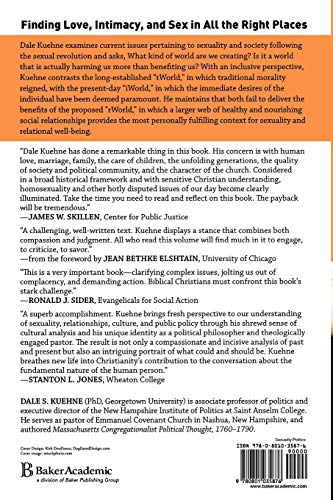

Sex and the iWorld: Rethinking Relationship beyond an Age of Individualism
D**H
Challenging, yet necessary
How in the world did we get here? Where are we going? And "who gets to define the future?" are three questions central to "Sex and the iWorld." It is obvious to all we are in the midst of great social change. Some gladly embrace this change and all it brings, including unfettered freedom and individualism. Others are more reactionary, and seek to use law and persuasion to clamp down on change, often-times quoting sacred texts and scary statistics to prove their point. In this book, Dale Kuehne seeks to step above the mudslinging, calling all readers to engage in a discussion about the nature of the world, and how best to support "the good life." In his toolkit, Kuehne brings along history, theology, philosophy, sociology, psychology, and even a lot of pop culture. Using these tools, the author paints a picture of our current culture, explaining how we left behind our old understandings of human nature and morality, and the road we traveled to get where we are today.Kuehne is concerned that our present world, with its tendency to eschew boundaries and all but a few taboos, is moving down a road toward self-destruction. While offering us freedom and independence like never before, the 'iWorld' leaves much to be wanting. From the breakdown of the family structure to the willingness to ignore basic biology, we have created a world of great loneliness and isolation; our children are being raised deficient in the most basic of essentials such as hope, love, and a solid foundation upon which to build their lives.Kuehne's answer is to push toward a new world, in which relationship is primary (hence his name for it - the 'rWorld') - a relationship defined as beginning with the 3 generation family, then on to neighbors, community, city, and out to the world. It is a world in which people are encouraged to seek fulfillment and meaning through a matrix of healthy relationships.It is in the area of sexuality that Kuehne is at his most challenging, as he makes the case that our current infatuation with sex is, in fact, doing great harm to us as a people, because sex short-changes relationships, redefining true intimacy with a momentary act of pleasure. Thus, Kuehne would call us to learn that, while certainly enjoyable, sex just isn't necessary for true happiness, for the good life. And, he would go on, all this emphasis on "sex as inalienable right" is truly a lie, and a damaging lie. Thus, all the legal work that has been done to open the doors to unfettered sexual freedom has led us down a dark path leading to a dead end. People are getting a lot of sex in a lot of different fashions, but, as a society, we're none the happier for it.One can guess where this leads. In the rWorld, sex is seen again as necessary to procreation, and helpful to bonding the husband and wife (who are responsible for creating the healthy family in which kids learn a healthy self-identity), but ultimately NOT a road to relational health anywhere else. This does, naturally, sound downright anathema to the iWorld. . .but the reader ultimately must ask whether or not the current situation is any better than the healthy promise of the rWorld.Family makeup is another arena much in debate today, and one addressed by Kuehne. The current culture is pushing in a direction of familial self-definition. With the growing numbers of single-parent homes, with gay marriage on the agenda and a swelling number of gay families, it is obvious that we've left the world of Leave it to Beaver behind. Again, Kuehne would argue that just because something is, or that just because people want something, that doesn't necessarily make it the best course of action. True relational health is found when children are raised by the parents who gave them birth. And the healthiest way to raise those children is with a parent of either gender, because gender matters - men and women each bring something unique to the table, and when one is missing, the child raised in that family, while fully loved and cherished, still misses out on something essential and important.For some, these are challenging words. But, in the end, I believe Kuehne would have us cease the flame wars brought about by personal desire, and ask again, What must be done to build a healthy world that will best support The Good Life? Whether one agrees with Kuehne or not, the discussion is certainly important, and the future is valuable enough that giving consideration to today's decisions is worth the time and effort. Wherever one stands on any of these issues, Kuehne's challenge in his afterword needs to be heeded:"Rather than look at the world with our eyes shut tight, we need to open them and take responsibility to be proactive in directing the future and live in the real world as opposed to being passive observers and potential victims of change."
A**G
Where did we come from and where are we going?
In our society today, there is the idea, brought forward by the "Sexual Revolution" of the 1960's, that in order to live a truly fulfilling life, one needs to be fulfilled sexually. In this book, Dale Kuehne challenges the modern idea that sexual fulfillment is essential to human happiness. The thesis he sets out to answer is this: "Is the scriptural teaching about sexuality good news for everyone?"( from an audio interview,2009)In this world of independence and individuality, we are not often presented with a book so thoughtfully written which describes our current cultural surroundings. As media has hailed the `self-made' man, Steve Jobs after his death, Kuehne writes of the intent of the title of this book:"I believe the best way to describe and understand our present moment is to call it the "iWorld." Steve Jobs and the people at Apple Inc. have brilliantly understood the spirit of our age--a spirit of unfettered individualism and freedom--by marketing many of their products using the prefix i...In short, the t [traditional] World is being replaced by the iWorld." (p.45)As a culture today, I believe we need to take time to understand where we came from, and the schools of thought about sexual relationships. In the classical world of Greek philosophy, the highest form of relationship was friendship, and our "appetites" (including sexuality) were detrimental to the highest form of human fulfillment. "Bodily passions" as so named by Socrates, were something to be mastered in the quest to "practice philosophy" and purify your soul. In the dialog from Phaedo, Socrates is quoted as saying:"But I think that if the soul is polluted and impure when it leaves the body, having always been associated with it and served it, bewitched by physical desires and pleasures to the point at which nothing seems to exist for it but the physical, which one can touch and see or eat and drink or make use of for sexual enjoyment, and if that soul is accustomed to hate and fear and avoid that which is dim and invisible to the eyes but intelligible and to be grasped by philosophy--do you think such a soul will escape pure and by itself?" (Plato: Complete Works, p.72)So which is correct? Should we attempt to try the ancient "Classical" ideal, or (as many conservatives seem to want) turn the clock back to the 1950's idea of the "Leave it to Beaver" life, or should we continue the search for ourselves and what makes us happy...especially our sex lives; but could there be another possible path? Kuehne begin his book with the warning that this is about all those things "...our parents warned us to avoid in conversation...it's about the way our individual and collective choices about sexuality affect us both personally and relationally." (p. 13) But we as Christians can no longer avoid these conversations.Is sexual intimacy essential to human fulfillment? Or have we lost something precious and vital to human flourishing by the sexualization of most of our most intimate relationships today? To read Dale Kuehne's book is to find a thoughtful and loving answer to these questions. This is not a book of dogmatism, but a true, loving, Christian response to the problems in the clash of the Bible and the culture of today.This, in my estimation, is a "must-read" for all people; within and without the Christian world, no matter the denomination or affiliation. Perhaps we can cease remaking ourselves, and begin relating.
X**X
tried to do too much
(disclosure: I'm a pastoral intern in an emergent community and this book was a textbook in a seminary class. I have a background in critical theory/philosophy & linguistics).This is yet another Christian book attempting to manage the postmodern shift. Dale Kuehne takesa unique viewpoint, however: how will this affect sex? His problem, however, is that he is a pastor and a political theorist, not a philospher or epistemologist. He sets up the "tWorld," the "iWorld," and the "rWorld," roughly corresponding to the premodern/modern, postmodern, and his own Christian idea of what the world should be going forward. His problem is that in trying to blame the postmodern world for hyperindividualism, he doesn't get it right. He still ascribes the "science = truth" epistemology to the iWorld, and he stops at Nietszche philosophically (he also kind of gets Nietszche wrong, not apparently understanding his transvaluation of values and instead latching onto the easier-to-understand "everything is meaningless" nihilism). While he recommends James K. A. Smith's "What Would Jesus Deconstruct" (which I also recommend) in one of his footnotes early on, he apparently hasn't read it thoroughly or has misunderstood the linguistic epistemological shift that Derrida, Lyotard, and Foucault really push forward.His rWorld is smack on in its emphasis of relationships. The postmodern world is going to be a much more relational world, and that shift /should/ be driven by the church. However, Kuehne's Old Testament exegesis is beyond problematic, to the extent that while the 2nd part of his book has a lot of good things to say, they're overwhelmed by bad theology.
U**Y
Insightful analysis
David Kuehne's book is original and interesting in several respects. He analyses the culture of family, relationship and sex from which contemporary Western culture has emerged (tWorld), then analyses the culture in which Western people now live, or are heading towards (iWorld, with the emphasis on the individual).But he does not then advocate a return to where we have come from. There was much that was wrong with tWorld (potential abuse of power and authority, for instance). Equally, iWorld with its excessive and ultimately destructive individualism, is not sustainable in the long run.Kuehne's proposal is to work at a new way of building culture and society around relationship (rWorld). Utopian? Perhaps, but well-thought-out.
P**Y
Outstanding exploriation of the truth about human sexuality, family and relationships
Exceptionally well written book which discusses and explains the radical cultural shift that has taken place in Western Society during the past 60 years. Written by a highly qualified academic, the material is very well researched and referenced yet written in a highly readable and accessible style. He applies Biblical truth to the issues of the day and explores how a Christian world-view of relationships offers so may advantages in comparison to both traditional and contemporary values. A must-read for students of sociology and politics as well as anyone dealing with the day-to-day family, relationship and sexual issues faced by everyone, especially young people.
Trustpilot
1 day ago
1 month ago
1 month ago
5 days ago