We remain fully operational. Our teams are working around the clock to ensure your deliveries continue safely.

DOWNLOAD THE APP


Copyright © 2025 Desertcart Holdings Limited
DOWNLOAD THE APP
Buy anything from 5,000+ international stores. One checkout price. No surprise fees. Join 2M+ shoppers on Desertcart.
Desertcart purchases this item on your behalf and handles shipping, customs, and support to Italy.
🛡️ Power your network like a pro — secure, fast, and effortlessly managed.
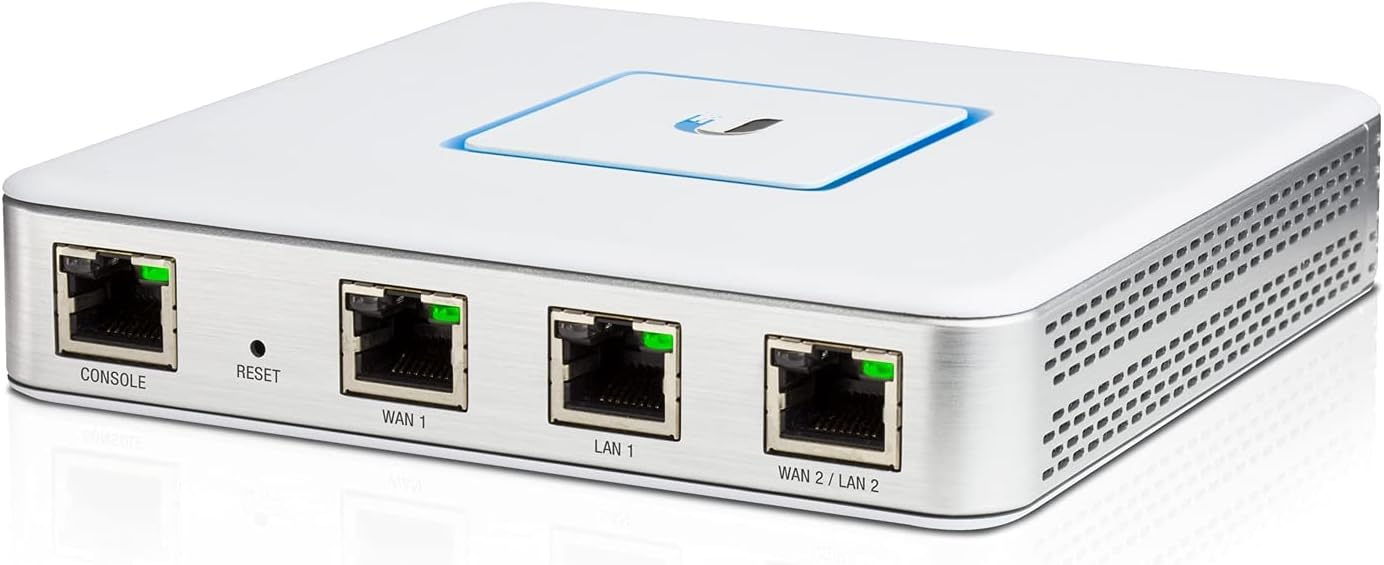
The Ubiquiti UniFi Security Gateway (USG) is a sleek, white network security appliance designed for professionals seeking enterprise-level firewall protection combined with seamless integration into the UniFi ecosystem. Featuring four gigabit Ethernet ports, VLAN support, QoS for VoIP, and a built-in VPN server, it delivers reliable, high-speed routing and advanced security. Managed centrally through the UniFi Controller software, the USG offers a streamlined setup and comprehensive network insights, making it ideal for tech-savvy millennials building future-proof home or small office networks.


| ASIN | B00LV8YZLK |
| Antenna Location | Business, Gaming, Home |
| Antenna Type | Retractable |
| Best Sellers Rank | #20,176 in Computers & Accessories ( See Top 100 in Computers & Accessories ) #653 in Computer Routers |
| Brand | Ubiquiti Networks |
| Built-In Media | Part |
| Color | White |
| Compatible Devices | Personal Computer |
| Connectivity Protocol | Ethernet |
| Connectivity Technology | Ethernet |
| Control Method | Remote |
| Customer Reviews | 4.5 out of 5 stars 5,541 Reviews |
| Data Transfer Rate | 3 Gigabits Per Second |
| Frequency | 5 GHz |
| Frequency Band Class | Single-Band |
| Global Trade Identification Number | 00810354020803, 00810354022807 |
| Has Internet Connectivity | Yes |
| Is Modem Compatible | No |
| Item Dimensions L x W x H | 5.31"L x 5.31"W x 1.11"H |
| Item Type Name | Ubiquiti UniFi Security Gateway |
| Item Weight | 12.3 Ounces |
| LAN Port Bandwidth | 10/100/1000 Mbps |
| Manufacturer | Ubiquiti |
| Maximum Upstream Data Transfer Rate | 1000 Megabits Per Second |
| Mfr Part Number | USG |
| Model Name | USG |
| Model Number | USG |
| Number of Ports | 4 |
| Operating System | UniFi OS |
| Other Special Features of the Product | WPS |
| RAM Memory Installed | 512 MB |
| Router Firewall Security Level | Advanced |
| Router Network Type | wired |
| Security Protocol | unifi |
| Smart Home Compatibility | Not Smart Home Compatible |
| Special Feature | WPS |
| UPC | 817882022996 884201858543 796594801498 810354020803 |
| Unit Count | 1.0 Count |
| Voltage | 240 Volts |
| Warranty Description | Year |
| Wireless Communication Standard | 802.11b |
| Wireless Compability | 802.11b |
A**N
Solid Gateway, No issues found so far...
So far so good. I am currently using this on a home network now almost exclusively of UniFi products. (3 UniFi AC APs 3 Trendnet 5 Port Switches and a BlueTech 24 Port Switch all running full gigabit) The box itself looks like nothing special, 4 ports, Lan, Wan, management and VOIP. If you are used to a traditional router with WiFi and 4 Lan ports this will probably seem a bit weird but it isn't at all. In my opinion moving to just a router, and just APs makes good sense becasue you can upgrade either without having to upgrade everything. But anyway, back to my review. *Update: with the latest 4.6.7 Controller software I have noticed that the gateway does seem to reboot a bit more often. But so far it has been seconds of downtime overall and I still think this is a good solution for a typical network. That said if you are in need of highly advanced features like others have noted they are not present in the GUI. After talking to the Ubiquiti folks I understand there are some more advanced options that can be enabled by using command line access and modifying files. But that isn't something I use. I find that in my home network setting this gateway and the associated APs are more reliable and I experience far less downtime than I did while using any typical home networking router (I have tried all the top end options from ASUS, Cisco and Belkin to name a few) Not to mention the setup is surprisingly more simple, which I atrribute to the simple interface. I do wish the controller software was more robust and allowed for an "Advanced" mode where you get the granular control like you get on Expensive business class equipment, but at this price point it's really not a bad gateway at all.* I am tech savvy but I am no trained network specialist. That said I had this set up on my network within 10 minutes (including upgrading to the Version 4+ controller software. The controller recognized it right away and it connected without a problem. (I already had the 3 UniFi AC APs up and running (using the V3 software) I have now had 30 Days since install with 0 downtime due to the gateway (I have Time Warner so they drop signal at least 2 times a week no matter what) This is on a home network and I have 12 wired devices and 18 wireless ones on my network at any given time and the only choke point is my internet connection. The router handles all the incoming/outgoing traffic without missing a beat. (Firmware v4.2.4.4733350) So far it's been a set and forget gateway and I couldn't be happier with it. If something changes I will update this review, but as of right now I am definitely willing to recommend this gateway to anyone who is building a UniFi products based network. Just my Thoughts, AK
C**.
Rock solid and easy to setup for a home network.
I had recently purchased a Ubiquiti Unifi switch and a couple of APs for my place and was really impressed with the whole Unifi concept so I went ahead and purchased the USG and another switch to complete the re-vamping of my home's entire network infrastructure. In anticipation, I read blogs, forums, and watched videos about this particular device and was really wondering how easy it was going to be to setup given some of the feedback but, for me, it was a breeze. The LAN interface is set to 192.168.1.1 by default, and as long as you are aware of that and account for it (like pretty much any other router you may purchase), the setup goes very easy. I plugged the WAN interface into my modem and my existing switch into the LAN port and that was pretty much it. I had to wait for a few minutes for it to sync up with the modem (get an IP, etc...) and for it to assign my PC an IP on the 192.168.1.x range but it eventually just started working and I could get on the Internet. After it was connected, I adopted it into my Unifi Controller and upgraded the firmware with no issues. I did have to re-boot my modem and then re-boot the USG in order to see full speeds but that was not really an issue. The only other thing I did was to change the default DHCP scope by making sure it ended lower than my old router to avoid potential IP conflicts. So, in my experience, for basic internet connectivity and DHCP setup it was very easy. Assuming your network is already 192.168.1.x and that your modem/ISP assigns you an IP via DHCP, it "just works". But is it an "easy" device? That really depends. On the one hand it integrates into the Unifi environment really well and the separate controller really gives you great insight into your network, way more than you would ever get with typical consumer grade stuff. However, while learning the controller interface is not hard (especially if you are reasonably savvy with networking) you do have to spend some time with it to understand where all the configurations are. And sometimes not everything is where you think it ought to be! But if you enjoy stuff like this, it's really fun! If you really can't be bothered it may be too much. Also, remember, for a typical consumer router, you just have a GUI to the router itself. With the Unifi environment you get a controller (purchased or downloaded separately) that controls everything (switches, APs, etc...). That means you have many more perimeters and areas to explore in the GUI than you may be used to which could add to the learning curve.. There are lots of forum posts and blogs that say that the USG is really limited by the Unifi controller GUI and that to do anything really complicated you have to go into the Command Line Interface. I guess that really depends on what you want to do! If you just want a good, solid router/firewall for Internet access that is easy to setup, inexpensive, and gives you a ton info about your network (via the Unifi Controller software) I think this is great. If you are brave and have more advanced needs you can do all that stuff as well. Just be aware that you may have to learn how to SSH into the device and configure things by the CLI. Otherwise, I'm super happy with this purchase as well as the entire Unifi environment. With the managed switches, professional grade APs, and advanced routing configurations this really gives people the opportunity to have a first-rate network at home without spending a ton on pro-grade gear. FYI, I have RCN cable in Chicago with 150Mbs speed and the USG seems to handle the speed/traffic without any issues. I believe I could go up to Gig speed without any worries.
E**A
Excellent SOHO/SMB Firewall - The Entire Unifi Line is Really Quite Good
August 25, 2017 - Update: Still 5 Stars - Very Pleased! At home, I've been using Unifi for nearly a year and I couldn't be happier. The USG works perfectly with the entire system. They're currently up to USG Version 4.3.49.5001150 and Controller Version 5.5.20. Over the past year, one of the most noticeable things is how far along Ubiquiti has brought the Unifi line through their product updates to the controller and devices. They seem to listen to their customers and work to incorporate their requests. I did some Layer 3 VLAN testing and did not experience any drops or packet loss like another reviewer had reported. I'm using the USG and a 24 port non-POE Unifi switch for testing and had 100% success. USG to USG VPN connections work perfectly - without issue - but getting the USG to create a connection to other devices over IPSEC requires a lot of CLI work and JSON files. As stated earlier, UBNT listens to their customers and they've told me they plan to include the ability to create tunnels to any device in a future firmware release. I still think anyone who has multiple public IP addresses and the need to NAT ports to multiple IPs would be better suited with another solution, but if you've got a single public IP or dynamic (cable/dsl), this would work perfectly. My IT firm has deployed these to about six organizations to date and we have had zero issues. It's been invaluable for us to be able to log into a single console and remotely connect to a client's controller and get instant feedback on their network. We've experienced no Unifi related network outages and clients love the range of the wireless and the fact that they never have to call us about network issues. To those who have had issues with equipment, all I can say is: these are pieces of electronics and it happens. We've deployed enough of these to get a sense of reliability and we're pleased. As a Disaster Recovery plan, we've ordered a few spare units that we've stocked in the office. That way, if a client ever does have an issue, we can easily re-deploy a new piece of hardware - a lot more cost effectively than than if we'd gone with Cisco or another, more expensive, vendor. I'm still very pleased with Unifi and the USG. November 7, 2016 - Update It's been about a month since installing my USG and I have been extremely pleased. I have had zero issues with uptime or reliability and I love having the near realtime visibility into my network statistics. I introduced it to my company (I work for a small IT firm) and we've also been testing it there for the past month. We started with a USG, Unifi Switch 24-150w, a cloud key and a UAP-AC-PRO but upgraded the USG to a USG-PRO-4 - everything has works flawlessly. We're in the process of rolling it out to a few smaller customers who don't need everything Cisco has to offer and my co-workers have been blown away with the ease of management/configuration and we all love the iOS app/remove management using Chrome. We have discovered that there is a very specific setup process for these and you can only adopt one USG per Unifi Controller. If you wish to replace/update the USG, you must first forget the one paired with the controller. Just a small caveat I thought I'd share. I'll post updates as I have them and/or maybe as we roll them out to customers. October 11, 2016 - Original Review As far as I can tell, the Ubiquiti Unifi Security Gateway has come a long way. I came across Ubiquiti's Unifi line about five months ago (May, 2016) when I purchased a pair of WAPs for my home. I was so impressed with their Wireless products that I decided to give their USG a shot. If you notice, the reviews for this unit have gradually gotten better and better as Ubiquiti has released newer versions of their controller and firmware. I'm currently using the USG with the Unifi Cloud Key, version 5.2.9 and this whole setup works flawlessly. My LAN IP scheme is different than what comes default on the USG, so my setup required a few additional steps but it wasn't difficult by any means. Essentially, I had to run their controller application locally from my computer while giving my computer a static IP address and connected to the LAN port of the USG. I adopted the USG to the local controller, then adjusted my site network to the correct IP range. Once the USG had the new IP address, I connected it up to my live network where I was able to use my Cloud Key to adopt the USG and that was it. The unit itself feels physically sturdy - the case is metal and feels very well made. It comes with the USG, a power adapter, instruction guide and wall screws in the box. When powered up, prior to being configured, the square on top flashes white which changes to blue once configured. As stated above, initial configuration was pretty simple. Once that's done, new configuration is handled through the controller, but CLI is also avaiable. Configuring port forwarding couldn't be easier as it requires only a few simple clicks to complete. The new version of the Controller adds features for Routing as well as advanced Firewall control, as well as some nifty autobackup features for the Cloud Key. I actually upgraded from a Ubiquiti Edgerouter Lite so I could take full advantage of the Data Packet Inspection and having the real-time view of my network and bandwidth. I really like the main dashboard screen that shows the current bandwidth utilization, your attached Unifi Devices as well as the top devices, clients and top users (if DPI is enabled). I feel slightly ridiculous seeing that I have 33 devices connected to my home network but, since this is what I do for a living, I find it very helpful to have that kind of visibility. My plan is to ultimately replace the core switch in my home lab with a Unifi 24 port PoE to do some additional testing with their VOIP security cameras and NVR and/or their VOIP desk phones. I am very pleased with my purchase and have already recommended the Ubiquiti Unifi solution to several of my coworkers/friends.
T**Y
Not easy to setup (poor tech support) and dead in 2-3 days (Update: the replacement has been working very well )
It took a long time to connect to the internet when first setup via DHCP. I almost gave up trying. At the end, instead of following the quick guide, I followed the recommendation from other people to first adopt the device in the Ubiquiti Controller before connecting the WAN port, and I was finally connected to the internet. So I wish a better documentation to save customer, special first timer, some headache. Things were working pretty ok after the device was connected to the internet. I have a gigabit internet, and I was getting around 900Mbps, which is pretty decent (I was also using the Ubiquiti 60W 8 port switch). I was also able to update the firmware via the controller through internet for both devices. It was pretty easy to do. However, after about 2 days, the USG suddenly stop working. The blue LED is gone, and the WAN and LAN ports' are gone as well. The console port's LED starts to flashing with constant intervals. I can't reset the device via the controller since the device is not responding to any request from the controller. And I don't have a console cable to connect to the console port. So the only thing left to try is doing the hard reset by holding the reset bottom for >10s, but the device doesn't respond to the reset. I think the device is somehow got bricked. I'm quite disappointed since I did a lot of research and finally spent more money to choose USG over the others for it's quality. I've just requested a RMA, and I will update the review after I use the replacement. For now, one start is the most I will give for a product that fails to live up with its reputation. Update: I've received the replacement, and things are SFSG. The only thing that I'm not happy about is the DPI feature's impact on the throughput. I'm not getting the full potential of my gigabit internet speed. With my old Netgear router, I get 920-940 Mbps but only 900Mbps MAX with USG. Some time the speed will reduce to 500Mbps depends on how many packets were lost during the inspection process. When the DPI feature is off, I get the full speed. You can find a lot of threads online about this issue, and some old firmware seems to take care of it. But I don't want to downgrade the firmware, so I'm going to run it without the DPI until it's fixed by future firmware releases. For now, a 4 start review is what it should deserve. Update: After updating the Firmware version 4.3.49 for the USG, and UniFi 5.5.20 for the controller, the DPI has been working very well. I hardly notice any performance decrease (Take a look at the 2 pictures taken before and after DPI enabled). So glad to see this feature got fixed.
J**E
Love this firewall and its integration into the Unifi software
I love this security device. It works well with my Ubiquiti APs and the Unifi software that I installed on a Raspberry Pi 3. Setup was relatively easy, but I ran into some small issues at first when I replaced another firewall device with this one with a different IP range. This device's DHCP server defaults to 192.168.1.x and my old firewall was set up to use 192.168.0.x. At first, the USG wouldn't connect properly until I realized I had to change the network settings in the Unifi software to use 192.168.1.1 instead of 192.168.0.1 and then the USG was adopted properly. Everything just works, period. And it works well. I get great speeds from device to device and to the internet. This device not only helps protect my network, but its integration into the Unifi software means I can view detailed info about my client devices, like the traffic utilization details that shows what kind of traffic is coming from each device and how much. It provides great insight into my network and my devices. I love it. I could go on with some technical details but there are many other reviews here that do a good job on that so I will skip it. If you are using Ubiquiti access points, this device is an excellent addition to the mix. You shouldn't be disappointed, as long as you can get it set up. :)
T**N
This is definitely Pro-sumer class.
This unit is amazing with capabilities that go far beyond what you can do with typical consumer router/firewalls. While it is straightforward to set up with the quick start guides, it could be a bit intimidating for those that start digging into the features. If you are a techie like me you'll be in LOVE!. I love the way it draws your network diagram and discovers your devices and even renders them in many cases (the iPhones look like iPhones, the echo dots are actually echo dot icons, etc. You can see what's connected to what at a glance. I'd forgotten about some of my iOT devices in the house. My only complaint is that for setup there is only a single LAN port. They expect you to have a switch downstream of that. In my case my initial purchase was this unit and a single WAP. initially, to use the controller setup software you have to run it on your laptop/PC and connect it to the same network as the WAP. You can't do that with a single LAN port. There is another WAN/LAN port but initially it is disabled until you run the configuration setup software. So, to get my WAP configured I needed to use a switch I had on hand to give me more than one connection to the enabled LAN. Once I had the WAP up and running, I simply switched the PC to a wifi connection and used the single port for the WAP. I then set the switch I had aside. The point is that you CAN have a minimalist setup of the USG and a single WAP but you will need a switch temporarily to initially connect them both. Once I saw how good this stuff was, I bought their 8 Port switch. That too is outstanding and I wanted that quality throughout. This is a MANAGED system. Each part shows up in the dashboard and can be managed. A passive switch simply doesn't "show" as it's invisible to the software. If you look at the pictures, the port on the left is actually a SERIAL port for a dumb ASCII terminal through which you can do command line setup. This is common in high end equipment but I expect most home users would never use it. Again, that's not a negative. It merely shows you that this stuff is actually enterprise grade at consumer prices. One of the other advantages to having their switch is that it supplies Power Over Ethernet (POE) so that you can simply run the CAT 6 to your WAP and the power comes through the cable. Once you get up an running you can enable the second LAN port and set up a separate network if you wish to segregate traffic if desired. The two ports can be configured to "bridge" so that devices on one network can communicate with the others (or not) as desired. This unit also has advanced intrusion detection/intrusion prevention capabilities to detect and block folks that might try to hack your network. It's kind of creepy to find out shortly after you install your network that folks from the Netherlands are trying to hack your home network! Before I was "blissfully ignorant." Now I'm blissfully enlightened and protected. Oh, one more thing. With the SAME internet provider and modem I am getting DOUBLE the speeds I was getting before with my old setup. I now feel like I'm getting my money's worth.
R**L
Not a perfect replacement for a well built do-it-yourself router, but definitely superior to most of the garbage sold these days
Even though I was initially skeptical of using a "canned" solution "off the shelf" as it were. I did my research and found that while the software that's used to more easily program and configure this router/gateway didn't appear to offer configuration options for the functionality that I require, in the end an advanced console like interface, albeit with an obscure json/xml like configuration syntax allowed me to configure it in exactly the manner to replicate all the essential functionality that I required out of my old PC based router that was running a custom setup of OpenBSD. Though I am still a huge fan of OpenBSD's "pf" packet filter firewall and it's great strengths, this is Linux powered and has advanced IPTABLES functionality to get done what I need in a similar manner just minus the bells and whistles. #1 thing, it is FAST. It can route and translate at pretty much wire speed from at least my initial testing (admittedly I have a very simple ruleset). #2 it is super quiet having no fans and low power consumption, but also appears to be built well, sturdy metal casing and not some cheap plastic. #3 it doesn't skimp on security for accessibility or accessibility for security. Some routers, in the name of lazy security don't offer IPv6 setup and support, or just allow primitive connectivity with no actual firewalling going on (I have one such router at another location I am looking to eventually replace). #4 so far it seems reliable working well over two months of uptime and in the two or three times I've rebooted it, that's the only time it's gone down. That's also another good sign. #5 software updates, I did have to do an initial update when I first got it, especially to get the low level configured IPv6 functionality to actually work (the functionality is there even if the setup software doesn't show many options related to it in the GUI, and they have to be configured in the command line interface). I was tempted to knock a single star off this product because while I get it that it's still a work in progress, in 2017 to not have at least a minimal set of IPv6 configuration options that aren't hidden in the low level command interface only is pretty much inexcusable. Also while since I bought it mid 2017 I've only seen 2 firmware upgrades, I do not know how timely they are about releasing firmware upgrades related to known vulnerabilities of the various software components they employ in this device as I'm sure it makes use of a lot of common open source software as do many routers these days. Of course this is the risk die-hard do it yourselfers like me have deal with when choosing to use an off the shelf product to get the job done instead of rolling your own like I did for almost 7 years with FreeBSD/OpenBSD based router that I kept up to date myself.
M**R
Great unit . . . when it works . . .
I have been using Ubiquiti equipment for some several years now starting with a USG 3P router to replace an old Netgear unit. I purchased my first USG 3P in June 2017 and it worked relatively problem free for about 18 months. I won't get into the setup that requires a UniFi controller but suffice it to say that once the UniFi controller is installed and configured, it is a very easy way to manage all aspects of the USG 3P as well as other Ubiquiti equipment. Since my original USG 3P purchase, I have bought Ubiquiti AP's and multiple switches, all managed by the UniFi controller. All works well, until it doesn't. About 15 months after my original installation of the USG 3P, it had a hard failure. And by hard failure I mean dead. The lights were on but nothing worked. The controller no longer recognized the USG 3P. Any and all attempts at dropping the USG and adding it (provisioning) it were met with failure. I had no other resort than to restore the unit to factory settings and start over. After a factory reset, I was able to successfully re-provision the USG. Thankfully I had backups of my configuration and was able to restore my network settings. I lost performance data but I had my configuration. After another 3 months went by, the USG 3P once again had a hard failure. Dead again. At this point I started doing research on potential issues. I discovered many articles citing inferior memory being used in the USG 3P. This is apparently not a common problem and the manifestation of bad memory is a hard failure. At this point I thought I had a bad unit. Since I was out of warranty but I liked the product, I decided to buy another USG 3P. My second USG 3P installed and configured on my controller without any issues. I was able to restore the configuration and everything worked well until about 9 months later. Again, a hard failure. I could not remove the USG 3P from my configuration and so began my journey with Ubiquiti tech support. First, you will wait a long time to get in touch with someone. I spent over an hour waiting for my first contact via chat. You will also spend more time documenting your case, responding to emails and waiting endlessly only to be asked routine questions. Have you power cycled? Have you done a factory restore? Do you have the latest firmware? Please send logs and more logs. At this point, I had spent 20+ hours with no end in sight. To move on, I purchased another router from another company. I firmly believe Ubiquiti has design or manufacturing flaws in this product. I have done everything Ubuiquiti has asked and I now have two failed units without any explanation or rationale explaining the failures. My faith and confidence has been shaken in Ubiquiti products. If any of my 6 Ubiquiti switches or 4 cameras fail, I will likely pursue other vendor's products. Ubiquiti support leaves a lot to be desired. I would say be wary, especially of the USG 3P. Maybe their other routers perform better and have better customer support. Your mileage may vary but I'm done. Ironically my old Netgear router still worked well enough as a backup router and I was able to have my home network up and running, albeit with reduced performance until my replacement router arrived.
Trustpilot
2 weeks ago
2 weeks ago