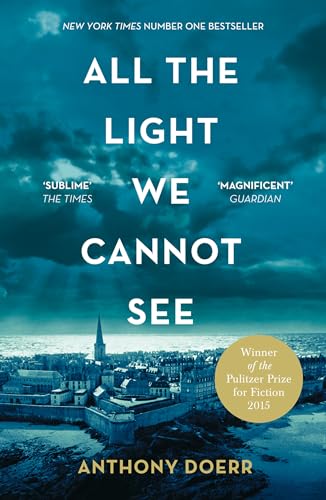


All the Light we Cannot See: The Breathtaking World Wide Bestseller : Anthony Doerr: desertcart.in: Books Review: Heartbreaking, mesmerising and such a plethora of emotions..!! - When I saw it, I was hugely skeptical about it, but given the time the author has spent writing it (10 years... yes you heard me, Anthony Doerr took 10 years to research and complete it), I thought it is worth giving a try. Set at the time of World War ||, this book speaks volumes about what a war brings forth, how cities are razed to ground and rebuilt, and how the world changes, how the ideologies, people, nations are torn and reborn again. It is a heartbreaking, yet a soulful narrative of destruction, but with an insurmountable fortitude and resilience. Amidst the war, the story shifts in turn between - Marie Laure, a blind girl in France and Werner Pfenning, a young boy in Germany and how their paths eventually cross later in the book. I have read several books on World War ||, and frankly, after reading "The Book Thief", I had my doubts on this one, as I find Markus Zusak incomparable when it comes to descriptions, characters and the story as well. But, to my surprise, Anthony Doerr has done every bit of justice to his characters and what seems to be a vague way of story telling in the beginning(France and Germany alternately occurring in the chapters), it turns out to be a magnificent way of introducing the characters, and keeping them alive in the reader's mind till the very end. Marie Laure - the blind french girl will make your heart race when she loses her sight and learns to see the world through her father's conscious efforts. Thanks, to the remarkable description by Anthony Doerr, you will actually see her freckled face, counting the storm drains with her cane on the road, as she goes left and right remembering the paths, enjoying the sound of molluscks, feeling the smell of the ocean. Your heart will ache when she wonders why people call her brave, while all she does is get up every morning and live her life. Isn't that what they all do? Yet, she radiates a strange kind of hope that almost always lingers around her. Werner Pfenning, the young German boy with white hair and lean stature, slightly reminds me of Rudy from the Book thief,but he is very much different from him in the way he thinks.How his inquisitive mind is passionate about the varied possibilities of science, but how his heart remains kind even in the most brutal times. The other characters are so meticulously crafted, be it Marie's agoraphobic uncle Etienne Le Blanc with a wealthy mansion, with his stout, stoic yet benevolent house keeper Madam Manec or be it Werner's cautious sister Jutta Pfening, and his friend Frederick, the young boy who is ecstatic about birds and "who sees what other's can't see..". But, above everything, what amazes you in the entire book is the plethora of descriptions, of the cities, the streets, the people, their clothes, their food, their anxieties, their fear, their conflicted minds, every bit as real as you can touch and see. A must read for those who love the kind of stories they can feel under their nerves and can keep them up at nights. Review: A literary marvel - The book is placed in a war-torn France and Germany during the third Reich. Its a story of a blind girl Marie-Laure LeBlanc who lives in Paris. Her Papa is a locksmith in the Museum of Natural History in Paris. Though constantly dealing with her physical handicap she grows up in a loving family. To make is easier for his daughter to navigate the streets of Paris Marie’s father creates a small model of the city which allows Marie-Laure to feel her way into the city. This family of two has to move to the coastal city of Saint-Malo to Marie’s great-uncle’s house to flee a German occupied Paris. But, the war eventually reaches them in the quiet, sleepy city. On the other hand is an orphan boy in Germany called Werner who has a way with radios. He lives in the Children’s home with his sister Jutta until an officer recognizes this prodigy and opens the door of the elite military school for him. The raciological exams where Werner’s eye colour is gauged “against a chromatic scale on which sixty or so shades of blue are displayed” and hair colour assessed using “thirty or so other locks clipped to a board” only amplifies the peculiar ways in which the Nazi Germany functioned. From this school he is sent to the frontlines to weed out the radio transmissions of the Allies. In this melee is a treasure hunt for the Sea of Flame, a precious stone which is widely believed to harbor the curse which although protects the beholder but brings misfortune upon everyone the beholder loves. Marie-Laure prays that her “Papa hasn’t been anywhere near it” when infact her father is one of the three men charged with protecting this stone. The story opens in 1944 in Saint-Malo where Marie-Laure is hiding in her house in the face of Allied bombings while Werner is trapped in the ruins of the Bees Hotel. Though most of the story takes place during WWII, the narrative still goes a lot back and forth. The stories seem unconnected on the surface but a fragile thread always wounds it all together. One such connection is a radio transmission that Werner and his sister used to listen to as kids and this broadcast was done by none other than Marie-Laure’s grandfather. The story always seems on course for the collision of the paths of these two individuals. The entire book is spent in expectation of the meeting of the protagonists and the result of this meeting. Like most other books about WWII this book is loaded with suspense, dread and horror in equal proportions. To make it easier for the reader Doerr makes the chapters very short (some chapters are less than a page long) while keeping the number of characters to a minimum. It provides a picture of the war from both sides, both Axis and Allied and the horrors of the war as experienced by the innocent French as well as the Germans. The decades after the war and the specter of war that hangs over the survivors is yet another one of the gems the book touches upon. This book doesn't have the reality of Anne Frank’s diary but has the dreamlike expectation of young love, it neither has the innocently ethereal beauty of The Book Thief but a severely intricate plot. In a world full of WWII narratives, this book certainly holds its own. The book is tragic yet it gives you hope and the story is indeed about all the light we cannot see in the darkness which we believe engulfs us. A must read, entirely absorbing and absolutely un-putdownable.


| Customer Reviews | 4.5 4.5 out of 5 stars (233,431) |
| Dimensions | 12.9 x 3.4 x 19.8 cm |
| Generic Name | BOOKS |
| ISBN-10 | 0008172420 |
| ISBN-13 | 978-0008172428 |
| Item Weight | 294 g |
| Language | English |
| Net Quantity | 500.00 Grams |
| Paperback | 544 pages |
| Publisher | Fourth Estate (10 December 2015) |
| Reading age | Customer suggested age: 15 years and up |
S**A
Heartbreaking, mesmerising and such a plethora of emotions..!!
When I saw it, I was hugely skeptical about it, but given the time the author has spent writing it (10 years... yes you heard me, Anthony Doerr took 10 years to research and complete it), I thought it is worth giving a try. Set at the time of World War ||, this book speaks volumes about what a war brings forth, how cities are razed to ground and rebuilt, and how the world changes, how the ideologies, people, nations are torn and reborn again. It is a heartbreaking, yet a soulful narrative of destruction, but with an insurmountable fortitude and resilience. Amidst the war, the story shifts in turn between - Marie Laure, a blind girl in France and Werner Pfenning, a young boy in Germany and how their paths eventually cross later in the book. I have read several books on World War ||, and frankly, after reading "The Book Thief", I had my doubts on this one, as I find Markus Zusak incomparable when it comes to descriptions, characters and the story as well. But, to my surprise, Anthony Doerr has done every bit of justice to his characters and what seems to be a vague way of story telling in the beginning(France and Germany alternately occurring in the chapters), it turns out to be a magnificent way of introducing the characters, and keeping them alive in the reader's mind till the very end. Marie Laure - the blind french girl will make your heart race when she loses her sight and learns to see the world through her father's conscious efforts. Thanks, to the remarkable description by Anthony Doerr, you will actually see her freckled face, counting the storm drains with her cane on the road, as she goes left and right remembering the paths, enjoying the sound of molluscks, feeling the smell of the ocean. Your heart will ache when she wonders why people call her brave, while all she does is get up every morning and live her life. Isn't that what they all do? Yet, she radiates a strange kind of hope that almost always lingers around her. Werner Pfenning, the young German boy with white hair and lean stature, slightly reminds me of Rudy from the Book thief,but he is very much different from him in the way he thinks.How his inquisitive mind is passionate about the varied possibilities of science, but how his heart remains kind even in the most brutal times. The other characters are so meticulously crafted, be it Marie's agoraphobic uncle Etienne Le Blanc with a wealthy mansion, with his stout, stoic yet benevolent house keeper Madam Manec or be it Werner's cautious sister Jutta Pfening, and his friend Frederick, the young boy who is ecstatic about birds and "who sees what other's can't see..". But, above everything, what amazes you in the entire book is the plethora of descriptions, of the cities, the streets, the people, their clothes, their food, their anxieties, their fear, their conflicted minds, every bit as real as you can touch and see. A must read for those who love the kind of stories they can feel under their nerves and can keep them up at nights.
T**E
A literary marvel
The book is placed in a war-torn France and Germany during the third Reich. Its a story of a blind girl Marie-Laure LeBlanc who lives in Paris. Her Papa is a locksmith in the Museum of Natural History in Paris. Though constantly dealing with her physical handicap she grows up in a loving family. To make is easier for his daughter to navigate the streets of Paris Marie’s father creates a small model of the city which allows Marie-Laure to feel her way into the city. This family of two has to move to the coastal city of Saint-Malo to Marie’s great-uncle’s house to flee a German occupied Paris. But, the war eventually reaches them in the quiet, sleepy city. On the other hand is an orphan boy in Germany called Werner who has a way with radios. He lives in the Children’s home with his sister Jutta until an officer recognizes this prodigy and opens the door of the elite military school for him. The raciological exams where Werner’s eye colour is gauged “against a chromatic scale on which sixty or so shades of blue are displayed” and hair colour assessed using “thirty or so other locks clipped to a board” only amplifies the peculiar ways in which the Nazi Germany functioned. From this school he is sent to the frontlines to weed out the radio transmissions of the Allies. In this melee is a treasure hunt for the Sea of Flame, a precious stone which is widely believed to harbor the curse which although protects the beholder but brings misfortune upon everyone the beholder loves. Marie-Laure prays that her “Papa hasn’t been anywhere near it” when infact her father is one of the three men charged with protecting this stone. The story opens in 1944 in Saint-Malo where Marie-Laure is hiding in her house in the face of Allied bombings while Werner is trapped in the ruins of the Bees Hotel. Though most of the story takes place during WWII, the narrative still goes a lot back and forth. The stories seem unconnected on the surface but a fragile thread always wounds it all together. One such connection is a radio transmission that Werner and his sister used to listen to as kids and this broadcast was done by none other than Marie-Laure’s grandfather. The story always seems on course for the collision of the paths of these two individuals. The entire book is spent in expectation of the meeting of the protagonists and the result of this meeting. Like most other books about WWII this book is loaded with suspense, dread and horror in equal proportions. To make it easier for the reader Doerr makes the chapters very short (some chapters are less than a page long) while keeping the number of characters to a minimum. It provides a picture of the war from both sides, both Axis and Allied and the horrors of the war as experienced by the innocent French as well as the Germans. The decades after the war and the specter of war that hangs over the survivors is yet another one of the gems the book touches upon. This book doesn't have the reality of Anne Frank’s diary but has the dreamlike expectation of young love, it neither has the innocently ethereal beauty of The Book Thief but a severely intricate plot. In a world full of WWII narratives, this book certainly holds its own. The book is tragic yet it gives you hope and the story is indeed about all the light we cannot see in the darkness which we believe engulfs us. A must read, entirely absorbing and absolutely un-putdownable.
K**A
A book that carries you away to another world in a different time as only excellent books can. Must read.
M**K
mi libro que quería leer y resulto buenisismo.
L**R
Full disclosure: I received an advance copy of this book from NetGalley in exchange for an unbiased review. I don't know why I waited so long to read Anthony Doerr's All the Light We Cannot See. I've loved his other books—in fact, his 2010 story collection, Memory Wall, was among the best books I read that year, so I know he's a tremendously talented writer. Maybe I hesitated because the book has already begun showing up on a number of year-end "best" lists, and lately I've had a bit of a disconnect between those the critics label as best of the year and those of which I'm most enamored. Well, I needn't have worried, because Doerr's latest is as good, and beautifully written, as I hoped it might be. In the early 1940s, the world is on the brink of war. Marie-Laure is a 12-year-old girl living in Paris with her father, a locksmith at the Museum of Natural History. Although Marie-Laure went blind at the age of six, she has a tremendous thirst for knowledge and a passion about the world around her, particularly the natural world. Ever-protective of his daughter, Marie-Laure's father built a model of their Paris neighborhood so she can navigate the streets and always find her way home. Meanwhile, in a German mining town, young Werner Pfennig is growing up with his sister, Jutta, in an orphanage. When the two discover a radio, it opens up a world of dreams and information. Werner also discovers his ability to repair and build radios, as well as his ability to grasp complicated mathematical and scientific concepts. This intelligence catches the interest of a Nazi officer, who sees that Werner is enrolled in an elite Hitler Youth school, where the fervor for perfection and rooting out inferiority begins to turn him into a person he doesn't recognize. As war closes in, Marie-Laure and her father flee Paris and head to the seaside town of Saint-Malo, where her eccentric great-uncle Etienne lives. Etienne has never been the same since the first World War, and he is unprepared for just how profoundly his life—and the lives of those around him—will be affected by Marie-Laure's presence, as well as the town's resistance to the Nazi occupation. And Werner finds himself on the front lines, as he is part of a team tracking down those using radios to subvert the Nazis. Werner and Marie-Laure's lives will intersect in a profound way, both when they are at one of their weakest moments. And this encounter will have an indelible impact on the lives of many for years to come. "To men like that, time was a surfeit, a barrel they watched slowly drain. When really, he thinks, it's a glowing puddle you carry in your hands; you should spend all your energy protecting it. Fighting for it. Working so hard not to spill one single drop." This is an exquisite, wonderfully told story. The characters are tremendously vivid and came to life for me, and I found myself fully immersed in what was happening to them. Although the book unfolds slowly, I was never bored, and although I had some suspicions about how certain events would be resolved, I felt some suspense at what would happen. Doerr is truly so talented, and although the book's switching back forth between two points in time sometimes made me take a moment to re-orient myself to where I was in the plot, I enjoyed this book so, so much. If you don't need a book to move at breakneck speed, but you want a story to savor, pick up All the Light We Cannot See. This is one of those books I could see as a fantastic movie as well, but the book is so worth reading.
G**O
I'm not normally a fan of prize-winning novels. I have to confess that I often find them tedious, pompous and unapproachable, which is likely a failing in me and not the novel, but I overcame my resistance to reading this one upon the recommendation of other readers and I was hooked from page one. "All the Light we Cannot See" tells two separate but converging stories set in Germany and Occupied France during World War Two. Marie-Laure, a young girl blind since the age of six and her father, who is the locksmith at the Natural History Museum in Paris, depart for the safety of St-Malo, a walled city on France's Brittany coast, carrying only the clothes on their backs and a secret cursed treasure. Werner is a German orphan whose fate is to work in the coal mines feeding the Nazi war machine as soon as he turns 15, but his skill with radio sees him indoctrinated into the Hitler Youth at 14 and a career with the German army locating and destroying Resistance transceivers. Their paths collide in June of 1944 during the American shelling of the city. I loved this book. Doerr writes with beauty and clarity, and I could see the novel unfolding in my head. His characters are three dimensional and inspire empathy in the reader (this reader anyway). I read the final third of the book in a single sitting, heart in my mouth, eschewing all other tasks so that I could find out what happened to the characters in the book. Conversely I didn't want it to end because I was engrossed in the story. I almost want to buy the physical book, just so that I can hold it in my hands. I will be reading this one again for sure, and seeking out Doerr's other literary offerings. This is by far the best book I've read in many years (and I read a lot). Read it! But make sure you have plenty of time on your hands. It's a tough one to put down.
J**N
It was a kindle, so no problem. Bloody good read.
Trustpilot
2 months ago
3 weeks ago