

Desert Online General Trading LLC
Dubai, United Arab Emirates
Desert Online General Trading LLC
Dubai, United Arab Emirates
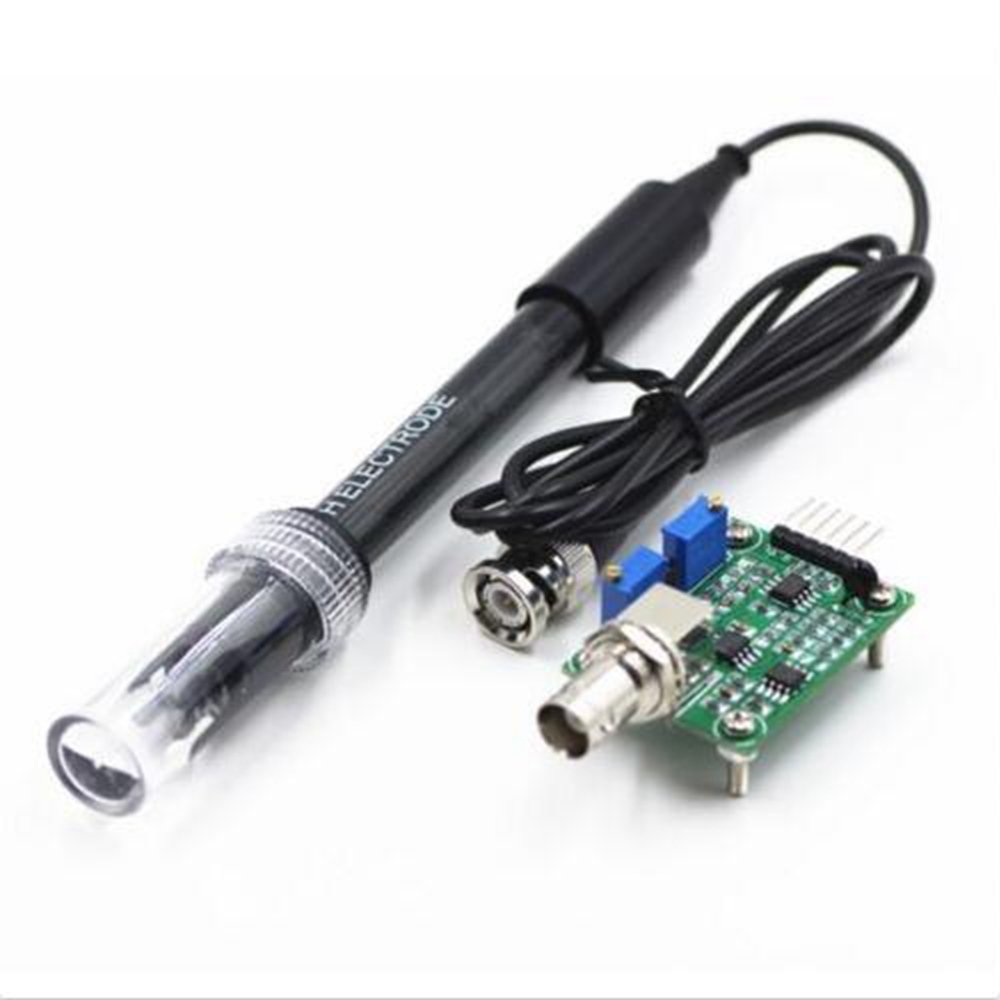


🌿 Measure Smarter, Live Greener — pH sensing that keeps you ahead of the curve!
The PH0-14 Value Detect Sensor Module paired with a BNC PH Electrode Probe offers fast (≤5s) and accurate pH measurement across the full 0-14 range. Designed for Arduino and compatible devices, it features low power consumption (≤0.5W), a compact form factor with mounting holes, and a universal BNC connector for easy integration. Ideal for hydroponics, labs, and aquariums, it supports operation in temperatures from 0 to 80°C and comes in eco-friendly packaging.
| Brand | GAOHOU |
| Item Weight | 0.09 Kilograms |
| Style | Modern |
| Current Rating | 5 Milliamps |
| Maximum Supply Voltage | 5.2 Volts (DC) |
| Measurement Accuracy | ±0.37% |
| Mounting Type | Surface Mount |
| Output Type | Analog |
| Response Time | 5 seconds |
| Upper Temperature Rating | 80 Degrees Celsius |
| UPC | 604714489672 |
| Manufacturer | GAOHOU |
| Part Number | YY6237 |
| Item Weight | 3.2 ounces |
| Package Dimensions | 5.94 x 4.92 x 1.02 inches |
| Item model number | YY6237 |
| Is Discontinued By Manufacturer | No |
| Size | 4.5cm×3.2cm×20cm |
| Color | As the Picture Show |
| Power Source | Corded-electric |
| Item Package Quantity | 1 |
| Batteries Included? | No |
| Batteries Required? | No |
A**G
Imagine a 15th century scribe trying to understand this stuff.
I wonder things, such as ash or bad rain, wouldst alter the water herein, that lieth await of measure. The "sensors", purchased from those of yonder great rainforest, have arrived.Doeth having so much waiste change our waters in ways we cannot imagine, yet may still divine?Valuing my fish and their health perhaps more than I do you and yours, reader, I shall not at mine own hand test these hypotheses. I shall defer to expert authority. Yet I would still measure, and have a little bird tell me in mine ear when such measures ring warning.
A**R
Decent quality, not electrically isolated
I'm using this probe in a hydroponic system with a Raspberry Pi and an Adafruit ADS-1015 ADC. Setup was quick and easy, and the device functions more or less as expected. I calibrated the system using linear regression on Atlas Scientific reference solutions at pH 4.0, 7.0, and 10.0.My code to read pH get samples from this device 50 times and returns the median value. I repeat this three times and take the mean of medians and round to the nearest tenth of a pH. One would expect that the pH value would be pretty stable at this scale with this method, but on subsequent recordings I see values +/- 0.2 pH. So, this has been useful for getting a general sense of solution pH but I would not recommend it for precise monitoring.Also, note that this device is NOT electrically isolated. This has caused headaches for me as the device works as expected in small samples, but when the probe is added to a solution containing electrical pumps, temperature sensors, etc, the pH is thrown off by about 2 pH.
J**S
Worked with ESP home on WEMOS
Works well. I am using it with ESP Home. You need a potentiometer if you are going to do that. Also you will need to use the ADC code module and pin A0. The Pot probably causes the accuracy to drop some, but it fits my need in my hydroponic system.
K**E
Board seems to work, Probe appears to be broken
Of course this kit comes without instructions. The instructions located here show two different PC boards - the photo differs from the diagram (6 pins vs 7 pins). What I received is the 6 pin version. The silkscreen info on the board seems straightforward. The board powers up but the probe doesn't seem to react to the calibration solution and is fixed at 3.78V. With more fiddling (connecting and disconnecting the probe), I'm convinced the board is functional - I suspect the probe is bad.I validated the behavior with an oscilloscope. So, I'm fairly sure I was shipped a non-functional probe.
D**H
Not easy with Raspberry Pi
I found it very difficult to get it working with the ADC and a Raspberry Pi. Maybe it is the 5V or other issues. I assumed it would work but was just frustrating enough I changed my approach. I would have like some better instructions.
T**R
Fast response and easy to use.
Great and easy to use PH sensor. The response time is almost instantaneous even from lower limit to upper limit. There are two trimmers on the circuit board. One of them is for offset adjustment (closest to BNC connector) accomplished by removing the Ph probe and shorting the BNC connector with a wire. The other trimmer is an upper limit threshold for the digital output pin.
R**A
This worked,
just turn the little calibration thing and it will correct the voltage. The previous issue was because I incorrectly had it calibrated and I was also apparently not familiar with how it worked at first. Got it working though, and it returns PH within error range as promised.
S**S
Does a decent job for a low budget sensor
They are claiming that the slope percentage is +-98%Getting the voltage varies on what you're using Particle photon has a 12-bit ADC with 8 channels input voltages and between 0 and 3.3 volts into integer values between 0 and 4095. So I use voltage = (pinvoltage/ 4095) * 3.3. The PH for this sensor is not at 0v for a PH7 it's around 2.51v from my multi-meter and PH4 at 3.03. If you calculate my step, 2.51-3.03 =-0.52. The difference between ph4.01 and PH7 is 2.99. That's .052/2.99 = 0.173916... That is the Step. So, 7+ ((2.51- voltage)/0.173916) in other words (PH(7) + ((Voltage@PH7- voltage from pin) / step))this should give you the PH. I run 10 samples and get the average to clean it up a bit. The accuracy of my unit swings around a PH of .05, which is higher than advertised .03. I'm a certified horticultural specialist by hobby and a software Engineer by trade. I've designed and developed custom hydroponics control system for large cannabis growers. I wouldn't use this for any growing operations without redundancies and fault tolerance in place. I'll monitor it over time. Just a heads up; If you're using a Particle product like the Photon or Argon, be aware of a bug that will drive you nuts. It's a hardware issue with the analog ports fluctuating a ghost voltage. This fluctuation is enough at these low voltage reading to make your ph sway by .7 or more. To fix this, you'll need to add a 0.1uF cap between the analog port your using and ground. This will clean up the signal. I've got it tweaked in par with a bluelab pH meter. Now you can control your own PH dosing system at a fraction of the cost with a ton more control.
Trustpilot
5 days ago
2 weeks ago
1 month ago
5 days ago