Desert Online General Trading LLC
Dubai, United Arab Emirates
Desert Online General Trading LLC
Dubai, United Arab Emirates


🎧 Power Meets Precision — Amplify Your Audio Game
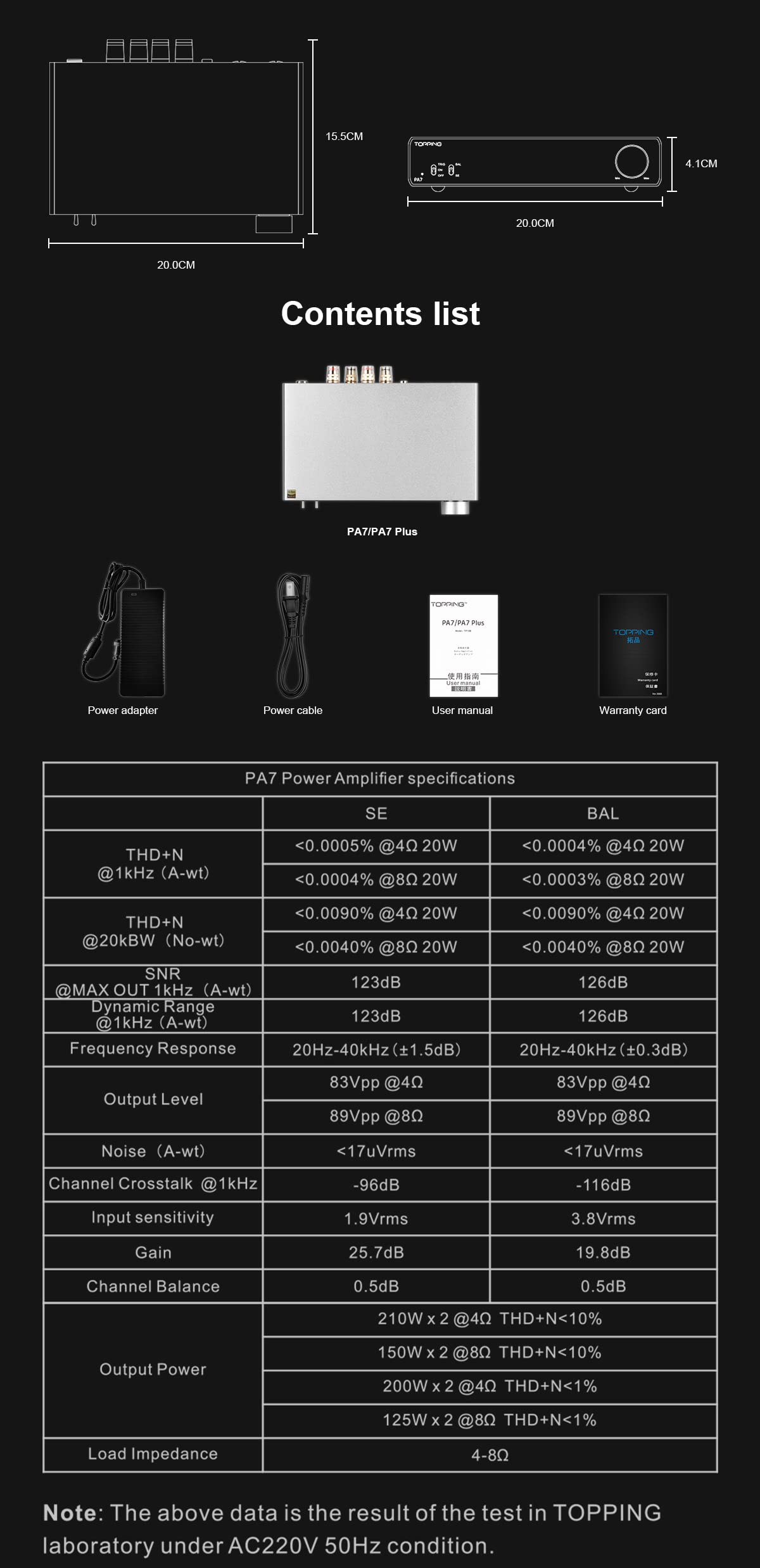
The KGUSS Topping PA7 is a compact, fully balanced Class D stereo amplifier delivering 210W per channel at 4-ohms with ultra-low distortion. Featuring XLR, TRS, and RCA inputs plus a 12V trigger for seamless integration, it offers audiophile-grade sound clarity and powerful output in a sleek form factor, perfect for elevating any home audio setup.




K**N
Logical upgrade from the PA3s/DX3 Pro+ stack.
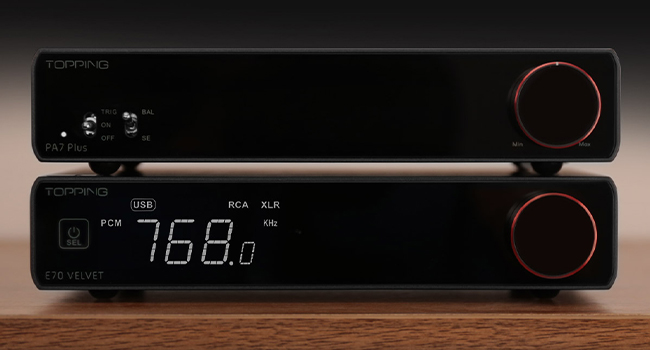
I’ve been using the PA3s/DX3 Pro+ stack for about a year now and still love it. It’s one of the best value combos in audio that I’ve ever found. The PA3s is the quietest amp I’ve owned and there is virtually zero hiss from any speakers I’ve tried them with. Naturally, it pairs best with the DX3 Pro+ as they both use the same chassis/design language. Like with the PA7/E70 stack, it’s hard to separate them from one another as it’s always been very aesthetically pleasing and satisfying to own matching equipment. I’d been wanting a newer, more powerful amp for awhile now to replace the PA3s, but had a harder time deciding to spend money on a new DAC that’ll probably sound exactly the same. While skeptical about any sound changes, the E70 still had some hardware features that made it easier for me to buy, not to mention a must for the PA7.We begin with the E70. The two big features this has over the DX3 Pro+ are the balanced outputs and trigger out. Many of these newer, superb measuring class D amps that use Hypex or Purifi modules commonly only utilize balanced inputs. To have a DAC that futuresproofs itself by having balanced outputs is a wise investment. The trigger is another great addition. Finally, I can power on/off both units at the same time with a remote! Regarding some other differences between the E70 and DX3 Pro+ is how volume is displayed. E70 displays .5db increments, up until you get to -60db, where it switches to whole numbers at and beyond that. The DX3 Pro+ is whole numbers only (which I kinda prefer, less clicks to adjust volume). Although, the E70 counteracts this by being able to adjust volume at a significantly faster rate if you hold volume up/down. Display wise, I’m kinda preferring the bluish/white display of the E70 over the orange of the DX3 Pro+ and the lettering is slightly bigger. Since the DX3 Pro+ has a headphone amp, the unit gets much warmer than the E70 which remains cool. The opposite is true with the amps, in which the PA3s remains cool and the PA7 gets much warmer. Thus, ideally you’d want the DX3 Pro+ on top, PA3s on bottom and PA7 on top, E70 on bottom (warmer unit on top for better ventilation). Volume knob has very slight indentations in the rotation and feels great, while the DX3 Pro+ has much louder plasticy-sounding clicks. I really like the look of the PA7 stack, the glossy black and shiny red accent knobs are neat, and they look more like serious equipment than the petite, almost toy-like look of the PA3 stack. Although, fingerprints, smudges, and scratches are inevitable.Moving on to the PA7. Only real difference around back is the PA7 uses XLR for balanced input while the PA3s uses TRS. Otherwise, the PA7 also includes the trigger in and volume bypass switch. The PA3s must be turned off manually via the button on front. The powered on light on the PA7 is white, matching the E70 display, whereas the PA3s is blue. In that the PA7 is quite a bit more powerful than the PA3s, it has large vents in the sides, back and bottom of the chassis, PA3s has none. This allows you to peek inside the unit and admire the tech. The power brick is also bigger with the PA7. Regarding dimensions, it’s worth noting that the depth of the PA7 and E70 are deeper than the PA3s and DX3 Pro+, so stacking mismatched units doesn’t work (i.e. DX3 Pro+ with PA7, or E70 with PA3s). The volume knob of the PA7 also feels smoother and higher quality than the more resistant one of the PA3s. Speaking of volume, the gain on these two units is nearly identical, so the volume will be the same between both amps if set at the same volume, even though the PA7 has more power.So what about sound? I came into this stack fully expecting virtually no change in sound quality. Instead, I found worth simply from balanced outputs, trigger feature, better appearance, superior measurements, and more peace of mind with higher available power from the amp. Describing sound quality is anyone’s game when speaking subjectively, so take this with a grain of salt. I “thought” I noticed a positive change with my Lintons. It seemed like the bass had a bit more control and was a little tighter overall. The highs seemed slightly more refined too, which can sometimes be a struggle for the Lintons. Overall, I feel the Lintons are a bit less unrestrained with the PA7/E70 vs the PA3s/DX3 Pro+. Whatever the case may be regarding actual sound changes, for a stereo based system, I’ve never heard better.A parting thought. I don’t understand why Topping opted for two versions of the PA7. The PA7 Plus costs $100 more, all for a whopping 10 more watts? Why? At $550, it now must compete against Hypex NC252 modules, which I’d take over the PA7 Plus any day of the week.So what’s the conclusion here and is the upgrade worth it? The PA3s/DX3 Pro+ stack will run you $350 or $300 when both units are on sale. The PA7/E70 stack will run you $800 or $700 when both units are on sale. Was the extra $400 worth it? Hmmm. I’d say not quite if coming from the PA3s/DX3 Pro+. Losing the very well-performing headphone jack is a pretty substantial loss, unless you are confident you’ll never use it. Otherwise, both stacks are so similar in features and sound, that you’ll have to decide if the differences listed throughout my review sound worth it to you. Lastly, I think the PA3s/DX3 Pro+ is the better option for a desk based setup, due to its headphone jack, matte finish that resists fingerprints, easy reach of PA3s power button, and smaller footprint. Whereas if you are in a bedroom/living room setup, the PA7/E70 might be the better choice with its trigger feature, slightly bigger screen, nicer glossy design, and less of a need for a headphone jack (unless you use a long extension to span the distance). Regardless of what stack you choose, I personally love them both and don’t think either is the inferior choice. No doubt the PA3s/DX3 Pro+ is the better value, but the PA7/E70 is the logical upgrade if you decide to pay the price of admission. Either way, happy listening!
D**R
nice versatile small amp
If you are going to run balanced inputs, there is a bit less gain as compared to the single-ended inputs. So if you are going straight from a DAC to the balanced inputs, you may have slightly less gain on tap. The exact numbers are listed in the product specs, just as an FYI. And as always, balanced output level can vary from DAC to DAC.On the other hand, If you are going DAC-to-preamp, your preamp will likely have tons of gain to make that a non-issue. Since it runs great single-ended, you are likely covered anyway. Just my observations from trying a few different DACs in different scenarios. In short, you might want a preamp in the line if you are definitely going to use the balanced inputs. If you are using single-ended, then straight from the DAC is quite likely never going to be a question.Overall, quite good. I suspect the next step up people would look at would be LA90, or a 1ET400A or NCx500 amp. So this product sits in a nice position in terms of price performance. I like the stuff that Topping is putting out. Note: this product has been reviewed on some of the audio websites as well.
H**Y
Very nice design
The amplifier functions perfectly and installs easily. It adds nothing to the sound and drives my speakers superbly
M**H
Great small amplifier
Very good power, sounds very good and small. has good ventilation and great connections. I used them with an external pre-amp/DAC and connected to my WiiM Pro streamer. Very clear and clean sound.
Trustpilot
2 weeks ago
3 weeks ago