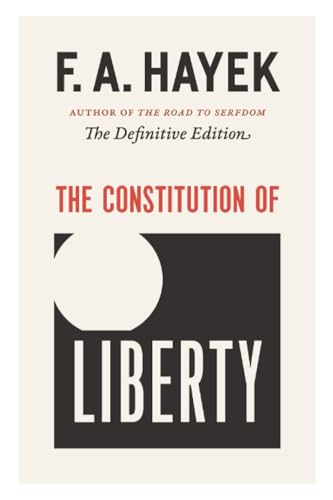
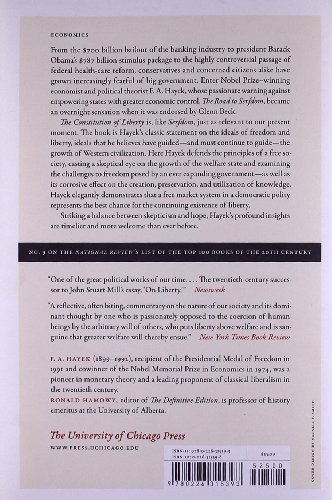
desertcart.com: The Constitution of Liberty: The Definitive Edition (Volume 17) (The Collected Works of F. A. Hayek): 9780226315393: F. A. Hayek, Ronald Hamowy: Books Review: Awe inspiring, amazing, adds to the human experience and the evolution of wisdom - Hayek is one of the foremost leaders in economic thought in the 20th century. Ever wonder why he won a Nobel prize and J.M.Keynes did not. Here are links to two videos that put the economic policy differences between Keynes and Hayek to rap music (Yes rap music). Simply brilliant and accurate and hilarious: http://m.youtube.com/watch?v=d0nERTFo-Sk.http://m.youtube.com/watch?v=GTQnarzmTOc. There have been many great economists of the various free market schools, Frederick August Hayek is one of the true Greats. He takes great pain to define terms that we take for granted and explain their value. Awe inspiring in his brilliancy, if you read this book you will be well armed with insights and information about the field of Economics and its far reaching impacts. You will learn things about the evolution of society that will cause you to rethink how much of an understanding and, indeed, education you have. He meticulously traces back through history the very origins of our modern arguments and shows us how in our modern arrogance we make the arguments of failed philosophies of yesteryear. Currently there is some French hack by the name of Piketty that is number one (for econ) on desertcart, it can only be the case that anyone who has given that book a positive review has never read F A Hayek. Or else it would be as obvious to them as it is to me (not a trained economist) the mistaken assumptions and out right dishonest conclusions as well as misleading analysis of statistics in Piketty's horrific 648 page waste of time. Piketty makes the failed arguments of the 17th century mercantalists and of the French rationalists who were simply wrong as most of their understandings of freedom came, not by experience, but by observing freedom elsewhere (England). Educate yourself, read anything by F A Hayek. These days we think so highly of ourselves that often it is the case that we do not realize the arguments of the day are, in actuality, the same as the arguments of a bygone era reworked and reworded for a newer more naive audience. No one should remember J M Keynes as his policies have proven failures everywhere they have been implemented (before durring and after his time). Personal and emotional bias in the field of Economics has led us to make heroes of failures and obscure references of true heroes. Rediscover an intellectual giant, learn from history, help turn the tide of bad decisions that we, as slaves of defunct economists, allow our society to make due to our ignorance. Review: Excellent Quality and Cover Design - Just received and am impressed with the quality.
| ASIN | 0226315398 |
| Best Sellers Rank | #85,693 in Books ( See Top 100 in Books ) #82 in Theory of Economics #120 in Economic History (Books) #325 in History & Theory of Politics |
| Book 1 of 18 | The Collected Works of F.A. Hayek |
| Customer Reviews | 4.8 4.8 out of 5 stars (333) |
| Dimensions | 6 x 1.49 x 9 inches |
| Edition | The Collected Works edition |
| ISBN-10 | 9780226315393 |
| ISBN-13 | 978-0226315393 |
| Item Weight | 1.8 pounds |
| Language | English |
| Print length | 595 pages |
| Publication date | April 1, 2011 |
| Publisher | University of Chicago Press |
M**S
Awe inspiring, amazing, adds to the human experience and the evolution of wisdom
Hayek is one of the foremost leaders in economic thought in the 20th century. Ever wonder why he won a Nobel prize and J.M.Keynes did not. Here are links to two videos that put the economic policy differences between Keynes and Hayek to rap music (Yes rap music). Simply brilliant and accurate and hilarious: http://m.youtube.com/watch?v=d0nERTFo-Sk.http://m.youtube.com/watch?v=GTQnarzmTOc. There have been many great economists of the various free market schools, Frederick August Hayek is one of the true Greats. He takes great pain to define terms that we take for granted and explain their value. Awe inspiring in his brilliancy, if you read this book you will be well armed with insights and information about the field of Economics and its far reaching impacts. You will learn things about the evolution of society that will cause you to rethink how much of an understanding and, indeed, education you have. He meticulously traces back through history the very origins of our modern arguments and shows us how in our modern arrogance we make the arguments of failed philosophies of yesteryear. Currently there is some French hack by the name of Piketty that is number one (for econ) on Amazon, it can only be the case that anyone who has given that book a positive review has never read F A Hayek. Or else it would be as obvious to them as it is to me (not a trained economist) the mistaken assumptions and out right dishonest conclusions as well as misleading analysis of statistics in Piketty's horrific 648 page waste of time. Piketty makes the failed arguments of the 17th century mercantalists and of the French rationalists who were simply wrong as most of their understandings of freedom came, not by experience, but by observing freedom elsewhere (England). Educate yourself, read anything by F A Hayek. These days we think so highly of ourselves that often it is the case that we do not realize the arguments of the day are, in actuality, the same as the arguments of a bygone era reworked and reworded for a newer more naive audience. No one should remember J M Keynes as his policies have proven failures everywhere they have been implemented (before durring and after his time). Personal and emotional bias in the field of Economics has led us to make heroes of failures and obscure references of true heroes. Rediscover an intellectual giant, learn from history, help turn the tide of bad decisions that we, as slaves of defunct economists, allow our society to make due to our ignorance.
R**R
Excellent Quality and Cover Design
Just received and am impressed with the quality.
H**N
Political Economy at its best
Hayek's "The Constitution of Liberty" is one of the most important books in social theory written in the twentieth century. In desperate brevity, the book is divided into three, very well integrated and symbiotic, parts. The first two parts of the book are political economy at its best. Part I concerns Hayek's definition of freedom, its historical emergence, the value of freedom, and the protection and institutionalization of freedom. Part II concerns freedom and its relation to the rule of law and political system as facilitating or undermining the realization of personal freedom. Part III unfolds the implications of freedom for the realm of economics in particularly within the so-called "Welfare State." There is a fourth part, or postscript titled "Why I am not a conservative," worth the purchase of the book by itself. Hayek argues conservatives are closer to socialists, than they are to `free-market' advocates. Conservatives have a dogmatic "fear of change" (p. 522), while Hayek embraces change for its potential of manifesting Truth and Freedom. If you think you disagree with Hayek, read this book; if you think you agree with Hayek, read this book. Now for elaboration ... "The Constitution of Liberty" is Hayek's magnum opus, a far stronger argument than is his more popular "The Road to Serfdom." There are two primary differences between these two books. First, "The Road to Serfdom" is a critique of what tends to absent freedom; "The Constitution of Liberty" is far less critical and more positive statement of the necessary conditions for the possibility of freedom. Second, "The Road to Serfdom" is a reaction to, and attack on, the possibility of continuing the planned war economies after WWII as quasi-socialism, whereas "The Constitution of Liberty" proclaims socialism to be dead (p. 370), wherefore defenders of liberty need to focus their attention on the rise of the "Welfare State." Hayek maintains that "some of the aims of the welfare state can be realized without detriment to individual liberty" (p. 375). This sentence will be far less shocking, when it is recalled 16 years prior Hayek argued in "The Road to Serfdom" the biggest problems that needed to be solved in market economies were: (1) the regulations of the monetary and financial system and (2) curtailment of the coercive actions of big business; further Hayek maintained that Western market societies should have institutions, analogous to the military but not requiring war activity, for individuals who prefer economic security and stable employment and income (perhaps something like a domestic or social peace corps, although Hayek does not specify). In "The Constitution of Liberty" Hayek declares he does not see big business as a positive market force (as Joseph Schumpeter had argued), and Hayek explicitly states "I still feel, as I did fifteen years ago, that it may be a good thing if the monopolist is treated as a sort of whipping boy of economic policy" (p. 381). What Hayek wants to point out, is not that there is no room for government involvement in personal security, work policy, monetary management, health-care, social insurance, taxation, city planning, environmental protection and education, but that government involvement has historically often been conducted poorly. But the necessity of government involvement in a market economy is never denied, but embraced by Hayek: "A functioning market economy presupposes certain activities on the part of the state" (p. 331). There are activities of the state that are consistent with freedom and there are activities of the state (and private big business) that are inconsistent with freedom. According to Hayek the exaggerated "appeal to the principle of non-interference in the fight against all ill-considered or harmful measures has had the effect of blurring the fundamental distinction between the kinds of measures which are and those which are not compatible with a free system" (p. 331). Caricatures of Hayek, from both the right and left, do no justice to his impressive insightful commentary, the eruditeness of his political economy, and the sober proportions of emphasis. Hayek's doctrinaire defense of market society is not because it is the "most rational" system, but instead it is the overwhelmingness of human (individual and collective) "ignorance" that must necessarily commit human beings desiring freedom to an experiential and evolutionary system, which includes both private and public spheres of experimentation. Although Hayek is doctrinaire he is not dogmatic. He carefully considers the role of the government and the coerciveness of private business. Make no mistake, Hayek believes in, and defends, liberal society generally and in particular market economy. However, he is far less dogmatic and exaggerated than the caricatures would have him. He is a mind of serious study by both the right and left.
P**T
Great book, highly recommended.
P**N
Hayek attempts to explain the origins of a free society. In his other books, Hayek discusses the benefits of a free society. This book digs deep into the question of how; liberty itself evolved into the present state of being. Hayek breaks down the legal structure. He identifies how social customs end up being transformed into laws. These laws were not invented by lawyers or the ruling class, but evolved from various socially accepted practices. This is an important point regarding social management. The best management results from governments adopting into law, what are already generally accepted principles and customs. Conflicts inevitably result, when governments attempt to introduce new rules of conduct, which are alien to the broader society. Hayek then compares the French and English traditions. In England most institutions evolved over centuries, with very little government interference. In France after their revolution, a stronger more proactive government approach was adopted. The French model involved larger governments based on a very strong leader. Hayek then analyzes and contrasts to two systems. The reader will walk away with a much stronger understanding of our; political, historical, and economic foundations. Hayek gives many examples on the importance of liberty, and how liberty enables a society to prosper.
H**E
Hayek makes a very thorough and critical analysis of concepts such as democracy, the purpose of law, government, welfare etc. But at the same time he fails to question his own assumumtions on the nature of freedom and coercion (specially the one done by the state), he defines these 2 concepts in a very specific way and follows such definitions in an almost religious way. He is extremely sceptical all non-liberal ideas of government and deconstructs them so much that at times it seems like he's trying to gaslight the reader. It's a pitty because the criticisms he makes are interesting and if he applied the same rigor to examine the implication of liberal economics I think he could have had some great insights.
1**1
Hayek's genius is undeniable. He gives a good example of an intellectual who still remembers how little we know. Economists often like to take the birds point of view and in their profession Hayek is clearly one of the high flying ones. His eye even pierces veils that Keynes' or Friedman's did not. (-> monetary matters) His conception is one of negative liberty and economic freedom, which are stated as essential ingredients of human progress and societal stability. The book contains general topics like freedom, determinism, equality - as well as practical matters like the necessary coordination housing or currency (non-)regulation. This book contains more valid thought than quite a few other smart ones taken together.
D**A
Very heavy reading, but excellent text.
Trustpilot
2 weeks ago
4 days ago