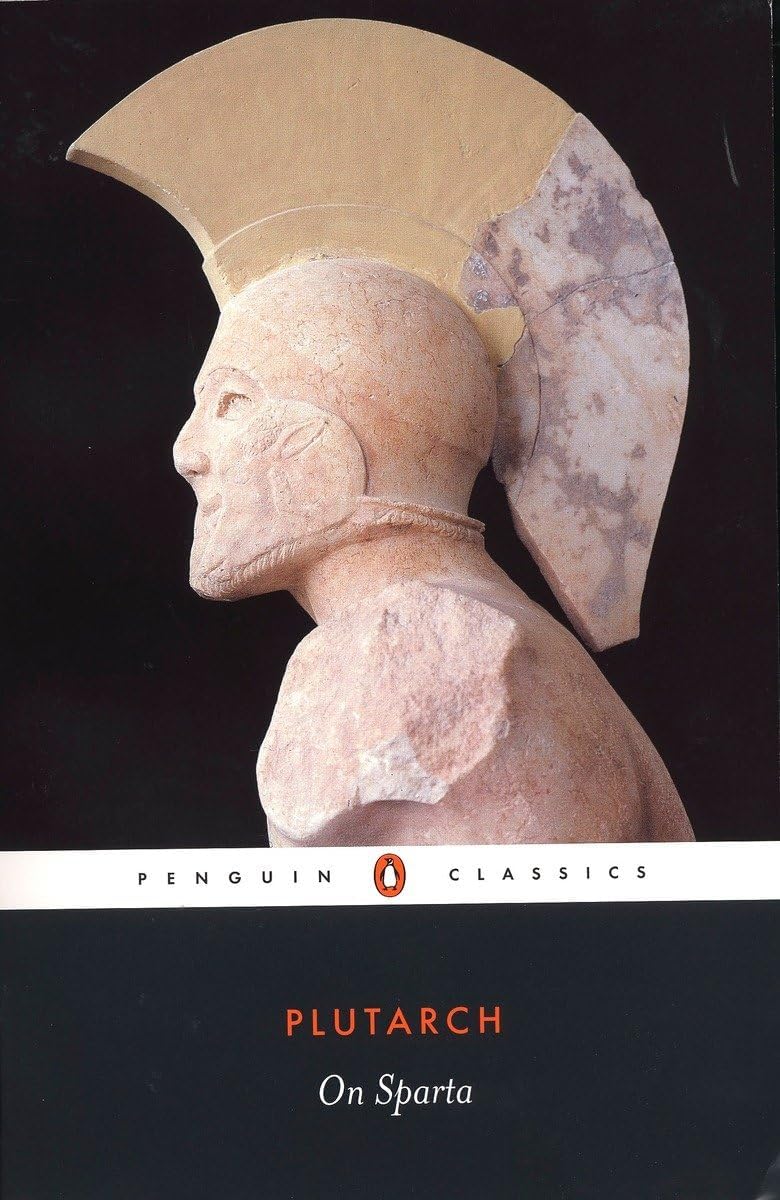
On Sparta
Product ID: 331334058
Buy anything from 5,000+ international stores. One checkout price. No surprise fees. Join 2M+ shoppers on Desertcart.
Desertcart purchases this item on your behalf and handles shipping, customs, and support to Italy.
On Sparta : Plutarch, Talbert, Richard J. A., Talbert, Richard J. A., Talbert, Richard J. A., Pelling, Christopher: desertcart.ae: Books Review: An eye opener on an exclusive ancient society,some of which are mind boggling,a book i will not get bored of. Review: Plutarch is simply one of the best ancient writers, with simple and engaging prose. No wonder so much of his original sources were lost because people would rather read and copy his works. Some merit is certainly due to the translator as well, which provides a nice introduction and context to each segment, as well as extensive notes and further bibliography on the topics. The book focuses on Sparta and its unique martial culture and leadership in Greece. To tell the story, it contains three biographies from some of its most illustrious leaders, a collection of quotes and sayings from Spartans and a summary of the unique customs of the city as perceived by other Greeks. The first (and most interesting) biography is from Lycurgus: the lawgiver, mythical figure that created the Spartan constitution and influenced the odd customs the city state is most famous for. Then there is Agesilaus, one of the Spartan kings at its height. A rather simple man, not raised to be king, both corrupt and capable military leader. It tells of the downfall of the Spartan hegemony in Greece in its conflicts with the Boeotian League leaded by Thebes. Finally, Agis and Cleomenes biographies, both reformers which tried to take Sparta back to its original constitution to save the city from the nobility corruption and stagnation brought by inequality, very similar to the Gracchi brothers of Rome. The first was felled during conflicts with the oligarchies of Sparta, the second lost its life amid the Successor Kingdoms politics, dying as a hostage in Ptolemaic Egypt after leading a brief recovery of Spartan power in the Peloponnese. The book finishes with sayings of Spartans and typical examples of laconism: brief witticisms used to justify the uniqueness of Sparta and its citizens. While they are most likely invented or retconned to explain past, they embody the image of Sparta that other Greeks had and that ended up forming our image of the Spartans: one that emphasizes courage, austere living, martial excellence and devotion of its citizens and families to the state. Many things surprised me throughout the book, with some interesting parallels to the present. It’s interesting to see how Lycurgus, the founding father of the Spartan constitution, was actually the amalgamation of different historical leaders and an ex-post justification for Spartan culture and (due to the deviation from the ordained constitution by him) its downfall as the preeminent city of Greece. The failure of Sparta to reform its political and economic system despite growing inequality, declining population and stagnant economy is also attested by a promise supposedly made by the people to him, a fact that carry strong symbolic meaning, even if unlikely to have happened. Speaking of tradition, it is also interesting to see how both sides of the political spectrum appeal to it to further their goals of reform: either to reinforce the oligarchical system in place or devolve more power to the kings. If you read Roman history you will feel at home with the recurring discussion on inequality, the reforms needed to curb it and how its fighting capability and moral quality of the citizens was affected by it. In the end, deep reforms seem to rarely go through without a significant breakup of the political order, which usually results in violence. Property also seemed to be linked to more freedom and broader political rights. Whenever it concentrated in the hands of a few, the system was liable to corruption, abuse of power by the elites and populists that promoted radical solutions and ended up concentrating political power.





















| Best Sellers Rank | #99,937 in Books ( See Top 100 in Books ) #88 in History of Ancient Greece #160 in Ancient & Medieval Literature #311 in Anthropology |
| Customer reviews | 4.8 4.8 out of 5 stars (211) |
| Dimensions | 12.93 x 1.73 x 19.66 cm |
| Edition | Revised ed. |
| ISBN-10 | 0140449434 |
| ISBN-13 | 978-0140449433 |
| Item weight | 223 g |
| Language | English |
| Print length | 304 pages |
| Publication date | 27 December 2005 |
| Publisher | Penguin Classics |
| Reading age | 18 years and up |
A**G
An eye opener on an exclusive ancient society,some of which are mind boggling,a book i will not get bored of.
P**O
Plutarch is simply one of the best ancient writers, with simple and engaging prose. No wonder so much of his original sources were lost because people would rather read and copy his works. Some merit is certainly due to the translator as well, which provides a nice introduction and context to each segment, as well as extensive notes and further bibliography on the topics. The book focuses on Sparta and its unique martial culture and leadership in Greece. To tell the story, it contains three biographies from some of its most illustrious leaders, a collection of quotes and sayings from Spartans and a summary of the unique customs of the city as perceived by other Greeks. The first (and most interesting) biography is from Lycurgus: the lawgiver, mythical figure that created the Spartan constitution and influenced the odd customs the city state is most famous for. Then there is Agesilaus, one of the Spartan kings at its height. A rather simple man, not raised to be king, both corrupt and capable military leader. It tells of the downfall of the Spartan hegemony in Greece in its conflicts with the Boeotian League leaded by Thebes. Finally, Agis and Cleomenes biographies, both reformers which tried to take Sparta back to its original constitution to save the city from the nobility corruption and stagnation brought by inequality, very similar to the Gracchi brothers of Rome. The first was felled during conflicts with the oligarchies of Sparta, the second lost its life amid the Successor Kingdoms politics, dying as a hostage in Ptolemaic Egypt after leading a brief recovery of Spartan power in the Peloponnese. The book finishes with sayings of Spartans and typical examples of laconism: brief witticisms used to justify the uniqueness of Sparta and its citizens. While they are most likely invented or retconned to explain past, they embody the image of Sparta that other Greeks had and that ended up forming our image of the Spartans: one that emphasizes courage, austere living, martial excellence and devotion of its citizens and families to the state. Many things surprised me throughout the book, with some interesting parallels to the present. It’s interesting to see how Lycurgus, the founding father of the Spartan constitution, was actually the amalgamation of different historical leaders and an ex-post justification for Spartan culture and (due to the deviation from the ordained constitution by him) its downfall as the preeminent city of Greece. The failure of Sparta to reform its political and economic system despite growing inequality, declining population and stagnant economy is also attested by a promise supposedly made by the people to him, a fact that carry strong symbolic meaning, even if unlikely to have happened. Speaking of tradition, it is also interesting to see how both sides of the political spectrum appeal to it to further their goals of reform: either to reinforce the oligarchical system in place or devolve more power to the kings. If you read Roman history you will feel at home with the recurring discussion on inequality, the reforms needed to curb it and how its fighting capability and moral quality of the citizens was affected by it. In the end, deep reforms seem to rarely go through without a significant breakup of the political order, which usually results in violence. Property also seemed to be linked to more freedom and broader political rights. Whenever it concentrated in the hands of a few, the system was liable to corruption, abuse of power by the elites and populists that promoted radical solutions and ended up concentrating political power.
L**T
Plutarch's book tells the immensely sad story of the relentless warring between the Greek City States: `Alas for Greece, how many men have you killed with your own hands.' His masterly brushed picture of Sparta is not less than astonishing. Sparta has been one of the purest communist States on earth. In order to stamp out arrogance, envy, crime, luxury, wealth and poverty among its citizens, the kings imposed redistribution of land, common messes for all Spartans, no free travel (foreign morals should be hidden) and no immigration (could be teachers of evil practices). Gold and silver coins were declared invalid and replaced by iron ones. Those who wanted to sin by amassing great wealth, needed vast granaries. Nepotism was impossible because children didn't privately belong to the fathers, but jointly by the city. Moreover, the city needed children from the best men (eugenics). Barbarous methods were used in the military education of the youth: thousands of human targets (helots) were killed in nightly survival exercises. The ultimate goal of the State was to create an army of bees swarming around their leaders and capable of defending Sparta's 4 villages against any outside enemy. For Plutarch, Sparta went under when it replaced its defence policies by offensive one: `empire and sovereignty war by force - unnecessary elements for maintaining the happy life of any State.' It was beaten by Epaminondas' Theban army. Sparta was the ideal State for Plato, of whom Plutarch adopted his anti-democratic reflexes: `those politicians, whose sights are set on glory, are servants of the crowd, even though they are called rulers.' This book is a must read for all those interested in the history of mankind.
S**R
Amidst all the contemporary historical deconstructionist prattling over the Spartans, the views and words of the more proximate historians among the ancients shine out like stars in a dark firmament. Plato and Aristotle had much to say of the Spartan constitution. Likewise did Plutarch, who was a later Greek historian living from 46-120 AD during the period of Roman Imperial ascendacy. In this book there is much instructive and readable biographical information on prominent Spartan lives, as well as explantions of culture and customs surrounding the "Laws of Lycurgus." There are Spartan tales and aphorisms as well and the inclusion of the tragic stories of the later reformers are invaluable inclusions taken from the perspective of time. They are archetypal stories of heroic-tragic figures who strive greatly to resurrect a noble but dying people and their way of life. I enjoy to ponder parallels between late Spartan reformer-Kings and the Roman Emperor Julian Apostate. Plutarch's book is required reading for students of Sparta. This edition is a good editing and compilation and the first version of Plutarch's writings on Sparta that I would recommend readers select.
G**E
This volume is a collection of books about Sparta . Every history in this volume gives to the reader a good panorama of what would be Spartiates. The characters are the best of elites warrior, heroes and kings but also common man. You also can find an appendix of Xenophon on the Costitution of Sparta or as the Spartans call it the Goods Laws. So you can understand why from the ancient times Sparta and his way of lives was so admired.
Trustpilot
5 days ago
1 month ago