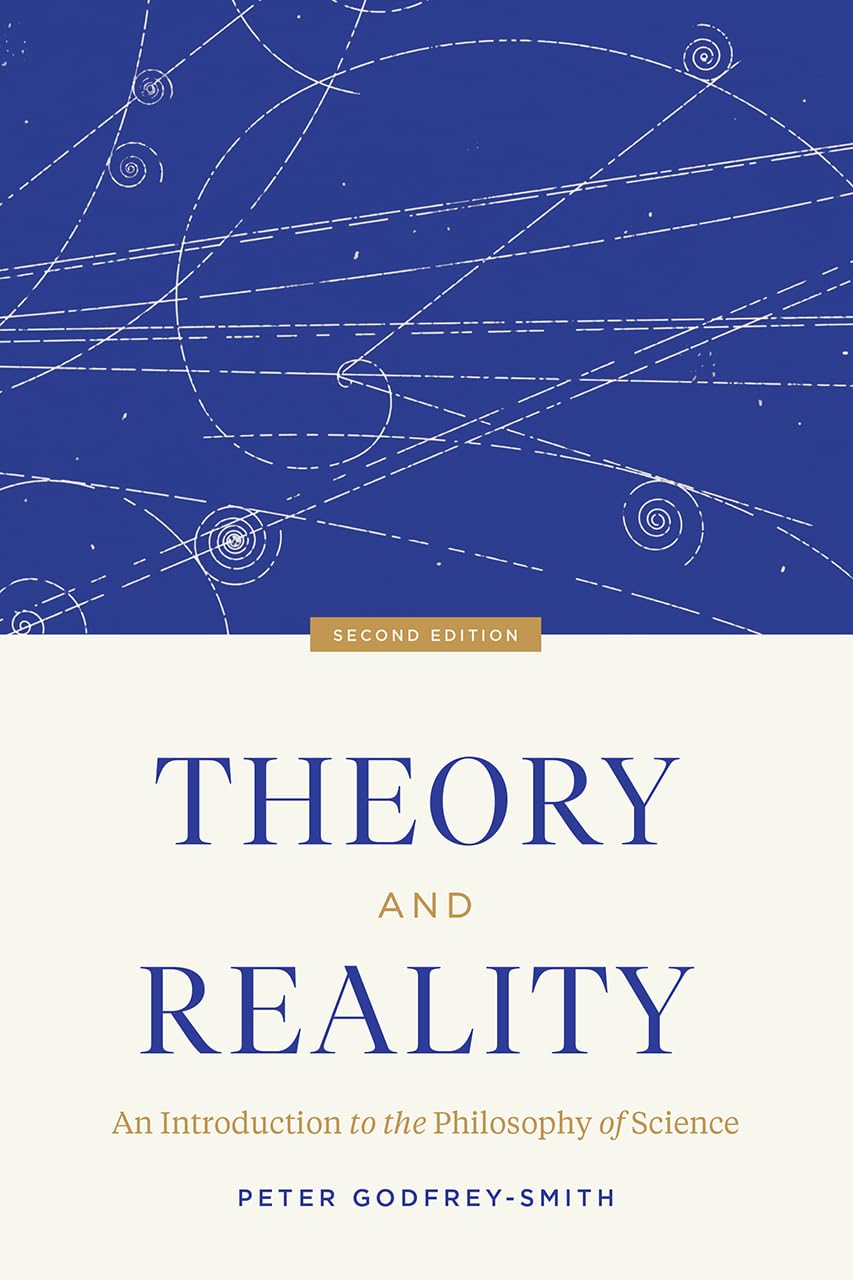
desertcart.com: Theory and Reality: An Introduction to the Philosophy of Science, Second Edition: 9780226618654: Godfrey-Smith, Peter: Books Review: A clear treatment for undergraduates that is just biased enough. - This review will probably be most helpful to those considering using it as a kind of "textbook" in a philosophy of science course. I am a Catholic priest with a background in physics who teaches philosophy at a Catholic university. In trying to decide what book to use for my philosophy of science course, I looked at six or seven different candidates and chose this one. In choosing a book for the course, I had three desiderata: 1. I didn't want a book that made constant polemical jabs at religion. 2. I wanted a book that gave some air-time to history, particularly the scientific revolution and Hume. 3. The writing needed to be engaging and accessible to non-philosophy majors. At my university, most of the students taking a course like this (roughly 3/4) will be taking it to fulfill an upper-division requirement of the core curriculum. So most are not philosophy majors. Moreover, about 50% of my students are first-generation college students, making it all the more important to find a book that uses plain language and isn't too boring. Godfrey-Smith's book fulfills all three of my desiderata, and I'm not sure that any other book I looked at even managed to hit two of them. The book is clear and engaging. The author injects his own views as he goes along, but isn't overbearing with them. The injection of his own views is actually quite helpful in a philosophy class because it gets discussion going and keeps us focused not just on learning facts, but on asking what is true. The second half of the book is more opinionated, and I didn't assign it for that reason. However, the introduction to the philosophy of science that Godfrey-Smith provides in the first six chapter is really gold. It was always above my students' heads to some extent, but it was presented in a clear enough way that by the end of class they were understanding. I've now used it twice for teaching philosophy of science, once with the first edition and once with the second. I found the (mostly minor) changes in the second edition to be mostly helpful. Again, though I only really use the first six chapters. For me, this book filled the role I needed it for in a way that no other book I've found could have done. I'm grateful to Godfrey-Smith for writing it, and I'd highly recommend it to anyone teaching an undergraduate course in philosophy of science. (I would note that I end the semester with some philosophy of biology for which I also found Godfrey-Smith's book on that topic useful and well-written.) Review: Book for class - Got this book for my PHI 314 class. New, no pages missing.
| Best Sellers Rank | #34,812 in Books ( See Top 100 in Books ) #2 in Epistemology (Books) #9 in Epistemology Philosophy #108 in History & Philosophy of Science (Books) |
| Customer Reviews | 4.6 out of 5 stars 96 Reviews |
W**O
A clear treatment for undergraduates that is just biased enough.
This review will probably be most helpful to those considering using it as a kind of "textbook" in a philosophy of science course. I am a Catholic priest with a background in physics who teaches philosophy at a Catholic university. In trying to decide what book to use for my philosophy of science course, I looked at six or seven different candidates and chose this one. In choosing a book for the course, I had three desiderata: 1. I didn't want a book that made constant polemical jabs at religion. 2. I wanted a book that gave some air-time to history, particularly the scientific revolution and Hume. 3. The writing needed to be engaging and accessible to non-philosophy majors. At my university, most of the students taking a course like this (roughly 3/4) will be taking it to fulfill an upper-division requirement of the core curriculum. So most are not philosophy majors. Moreover, about 50% of my students are first-generation college students, making it all the more important to find a book that uses plain language and isn't too boring. Godfrey-Smith's book fulfills all three of my desiderata, and I'm not sure that any other book I looked at even managed to hit two of them. The book is clear and engaging. The author injects his own views as he goes along, but isn't overbearing with them. The injection of his own views is actually quite helpful in a philosophy class because it gets discussion going and keeps us focused not just on learning facts, but on asking what is true. The second half of the book is more opinionated, and I didn't assign it for that reason. However, the introduction to the philosophy of science that Godfrey-Smith provides in the first six chapter is really gold. It was always above my students' heads to some extent, but it was presented in a clear enough way that by the end of class they were understanding. I've now used it twice for teaching philosophy of science, once with the first edition and once with the second. I found the (mostly minor) changes in the second edition to be mostly helpful. Again, though I only really use the first six chapters. For me, this book filled the role I needed it for in a way that no other book I've found could have done. I'm grateful to Godfrey-Smith for writing it, and I'd highly recommend it to anyone teaching an undergraduate course in philosophy of science. (I would note that I end the semester with some philosophy of biology for which I also found Godfrey-Smith's book on that topic useful and well-written.)
M**L
Book for class
Got this book for my PHI 314 class. New, no pages missing.
A**R
For class
Decent
F**A
Professionalism
Good book
W**H
The best intro to philosophy of science?
I used the first edition several times to teach my undergraduate philosophy of science class for philosophy majors. Because it tells a coherent story, I like it better for that purpose than the anthologies of philosophy of science papers I had used previously. Now in fall 2024, I'm about to use the second edition, which is mostly the same book with some nice updates, small changes, and additions. The style is excellent, the content covers the field well and explains it well to undergrads. GS (as we call him in class) argues for his own view, though not in a way that is overbearing or that distorts his interpretation of other views. That makes it a model for students to emulate in their own writing. The book isn't long enough, for me at least, to use it alone as a text for a whole semester, so I supplement the reading list with various journal articles I especially like--or sometimes ones I dislike so I can critique them!
W**I
Poor philosophizing
The book reads like oral lectures reproduced in book form, at undergraduate level, too inconcise for the subject. As someone who does science for a living I was wondering whom this book is for? I’d rather recommend “What is this thing called science” by Charlmers. For books written by a practicing scientist, I recommend “Scientific method in practice” or “in brief” by Hugh Gauch.
Trustpilot
1 month ago
1 month ago