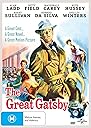
The Great Gatsby
Product ID: 20918782
Details
- FormatImport Formats
- GenreDrama
- ManufacturerVia Vision
- Number Of Discs1
Desertcart purchases this item on your behalf and handles shipping, customs, and support to Italy.
This 1949 movie lavishly takes us on the journey of Jay Gatsby (Alan Ladd) who worked his way from poor fisherman to extravagant millionaire. Travel back in time to the roaring 20s, a time of flappers, bootlegging, art deco architecture, and jazz music, through this classic tale of love and betrayal, deception and mystery. This is the second film adaptation of F. Scott Fitzgerald's famous novel and was made before the book became considered an American classic. Review: Ladd Does Gatsby - I no longer favor Hollywood's casting machine since the miscasting of "Gatsby"('74) to the present. (Di Caprio?) It was a documentary of Alan Ladd that drew me to this version. When I saw the release date (1949) so close to the death of F.Scott Fitzgerald, I thought the literate-minded moguls at that time would give it the best effort. They do. The cast is top notch and the script like Scotty would have it. Opposite Alan Ladd is (Daisy)Betty Field who captures the strangeness of Zelda which is found in the original narrative; then you have Macdonald Carey, Ruth Hussey, Henry Hull,Elisha Cook and Howard DaSilva as the excellent cuckolded husband to Shelley Winters. Barry Sullivan plays the two-timing husband of Daisy. Ladd draws upon his youth as a low grip to the movie studios to understand Gatsby's ambition and he also gets to display his swimming credentials a couple times in his mansion pool. I bet he met Fitzgerald in the 30s when he was a studio grip because they both had a similar fondness for liquor, and were both comfortable with the work hands. The Gatsby tragedy plays out capturing the decadence of the time, the opulence, the phoniness and uncertainty of the lost generation with Shelley Winters playing her cameo brightly as the wife (of DaSilva) who wanted more. The only thing that holds this back from being a classic is that it needs a complete restoration that will brighten the dark noir shadings more fully. Black and white is perfect for this dream that becomes a nightmare in a short while. It was an exuberant time with cautionary warning at key scenes. I found Ladd's "Gatsby" excellent in every way. Macdonald Carey playing Nick Carraway(aka Fitzgerald) along with Ruth Hussey are excellent friends in high places. It was touching to realize when only the two of them showed up for Gatsby's grave that they were echoing Fitzgerald's sad, lonely burial as well. He sold millions of novels but less than 6 people attended his funeral. In this film, you will see and feel F.Scott Fitzgerald and Zelda in Gatsby and Daisy, as well you should. Review: Finally! I Understand the Gatsby Story! - My first exposure to "The Great Gatsby" was in a college literature class called "The American Dream." I read the selection that was presented in the class and also watched the Robert Redford version of the movie (as required in the course) but could not understand what the connection was between The Great Gatsby and The American Dream. I also hated the story. I learned about the Alan Ladd version while visiting the Nethercutt Museum, where a one-sheet for the film was displayed next to an automobile featured in the film. I had no idea that the story had been filmed with Alan Ladd before Robert Redford so I was delighted that desertcart had it available. I was amazed! It was a totally different approach to the story from the Redford version. It explained the back-story of how Gatsby fell in love with Daisy and why he was motivated to do the things that he did. I will say categorically though, THIS STORY IS NOT ABOUT THE AMERICAN DREAM! Anyone who believes that it is either doesn't understand the American dream or is intentionally trying to discredit it. The American Dream is the aspiration to benefit from one's own labor rather than to labor for someone else. Although Jay Gatsby did technically do that in his effort to win Daisy, it was not the core theme of the story. The Great Gatsby is a trashy story about an earnest young man who is willing to do anything to win the love of the blonde bimbo he adores. If you watch this movie with that in mind, it is an excellent interpretation of the story. I highly recommend the Alan Ladd version on DVD.
| Contributor | Alan Ladd, Barry Sullivan, Betty Field, Diane Nance, Ed Begley, Elisha Cook Jr., Elliott Nugent, F. Scott Fitzgerald, Henry Hull, Howard Da Silva, Macdonald Carey, Nicholas Joy, Ray Walker, Ruth Hussey, Shelley Winters, Tito Vuolo, Walter Greaza Contributor Alan Ladd, Barry Sullivan, Betty Field, Diane Nance, Ed Begley, Elisha Cook Jr., Elliott Nugent, F. Scott Fitzgerald, Henry Hull, Howard Da Silva, Macdonald Carey, Nicholas Joy, Ray Walker, Ruth Hussey, Shelley Winters, Tito Vuolo, Walter Greaza See more |
| Customer Reviews | 4.3 out of 5 stars 233 Reviews |
| Format | Import, Multiple Formats, NTSC |
| Genre | Drama |
| Manufacturer | Via Vision Entertainment |
| Number Of Discs | 1 |
G**O
Ladd Does Gatsby
I no longer favor Hollywood's casting machine since the miscasting of "Gatsby"('74) to the present. (Di Caprio?) It was a documentary of Alan Ladd that drew me to this version. When I saw the release date (1949) so close to the death of F.Scott Fitzgerald, I thought the literate-minded moguls at that time would give it the best effort. They do. The cast is top notch and the script like Scotty would have it. Opposite Alan Ladd is (Daisy)Betty Field who captures the strangeness of Zelda which is found in the original narrative; then you have Macdonald Carey, Ruth Hussey, Henry Hull,Elisha Cook and Howard DaSilva as the excellent cuckolded husband to Shelley Winters. Barry Sullivan plays the two-timing husband of Daisy. Ladd draws upon his youth as a low grip to the movie studios to understand Gatsby's ambition and he also gets to display his swimming credentials a couple times in his mansion pool. I bet he met Fitzgerald in the 30s when he was a studio grip because they both had a similar fondness for liquor, and were both comfortable with the work hands. The Gatsby tragedy plays out capturing the decadence of the time, the opulence, the phoniness and uncertainty of the lost generation with Shelley Winters playing her cameo brightly as the wife (of DaSilva) who wanted more. The only thing that holds this back from being a classic is that it needs a complete restoration that will brighten the dark noir shadings more fully. Black and white is perfect for this dream that becomes a nightmare in a short while. It was an exuberant time with cautionary warning at key scenes. I found Ladd's "Gatsby" excellent in every way. Macdonald Carey playing Nick Carraway(aka Fitzgerald) along with Ruth Hussey are excellent friends in high places. It was touching to realize when only the two of them showed up for Gatsby's grave that they were echoing Fitzgerald's sad, lonely burial as well. He sold millions of novels but less than 6 people attended his funeral. In this film, you will see and feel F.Scott Fitzgerald and Zelda in Gatsby and Daisy, as well you should.
N**L
Finally! I Understand the Gatsby Story!
My first exposure to "The Great Gatsby" was in a college literature class called "The American Dream." I read the selection that was presented in the class and also watched the Robert Redford version of the movie (as required in the course) but could not understand what the connection was between The Great Gatsby and The American Dream. I also hated the story. I learned about the Alan Ladd version while visiting the Nethercutt Museum, where a one-sheet for the film was displayed next to an automobile featured in the film. I had no idea that the story had been filmed with Alan Ladd before Robert Redford so I was delighted that Amazon had it available. I was amazed! It was a totally different approach to the story from the Redford version. It explained the back-story of how Gatsby fell in love with Daisy and why he was motivated to do the things that he did. I will say categorically though, THIS STORY IS NOT ABOUT THE AMERICAN DREAM! Anyone who believes that it is either doesn't understand the American dream or is intentionally trying to discredit it. The American Dream is the aspiration to benefit from one's own labor rather than to labor for someone else. Although Jay Gatsby did technically do that in his effort to win Daisy, it was not the core theme of the story. The Great Gatsby is a trashy story about an earnest young man who is willing to do anything to win the love of the blonde bimbo he adores. If you watch this movie with that in mind, it is an excellent interpretation of the story. I highly recommend the Alan Ladd version on DVD.
M**N
Best of a mixed lot
There has never been a perfect movie version of "The Great Gatsby" - each and every one has had flaws. The 1920s silent version is "lost", but was apparently a forgettable adaptation of a stage adaptation. The 1974 version buried the story under sumptuous sets and costumes. The most recent version - really? Rap music? You kidding me? And then there's the 1949 version.... There was a lot of trouble just getting it made in the first place. Writer Richard Maibaum wanted to do it, and wanted Alan Ladd to star in it. According to Maibaum, it all started one evening when Ladd took Maibaum up to his bedroom, showed off the contents of his closet, grinned cockily, and said "Not bad for an Okie kid, is it?" The writer "flashed on" the scene in the novel where Gatsby shows off the contents of *his* closet - and that started the ball rolling. But first he had to convince Ladd, who had a humongous inferiority complex. He got an assist from Geraldine Fitzgerald, who was just coming off costarring with Ladd in another film and helped convince him he was the right choice. Then Maibaum and Ladd had to convince the studio, which had a "sure thing" in Ladd's tough-guy actioners and wasn't sure it wanted to break the pattern. Besides, Fitzgerald was pretty well a "forgotten" writer at that point, which added to the risk. But Paramount eventually came around...reluctantly. Next they had to sneak the script past the Hays/Breen Office, which still had all its teeth and was strongly opposed to even single adultery, let alone the double adultery of the novel, and wouldn't tolerate even the suggestion that crime could pay (this probably explains the bizarre "Wages of Sin" opening sequence). Reportedly it took four rewrites, and a lot of shifting of emphasis, before the censors were satisfied. This may be where the strong emphasis on the Dan Cody subplot, and the strengthening of its resemblance to the Faust legend, came from. Cody, played by Henry Hull, was given a makeup more than slightly suggestive of Mephistopheles and asked to play up the "devilish" aspects of the character, casting him as Gatz/Gatsby's "evil genius" and a negative influence throughout the rest of his life. There were other casting problems, also. All three of the other male leads were close to or over six feet tall, and Ladd...wasn't. That meant a lot of camera trickery - sloped sets, forced perspective, etc. - to conceal that issue. (No, Ladd never stood on a box - probably wore lifts - but most of it was handled through strategic use of different set levels.) The studio had committed to the project and the cameras finally started rolling - but they hedged their bets as much as possible, cutting every corner they could find. The budget was not that much bigger than a "typical" Ladd flick, and despite the best efforts of costume designer Edith Head, it showed. (All the same, that meant there wasn't any worry about getting elaborate costumes wet when the scene called for it.) The director wasn't really that interested in the movie, and ran it with a slack rein. The studio wanted the "gangster" aspects played up to cash in on a new cycle of gangster movies. And there was the inevitable Executive Meddling to force a "happy" ending of some sort. The main reason the end product turned out as well as it did was, in two words, Alan Ladd. He knew all about Gatsby, from the inside out - because he *was* a kind of Gatsby himself. He'd been brought up dirt-poor, struggled for years, and then suddenly been clobbered by riches and fame he wasn't entirely sure he deserved (a problem that, alas, he never overcame). He knew all about pretending to be something he was not (strong, self-confident, tough) - and he pulled it off brilliantly. That underlying vulnerability made his Gatsby a very sympathetic character in spite of all the things he did. It helped considerably that instead of doing all his own boasting, per the novel, much of the backstory was explicated (with accompaniment on the piano) by Klipspringer (played by Elisha Cook, Jr., who bodily stole every scene he was in that he didn't share with Ladd, and succeeded in drawing off some of the attention even in those). He and "Lupus" (a renamed Wolfsheim, played by veteran character actor Ed Begley Jr.) were rewritten to be Gatz' henchmen rather than, respectively, a nervous hanger-on and Gatz' sinister boss - this was part of the "gangster-izing" of the story. Ladd, in fact, only attempts one snow job on Nick Carraway (Macdonald Carey), who catches him out right away, and he grins, gives it up as a bad job, and starts telling the probably-true version of his background. Carey was a reasonable choice for the "inconspicuous" if not always reliable narrator, capable but not flamboyant and not drawing too much attention to himself. It is, after all, not *his* story he's telling. Tom Buchanan, as played by Barry Sullivan, got a near-total whitewash. Rather than a hulking brute with Homo Erectus attitudes, he's urbane, civilized, silky-smooth, but still not to be crossed. If he played football, it was quarterback - a position that demands speed and agility more than strength and bulk. Shelley Winters, as Myrtle, didn't have half enough screen time, but she made the most of every frame she got. No one has ever bettered her. And Howard DaSilva as the much put upon George hit all the right notes as the worm who finally turns. Ruth Hussey cut a bold figure as the venal and unscrupulous Jordan Baker - softening the character only a little at the end, where she admits she threw the golf match she'd been so determined to win, because it no longer mattered to her. (Novel-Jordan would never have done that, and would never have earned a pairing-off with Nick.) And then there's Daisy...perhaps she's an impossible character to cast, because no living woman could come up to Gatsby's ideal of her and Fitzgerald's complex abstraction. Betty Field was *not* right for the part, and knew it, and did the best she could with it anyway. Her version is entirely too intelligent and level-headed - she knows she's trapped in a loveless marriage with a man who's cheating on her, and she knows it's all her own doing. She knows, in short, too much - more than Daisy should. But it's an interesting performance nonetheless. The editorial blurb is inaccurate in stating that this film was "lost" - it was locked up in Paramount's vaults and intentionally "forgotten", first because it didn't make as much money as expected (though it did turn a tidy profit), and then because it was dangerous competition for the overblown, over-budget 1974 version. I don't think there have been any official releases even yet, so, well, caveat emptor.
&**;
It was just ok-it could have been better.
This version deviates a lot from the book. I love watching Alan Ladd -his interpretation of Gatsby was good and the other actors are fine but the role of Daisy was not as strong, and that of the mechanic was not as I imagined. I have not seen the Redford version but I truly did enjoy the DiCaprio version except I did not agree with the director's choice of using contemporary music when there is a lot of good Jazz music from that era that could have been employed,
J**N
Interesting version... Ladd surprisingly good
In 1925, American author F. Scott Fitzgerald published his iconic novel that follows a cast of characters living in the fictional town of West Egg on prosperous Long Island in the summer of 1922. Considered to be Fitzgerald's magnum opus, The Great Gatsby explores themes of decadence, idealism, resistance to change, social upheaval, and excess, creating a portrait of the Jazz Age or the Roaring Twenties that has been described as a cautionary tale regarding the American Dream. In cinema, the work is probably best known for the 1974 version directed by Jack Clayton, written by Francis Ford Coppola and starring Robert Redford. A more recent version was directed by Baz Luhrmann with Leonardo DiCaprio in 2013. The first version of the 1925 novel was an eighty-minute silent film version produced in 1926. It is now considered a ‘lost’ film. In 1949, an American sound version was directed by Elliott Nugent, and produced by Richard Maibaum from a screenplay by Maibaum and Cyril Hume. It starred Alan Ladd, Betty Field, Macdonald Carey, Ruth Hussey, and Barry Sullivan and featured Shelley Winters and Howard Da Silva. Da Silva would later appear in the 1974 version. Paramount owned film rights to the novel. Producer Richard Maibaum showed it to Alan Ladd and his wife Sue and says "they liked it; they were a little dubious, but I talked them into it." Maibaum later said they liked it in part "because it would be a change of pace for him from the usual action stuff, and an opportunity to prove he was more of an actor than Hollywood thought.” Paramount was reluctant to make the film with Ladd - Fitzgerald's reputation was not as strong in 1946 as it would be later - but Maibaum and Ladd persisted. Plans to make the film were announced in 1946, with the script to be written by Maibaum and Cyril Hume. However, it was pushed back a number of years, reportedly due to censorship concerns. "The Johnson office seems to be afraid of starting a new jazz cycle," Maibaum told the press in 1946. Maibaum eventually got around the censorship issues by adding a scene at the beginning of the script where Nick and Jordan quote from Proverbs that " There is a way which seemeth right unto a man, but the end thereof are the ways of death". Maibaum said in 1986 that this appeased the censor because it provided the "voice of morality... I had to do it, which I now think was all wrong and very un-Fitzgerald-like. To moralise like that was something he never did; he was always indirect. It was the price I paid to get the film done.” The original director was John Farrow, who had made a number of films with Alan Ladd and The Big Clock with Maibaum. However Maibum says he and the director disagreed over the casting of Daisy. (Ironically, Farrow’s daughter Mia would play Daisy in the 1974 version.) Farrow was replaced as director by Eliot Nugent. The film did well financially although reviews were mixed. Critics differed as about Betty Field's Daisy. Some thought she was perfect, others that she was subtly wrong. Ladd, for the most part, received surprisingly good personal notices.
B**N
Elliot Nugent Directs Alan Ladd, Betty Field, Barry Sullivan and Shelly Winters in 1949 Black & White Gem
This movie is adapted from the novel of the same title published in 1925 by F. Scott Fitzgerald. It was preceded by a 1926 silent version and followed by 1974, 2000 and 2013 versions. All versions differ from each other and are worth seeing, but are based on the same structure including a two men, one woman love triangle, a hit-and-run car accident killing the mistress of one of the men with disputes over who was driving and a murder of the other man with links to the car accident and disputes over the choice of the killer's target. For more details on these matters, please see my review of The Great Gatsby 1974, and then consider my comparisons of the 1949 and 1974 versions that appear below as sufficient information to guide someone trying to decide whether to buy the 1949 version or not, Black & White versus color differences give the 1949 version more dramatic impact and less beauty than the 1974 version. The plot is more explicitly stated and complete in the 1949 version, favoring viewers who want to know what is going on at all times. The plot has more omissions, key information stated in a whisper or delayed revelations in the 1974 version, favoring those who want to be mystified for a time, with revelations falling together late. The 1949 acting reveals people more like they probably were in the 1920s, with the loud staccato male voices and with rottenness selectively revealed as characteristics of individuals. The 1974 acting reveals smoother, less forceful behavior patterns in men living farther the 1920s and rottenness distributed widely as an almost universal characteristic.
J**M
Finally, a good print of this never before seen 1949 version.
I now have all three versions and this is the best. Alan Ladd makes the best Gatsby. It does not blow-up the story with over-whelming sets and gimmicks. I am so glad to finally have this 1949 version that has never been available until now. We are so used to Blu-Ray, but this print is very good in the regular format. There is even a preview of the 1926 silent version.
A**T
The Luminous Ladd
Alan Ladd has been overlooked a little in the acting department compared with his contemporaries. He made many fine, interesting films and The Great Gatsby must be considered one of his finest portrayals. It's an interesting tale of a young man's desire to get on in the world in order to have the love of his life who has married some-one else. The supporting cast is made up of well-known actors of the time and all do their roles with the expertise expected of these fine actors and actresses. The film is well worth watching and I recommend it to both Alan Ladd fans and devotess of films of the past. Annette.
R**R
The best Gatsby of them all
I loved the 1948 picture of "The Great Gatsby". Alan Ladd was born for the part. The film gives an excellent background into his past, and the mysterious Dan Cody character, something you don't get from the 1974 or 2013 takes. I would have liked to have seen the 1926 version but sadly, it is lost (for now anyway, just as this version was until it was discovered). A great film and excellent role for Alan Ladd.
S**N
Finally a classic against all the modern versions
In my younger and. More vulnerable year I read a book... the Gratisbeilage catches me from the first minutes of read it. I touching story of love, wealth and the American dream. I loved to write interpretations and made analysis of each character and chapter for school. But for my bad English I never reached a good grade for my work. I’m so happy to find this movie! The Redford one is a Ralph Lauren dream and the DiCaprio is modern times Magic... this one is a classic.
A**R
I am convinced that the 1949 version is the best by far
I am convinced that the 1949 version is the best by far, being the one which really "lives" the Twenties, while the more recent ones are just acting the Twenties. F M Messina
J**N
Old Hollywood know how.
Yet another excellent example that old Hollywood had the know how. This 1949 Alan Ladd vehicle is a little black and white gem. Told via several flashbacks, the film is a cohesive whole. Screenwriter Richard Maibaum (yes he of Bond fame) based Jay Gatsby's pursuit of wealth to fulfill his dream against the backdrop of the material and immoral excesses of the Jazz Ago with the sobering words of Proverbs 14:12. Howard Da Silvia plays the avenging George Wilson who's steel rimmed glasses remind us of the gigantic eyes of the Dr. T. J. Eckleburg billboard that overlooks Wilson's garage - 'the all-seeing eyes of God'. Gatsby comes to realize his accumulation of wealth cannot bring the happiness he so desperately craves. But this realization comes to late to save him. Sure the writer plays fast and loss with the novel but it is entertaining. That cannot be said of Jack Clayton's 1974 ponderous effort starring Robert Redford or Baz Lumberman's terrible excesses with CGI and casting. Joel Edgerton's yobbish Tom Buchanan and Tobey Maguire as the morbidly alcoholic Nick Carraway both reflect the director's self indulgence. Give me the 1949 ending with Carraway moving back west and getting on with his life holding Gatsby's fate as a warning of want is and isn't possible. Good old Hollywood know how.
C**Y
Great film
Arrived quickly and is of good quality
Trustpilot
1 month ago
1 month ago