
DOWNLOAD THE APP


Customer Services
Copyright © 2025 Desertcart Holdings Limited
DOWNLOAD THE APP

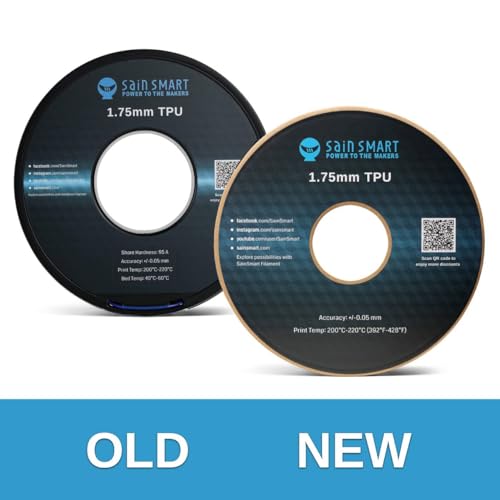
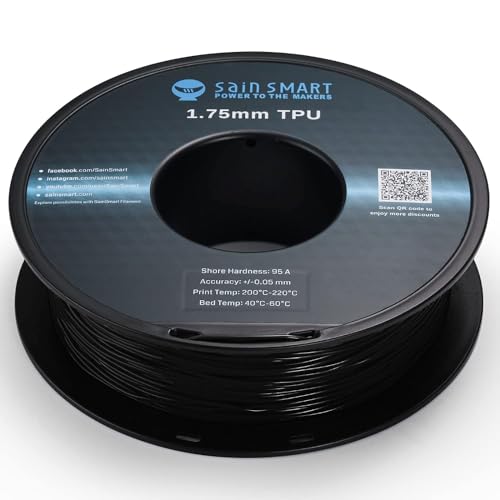
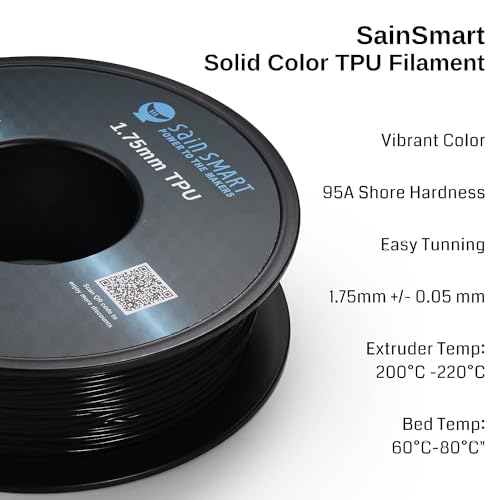
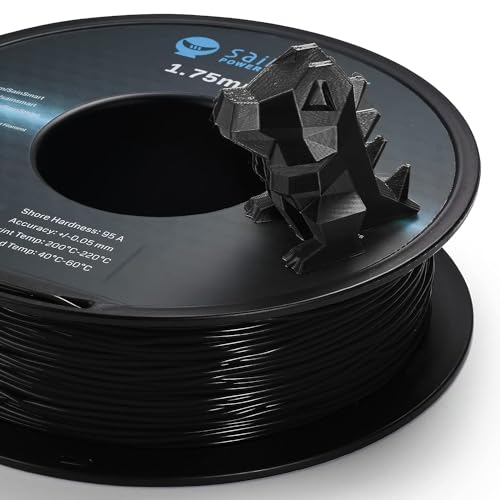


🖤 Print Bold, Print Flexible — Own the Future of 3D Creativity!
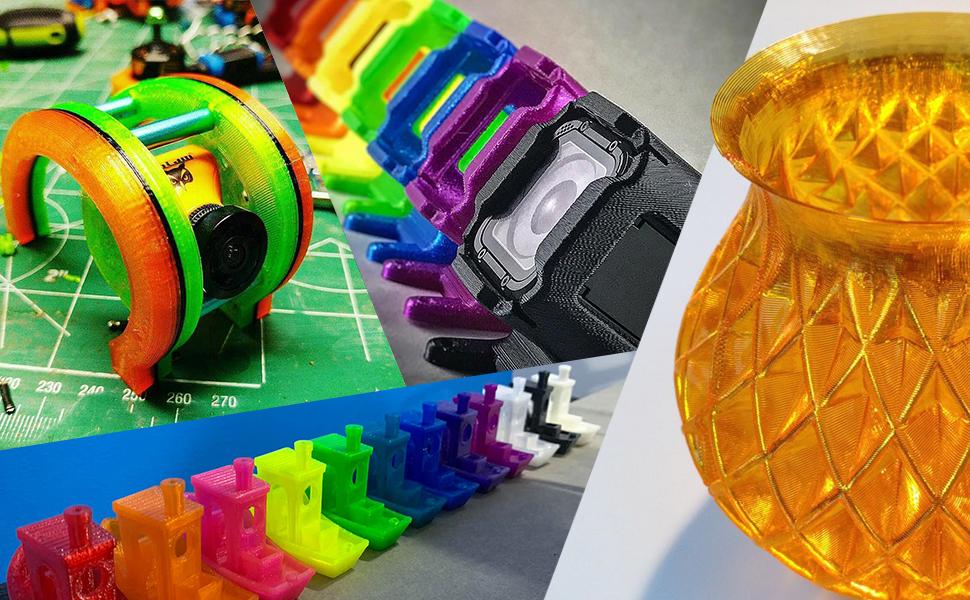
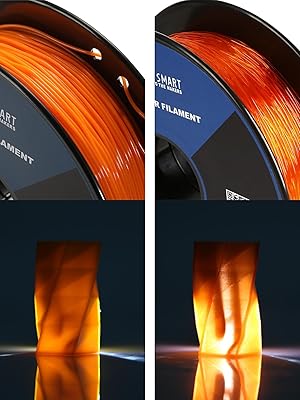
SainSmart TPU Filament 1.75 mm is a premium flexible 3D printing material offering ±0.05 mm dimensional accuracy and Shore Hardness 95A. Weighing 0.8 kg per vacuum-sealed spool, it’s engineered for strong, elastic prints compatible with all major FDM printers. Ideal for professional prototyping and creative projects requiring durability and flexibility, it prints best at 200-220°C extrusion and 40-60°C bed temperatures, delivering consistent, warp-resistant results.











| ASIN | B00TI3JUTM |
| Best Sellers Rank | #21,496 in Industrial & Scientific ( See Top 100 in Industrial & Scientific ) #535 in 3D Printing Filament |
| Date First Available | February 12, 2015 |
| Is Discontinued By Manufacturer | No |
| Item Weight | 1.76 pounds |
| Item model number | 101-90-164 |
| Manufacturer | SainSmart |
| Product Dimensions | 8.07 x 2.72 x 8.07 inches |
B**9
I love this stuff (way more than expensive Ninja)
I bought this in black and yellow, waiting on the multi-color pack to get back in stock now. I spent a week in hell, as I was new to FLEX and had to learn some things the hard way. Punch line: this is AWESOME filament! The yellow looks like a glowing fiber optic when light is nearby, it is simply marvelous!! They are both extremely strong, but also soft and lustrous. Super elastic. You can take the single skirt extrusion and stretch it to perhaps 10 times it's size without breaking, but the material seems to remain slightly stretched if you do that, perhaps 30-60%, but after that it always snaps back to that size. Ordinary prints are super strong and hold their shape perfectly. Here are the bottom line lessons learned if you are new to TPU: LOOSEN THE IDLER!; start at 15-20mm/s for everything except travel; be certain your 1st layer is dialed in well for this filament; and TURN OFF RETRACTION. TPU will wrap itself around your extruder gear, or jam, and speed and retraction are the enemy here. Get it to print, enjoy how amazing it is and be happy, and optimize from there! I have a Prusa i3 MK3. My original hell began on this, and I naively tried to use the stock profile for Sainsmart TPU (I mean, it was there, right?). It seemed to work, but ended up dying mid print, almost always. Ended up wrapped around the extruder gear. Annoying to open things up and unravel it. Rinse and repeat, no joy. Played with very many settings, read very many blogs. Nothing worked. Finally blew the dust off my MK3S upgrade kit, bit the bullet, and spent a bunch of hours tearing down and rebuilding my extruder. Tried again, this time switching to the much more expensive *good filament* I bought (Ninjatek). IT JAMMED AGAIN. WORSE. OVER AND OVER. Finally, it basically tied a knot around the gear and I had to do a 50% disassembly of the extruder to get it out (luckily the MK3S upgrade anticipates this and it's easy). Ditched the Ninjatek (I really dislike that filament, it's expensive, has a dull luster, is too soft, and even harder to print, what a bunch of overhype!). Read a bunch more blogs, and finally realized the only real problem was trying to use the stock profile. The answer was go extreme at first, and optimize after you are happy and can go from there. Here are the full changes I made to the stock Sainsmart profile to start with: - Everybody says "loosen the idler"....but to what?! I had to loosen the idler almost entirely, for me almost the entire screw head was jutting out, and perhaps 1-2 turns of the screw were in the nut. This is super important, and I found you can find the sweet spot by starting loosest (screw just biting), try to load, and tighten until it loads, then stop! Experiment from there. - Bed Temp 70 deg C - Extruder Temp 235 deg C - All print speeds 15mm/s (keeping fast travel speed seemed fine, if a little stringy) - Turned off "keep fan always on" - Enabled auto cooling - Turned off retraction! (in Prusaslic3r this is in the printer settings tab under Extruder 1) I have so far turned the speed up to 35mm/s for infill and it seems to work fine, others say 40mm/s works. I love this filament. After a week of misery, once tuned in it just works every time, good luck!
R**N
TPU - The Tire Filament
Picked the brand as a modeler on YouTube recommended it. Prints great on our BL P1S. My favorite filament type. Little on the hard side (15% infill), but might be something I can adjust with infill percentage. Looks amazing, shiny, and layer lines are hard to detect.
P**N
Works great with the right settings
Good product. Okay... first time printing TPU after using PLA exclusively. On the first few attempts, I had adhesion issues like everyone else here. Even cleaning the bed with rubbing alcohol between prints didn't do the trick (I always do this whenever my fingers touch the bed). Adhesion is easily fixed with the right settings. I'm using a 0.5 mm nozzle to print some tubular adapters, so I care more about function than things looking pretty, but the settings should translate to other nozzle sizes too. Here's what I'm doing: * Printer: Ender 3 v2 What I find makes or brakes this TPU: * Nozzle temperature: 200 C (anything hotter, even at 210 C, the filament starts looking "bubbly" and unclear/cloudy rather than smoothly transparent; I can probably lower it to 190 for even more clarity - see picture for what I mean) * Bed temperature: 50 C (cooler bed seems to perform better, anything hotter and I get bad adhesion) * Initial layer speed: 10 mm/s (first 6 layers are at this "slower" speed, # can probably be reduced to like 2-3) * Speed: 30 mm/s (max, I typically reduce this even more down to like 50% i.e.15 mm/s) * Wall speed: 15.0 mm/s * Cooling: from 50% to 70% during the first 4 layers, then 70% for the rest (I tested starting at 0%, which made the bottom layers look way off compared to the rest of the print) * Retraction: 6.5 mm @ 25 mm/s With TPU being so "stretchy" compared to PLA, I think some retraction is necessary regardless of what I read online. I haven't tried it without, as even with retraction there is some "smearing" / trailing happening, but it's very minimal and hasn't impacted the structural / look of my pieces. Other print settings I'm using that may have an impact: * Layer height: 0.25 mm across the board * Line width: 0.5 mm across the board * Wall line count: 3 * Top/bottom layers: 4 * Infill: 50% (for my use case) This works for me, adhesion is no longer an issue, no need for tape or whatever other hacks are suggested out there. Just lower your temperatures a bit and it will work great. Hopefully this helps everyone having issues.
F**O
Ho aspettato a lasciare quasta recensione per aver il tempo di testare piu bobine di colore diverso di questo filamento e devo dire che fra i vari che ho avuto modo di provare è sicuramente uno dei migliori. E' disponibile in un'ampia gamma di colori ed è molto facile da stampare, non tutte le stampanti soprattuo quelle di fascia economica escono predisposte per stampare il TPU, ma basta aggiungere un piccolo supporto all'interno dell'estrusore che impedisca al filamento di aggrovigliarsi per risolvere il problema, lo consinglio anche ai neofiti che si avvicinano per la prima volta alla stampa 3d e vogliono provare a stampare oggetti gommosi. Ho impostato la temperatura dell'estrusore a 220-230°C, anche se in genere da stampante a stampante può leggermente variare, ottendo ottimi risulati. Lo utilizzo soprattuo per stampare acessori e componenti per droni che sono soggetti a forti sollecitazioni e devo dire che la resistanza di questo materiale è sorprendente.
F**N
Great product worked well on speed 30, and temp 210, bed temp 60 perfect no stringing using cura and ender 3 V2 with a 0.6 nozzle
G**!
This is top quality product - 👌 other brands are just followers...
K**D
Great TPU material from Sainsmart. Used to order direct from China, but shipping times are a pain. Ability to get from Amazon at roughly the same price is a great result. TPU prints out at 215 deg on a 70 deg bed, no stringing and great quality prints. Highly recommend this material for home printing in flexible materials.
B**N
Als 3D-Druck-Enthusiast habe ich das SainSmart TPU Filament für eine Reihe von Projekten verwendet und bin von seiner Leistung und Qualität beeindruckt. Dieses Filament hat meine Erwartungen übertroffen und bietet eine ausgezeichnete Basis für diverse Druckvorhaben. Hohe Druckqualität: Das Filament liefert konstant hochwertige Ergebnisse. Die Drucke haben glatte Oberflächen und präzise Details, was für meine anspruchsvollen Projekte entscheidend ist. Hervorragende Flexibilität: Die Flexibilität des TPU-Materials ist beeindruckend. Es ermöglicht mir, Objekte mit variablen Härtegraden und flexiblen Eigenschaften zu drucken, die mit herkömmlichen Materialien nicht möglich wären. Einfache Handhabung und Kompatibilität: Das Filament hat sich als kompatibel mit verschiedenen 3D-Druckern erwiesen und ließ sich problemlos laden und verarbeiten. Die konstante Filamentstärke von 1,75 mm sorgt für ein verstopfungsfreies und gleichmäßiges Druckerlebnis. Starke Haftung und minimales Warping: Das Filament haftet gut auf der Druckplatte, was Warping reduziert und zu einer höheren Erfolgsrate bei den Drucken führt. Langlebigkeit: Die Drucke sind robust und langlebig, was das Filament ideal für praktische Anwendungen macht, wie z.B. Schutzhüllen, Verschleißteile oder flexible Verbindungen. Umweltfreundliche Verpackung: Das Filament kam in einer umweltfreundlichen und wiederverschließbaren Verpackung, was ich sehr schätze. Gutes Preis-Leistungs-Verhältnis: Angesichts der Qualität und Vielseitigkeit des Filaments finde ich den Preis angemessen. Die 0,8 kg Rolle bietet genug Material für zahlreiche Projekte. Fazit: Das SainSmart TPU 3D-Drucker Filament ist eine ausgezeichnete Wahl für alle, die nach einem hochwertigen, flexiblen und benutzerfreundlichen Filament suchen. Es erweitert die kreativen Möglichkeiten im 3D-Druck und liefert zuverlässige und dauerhafte Ergebnisse. Eine klare Empfehlung für Hobbyisten und Profis gleichermaßen!
Trustpilot
1 week ago
3 weeks ago