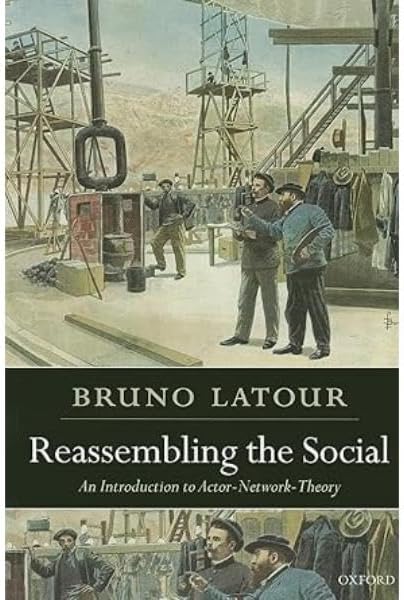


Reassembling the Social: An Introduction to Actor-Network-Theory (Clarendon Lectures in Management Studies)
Product ID: 8861582
Buy anything from 5,000+ international stores. One checkout price. No surprise fees. Join 2M+ shoppers on Desertcart.
Desertcart purchases this item on your behalf and handles shipping, customs, and support to Italy.
desertcart.com: Reassembling the Social: An Introduction to Actor-Network-Theory (Clarendon Lectures in Management Studies): 9780199256051: Latour, Bruno: Books Review: My favorite thinker of the last 50 years. - This was the first book I’ve read by Latour himself: I’d approached his work before through Graham Harman, another author I’d recommend. I’m studying ANT as part of my PhD project. Latour is the best thinker on the subject of associations (as he explains, perhaps this just is what “social” means) that I have ever read. A perfect counterpoint to object-oriented ontology, this interdisciplinary and transformative method of focus on relations known as actor-network theory can, I am convinced, in the hands of a good researcher, trace the relations between anything and anything else in a network. It does this by erasing the nature/social dichotomy, reducing Nature to a preformatted concept irreconcilable with any real phenomenon, which in turn reopens the discussion of what Society even means: if there is no Nature, then what we call “the social” doesn’t mean what we thought. Now, Latour is not the only thinker who posits that Nature is a myth and even a dangerous mistake in terms of ecology/society. Dark ecology and OOO also say this convincingly. But whereas Tim Morton is obscurely metaphorical-mystical about it, and Harman is not excited about arguments pertaining to a product of holistic religion that has little to do with his main arguments. Latour makes his point clearly, thoroughly and effectively, that sans Nature, “social” simply means that which pertains to any association at all, whether human, nonhuman, or hybrid, and thus more data is made available (because it hasn’t been bracketed off as “merely social” and therefore somehow less real than, for example, hunger or sex or “the selfish gene”). The social includes the physical, as long as the physical does anything pertaining to a collective, and the non-physical (again, by its ability to act on others through whatever agency) is also the Real. This intervention could, very plausibly, set all the social sciences—and the popular understanding of the natural sciences as well—on a much more empirically informed and justified track. Latour’s prose is wonderful. I find him similar, as a writer, to Aldous Huxley at his best: conversational, playful, treating writing as an art form. Even when writing polemically about his enemies, he does so in a warm, jovial, only gently derisive way that pokes as much fun at himself as at his targets and invites them to return to the table where we can all go back to being imperfect again. Latour has been attacked a lot for being “obscurantist”, but I’m convinced that people who can actually read (and not just “surf” pages to find something they basically already agree with) will find the opposite. Beware of reviewers who failed in theory and so have to reduce it by claiming it has no relevance to the real world: given what ANT says, these people are unsurprisingly Latour’s enemies. They don’t do anyone else any favors either. Review: I really enjoyed reading the book - I really enjoyed reading the book, and I congratulate Latour for its publication. I see the book as more or less basic text that conveys the main ideas with which Latour has been playing for some while now. The book is highly accessible and thought-provoking (i.e. inspiring), and I found myself marking more and more lines and citations therein while reading. So I liked it and it got to me; mainly this is the social-material or social-technological re-assemblage idea that Latour has been promoting, and it allowed me to freely so systems as complex and hybrid in a way that I didn’t see/phantom before. So it helped me in terms of my own conceptualization and academic writing on these topics. Also in terms of the distribution of agencies across times and places, and across human and non-human agents. So all this is good an inspiring for intellectual and scholarly research. At least this is how I found the book. Finally, I think that academic and related books are, or at least can be, scholarly inspiring not only in terms of what they have/contain or give in a direct and positive sense; but also in terms of how they enrich my academic wonderings. One way for me to note this is how I’m excited by reading the book, how many (new) ideas come to my mind, and if they infiltrate my scholarly daydreaming – if I can call it this way. And this manuscript has certainly done all this work. So I like it and recommend it. I should say that I got to read it after being quite familiar with the literature and having researched and published myself. So in this senses it’s hard for me to say how the book would be understood and received by, say, undergraduate audience, or even graduate audiences who are not familiar with the topics.
| Best Sellers Rank | #321,713 in Books ( See Top 100 in Books ) #85 in Sociology (Books) #11,460 in Social Sciences (Books) |
| Customer Reviews | 4.5 4.5 out of 5 stars (107) |
| Dimensions | 9.1 x 6.1 x 0.7 inches |
| Edition | First Edition |
| ISBN-10 | 0199256055 |
| ISBN-13 | 978-0199256051 |
| Item Weight | 1 pounds |
| Language | English |
| Part of series | Clarendon Lectures in Management Studies |
| Print length | 301 pages |
| Publication date | October 25, 2007 |
| Publisher | Oxford University Press |
N**I
My favorite thinker of the last 50 years.
This was the first book I’ve read by Latour himself: I’d approached his work before through Graham Harman, another author I’d recommend. I’m studying ANT as part of my PhD project. Latour is the best thinker on the subject of associations (as he explains, perhaps this just is what “social” means) that I have ever read. A perfect counterpoint to object-oriented ontology, this interdisciplinary and transformative method of focus on relations known as actor-network theory can, I am convinced, in the hands of a good researcher, trace the relations between anything and anything else in a network. It does this by erasing the nature/social dichotomy, reducing Nature to a preformatted concept irreconcilable with any real phenomenon, which in turn reopens the discussion of what Society even means: if there is no Nature, then what we call “the social” doesn’t mean what we thought. Now, Latour is not the only thinker who posits that Nature is a myth and even a dangerous mistake in terms of ecology/society. Dark ecology and OOO also say this convincingly. But whereas Tim Morton is obscurely metaphorical-mystical about it, and Harman is not excited about arguments pertaining to a product of holistic religion that has little to do with his main arguments. Latour makes his point clearly, thoroughly and effectively, that sans Nature, “social” simply means that which pertains to any association at all, whether human, nonhuman, or hybrid, and thus more data is made available (because it hasn’t been bracketed off as “merely social” and therefore somehow less real than, for example, hunger or sex or “the selfish gene”). The social includes the physical, as long as the physical does anything pertaining to a collective, and the non-physical (again, by its ability to act on others through whatever agency) is also the Real. This intervention could, very plausibly, set all the social sciences—and the popular understanding of the natural sciences as well—on a much more empirically informed and justified track. Latour’s prose is wonderful. I find him similar, as a writer, to Aldous Huxley at his best: conversational, playful, treating writing as an art form. Even when writing polemically about his enemies, he does so in a warm, jovial, only gently derisive way that pokes as much fun at himself as at his targets and invites them to return to the table where we can all go back to being imperfect again. Latour has been attacked a lot for being “obscurantist”, but I’m convinced that people who can actually read (and not just “surf” pages to find something they basically already agree with) will find the opposite. Beware of reviewers who failed in theory and so have to reduce it by claiming it has no relevance to the real world: given what ANT says, these people are unsurprisingly Latour’s enemies. They don’t do anyone else any favors either.
C**Y
I really enjoyed reading the book
I really enjoyed reading the book, and I congratulate Latour for its publication. I see the book as more or less basic text that conveys the main ideas with which Latour has been playing for some while now. The book is highly accessible and thought-provoking (i.e. inspiring), and I found myself marking more and more lines and citations therein while reading. So I liked it and it got to me; mainly this is the social-material or social-technological re-assemblage idea that Latour has been promoting, and it allowed me to freely so systems as complex and hybrid in a way that I didn’t see/phantom before. So it helped me in terms of my own conceptualization and academic writing on these topics. Also in terms of the distribution of agencies across times and places, and across human and non-human agents. So all this is good an inspiring for intellectual and scholarly research. At least this is how I found the book. Finally, I think that academic and related books are, or at least can be, scholarly inspiring not only in terms of what they have/contain or give in a direct and positive sense; but also in terms of how they enrich my academic wonderings. One way for me to note this is how I’m excited by reading the book, how many (new) ideas come to my mind, and if they infiltrate my scholarly daydreaming – if I can call it this way. And this manuscript has certainly done all this work. So I like it and recommend it. I should say that I got to read it after being quite familiar with the literature and having researched and published myself. So in this senses it’s hard for me to say how the book would be understood and received by, say, undergraduate audience, or even graduate audiences who are not familiar with the topics.
I**A
another model for a non-Durkheimeian sociology
This is a book which deserves a wide reading in the social sciences for its brazen and determined effort to deeply problematize the notion of the "social." At the same time, as I read the first few chapters, I had a sense of deja vu. The program Latour is putting forth--at least initially-- appears not so different from that of Fredrik Barth -- not Barth's early transactionalist stuff, but his later work on the anthropology of knowledge. Specifically, Barth, F. 1992 Towards greater naturalism in conceptualizing societies. In Conceptualizing Society. Kuper, A., eds. Pp. 17--33. : Routledge. and Barth, F. 1993 Balinese worlds. Chicago: University of Chicago Press. put forth a very similar approach to the "social." Barth himself is a great admirer of Latour (see his praise for Laboratory Life and Science in Action in his 2002 piece in Current Anthropology) but Latour--at least here--doesn't seem to be reading Barth.... Latour is also taking great pains to distance himself from Bourdieu's reflexive sociology, and from critics who would label ANT as postmodernist. Highly recommended if you're interested in this sort of thing.
J**S
Great Book. Important Thinking.
Latour outlines the basic precepts of Actor Network Theory in a (la)tour de force. Seems like a must read at this point for anyone wanting to know what ANT is about, and generally important for anyone thinking or writing about how we understand and write about the interactions and connections that make up life. On top of it all he's charming, self-depreciating, and witty. I'm not in the social sciences per se but this book will be quite useful to me.
A**R
Creative
Thought provoking
M**T
Okay, its a bit academic, but the people likely to buy this book will academically minded. Stick with the book as it will change the way you think about society and your world view. If you are of a logical/rational mindset, jog-on as this book isn't for you, but if you are open to see the world from alternative paradigms read-on - Enjoy!
M**E
Da bleiben keine Wünsche übrig. Sehr bescheidener Verkäufer: Das Buch wurde nur als "gut" eingestuft, ist aber in einwandfreier/fast neuer Verfassung - keine Ecken, keine Markierungen, intakter Umschlag.
D**S
very good
A**ー
綺麗な本で満足です。到着までの時間はかかりました。また、機会がありましたら利用したいです。
喧**喧
何でもいいが、ある現象を「社会学的」に説明するとなると、次のようになる。まず、その現象を除いた他の現象の総体を「社会」として括る。そして、その「社会」なるものが原因となって、当該の現象が結果として生じるロジックを構築する。「社会学的説明」とは大雑把に言えばそんな感じである。「社会」が根底にあって、そこから諸現象が帰結として現れる、と。 しかし、そもそも当該の現象それ自体もまた「社会」を構成し、その「社会」をそのような「社会」たらしめているものなのではないのか。だから、当該の現象を切り離したところにある「社会」などありえないのではないのか。たとえば、大英帝国を代表する科学者ケルヴィンが大陸間横断の海底電信ケーブルを作り上げた「原因」は疑いもなく大英帝国という「社会」の要請であったが、同時に、海底電信ケーブルの存在によって大英帝国が大英帝国でありえたのだともいえる。海底電信ケーブルは大英帝国の結果であると同時にその原因でもある。 ある意味、ごくごく当たり前のことを、こんなそれなりに厚い本を書いてまで説明しなきゃいけないという状況が不可解ではありますが、エディンバラ学派が推進した科学知識の社会学の試みによって単純すぎる「社会学的説明」のやり方の限界が露呈したというラトゥールの指摘は当たっていると思う。 デュルケム批判からタルドの再評価へ、といった具合に進む本書は、ラトゥールの本領たるサイエンススタディーズ分野に限らず、広く社会学的研究一般に関心のある人たちに訴える内容になっています。
Trustpilot
1 month ago
5 days ago