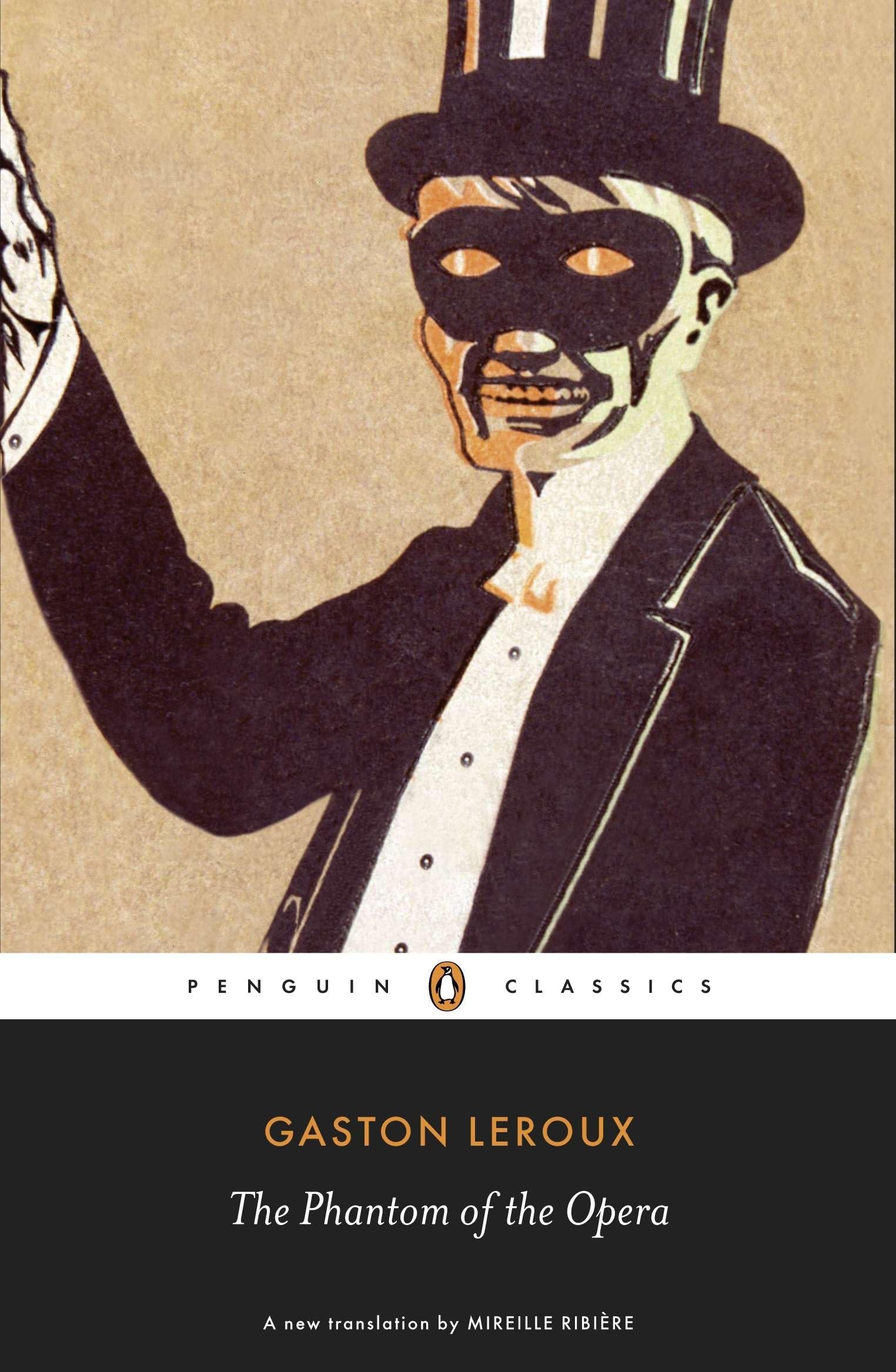
The Phantom of the Opera
Product ID: 77603569
🎭Inspired iconic stage musical
📚Classic Gothic novel, 1910
🕯️Rich atmospheric suspense
Desertcart purchases this item on your behalf and handles shipping, customs, and support to Italy.
🎭 Unlock the haunting romance that defined a genre—don’t miss the legend that still mesmerizes.
Gaston Leroux’s The Phantom of the Opera (1910) is a seminal Gothic horror novel blending tragic romance and mystery, set in the iconic Paris Opera House. This Penguin Classics edition features a highly readable translation by Mireille Ribière, enriched with scholarly notes and a new introduction by Jann Matlock. Celebrated for inspiring the world’s most successful stage musical, the novel remains a must-read for lovers of suspense, dark romance, and classic literature.
| Best Sellers Rank | #95,167 in Books ( See Top 100 in Books ) #181 in Horror (Books) #259 in Historical Romance (Books) #882 in Classic Fiction (Books) |
| Customer Reviews | 4.4 out of 5 stars 8,172 Reviews |
N**S
A Parisian gothic horror.
The opera house which served as the inspiration for Gaston Leroux’s, ‘The Phantom of the Opera’ was the Palais Garner in Paris. This opera house was the epicentre of notorious incidents and rumours in the beginning of the twentieth century. The fire in the roof and the unfortunate death of a stagehand, the chandelier crash, the lake beneath the opera house and even the existence of the Phantom has been defended by Leroux till his death bed. Leroux had spent a significant amount of his life researching for more evidence vis-à-vis the opera ghost. The novel inaugurates in the 1880s where a mysterious phantom was suspected to have haunted the Palais Garner opera house and the unexplainable death of a stagehand named Joseph Buquet. A young soprano named Christine Daae emerges to be outstanding unexpectedly in a concert held in the opera house. She is identified by the Vicomte Raoul de Chagny as his childhood companion who had his heart since a very young age. He goes on to proclaim his love and congratulate her but is taken aback as he overhears an intimate conversation of a mysterious man with Christine. Upon Christine confirming him that she was being taught by the Angel of Music, Raoul is unsure of this figure and goes on to hold a little investigation. In the opera house, the managers start receiving requests from the Phantom himself. But they do not realise the sincerity of these requests and dares to ignore them which ends up in disastrous consequences. As the Phantom reveals his mysterious self to Christine, she is caught between the violent passion that he held for her and the devotion of her childhood playmate, Raoul. The Phantom is desperate to gain the young soprano's love but he is unaware of the bearable conduct of a lover that a lady desires. He is surrounded by his own battles that he has been fighting since being born and his love for Christine is a battle that he simply cannot compromise with. Raoul, on the contrary is a hero with a strong saviour complex and a non-extinguishable yearning to marry Christine. The Phantom of the Opera is not an ordinary love triangle. A true gothic horror in every aspect, its pages is filled with madness, desire, romance, ghosts, superstition and revenge. One cannot limit this outstanding work by Leroux in a single genre. Is it a ghost story? Is it a love story? Is a ghost worthy of love? A very Parisian and heart-breaking take on the classic Beauty and the Beast tradition. The Phantom demands you to read this book immediately or face unavoidable spook till you do.
D**A
A compelling and engaging novel.
This remarkable novel by Gaston Leroux is one that is difficult to put down. The setting is inside Paris' magnificient Opera House around the end of the 19th Century; but the interior of this edifice,in the author's world , has been transformed into a fantastic and saturnine labyrinth of passages,staircases, secret doors, dark basements, underground lakes and the strange men and beings that dwell within, where strange events ,disappearances and murder take place around a beautiful young singer. Into this setting is minutely crafted a story(is it a love story? A ghost story?An adventure story? A detective novel?) that is full of twists and turns as it winds up to its unexpected denouement. Five stars are probably insufficient to do it justice; if there was a sixth star that should have been added as well. The book is a “must-read.”
A**R
Had a good read, will recommend
The book is overall good– the gothic setting in the paris opera house is amazing. It's a slow read and i love the theme of manipulation, loneliness, innocence, the rigid double faced nature of society, mastery and trickery blended in the events of the wonderfully structured/ described Opera house mixed with music creating a dark and gothic musical masterpiece. Unfortunately the story is quite not for me as much as i thought though i enjoyed it since i found it hard to blend with the characters in my reading experience It's like the story is too slow paced and at the same time too fast paced with the shifting narratives (in which Leroux did an admirably good job) for me to properly feel the characters and the story. The ending was beautifully tragedic. The story is like that flower whose beauty isn't found in it's bloom but it's beauty is found in it's withering. It's a good read overall so i will recommend this to those who like dark gothic themes in the essence of music mixed with a slow paced tragedy of love.
A**A
Must buy!
Loved the story and the product!!!
S**R
You may go
It's an OK one.
P**K
Good Thriller
Loved the writing and the world building in Opera. Erik's character is dark and tragic.
G**L
Le fantome de l'Opera....
Superbly the gothic phantom that haunts the opera. Leroux's famous work of fiction and inspiration for the 1925 movie as well (Lon Chaney Sr.) Thrilling story indeed...
D**E
Old and Gold
This is one of the few novels that remain so exciting doesn't matter how many times you read it. The story of the Phantom and the pain earlier and even now in its existence is something to reckon with. It is not easy to understand the whole dynamic here but it is all worth reading. This is a complex but engaging book.
E**I
Good!
Good! It’s a nice paperback, and quite cheap. The cover is simple, yet nice. Very good quality.
C**E
Perfect
Amazing, amazing
K**T
Long time fan, reading the unabridged for the first time
This was far from being my first experience with Leroux's story, but it WAS my first time reading an unabridged English translation. For anyone unaware, the standard English translation (which is usually published without a translator's name) is abridged, but not labeled as such. That translation was what I was previously familiar with, but having been a fan of PotO for nearing a decade, I thought it was high time I read a different translation... And honestly, I'm not sure how good this one is. Given that Ribière is French herself, I assumed that her translation would be most faithful, but there were several points in the text where I found glaring errors (most notably in the epilogue, where a translation mishap sent the Samarkand merchant to fetch Erik from the fair, instead of the Daroga). But, as I'm not perfectly fluent in French (and don't have a copy of the French text handy to compare them, anyway), I can't speak adequately on the accuracy of this translation. I may be in the minority, but I have always vastly preferred Leroux to Lloyd-Webber's musical. The novel's atmosphere can't be matched, in my opinion. Written as detective fiction, Leroux's speaker is investigating (years after the events of the novel) the legend of the "Phantom of the Opera," a mysterious specter that wreaked havoc at the Palais Garnier in years past. During his investigation, he begins to suspect that there are ties between the Phantom, the murder of Count Philippe de Chagny, and the disappearances of his younger brother, Raoul, and an opera singer called Christine Daaé. Thus, Leroux takes the reader on a journey into the past, often referencing interviews with, and written documents by, several prominent figures at the opera at the time of the "de Chagny affair." Most of the fantastic tale is seen from the perspective of Raoul de Chagny, whose love for his childhood friend, Christine, seems to be thwarted by an unseen rival - a disembodied voice which has convinced the pious Christine that it belongs to the Angel of Music. Raoul and Christine soon find themselves trapped in a nightmare, as the love-sick "Angel" has no intentions of letting his beloved wed another. The narrative often shifts to the perspective of the opera's directors, who are at their wits' end with the Phantom's outrageous demands. Most of the latter section of the novel is told from the point-of-view of the Persian, a figure from the Phantom's past who is often left out of film and stage adaptations. In this day and age, most readers already know the plot to the story, so the strength in Leroux's writing lies less in the "mystery" of it all, and more in his beautiful language and imagery. It is all too easy to imagine the graveyard at Perros-Guirec, laden with snow and blood-red roses, littered with skulls, eerily silent under the full moon. The reader can understand Raoul's terror when he comes face-to-face with the "Death's head" in such a setting. Leroux's detailed descriptions of the opera house, too, lend a sense of realism to the story that leaves the reader wondering if the fantastic tale might not be, as Leroux claimed until his death, grounded in fact. Perhaps my favorite thing about the novel, however, is Leroux's use of music as symbolism. Every piece of music mentioned by name in the novel is symbolic of something in the plot. Gounod's Faust, which underscores the entire story, tells the tale of a man who sells his soul to the devil for the love of a beautiful woman - certainly a parallel to the doomed love the Phantom holds for Christine Daaé. Other musical selections act as foreshadow. For example, "Danse Macabre (Dance of Death)," played at the gala in the second chapter, seems to herald the arrival of the Red Death at the masquerade ball. All in all, Leroux's novel is, I would say, a masterpiece. With an ingenious story, tied together with beautiful descriptions, often witty dialogue, and sympathetic characters. It is perhaps one of the only "classic" novels I know which contains a morally grey antagonist whose victims pity, rather than despise, him. While "Le fantôme de l'opéra" didn't sell well upon publication and was, in fact, out of print for several years, the popularity of the story speaks to the brilliance of Leroux's vision. I would advise everyone, particularly fans of the musical, to give this novel a try.
E**N
Blijft een geweldig verhaal
Het blijft een mooi en meeslepend verhaal
A**L
Sayfa sayısı ve boyut
Boyutu küçük sayfa sayısı açıklamadakinden az geldi kağıdı da gazete kağıdına benziyor.
Trustpilot
2 weeks ago
1 week ago