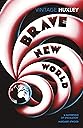
Brave New World
Product ID: 76898229
🏆Top #2 in Genetic Engineering Sci-Fi
📚250 pages of timeless dystopia
🔬Pioneering genetic engineering theme
Desertcart purchases this item on your behalf and handles shipping, customs, and support to Italy.
📖 Unlock the future’s darkest secrets—before everyone else does.
Brave New World by Aldous Huxley is a 250-page dystopian masterpiece that explores a genetically engineered society obsessed with consumerist happiness. Ranked #2 in Genetic Engineering Science Fiction and praised by thought leaders like Yuval Noah Harari and Margaret Atwood, this export edition features sharp fonts and insightful introductions, making it a must-have for discerning readers and trendsetting professionals.
| Best Sellers Rank | #3,060 in Books ( See Top 100 in Books ) #2 in Genetic Engineering Science Fiction (Books) #8 in Dystopian Fiction #96 in Classic Fiction (Books) |
| Customer Reviews | 4.4 out of 5 stars 46,423 Reviews |
A**R
This book is equally good if not better than Orwell's 1984. Highly recommended.
Aldous Huxley has depicted a dystopian world in this book where children are no longer born naturally and are rather genetically engineered and grown in decanters. Every child born has a predestined caste depending upon the conditioning of its decanted embryo. The residents of the world state are segregated into alphas, bravos, gammas, deltas and epsilons with alphas being the highest in the degree of precedence and epsilons being the lowest. A decanted embryo is raised according to the caste it is predestined to born into. Alphas are breeded to be intellectuals and have excellent physical and mental conditioning whereas epsilons are conditioned to have stunted growth and low IQ so as to perform menial jobs. Once a child is born from the embryo , it is made to undergo a training program wherein it's reactions to various stimuli is engineered depending upon its caste and future job role. The juveniles are exposed to hypnopaedic learning or sleep teaching and also encouraged to perform erotic play to encourage promiscuity. In the world state, there is no concept of religion, family or marriage. Women are born freemartins and don't give birth. All the residents are non- chastate and are promiscuous ("Everyone belongs to everyone else"). The world is depicted as technologically advanced where everyone commutes in a helicopter and residents are secure from all diseases and worries. They are kept in a false state of happiness with sex, drugs and music. The residents of the world are conditioned not to question their existence or have an opinion on things. There are no history books or literature available to them. 'Soma' is a magical drug which removes their worries, anger and frustration and calms them. The drug is rationed to all the residents and they all are shown as its slave. The world depicted in the story shows no struggle for the residents and all of them are kept in a false state of happiness. Terms like vibro vacuum massage, sec hormone chewing gum and feelies ( movies where you feel all sensations) are a part of the false utopian world of the residents. Other than the residents of the state world, there also exists 'savage' reservations. There is no specific protagonist in the story. There are various characters like Bernard Marx, Lenina, Helmholtz, John (savage), Linda ,Mustafa Mond etc. The story takes Bernard and Lenina to a savage reservation in Mexico where they meet John and Linda and bring them along to their world in London. The rest of the novel involves the Savage's point of view and his feeling with respect to the so called utopian world. The story with a few turn of events change the Savage's perception of the world completely. The book is an excellent read. This book is equally good if not better than Orwell's 1984. Highly recommended.
H**K
Light Print but Sharp Fonts - Decent Purchase
The fonts of this book feel slightly on the lighter side but the fonts are very sharp and are easily readable, this book is from fingerprint classic publications and it has 250 pages for only 125, that makes it a super deal to purchase for such classic books
R**A
A Dystopian Classic
Over the last two or three weeks, I’ve read three dystopian novels, each depicting society in different ways. The common thread connecting them is the loss of individuality, reduction in human thought, coupled with complete control by an unknown master, or set of masters. Each book possesses a unique flavor, depicting different aspects of futuristic societies. Aldous Huxley set “Brave New World” in 2540 CE, or AF 632 (After Ford). Management students may recall that Henry Ford changed production methods in the early years of the 20th century, reducing workers to automatons. A modern emerged between owners, managers and workers, creating a modern class system with unbreakable barriers between them. Modern production systems and society create false utopia, with the majority falling prey to superficial feelings of delight. Aldous Huxley’s cynical view of the marvels of technology inspired him to create a dystopian novel set in the future. The Directors divided society into distinct castes, ranging from Alpha to Delta. The Alphas sit on top of the pile, whereas the Deltas lie at the bottom, doing menial labor. Technological advances have converted human procreation into a mechanized process, distilling and sorting babies into their respective castes. Mustapha Mond, the controller, devised education systems teaching babies to seek simple pleasures (sex etc), and to fear anything that could reduce their productivity (nature, for instance). People use soma to induce pleasure, reduce stress, or to spend their leisure time. Love does not exist, and no one has a permanent partner. Everyone lives in a numb, blissful state, controlled by the state. Enter an Alpha, Bernard Marx, who takes his love interest, Lenina Crowe, to a savage reservation, where they find a long-lost woman, the ex-companion of the Director. The pair find her, and her son, John, whom they call John Savage. Bernard tries to use John Savage to boost his social standing, and Lenina appears to fall in love with him. John’s growing anger with society forces him to rebel and he escapes to a lighthouse to live alone. I shall not reveal the end. Many readers may consider the novel to be unrealistic. We may not consume soma, but we allow social media, alcohol, etc., to rule us. Lives and relationships have become superficial, and we are losing our connection to ‘the real world,’ including nature, which we fear. Aldous Huxley’s novel is brilliant and prescient and is a book we must read.
N**N
A classic!
A great book, the print quality is good. Soft cover.
S**N
Not the best sci-fi book, but one of the most famous ones
This is my 3rd classic dystopian science-fiction book (after 1984 and This Perfect Day). What I’ve come to notice as a pattern is probably a very common phenomenon; the future world/technology described in a book depends on the paranoia of the times it is written in. Levin’s This Perfect Day was based on the computer technologies at its infancy; Orwell’s 1984 is a product of anti-communist fear, while this book was written at the time when assembly lines and modernisation was one of the most important things being talked about. I wanted to read this book for a long time, but just recently got the chance. Sadly, it wasn’t really worth much. While the world building here is incredible, it definitely feels dated as it is mostly based on technologies available 85 years ago. All of this could have been fine, if it had an actual plot and not just a series of events. The story is set in a somewhat distant future, which is somehow based on 1930s technology. Human beings are not born; they are rather grown in pods (something like the matrix). All forms of societal interactions are obliterated, and in its place are class structures in which human beings are born. Everyone has a set purpose in life defined by the class he/she is raised in. When one upper class member from this society travels to a reserve of pre-modern humans living in old world misery, this is when he comes to realise the dichotomy in the world. The problem with this book was that it had no actual plot, no storyline. Things just happen; characters come and go without any major conclusions. Huxley just wanted to write a commentary on assembly line movement. It seems like Huxley had a bunch of great ideas, but ultimately made a mediocre book with real good back stories. As a framework, this works really well for other works of fiction (This Perfect Day being much closer to this book in spirit). Had the story followed a much structured manner with actual character developments, this could have been an amazing book. I’d say I was let down by this book. It did not turn out to be a great book, let alone an awesome one. It is just an alright read. A lot of people found this the book to be a great read (some even going as far as saying this is better than 1984), but it just doesn’t cut it for me. This goes off my list.
S**J
9.5/10, the papers is slightly thin but it's worth for the price
The book had arrived without any scratches, but the paper is slightly thin but for this price, it's okay Go for it.
A**N
Fascinating setting & an interesting metaphor
The title of the book is taken from a line in Shakespeare’s The Tempest – “O brave new world, that has such people in it!” – uttered by the character Miranda who has grown up in an isolated society and sees a large number of people for the first time. Huxley’s Brave New World is about the clash between the Miranda-like protagonist, John (who incidentally has read only Shakespeare while growing up), who lives in an isolated settlement, and a world where humans are engineered in labs to lead a perfectly contented life. The first third of the book describes the dystopian World State where everything, ranging from procreation to employment to recreation, is created and controlled artificially in line with its motto of “Community, Identity, Stability”. Humans are artificially produced in batches and divided into a caste system ranging from Alpha Plus to Epsilon Minus, conditioned from the embryo stage. They (including the lower castes) lead a happy life driven by technology, promiscuity and a drug called “soma” – overall a “civilized infantility” as Huxley puts it. Henry Ford seems to be the presiding god of this world, possibly in line with his famous assembly line system of manufacturing. The second part deals with the exploration of a “savage” settlement, where people live the old-fashioned way, by Bernard Marx (an Alpha Plus but one who does not wish to conform to the ideal world, like his friend Helmholtz Watson) and his date of the moment, Lenina Crowne. They meet John, a naturally created offspring of a senior functionary of the World State, but one who has grown up oblivious to it. The final part is about John, like Miranda, trying to blend in the World State and the inherent conflicts that it creates. The highlights of this part, in my view, are the discussions between John and Mustapha Mond, the controller. It’s about the eventual salvation of Bernard and Helmholtz and the only possible conclusion of John’s story. Brave New World, like 1984 published 17 years later, discusses a dystopian world and the perils therein. But the books’ approaches to this end are significantly different – the latter explores control through fear while the former sees pleasure as a tool for control. Brave New World is an interesting and short read about the clash between those who want to “get rid of everything unpleasant instead of learning to put up with it” and others who would like to “claim the right to be unhappy”, while simultaneously discussing issues such as racism and casteism. It's easy to see that it would have been a radical book in 1932. It obviously is significantly less so today which makes this book seem obsolete at times. But if one can get past it or if possible, read this book through the lens of a 1930s reader, the book is an extremely interesting and rewarding read. Pros: Fascinating setting, using Shakespeare as an interesting metaphor, easy read Cons: May seem a bit outdated now
C**U
Relevant
Relevant and chilling, in pretty much the same way as 1984. Would certainly recommend.
D**M
Good contents of the book, but no mention of the dust jacket
Pros: A classic that holds up, font and text is clearly readable, the introduction is brief an concise. Cons: From the pictures on Amazon page you cannot clearly tell that the illustration on the hard cover is not engraved into the book itself but just a dusk jacket. I have not found anything in description on the Amazon page that specifies otherwise . For a 90th Anniversary Edition I expected a more premium care/build of the book.
J**S
Perfeito!
Perfeito!
J**O
Excelente Libro
Estupendo libro, leanlo
F**S
Un peu vieillot mais agréable
Un grand classique qui a un peu vieilli mais dont la lecture est agréable, car le style aujourd'hui suranné est charmant. Un bon moment. Les traductions françaises n'étant pas exceptionnelles, on profite de la version originale, particulièrement bien écrite
S**N
Książka
Bardzo fajne wydanie.
Trustpilot
3 weeks ago
5 days ago