Buy anything from 5,000+ international stores. One checkout price. No surprise fees. Join 2M+ shoppers on Desertcart.
Desertcart purchases this item on your behalf and handles shipping, customs, and support to Italy.
โ๏ธ Weigh like a pro, wherever you go โ precision meets portability!
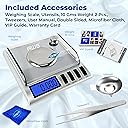
The AWS Gemini-20 is a sleek, pocket-sized digital scale offering lab-grade precision with 0.001g readability and a 20g capacity. Designed for professionals and enthusiasts weighing jewelry, powders, or precious metals, it features multi-unit modes, a protective draft shield, and essential accessories including calibration weights and tweezers. Backed by a 10-year warranty, it delivers reliable accuracy at an unbeatable price point, perfect for meticulous measurements on the move.


| ASIN | B0012TDNAM |
| Best Sellers Rank | #11,406 in Kitchen & Dining ( See Top 100 in Kitchen & Dining ) #69 in Digital Kitchen Scales |
| Brand | AMERICAN WEIGH SCALES |
| Brand Name | AMERICAN WEIGH SCALES |
| Color | Silver |
| Customer Reviews | 4.4 out of 5 stars 5,679 Reviews |
| Display Type | LCD |
| Form Factor | Modern |
| Global Trade Identification Number | 00814859010277 |
| Included Components | SDf |
| Item Type Name | ZXC |
| Item Weight | 0.12 Kilograms |
| Manufacturer | American Weigh Scales |
| Material Type | Plastic |
| Measurement Type | weight |
| Model | GEMINI-20 |
| Part Number | GEMINI-20 |
| Recommended Uses For Product | Coins, Food, Jewellery, Medicines |
| Special Feature | Precision weight sensors |
| Special Features | Precision weight sensors |
| UPC | 814859010277 |
| Unit Count | 1.0 Count |
| Warranty Description | 10 Year Limited Warranty |
| Weigh Scale Type | Counter Scale |
| Weight Capacity Maximum | 20 Grams |
| Weight Limit | 20 Grams |
G**O
Almost a true milligram scale by laboratory testing
A great bargain for a cheap scale. It will perform reasonably well if used carefully. Do not expect it to compete in accuracy or durability against laboratory scales, such as those by Mettler or Sartorius selling for $5-10K. This is a nice little scale with a 4 by 4 inch footprint, about 1-1/2 inch tall, including the clear and colorless hinged draft shield. It fits into a neat magnetic-latch box. Batteries are included, two 10g reference weights, and cheap tweezers. The weighing pan is non-magnetic stainless steel. I have two of these scales to save trips to the weighing room. The first one has been in use for 6 months with no problems. The scale is not quite ready to use as delivered. First, the weighing pan has adhesive residue. It is that sticky gum that can only be removed effectively with citrus oil or a citrus oil cleaner, such as Goo Gone. Second, and as others have noted, the pan sits too low on the scale body, and often touches the body of the scale during weighing. This, of course, will not work. The remedy is to glue a 10 mm diameter by about 0.5 mm thick non-magnetic metal washer to the underside of the pan. See my photograph at top of the Amazon listing. Although this will reduce the weighing capacity of the scale by the weight of the washer, it is insignificant. The washer I used weighed about 530 mg. Third, the tweezers are crude. If you have any serious weighing to do, you really should buy some quality tweezers with about tip #2. Dumont (Swiss) and others make good stuff. Of course, a single quality tweezer can easily cost more than this scale. You can economize by buying their epoxy coated electronic tweezers. NOW, REAL TESTING. How accurate? How precise? To test, I used a set of laboratory reference weights, and an older Mettler Toledo AG204 DeltaRange scale in the lab. This is an expensive machine (about $5-10K depending on features) that measures to 0.1 mg. First off, on the Mettler, the two 10 g AWS calibration weights weighed in at 9.9991 g and 10.0001 g. Not bad; they were within a milligram. How about precision? Took a 1000 mg lab reference weight and weighed it on the AWS ten times, with a complete on/off/tare between each weighing and a closed draft hood, in mg: 999, 1003,1001, 1001, 1000, 1000, 998, 998, 1000, 998. Not too bad. Variation of 5 mg. Perhaps with careful placement, a solid surface, and a quiet environment, this variation could be reduced. How about accuracy? Here are side-by-side measurements of reference weights on the Mettler and the AWS. The scales were not tared each time. Just put the weight on the pan. The AWS was not calibrated first trial, calibrated on the second trial. Accuracy could surely be improved with taring, stable environment, etc. Calibration weights, in mg - Mettler - uncalibrated AWS (calibrated AWS) 5 - 5.0 - 5 (5) 10 - 10.0 - 10 (10) 20 - 20.0 - 19 (19) 50 - 50.0 - 48 (50) 100 - 100.0 - 100 (100) 200 - 200.1 - 200 (199) 500 - 499.8 - 501 (499) 1000 - 1000.3 - 1001 (999) 2000 - 2000.0 - 2001 (2000) 5000 - 5000.2 - 5005 (5000) 10000 - 9999.6 - 10011 (9999) 20000 - 20000.0 - 20022 (20002) Again, this is impressive. With calibration, the measurements were off by no more than a milligram or two. My recommendation is that if you need an inexpensive scale to measure within a few milligrams, and are willing to calibrate manually, buy this scale. If you must have absolute accuracy, set aside at least $10-20K on a laboratory scale, stand, and accessories, and dedicated weighing room. And if you need real accuracy, get an equal-arm balance. Update 30 May 2012 These two scales have been in use for over a year. Still perform well. They have been repeatedly tested. The measurements continue to be at least as accurate and precise as given above. Measurements have been published in peer-reviewed scientific journals. Depending on the project needs, and with reference weights and quality scales to verify performance, you can use this scale for scientific research. And remember, when you are weighing to the milligram and below, even the best scale will perform poorly with bad technique. This is not some yard-dog scale at a metal recycling plant. Have a clean, stable environment. Eliminate vibration and movement. Place the scale on a stable bench (if possible, granite is used in labs). You should be sitting, not standing. Arms off the bench. Eliminate air currents. No magnets. Keep magnetic steels away. Do not breathe directly on the scale. Use the draft shield. Gently place the object to be weighed on the pan. Don't drop it onto the pan. Don't use your fingers. Do not place the object directly on the pan. Use weighing paper or a disposable pan. After placing it on the pan and closing the draft shield, wait 10 seconds or so, for the scale to settle, before recording the weight. If you would like a fuller explanation of good weighing technique, Mettler has an excellent pdf user guide, "Weighing the right way," on their website. Update 4 Sept 2012 Some mention should be made of the pan. It is not the usual flat pan, but rather a dish with a spout. It gives the unfortunate impression that one can load a powder or some such in the dish and then pour it out. Not standard practice. For my use the pan is fine, but others should consider a substitute "pan" out of non-magnetic metal or even cardboard with a washer spacer below. The subject powder or object should be placed on weighing paper or weighing cup. Be sure that there is enough room to close the draft hood, because without the draft hood closed, all milligram and sub-milligram scales are unreliable. Update 9 Sept 2012 For those who have not worked in a lab, some mention should be made, after reading reviews on this scale, just what can be expected from any milligram or submilligram scale, whether it costs $25 or several thousand dollars. At this measurement level, subtle influences can greatly affect measurement. You cannot just throw a sample on the pan and hope for the best. Unfortunately, you need to know what follows. First off, these are scales, not balances. Balances compare a known, measured, mass against an unknown mass. They operate correctly anywhere there is gravity, no matter what the variation, even on the moon. In contrast, the AWS scale and even many expensive laboratory scales measure the force that gravity and centrifugal force of the earth's rotation exerts on a mass. Because gravitational force and centrifugal force vary slightly with the position of the scale on the earth, all these scales need to be calibrated after installation. Expensive scales do this automatically. With cheap scales, such as the AWS, you do this with a calibration weight. Unfortunately, the AWS calibration weight is too big, so you cannot close the draft shield when calibrating. Bad design. Use an inverted small beaker or such as a draft shield. Beyond that, there are several other significant sources of error affecting all scales: 1. Drafts. All drafts cause severe variation in recorded weight. Keep away from windows, doors, HVAC outlets, radiators, etc. Use the draft shield. 2. Vibration and movement. This will cause erratic readings and visible drift. Even absent outside movements, expensive scales take several seconds to settle down. 3. Temperature. Expensive scales measure and compensate for temperature, Cheap scales do not. If you have access to a set of milligram reference weights, you can check for this. 4. Humidity. Not too high, not too low. 5. Light. Light causes heat, which changes the measurement. Keep out of sunlight and bright artificial lights. 6. Leveling. Expensive scales have levels. Cheap scales do not. 7. Sample position on pan. Always place sample in the middle of the pan. 8. Electrostatic charge. A common and severe problem with low humidity and non-conductive weighing vessels, such as glass and plastic. Increase the humidity or change the weighting vessel. 9. Temperature gradients. Differences in pan, weighing vessel, and sample temperature causes severe problems because of convection air currents. 10. Magnetism. Obviously, any magnetic attraction between sample and something else will cause problems. Several materials commonly thought of as non-magnetic are somewhat magnetic. 11. Buoyancy. Because of the sample size, the AWS scale should not be affected much by this, unless one is weighing a large, low-density sample, which would be buoyed by air. 12. Oil and dirt. A common problem with beginners. Don't touch the pan or reference weights with fingers; use a tool, such as forceps or tweezers. Use weighing paper or some sort of weighing vessel on top of the pan. Generally, do not place a sample directly on the pan. If you make a mess, Windex is the usual cleaner for scales. So, for those reviews that claim without qualification that the AWS is accurate down to a milligram, it would take a lot of convincing. On the other hand, for those reviews that claim complete unreliability, assuming the item is not defective, it may just be one of the many inherent weighing problems. Still, a remarkable scale for the price.
W**.
LIKE IT
Works very good . Have checked it against other high end scales and it is spot on . The point I like is that there is little if any drift . Only have used it for 4 or 5 powder charges for reloading and it has worked great from 410 to 12 gauge loads . Nice little scale . Very easy to read, set up, and use also .
R**X
Very Nice Low Cost Scale - Seemingly Poor Calibration Weights
Slick looking small milligram scale. This could technically be a pocket scale but is better suited to carrying in its provided box, the lid of which is retained by magnets to allow quick easy opening but keep it closed otherwis. The measuring surface by itself is not very large and is better suited to using the saucer that comes with it or something like SEOH Plastic Hexagonal Weigh Boats Micro Dish 100pk which I have bought myself. The Seoh boats provide a larger container then the provided metal saucer. I compared this to an older Ohaus digital scale I had that only goes to .1 grams and they both seemed to match. The provided calibration weights seem fairly cheap. They are not solid and the bottoms seem to be poorly glued on which retains the fine material inside that apparently allows them to tune the weights before shipping. You can pick up and shake the weight and hear the bits bounce around inside. Actually upon opening my box the piece of scotch tape on the plastic bag holding the scale had a few metal bits stuck to it.I was confused where these came from until I pulled the calibration weight stuck in the box out to see the bottom missing. See my photos The real problem to this is when the scale first arrives you will probably need to calibrate it. However to properly calibrate requires BOTH 10 gram weights. So this left me in a bit of pickle where sure I can compare the first 10 gram weight to the 2nd damaged 10 gram weight but since I could not properly calibrate the scale to begin with I am unsure if this comparison is accurate.... I glued the pieces in and it looks like I may be off around +/- .003 grams or so. I considered requesting an exchange or a new set of weights but it seemed like a lot of trouble. I may end up picking up some higher quality calibration weights later but they would likely cost more then the scale itself. Another issue I have is I wish the scale would stay on a little bit longer or have an option to stay permanently on or at least an extra minute or two. You really have to have everything setup and ready to go as soon as the scale is turned on and your weighing container is tared. Conclusion Pro: Cheap, accurate, nice looking scale. Including calibration weights, weighing pan, tweezers Con: Poor calibration weights - one of mine arrived damaged, weighing pan fairly small - recommend purchasing plastic weighing boats
P**R
Great, inexpensive milligram scale
The Gemini-20 is a great scale for the price. I think they have made improvements to it, because I didn't have some of the problems that I read about in other reviews. I didn't have any problems with interference between the measuring surface and the tray. The tray did not have any adhesive or stickiness on it, and I didn't have packing particles on the reference weight. So I didn't experience a lot of the negative comments I saw in some of the reviews. The scale is great for what I am using it for, which is measuring ingredients for making electrolyte drinks. For that, I need to measure quantities in the 300 - 4,000 mg range, and they don't have to be exact, so variations of +- 10mg are not a problem. The scale is consistent: when weighing the same item several times, I get the same weight within +- 10 mg, even between power cycles. I also get the same results when I put it in a different location on the table. The consistency makes it easy to use: just pull it out and start measuring. I leave it on the default "g" mode, so I just need to press "on" and "tare". The measurements settle quickly, I can make back to back measurements easily. The build quality is what you would expect from an inexpensive scale, but it is well made. Everything is plastic except the measuring surface and the tray. One thing that hasn't changed is that the reference weight is too large and doesn't let you calibrate with the cover down. Not sure why they didn't think of that, but it isn't really a problem for me. If you needed, I am sure you could find a smaller set of weights. For what I need this scale for, it is awesome. I would highly recommend it.
A**R
Amazingly accurate little scale!
I ordered this scale to weigh capsules from a compounding pharmacy. My suspicion was that the drug-to-filler ratio was varying widely. Since one ingredient weighs more than the other, if some capsules in the batch weighed a lot more than others did, there was a good chance I was getting an inconsistent mix of filler to drug. When the scale arrived I followed the calibration instructions (easy-peasy!) and then started weighing the capsules. Yup--big difference. So I took the scale in it's sturdy box and some capsules down to the pharmacy. The pharmacist viewed me with an expression of polite and slightly condescending patience, an "all right, I'll watch--then I'll show you that your cheap little toy doesn't weigh correctly" look. I weighed some capsules and he wrote down the numbers, then took the capsules into the back room to weigh them on his very expensive and accurate scale. When he returned, his look had changed to stunned interest. He asked where I got the scale and how much I had paid for it. He said he was going to recommend it to his customers, who had asked him where they could get an affordable and accurate scale. Yeah, the little round weighing platform is small, but it will accommodate a small pill very well. I didn't have any troubles with the little dish as one person claimed they did-I bet they didn't point the dish's pointed spout towards the calibration weight. That makes a difference! This scale is the REAL DEAL, and does the job. Just read all the instructions and follow them step-by-step. TIPS FOR ACCURACY-- 0) Read the 4 star rating for additional good tips. 1) Calibrate often, as this is a delicate instrument. Calibration is pushing a button and adding 2 weights (included). 2) If you are weighing a capsule or powder to use the little dish (included). 3) Be sure to point the spout on the dish directly at the calibration weight which is stored in a little holder on top of the scale. This scale is VERY sensitive, so if the dish always sits the same way, it will weigh the same each time. 4) When weighing capsules, point one end towards the same stored calibration weight also. That way your capsules and dish will always be in the same position, giving you more "sameness" when weighing things. 5) Always put the scale and accessories (extra calibration weight--you need both to calibrate but one stores on the scale and one in the box--and long tweezers) in the box when done with them. This scale probably won't survive banging around or being dropped on the floor, so put the box where it won't get knocked off a shelf.
G**V
What a delightfully packaged little turd
For info: I bought this scale to measure powder for reloading rifle cartridges. So, if you want the scale for something else, a lot of these gripes won't apply to you. There is a lot of fail packed into this cute little device: 1. The little holding pan included with the unit does not properly fit into the recessed weighing platform. More specifically, it touches the sides of the housing if you don't place it perfectly on the weighing surface - just a tiny bit off-center, or tilted, will result in incorrect readings. I tried picking up and replacing the pan with exactly the same amount of powder about 15 times and got significantly different results every time (> 50% deviation). 2. The pan is too flat to hold powder effectively. Trying to get powder from your powder measure into the pan *will* result in a granule covered workbench. Every time. Because of #1 and #2 above I had to find a different container in which to place the powder for weighing. But, trying to find something that would properly fit in the recess, and balance on the weighing surface (which has ridges on the outside), and have sides to properly hold powder, was an 'fun filled' exercise. I finally found plastic glue bottle cap. 3. The accuracy is questionable at higher loads. I compared the accuracy of my initial loads (19-24 grains of powder) to that of my RCBS balance scale and it was perfect. But when charging to loads in the 42-47 grain range this thing was off by .7-1 grains (again, compared to the RCBS balance scale). I trust the RCBS scale. 4. The auto-off feature is designed to make a prostate exam seem like a fun event by comparison. By 'fun' I mean watching puppies being set on fire type of fun. In other words, it is really awful. My workflow is: - Place measure of powder in container, - Weigh powder (and correct weight if needed), - Place powder in cartridge, - Insert and seat bullet, - repeat... Upon conclusion of this workflow I am often *just* in time to see this absurd little troll switch itself off. I had to add 'switch unit on, wait to power up, recalibrate' to my workflow. Yay. 5. There is a gap between the recessed weighing platform and the body of the scale. I strongly suspect that this gap is to reloading powder granules what the Bermuda Triangle is to unsuspecting boats -> a mysterious force that lures them in never to be seen again. Seriously, if you mess any powder near the scale, chances are some of the granules will find their way onto the weighing platform (which, being recessed, is an almost certainty), and any attempts to get the granules out will result in the powder finding its way into the internals of the unit (because of the gap). It's not all doom and gloom though, there is a plus side, the box it comes in is really cool.
S**G
so this was unnecessary. However
*********WHY I PURCHASED THIS SCALE*********** I purchased this scale so I could weight out various Nootropics supplements down to double digit MG. Here is a breakdown of what I needed to weigh and how much of each. I filled #00 gelcaps, for the most part, with the following, using the scale to weigh: 12.5MG of Tianeptine Sodium 300MG Adrafinil Powder 400MG Panax Ginseng Leaf Extract (42+% Gensenosides) 600MG Green Tea Extract (50% EGCG, 98% Polyphenols, PE) 1000MG Choline L-Bitartrate 600MG Phenibut HCL These are all part of the current Nootropics stack I'm trying, and in particular, I was unable to weigh out anything under 1g accurately with the scale I had. So, I purchased this scale to accurately weight 1mg - 1000mg accurately. ***********PERFORMANCE AND QUALITY************** This scale comes with 2 x 10g weights, which are both needed to calibrate the scale. My scale arrived perfectly calibrated, so this was unnecessary. However, at some point I will definitely need to calibrate it since all scales require service at some point, so having the price instruments needed to calibrate is very nice. The scale also came with a nice metal tray for weighing small powders, salts, and supplements out. I found it very convenient. Residue has a tendency to stick to it, but that not the tray's fault. The scan performed with STELLAR accuracy. I opened a couple preweighed gelcaps with ~20-200mg and was able to get an accurate reading down to the mg ever time. It was always spot on. Always make sure you scan is on a perfectly LEVEL, FLAT SURFACE. I can't stress this enough. At first my readings were slightly off, even though the scan was on a flat desk that should have been level. Come to find out the floor was off a couple degrees. When relocating to another surface that was flat AND level (on a level floor) I go consistent, perfect readings. *************Conclusion**************** Overall, I'm extremely happy with this scale. I was a bit upset because I selected Saturday delivery, when ordering it on a friday (I needed it ASAP. When the mail came on Saturday and their was no package, I went back to look at the order and the fee for saturday delivery was no where to be found. This is the second time Amazon ignored the fact that saturday delivery was selected (and both times my total had the $8.99 added which I placed the order, and both times the confirmation email had free shipping selected.......) I did, however, receive it the following monday, which is the next business day. The fact that the scale comes with 2 x 10g weights for calibration, a metal tray for weighing powders, as well as some nice tweezers, I think it's well worth the price. I'm very happy and feel I go exactly what I ordered. ####******######******Please vote if this review was helpful!!!!! Thanks and have a wonderful day!!!!*******#########*******########
B**K
This works for 1mg reductions in dose.... if you use it right.
To be clear... this scale is NOT accurate to 1mg. But I found that with the pills I take, a 5mg "dose" pill may actually weight 100mg. OR about 1mg does equals 20mg weight. And this scale does seem very accurate for that. After I bought this unit and was waiting for it to arrive I did some added research on its accuracy and was initially bummed out that it probably would not work..... but it did! Here is what I was trying to do. I am ramping down off of a long duration use of prednisone. I am towards the end of that ramp and am trying to cut the dose by 1-2mg per day. The pills I have are 20,10, and 5mg. So I have been cutting them and eyeballing how big the cut piece was to go from 10 to 9 to 8 to 7 etc. It was kind of inaccurate. This unit does not really show what the accuracy is but its resolution is .001g or 1 mg. If you read the reviews, the readings in the <1 gram are all over the place. So I thought this will not work. But I found a way... First..... you should know (I did not know) that a 10mg pill does not necessary weight 10mg..... it may actually weight as much as 200mg. That is becuase of all of the fillers and coatings in a hard pill. The 10mg is actually the dose weight of the active ingredients??? You don't have to know what % is active but its good to know so you don't freak out when you try to weigh your pill. Next... I already know by eyeballing the pills what the approximate dosage should look like. I would not suggest trying this unless you can do this. In other words do not wholly trust the scale. Next.... calibrate the unit (instructions in manual) Next... You should know that weight measuring devices work best in about the middle of thier range. So turn the unit on.... let it warm up for about a minute. Add the 10g standard weight. It should read 10.000g, right in the middle of its range. Next add a whole pill. Say you want an 8 mg dose. Add the 5mg pill. In my case it then read 10.100g (the pill wt was actually 100mg or 20 times the stated dose). I know I want 3 more mg. So I cut some of the 5 milligram pills into rough quarters (but really all a bit different). I know now that for a 8mg dose I need to see it read about 20 times that or 160mg or on the gauge 10.160g. I put in different pill quarters till I get a reading close to this. It turns out that the scale is very repeatible and I can pull that quarter piece off and put it back on several times and I get about the same reading each time. You can tare the 10gm weight out but I like to see everything being weighed. Again do not do this if you do not allready know roughly what your cut dose should look like. Also I have read that the actual dose weight of a pill can be 5-20% of the actual total pill weight. So you will have to figure that out for your own pills.
H**Z
Muy precisa para cosas pequeรฑas, incluye modo kilates para gemas
Es justo lo que buscaba para pesar gemas pequeรฑas y conocer cuรกntos kilates pesan hasta 3 decimales de precisiรณn. Anteriormente comprรฉ otras bรกsculas de precios mucho mรกs econรณmicos pero nunca me sirvieron, aprendรญ mi lecciรณn de que es mejor invertir en algo bueno. No se descalibra seguido, pero es recomendable siempre corroborar con una de las pesas de 10 gramos que trae antes de usarla. Trae unas pinzas y un platito para usarlo en modo Tare, en fin, muy recomendable para quienes buscan calidad y excelente precisiรณn.
A**R
Good product
High precision and easy to use.
D**N
Good
Good milligram scale
J**N
Made in China
Leugens, niet Americans maar made in China. Rommel, onnauwkeurig, onbruikbaar.
M**Y
Excellent scales
I bought these to weigh air rifle pellets in grains. I tried a few different brands beforehand and found they were inconsistent - a different weight would register when a pellet was removed from the scale then replaced. Not so with these, they are 100% consistent. Also, the supplied 20 gram calibration weight is a quick and precise check that the scales are working accurately. I use it every time I use the scales - if it doesnโt measure exactly 20.000 grams (there are good reasons this might occur), I recalibrate. Really pleased with this piece of kit.
Trustpilot
5 days ago
1 month ago