Buy anything from 5,000+ international stores. One checkout price. No surprise fees. Join 2M+ shoppers on Desertcart.
Desertcart purchases this item on your behalf and handles shipping, customs, and support to Italy.
🌟 Own the saga that redefined sci-fi—because the spice must flow in your collection!
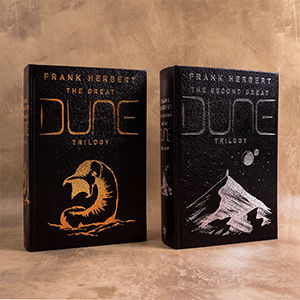
The Great Dune Trilogy Collector’s Edition compiles Frank Herbert’s legendary first three novels—Dune, Dune Messiah, and Children of Dune—into a single, premium hardcover volume spanning 1302 pages. Celebrated for its intricate political plots, profound world-building, and enduring cultural impact, this edition is a must-have for discerning readers and fans of visionary science fiction.


| Best Sellers Rank | 15,995 in Books ( See Top 100 in Books ) 13 in Genetic Engineering Fiction 20 in Environment (Books) 23 in TV, Movie, Video Game Adaptions |
| Customer Reviews | 4.6 out of 5 stars 12,634 Reviews |
S**E
The Spice Must Flow!
Frank Herbert's Dune is a collection of books that have always left me a little intimidated. I've never been a great reader and find myself getting easily lost with books that have too much information. I find it hard to process and is the main reason why I never got round to reading these books. But with the new film coming out, doing a bit of reading on the behind the scenes of the 1984 David Lynch film, I thought I would finally give the original Dune trilogy a shot. The original book was published all the way back in 1965. The original publication was a two part story in Analog magazine. It was officially released as a book by Chilton Books and has since become one of, if not the most famous science fiction novel ever written. The version I acquired is published through Gollancz and is a large hardback book featuring Dune (1965), Dune Messiah (1969) and Children of Dune (1976). The book as a whole is 912 pages long, features the three books, all four Appendix, The Terminology of the Imperium and Cartographic Notes For Map. It's a heft beast of a book. The cover whilst nicely designed with a cool golden sandworm on a black leather backdrop, still looks a little on the cheap side. It's a nice idea on paper but leaves a little to be desired. The spine of the book is also a slight issue. I found the pages didn't bend too well and made for the first and last one hundred pages to be a bit awkward to read, especially on my adjustable book stand. Considering the hefty weight of the book, I certainly wasn't going to hold it whilst reading. This made for a bit of a problem but one that I pushed through. As for the story itself. Well, if I were to right a small overview of the story of these three books, this review would be horrendously long. Lets just say that the book features lots of political and family issues. There's plenty of back stabbing as well as issues with religion, false idols and the issue of drug induced hallucinations. There's a lot going on here and considering how dense it is, I think Frank Herbert managed to get the story across perfectly. There were very few occasions where I felt a little lost. With a good use of wording and the way the chapters are spread out, you can get a dose of information and plenty of time to soak it all in before moving on. It gives this book great pacing and makes it surprisingly easy to read. My favourite part of the book is without any doubt, it is the world building. Each faction have their unique traits. Their clothing, their vocabulary, the way they walk and portray themselves amongst others. It's all very well done. Even the use of secondary and lesser characters have a lot of depth to them. The planet itself, Arrakis as a world feels just as alive and unique as characters like Stilgar, Paul Atreides and the Baron. The way Herbert describes the different environments from Sietch Tabr, Arrakeen, the endless desert etc is so intense that you could so easily imagine yourself being there. In terms of quality, I would say that Dune is by far the best book of the three and shouldn't be a surprise to anyone. It's extremely focused and Herbert clearly knew what story he wanted to tell and how to go about doing it. Dune Messiah is a very good but short follow up. It's considerably more bleak than the first book and really brings a downer to everything that happened previously (no spoilers). It's a really good read, acting more like an extension of the first book rather than a full novel in itself. Children of Dune is a much stronger affair with the Atreides story going in a completely different direction. It's a longer, more detailed and more philosophical story compared to its predecessor. There's a lot going on in this one, it's a fantastic way to round off the story of Paul, his family and the people of Arrakis. I won't even deny the fact that I am far from qualified to do Frank Herbert's Dune justice in this review. I'm a fairly simple person who hasn't got the right grasp of the English language to properly emphasise just how good this book is. Up until now, Tolkien's Lord of the Rings and Homer's Odyssey were my favourite books. That was until now. I think Dune has everything I love about science fiction and scratched that itch caused by blasphemous nonsense like the Disney Star Wars trilogy and Star Trek Discovery. It's a very clever, very well written and extremely detailed story that I would call a must own. Some might find it a bit over whelming, others will just sink into it and never come out of their spice trance. I am the latter. My mind hasn't stopped processing the information I got from Dune and I don't think I ever will. I am glad I got over my fear of this book. After all, fear is the mind killer.
M**R
A great Science Fiction trilogy
I've re-read this trilogy after 30 years and enjoyed it as much, if not more. Frank Herbert's masterful skills immerse the reader in an alien fictional world- although water is precious. Dune is a desert planet. Read this as an adventure story and you'll love it. The author gives you multifaceted characters with subtle emotional and political intelligence and each development in the plot, brings satisfaction and anticipation to the reader. This book is heavy and large , so I used cushions to support its reading , in bed! After each part, I set it aside, to read something else. Like chocolate or fine wine, I didn't want to over indulge. Don't be intimidated by its size. You won't want to stop reading. And finally, I found myself thinking of the world I live in; political schemes and machinations. "Observe the plans within plans within plans." Putin anybody? John le Carré's Smiley? Like all great science fiction, thus trilogy is so much more. You've seen the film, now read the book.
C**Z
Good book with a few gripes
The Dune series is a very interesting one, it is unique to other sci-fi novels, in the sense that it doesn’t feel very futuristic. It could possibly remind one of medieval times, with the exception that it has vastly different technology. However, the societies feel reminiscent of each other. The book(s) is a great read, and it has some of the best world building I’ve ever seen. However, the reason I do not give this five stars is because there are a few problems with the product itself, and not of the literature inside. For one, the binding is glued together, which could possibly lead to some damage to the book if you aren’t careful, (however I have not had such problems (yet)) which defies the point of a hardback cover, which is to preserve the book and prevent it being damaged. There are a few spelling errors and grammatical errors, however these are negligible, but still noticeable and a bit annoying, as they take you out of the experience. It is really well thought out and an incredibly captivating and complex book. I recommend it to anyone who can understand it the way it was intended. The House Harkonnen is exactly what I want from a villain- ruthless tyrants that are made to be disgusting and vile human beings. Frank Herbert wanted you to hate them as much as he did, and it is really conveyed in this book. The “protagonist” is quite likeable in most aspects, and while Paul technically isn’t the hero in the story, he is understandable as a character, and you can see why he chooses to do what he does. I like how this series branches off from it’s main characters into other plot lines; for example, the way Paul is the main character of the first two books, but eventually become “The Preacher”, and then his character is dropped entirely during the series. Overall, a lovely book. The four stars is for the quality of the product itself, and not of the writing.
N**E
What can you say
Well many people before me have praised Dune as the greatest SF novel ever and I do not disagree, the following novels had more mixed reviews but you cannot help being dragged into Frank Herbert disfunctioal distant future (not much as changed then). Anyway superb stories, go and read if you haven’t already (perhaps miss sequels,completely different writing style). Now to this volume containing the first three novels, I have no complaints, other people have complained about missing and upside down sections, I haven’t found any. Print size, well maybe a bit small but there’s a lot of words to get in one volume, how much do you want it to weigh and I found quite readable and I’ve worn glasses for my sight all my considerable life. I admit I bought to joint other books in my black library collection and it looks very smart too, but all in all well worth the price Amazon were charging and I’ve no regrets. You maybe able to get better editions but you will pay a lot more and this one is really good value for money for a hardback edition of the first three novels.
M**E
Three excellent books in one.
I read all of these when I was a child. I'm reading them again because of the new Dune films, which are less faithful to the books than the previous ones were. There was never any mention of artillery in the books or the previous films and mini series. Read the books and know the truth.
B**H
massive
these are beautiful, massive ,sturdy, strong tomes. will take years to read, but well worth the effort. they have a pride of place in my collection of hard backs
R**E
Superb
An excellent read. Growing up in the 80s and having got glimpses of the David lynch movie version of this I wasn't really expecting much from this book .... But mind blown. An exciting read, a page turner,was gripped from beginning to end. If you like sci do and you haven't read t you're doing yourself a disservice...religion politics philosophy and a brilliant story. Excellent.
K**1
worth a read.
good read, kept storyline and interest all the way through. I hadn't read a book in years but found it hard to put this one down.
C**E
Great books, terrible binding quality
For a series like this I wanted a durable and well made hardcover edition. Purchased 'new' via Amazon, the condition seen in the photos is exactly as it arrived, as yet unread, it has only been waiting on the bookshelf! The binding glue appears to have been insufficient or missing, the spine puckered along the left edge as a result. I've only noticed it today now that books 4-6 are arriving soon.
P**E
Good sci-fi
Great novel. Some long repetitive chapters. But good.
A**I
Dune najlepsza Trylogia
Książka cudowna piękne wydanie w twardej oprawie Dune najlepsza Trylogia polecam tylko w Amazone dobrze zapakowane szybka dostawa 🙂
M**N
Great buy
J**E
Unlike anything else out there, even after all these years
My rating is for the whole series; while I think that each book is progressively a little weaker, I still think that the saga as a whole is too compelling and unique to merit anything less than five stars. DUNE: Maybe it's the freshness in my mind of the recent (and outstanding) film adaptation; maybe it's just that I'm many (many) years older; maybe it's the way that fantasy has evolved since it was published (and in response to it). But whatever the case, even though I remembered Frank Herbert's Dune being a dense, difficult read, that turned out not to be the case as I revisited the world of Arrakis after a good thirty years. Indeed, you can see some of Herbert's pulpier edges here and there - some florid plotting, some big dramatic characters - all grounding the massive scope of the book and Herbert's quite frankly astonishing imagination in things that we can latch on to and understand. There's little need to revisit the plot here, especially thanks to Villeneuve's adaptations (which only impressed me more after this re-read, as I could see the ways in which he changed the source material to make it work as a film while never betraying its spirit); what I will say is that I was so much more acutely aware this time of the way that Herbert is viciously critiquing so much of the modern world - the exploitation of the middle east, the use of religion as a way to gain power, the scheming of those in control to keep the profits for themselves - and just how deeply cynical the book is. Even if you don't have knowledge of where the series goes from here, it's evident that Paul is never intended to be a wholly noble hero; indeed, no one in Dune comes out looking particularly good, with the compromises needed to keep power and the willingness to sacrifice others being so key to the methods of "winning" here that they're undeniable. The other thing you forget, though, is how willing Dune was to just be wonderfully weird, especially in the second half of the story, and it's where the book really shines; without that, you'd have a powerful but a little stiff exploration of power and exploitation of native populations, but with it, you get this fascinating science fiction epic that feels still pretty sui generis after all this time, even though it's impossible to read it and not think "oh, there is so much sci-fi and fantasy that wouldn't exist without this.'' It's got its flaws - some clunky dialogue, a few iffy pieces of characterization - but generally, they're minor and pale in the face of just what Herbert is going for - and what he largely accomplished. DUNE MESSIAH: When I revisited Dune, I found the book more accessible and less complex than I remembered, and I wondered how much of that I could simply chalk up to age (and the familiarity that came from the film). But now that I've read Dune Messiah? Oh, there's the complexity, weirdness, and density. In less than half the length of the original novel, Herbert delivers a truly subversive sequel that transforms the context and impact of its predecessor, giving us a book that turns Paul from a hero to a tyrant, turns a rebellion into a religious crusade, questions the nature of seeing the future, and so much more. And that doesn't even get into the oddness of the book itself, in which most of the major events happen off-page entirely, a conspiracy turns out to be about something wholly else than we think, a character returns from the dead in a bizarre way that only deepens the weirdness, and characters' actions can be maddeningly opaque. That all of this happens in such a lean volume is kind of fascinating; it's hard to think of another sequel that is this interested in completely revising the impact and meaning of its predecessor, changing the story from a heroic one to a tragic tale of the corruption of power. Dune Messiah isn't quite as solid as its predecessor, and part of that undeniably comes from the short length; there is a lot going on here, and Herbert's abbreviating of context and characters can lead to things being confusing even before we learn that most of the major events of the book happened between the volumes or even between the chapters. But it feels like a logical next step from the conclusion of Dune, and thematically/morally/emotionally, it's a fascinating way to keep the saga going in a way that reveals how little Herbert was really interested in the "white savior" archetype; instead, what he's given is a cautionary tale of the danger of such tropes, as well as a vicious allegory for the corruption of wealth, power, and control that rears its head in human nature - especially in a certain region of the world dense with oil - all done with an intent that transforms the previous book in compelling ways. CHILDREN OF DUNE: By the time I finished Dune Messiah, I was starting to remember just how complex and challenging Herbert’s series could be, but Children of Dune still feels like another step up in terms of difficulty and density, throwing us into a world of adults in 9-year-old bodies, warring prophecies, religious reform, tyranny and violence, and a whole lot more - but with a lot of things happening off screen still, a lot of characters hiding their motivations, a lot of ideas unexplained, and the plot beyond complex, with schemes within schemes within bluffs within feints. All of which could be manageable, if frustrating (I read and reread the Preacher’s messages multiple times, trying to parse their complex ideas, and still am not sure I followed it all), if Herbert had simply given us anyone to hang onto. With Dune, we had Paul, who was forced into dealing with his destiny and unspeakable choices, and while he was becoming harder and less approachable in Messiah, his regrets for what happened and efforts to ameliorate the damages still gave readers something to latch onto. But by the time we get to Children of Dune, there’s not a recognizably “human” character in our story, and the result is a book so full of ideas and philosophy that it forgets to give us anyone to like. The children are utterly alien and off-putting, Duncan is a walking computer, Alia is a monster, and Jessica…well, she’s still a Bene Gesserit, isn’t she? And all of that is before things start getting very weird towards the end, setting up the insanity of later books. But I think it’s here that I’m tapping out from my reread; I can admire the density of Herbert’s vision, and the nuance that he brings to all of the factions and power plays and groups, but ultimately Children of Dune feels like a book for mentats, not for people - it’s all ideas and cold machinations, with no humanity left for us to care about.
Trustpilot
1 month ago
2 months ago