Buy anything from 5,000+ international stores. One checkout price. No surprise fees. Join 2M+ shoppers on Desertcart.
Desertcart purchases this item on your behalf and handles shipping, customs, and support to Italy.
📡 Solder, Switch, and Tune Your Way to Radio Genius!
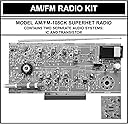
The Elenco AM/FM Radio Kit is a comprehensive, solder-required STEM project designed for high school and university learners. Featuring a superheterodyne tuner, it allows users to build a fully functional AM/FM radio by assembling 9 distinct circuit stages. The kit includes a unique PCB with printed schematic symbols, a 56-page step-by-step manual, and the ability to switch between transistor and IC technologies, offering a hands-on education in radio electronics and soldering techniques.


| ASIN | B008515U1U |
| Additional Features | Built-In AM Antenna |
| Best Sellers Rank | #387 in Single Board Computers (Computers & Accessories) |
| Brand | Elenco |
| Built-In Media | Owner's Manual |
| Color | Blue |
| Compatible Devices | AM/FM Radio Receivers |
| Connectivity Technology | NFC |
| Customer Reviews | 4.4 out of 5 stars 442 Reviews |
| Display Type | LCD |
| Enclosure Material | Plastic |
| Frequency | 108 MHz |
| Global Trade Identification Number | 00756619008769 |
| Hardware Interface | 3.5mm Audio |
| Item Dimensions L x W x H | 18"L x 12"W x 12"H |
| Item Weight | 12 Ounces |
| Manufacturer | Elenco Electronics LLC |
| Mfr Part Number | AMFM108CK |
| Model Number | AMFM108CK |
| Number of Batteries | 1 9V batteries required. |
| Power Source | Battery Powered |
| Product Dimensions | 18"L x 12"W x 12"H |
| Radio Bands Supported | 2-Band |
| Special Feature | Built-In AM Antenna |
| Style Name | Raw |
| Tuner Technology | Superheterodyne, AM , FM |
| Tuner Type | Superheterodyne, AM, FM |
| UPC | 756619008769 |
| Unit Count | 1.0 Count |
| Voltage | 9 Volts |
| Warranty Description | Warranted for manufacturing defects |
| Water Resistance Level | Not Water Resistant |
U**I
It's a bird, it's a plane, it's a superheterodyne radio, with great instructions!!
I was pleasantly surprised when I received this kit and opened it. Way more than I expected in terms of quality and educational value. This is a bit more than a quick soldering project; it teaches basic radio fundamentals and lays out the process in an extremely well written manual. A quick google/AI check can help one out if they get a little lost in the process but that's a fair price to pay for it's educational value. It's a little pricier than some of the other project radio kits but very well worth it. I very highly recommend.
O**E
Great Fun And A Great Teaching Tool
With this review I hope give you some idea about what this kit does and doesn't do and how it can be a great learning tool for both young and old alike. This kit is very complete, everything needed for building a complete AM and FM radio is included in the box. All the parts are neatly laid out and placed on cards for easy identification. The construction manual is very easy to follow and it also includes tests needed to be done during the construction process as well as final tuning when complete. The radio's circuit board is laid out is with the AM section on the bottom and the FM on the top of the board. If you follow the manual you will be building the AM section first with the FM section second. This makes the construction easier as both the AM and FM sections of the radio are broken down into small sections, then a test to make sure everything is working before moving to the next section. The manual goes into how and why the circuits and other electronic parts do what they do and how they do it. This kit can be built with just a multi-meter or you can also use an oscilloscope for more complete testing and understanding of the parts and circuits, but the oscilloscope is not necessary for the build. This is kit is both a relaxing build and a great teaching tool. If you have teenagers in the house, this kit will teach how to make good solder connections of the parts onto the board. The board has more room between parts and solder pads, so the process is much easier to get the parts mounted to the board successfully. The board also has all the symbols printed on the board that you would normally see on a schematic drawing layout. This is a good way to see both symbols together and it helps in the learning process. The board also includes dedicated test points for doing the testing needed during the building process. This is one of the best kits to get your feet wet in electronics or as a very good teaching tool for young adults and adults alike. Once done you have a working AM/FM radio. Since this is a battery operated radio, its great to have around when the power goes out. I would recommend using a good 60/40 Tin Lead solder, with a diameter of 1mm, this solder is much easier to work with and make a good connection, you don't need all that heat on the board and electronic parts when learning. The provided solder is lead free and makes it more of a challenge to get a good solder joint when learning the soldering process. Fun project!
R**R
Interesting kit but with some disappointments
It's an interesting kit and rather fun. Certainly not for a beginner, but not overly difficult. Instructions were certainly good, even excellent. I had the "education" version which covered not only construction but also extensive testing and alignment information and a bit of radio theory. Unfortunately it was missing several transistors. Fortunately they are a very common type and I had some on the shelf. The lead-free solder the kit came with was useless and after a few frustrating attempts to work with it, it went in the trash and I used normal 0.032" rosin core lead/tin solder. Resistors and capacitors are attached to convenient cards and clearly labeled making finding the right parts easy. Unfortunately that isn't true of the transistors, which are simply dumped into small bags with other misc. parts. The coils are about as cheap as they they come. Use caution when turning the slugs to adjust them, they're easy to mess up Full testing and alignment really require an oscilloscope and audio/RF generator to get the most out of the kit. If you lack one or both of those, you can get away with just a VOM for preliminary testing and troubleshooting. Maybe? Alignment for proper receiving is going to be interesting if you're trying to play it by ear without the right test gear I'd think, but could probably be done.
A**R
Good kit, could be a bit better
I bought this because I thought it would be fun to build and refresh some of my basic RF electronics skills. Kit is fairly easy to assemble but not for a total novice. The manual starts you off but then leaves you to assemble the kit without the step-by-step that other kits include. Or perhaps I'm missing some supplemental documentation. Not a big deal if you're careful and have some background in electronics and/or assembling kits like this. Another issue is all of the solder pads on the board are very shiny and smooth and solder doesn't want to stick, even if you use flux. You're going to want to rough up the pads slightly with an emory cloth or other small abrasive tool. The ferrite AM antenna coil needed to be reglued to the core.
J**S
Great electronics project
I built the AM section first. Just followed the instructions for assembly and ignored all the tests. When finished, I had an operating AM radio. A few adjustments later (following instructions for adjusting with no test equipment), I could tune many local stations. I then assembled the FM section by installing all components and ignoring assembly instructions. I installed all resistors, then all capacitors, then coils, diodes, transistors, and transformers. The FM section didn't work. I used a signal generator at 90MHz, no modulation, and a multimeter and traced the problem to transformer T4. Transistor Q6 had no collector voltage indicating an open circuit in T4. I removed T4 from the circuit board and removed the can from the assembly. It took a magnifier and some patience to find a broken, hair thin wire and reconnect it. I replaced the can and soldered T4 back on the circuit board. With power applied, the FM section came to life. After a few adjustments (following instructions for adjusting with no test equipment), I could tune several local stations. Recommendations: 1. The radio kit is a fun project and can be a rewarding learning experience but some precautions are necessary. The copper circuitry on the PC board is very thin and easily damaged. A soldered connection can be broken by applying pressure to the component side. If any movement is possible, the soldered connection will be torn away from the rest of the circuitry and may not be visually evident. This happened twice with me. 2. I have had many years of electronics experience and felt pretty confident with my skipping so much of the instructions. I do NOT recommend my method. The kit is a learning experience and all instructions should be followed. 3. All resistors and small capacitors are provided on cards with the reference numbers and values. The schematic diagram provided on the back of the instruction book shows the reference numbers for all parts, but not their values. Don't throw the cards away or it will be a pain in the neck to determine the correct value for a referenced part. 4. Diodes D2 and D3 are type 1N34A. Diode D1 is a Varactor diode and looks like D2 and D3. Keep them separate or suffer the consequences. 5. A 60 watt soldering iron is appropriate for all soldering, Use 60/40 Tin/Lead solder and throw the solder supplied in the kit away. It requires too much heat to work properly.
S**T
A fantastic teaching tool!
I have built hundreds of kits, perhaps a thousand. It has been fifty years since I built my first. This is the best AM/FM radio receiver I have built to date, but for some perhaps the worst possible choice. It depends on what you hope to accomplish by building the kit. If you hope to build an awesome radio there are much better kits. If selectivity, sensitivity and audio quality are important, here again you could do better. If you want soldering practice, this is far to simplistic to be any challenge. It is large, ugly, and it's design does not lend to a nice finished product. So why do I LOVE it so much? If you want to learn radio electronics, really learn what is happening inside a radio and why (to the greatest detail). If you want to learn how to optimize (tune, calibrate) a radio receiver. If you want to learn to use your test equipment, your frequency generator, your oscilloscope, then this is an outstanding kit! I have learned a great deal from this kit even after fifty years. In fact, the most I've learned from a kit in many, many years! However, if you don't own a scope or have any test equipment or the desire to learn those techniques then 90% of the printed directions are for somebody else. Find another kit! This kit is wasted on those looking for a soldering kit, many better choices in that respect (although if you want to build a truly nice radio you'd spend a great deal more as well). You will need an oscilloscope and a signal generator that will modulate your test signal at various frequencies (so the old 1000hz test signal isn't enough to perform all tests as suggested). As many reviewers have pointed out, you can build the radio without these items, but you would be paying for documentation that you won't use (the parts aren't worth ten dollars). Remember, 90% of the documentation is aimed at using these two pieces of test equipment. I would also suggest that if you aren't familiar with this test equipment then you will need additional documentation as these instructions clearly assume you know how to use the tools you have purchased. This is an ADVANCED kit with a set of beginners instructions included.
G**R
Excellent, Versatile AM/FM Radio Project (and Learning) Kit
Excellent project kit. This kit can be used and enjoyed by just about anyone, regardless of their electronics knowledge level. If you are looking for a kit that you want to put together to make both and AM and FM radio, it can be used for that purpose. If on the other hand, you are studying electronics as a hobbyist or student, you can also take advantage of instructional lessons that come with it. Both radios are built in "Sections" (AM/FM-IC and Transistor Audio Amplifier; AM- AM Detector Stage, 2nd AM IF Amplifier Stage, 1st AM IF Amplifier Stage, and the AM Mixer/Oscillator Stage; FM- FM Detector Stage, 2nd FM IF Amplifier Stage, 1st FM IF Amplifier Stage, and the FM RF/FM Mixer/FM Oscillator/AFC Stage. Each stage concludes with tests that can be performed to verify the stage was assembled correctly. "Static" tests can be performed using a standard VOM, but if you prefer to perform the more advanced tests you can also do those using a RF Generator and Oscillator. (Your RF Generator will need to be able to produce modulated signals from 400 Hz to over 1 KHz. Novice solderers should have no problem wither as the average size of a soldering pad is 1/8" and larger! Elenco even designed "Test Points" into the PC Board to connect test equipment at various stages. While some of the instruction is a bit advanced without less-complex explanations of the principles, (Reminder: this is an AM/FM Radio Learning project not a Basic Electronics Project) the price for the components, well thought out design, instruction, and ease of construction is well worth the price!
D**R
Fun kit to build
This kit was a lot of fun to build. I learned a lot building it and still learning as I dig deeper into understanding how everything really works together. Offers some great opportunities to learn how to build, test, diagnose issues in radios - especially if you have test equipment (signal generator, oscilloscope, multimeter). (Don't worry the kit doesn't require you have any test equipment. It has steps for with test equipment or without.) Building each part step by step and testing it was great for learning and increases your chances of a successful build. Some notes: - It has you build a second amplifier in place of the lm386 chip to show details of how the amplifier works. Which is great. Just remember this is to be temporary as it will direct you to replace the chip when done. If you aren't careful you might do what I did and bend all of the pins in the IC 8 pin socket making the secondary amplifier not work and then making it impossible to put the chip back later. - If you have a signal generator it needs to support 455khz, 10.7 MHZ and around 88 MHZ with FM and AM modulation. (This might be a really expensive signal generator to support all of those. Mine didn't it only supported up to 10.7 MHZ and for some reason my FM modulation wasn't work. ) - To make it easier to confirm frequency alignment at the end I used a bluetooth connected old car speakerphone that had FM support in it and I made it broadcast my music player from my phone at the specific frequencies needed - that made alignment a lot easier. - Keep an eye on the traces on the board - some of them broke connecting where the component was - Many times just adding more solder could solve it - though in one case I had some spare wire around and just made a jumper to the rest of the trace it broke off from.
R**V
Kit interesante y educativo
Mejorar la calidad del PCB
C**S
O kit vale a pena!!
O kit é excelente. Muito boa a apredizagem.
A**R
Recommended
Working very well Highly recommended Very informative
A**ー
AM/FMラジオの仕組みと測定機器の使い方の基礎を学ぶのに最高の教材‼︎
2つ購入しました。一つは組み立て用、もう一つは部品の特性測定用や部品在庫用としてです。しかし、組み立てテキストが、細部まで気を使っているので驚いた。つまり、電源とアンプ回路から始まって、最後にアンテナとLC回路を作る形になっていて、回路毎に、直流電圧測定による動作確認や、信号発生器とオシロスコープを用いた回路特性測定をする仕組みになっているのだ。しかも、AMのみでなくFM も受信出来るのにも感動した。
I**A
Muito bem embalado. Instruçoes excekentes
Excelente
Trustpilot
3 days ago
2 months ago