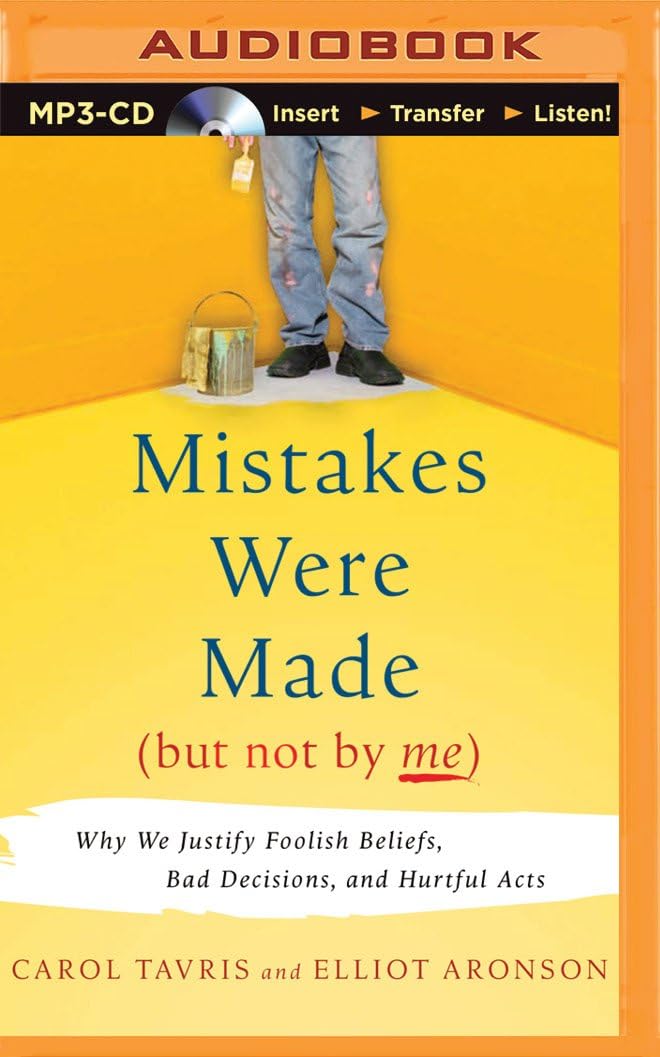

Mistakes Were Made (But Not by Me)
Product ID: 70180096
Buy anything from 5,000+ international stores. One checkout price. No surprise fees. Join 2M+ shoppers on Desertcart.
Desertcart purchases this item on your behalf and handles shipping, customs, and support to Italy.
Mistakes Were Made (But Not by Me) [Carol Tavris, Elliot Aronson, Marsha Mercant, Joe Barrett] on desertcart.com. *FREE* shipping on qualifying offers. Mistakes Were Made (But Not by Me) Review: Proof That Victory Has Many Fathers but Defeat is an Orphan - Authors Travis and Aronson present a wonderful explanation of how we "justify foolish beliefs, bad decisions and hurtful acts" in this fascinating and easy-to-read book that will make you smile or shake your head as you recognize the mental gymnastics on the balance beam of your brain and the brains of others. They show us how our mind overcomes cognitive dissonance through self-justification where we create blind spots to our pride and prejudice, keep editing our memories until it provides a recall we are comfortable with, how "good" people lose their ethical compasses, how we justify our biases and prejudices, how the "us mentality" fulfills the paramount need for belonging and a sense of superiority, which allows us to do bad things to good people, our spouses, our co-workers, and even strangers who pose no threat or insult. They explain this using a pyramid where every one of us starts at its apex. One story, act or event leads us down one side of the pyramid that will define our beliefs, character and philosophy while the same experience or a different one will lead someone else down another side of the pyramid. To avoid dissonance, the feelings of being wrong, stupid or weak, we will seek confirmation of our new belief so that we tell ourselves we have not gone down the wrong side, until we find ourselves at the base, unwilling to acknowledge even the most irrefutable evidence that might contradict that belief. When we are confronted with such evidence, it is called dissonance. It can be so threatening that we find a number of ways of projecting or rationalizing our previous action so we don't have to face the embarrassing possibility of having been wrong. When prosecutors feel they have imprisoned the right man even after DNA proves he didn't commit the crime, they have become convinced in their belief, which is now rooted in the base of the pyramid. They will experience dissonance even when it turns out that the victims of the eight people they successfully prosecuted for murder turn out to be very much alive after all. Self-justification in the form of a rationalization will save the ego from the enormous guilt of having put the wrong man in prison. Travis and Aronson also take aim at Freudian psychoanalytic theory, especially repression and memory therapy through the tragic experience of Holly Romana and the daycare centers of the 1980's, stories that were chilling in the lives they destroyed because of the overconfidence of therapists, police and district attorneys where, despite their experience, their ability to pick out the molester, abuser, or criminal was no better than chance. Their experience gave them confidence but little insight. They make even a stronger case against the theory with Holocaust survivors who suffered unspeakable, repressible misery, yet were able to remember almost every detail of their depositions forty years earlier when they were liberated. Those who clung to repression theory found validation if a survivor couldn't remember every single detail. What drew my attention to this book was an intuition that no power of intellect, knowledge, or persuasion would influence people whose political opinions differed from mine in a substantial number of desertcart reviews and comments under dozens of titles. I was fascinated with the contradictory message of being told to read extremist authors (who believed that criticism of national policy was an act of treason), with the admonishment that it should be read by, or was only for "those with an open mind." Equally odd was the saying "the truth really hurts" from people who were reading propagandists. As the authors explained, people see themselves as open-minded and fair with reasonable opinions. Therefore, since they are reasonable, fair and just, and find the book "factual," those who don't share their opinion must be unreasonable, biased, and unable to face the truth, at least as they see it. In other words, it's the other guy who lacks an "open mind." The more I read, the more I found applications from the book in other comments and reviews. One commentator could not understand how I admired the book "The Greatest Generation," by Tom Brokaw, because of my liberal leanings. According to her, I was one of the people "on [my] side of the fence," that "actually despise every aspect of American life." (It was the authors' example of the "us mentality" that provides the person with the sense of belonging). Membership in a particular group is a must, as is the perception to view our group as being more intelligent, open-minded, or moral than those in a different group. This allows us to see traits in the other group that are undesirable, traits that members are unable to see in their own group, unless it is with justification. The stereotype tends to serve as a defining line where there is only one possible rational explanation for things--hers. Although she felt my respect and politics were incompatible, I could be explained as an aberration, in her mind. (There was hope for me). Conflict resolved, dissonance spared, and paradigm and belief remain intact. The authors demonstrated the power of rationalization and denial that was all so clear here in discussion threads. If people believed there were WMD even after an administration acknowledged that there weren't any after all, they would still believe that they were driven away by trucks to Syria while still not knowing where in Syria they actually were. Some had their belief systems so tied to the previous administration that criticism could only be an expression of irrational hatred or an act of treason. Travis and Aronson's message explained the rationale of not wanting to understand our enemies. It would be much more convenient to believe they hated us for no good reason, and anyone wanting to understand could be simply explained as a terrorist sympathizer. Righteousness without proof of being right, wins. In actuality, questioning our beliefs or admitting our mistakes doesn't make us look weak or stupid. It creates the opposite impression. Our society promotes the idea that this is a weakness, and it is instilled in our children early on, turning them into human beings who can never be wrong on their jobs, in their relationships, and about their personal beliefs. The fear of ridicule, failure, and retribution is too strong and difficult for us to face. Few have risen to the occasion such as President Kennedy who has been the last president to admit having made a mistake on a grand scale. Richard Clarke was the only one in the previous administration who flat out stated that he was responsible for the attacks of 9/11, and was the only one to ask for forgiveness. (No one came close). N. Wayne Hale Jr. took full responsibility for the Columbia Shuttle Disaster. He was since promoted to Manager of the Space Shuttle Program. General Eisenhower had a statement ready in case the invasion of Normandy on June 6, 1944 had failed. He changed a key phrase in it from "The troops were withdrawn" to "I withdrew the troops." I cannot recommend this book enough, because knowing what we believe depends upon how we think, and how we think about those of us with opposing viewpoints. It adds tremendous insight into the human condition and our need to protect our own egos. The authors provide some hope believing that we have the ability to recognize our self-destructive thought patterns and change for the better. As they so blithely state, the body might want sugar, but we have learned to eat vegetables. This book is proof that victory has many fathers, but defeat is an orphan. When asked by a reporter what three mistakes he made as president, George W. Bush replied: "[When people ask about mistakes] they're trying to say, `Did you make a mistake going into Iraq?' And the answer is, `Absolutely not,' It was the right decision...Now, you asked what mistakes, I made ...some mistakes in appointing people, but I'm not going to name them. I don't want to hurt their feelings on national television." Page 235. Just as the authors said, mistakes were made--but not by me. Also Recommended: Jackson, Brooks & Jamieson, Kathleen, H., "un-Spun: Finding Facts in a World of Disinformation," Random House, 2007. Review: No Mistake Here! - Mistakes Were Made (But Not by Me): Why We Justify Foolish Beliefs, Bad Decisions, and Hurtful Acts by Carol Tavris and Elliot Aronson. "Mistakes Were Made (But Not by Me)" is an interesting book about how the brain is wired for self-justification. Social psychologists Tavris and Aronson take us through a psychological ride of how we deal with cognitive dissonance. This 304-page is composed of the following eight chapters: 1. Cognitive Dissonance: The Engine of Self-justification, 2. Pride and Prejudice...and Other Blind Spots, 3. Memory, the Self-justifying Historian, 4. Good Intentions, Bad Science: The Closed Loop of Clinical Judgment, 5. Law and Disorder, 6. Love's Assassin: Self justification in Marriage, 7. Wounds, Rifts, and Wars, and 8. Letting Go and Owning Up. Positives: 1. Excellent, accessible and conversational prose. 2. Fascinating subject topic and a book that lived up to the expectations. 3. The power of self-justification illustrated with a luxury of compelling details. 4. Great water-fountain stories that support their arguments. 5. Great quotes spruced throughout the book. 6. Confirmation bias explained. 7. How our brains react to dissonant information, fascinating stuff. Dissonance theory explained. 8. Some interesting personal convictions have been debunked and that alone is worth the price of the book. 9. Personal experiences can be so misleading. 10. Interesting examples including many political ones. 11. Tidbits of wisdom in even strange areas. Consider the impact of pharmaceutical deregulation...you will from this book. 12. Good use of science, always a positive. 13. The power of the gift...you must reciprocate. 14. The difficulty in dropping prejudice. 15. Memories as self-justifying historians. 16. Fascinating facts. 17. The terrible accounts of the recovered-memory movement. 18. Absolutely loved the Law and Disorder chapter. DNA is amazing... 19. The fascinating and "painful" look at marriage. 20. The interesting look at how to help victim find closure. 21. Interesting take on torture. 22. Christian penance has a totally different connotation. 23. Mandela. 24. So many great examples...from Oprah, the Crusades, the Bay of Pigs, etc... 25. The power of accepting responsibility. 26. Extensive bibliography, that's always good. 27. A treat to read from cover to cover. Negatives: 1. Conservatives may find this book to be biased toward liberals. 2. Can be "preachy" at times. In summary, I truly enjoyed this book. This is a book that lived up to the hype. It's fascinating, interesting and memorable. I can't recommend it enough. Further recommendations: "Supersense" by Bruce M. Hood, "Hardwired Behavior..." by Laurence Tancredi, "The Belief Instinct..." by Jesse Bering, and "Human" by Michael S. Gazzaniga.
| Best Sellers Rank | #7,142,659 in Books ( See Top 100 in Books ) #191 in Medical Social Psychology & Interactions #280 in Popular Social Psychology & Interactions #46,131 in Books on CD |
| Customer Reviews | 4.6 4.6 out of 5 stars (1,195) |
| Dimensions | 5.5 x 5.5 x 0.25 inches |
| Edition | Unabridged |
| ISBN-10 | 1491514132 |
| ISBN-13 | 978-1491514139 |
| Item Weight | 3.5 ounces |
| Language | English |
| Publication date | May 6, 2014 |
| Publisher | Brilliance Audio |
E**R
Proof That Victory Has Many Fathers but Defeat is an Orphan
Authors Travis and Aronson present a wonderful explanation of how we "justify foolish beliefs, bad decisions and hurtful acts" in this fascinating and easy-to-read book that will make you smile or shake your head as you recognize the mental gymnastics on the balance beam of your brain and the brains of others. They show us how our mind overcomes cognitive dissonance through self-justification where we create blind spots to our pride and prejudice, keep editing our memories until it provides a recall we are comfortable with, how "good" people lose their ethical compasses, how we justify our biases and prejudices, how the "us mentality" fulfills the paramount need for belonging and a sense of superiority, which allows us to do bad things to good people, our spouses, our co-workers, and even strangers who pose no threat or insult. They explain this using a pyramid where every one of us starts at its apex. One story, act or event leads us down one side of the pyramid that will define our beliefs, character and philosophy while the same experience or a different one will lead someone else down another side of the pyramid. To avoid dissonance, the feelings of being wrong, stupid or weak, we will seek confirmation of our new belief so that we tell ourselves we have not gone down the wrong side, until we find ourselves at the base, unwilling to acknowledge even the most irrefutable evidence that might contradict that belief. When we are confronted with such evidence, it is called dissonance. It can be so threatening that we find a number of ways of projecting or rationalizing our previous action so we don't have to face the embarrassing possibility of having been wrong. When prosecutors feel they have imprisoned the right man even after DNA proves he didn't commit the crime, they have become convinced in their belief, which is now rooted in the base of the pyramid. They will experience dissonance even when it turns out that the victims of the eight people they successfully prosecuted for murder turn out to be very much alive after all. Self-justification in the form of a rationalization will save the ego from the enormous guilt of having put the wrong man in prison. Travis and Aronson also take aim at Freudian psychoanalytic theory, especially repression and memory therapy through the tragic experience of Holly Romana and the daycare centers of the 1980's, stories that were chilling in the lives they destroyed because of the overconfidence of therapists, police and district attorneys where, despite their experience, their ability to pick out the molester, abuser, or criminal was no better than chance. Their experience gave them confidence but little insight. They make even a stronger case against the theory with Holocaust survivors who suffered unspeakable, repressible misery, yet were able to remember almost every detail of their depositions forty years earlier when they were liberated. Those who clung to repression theory found validation if a survivor couldn't remember every single detail. What drew my attention to this book was an intuition that no power of intellect, knowledge, or persuasion would influence people whose political opinions differed from mine in a substantial number of Amazon reviews and comments under dozens of titles. I was fascinated with the contradictory message of being told to read extremist authors (who believed that criticism of national policy was an act of treason), with the admonishment that it should be read by, or was only for "those with an open mind." Equally odd was the saying "the truth really hurts" from people who were reading propagandists. As the authors explained, people see themselves as open-minded and fair with reasonable opinions. Therefore, since they are reasonable, fair and just, and find the book "factual," those who don't share their opinion must be unreasonable, biased, and unable to face the truth, at least as they see it. In other words, it's the other guy who lacks an "open mind." The more I read, the more I found applications from the book in other comments and reviews. One commentator could not understand how I admired the book "The Greatest Generation," by Tom Brokaw, because of my liberal leanings. According to her, I was one of the people "on [my] side of the fence," that "actually despise every aspect of American life." (It was the authors' example of the "us mentality" that provides the person with the sense of belonging). Membership in a particular group is a must, as is the perception to view our group as being more intelligent, open-minded, or moral than those in a different group. This allows us to see traits in the other group that are undesirable, traits that members are unable to see in their own group, unless it is with justification. The stereotype tends to serve as a defining line where there is only one possible rational explanation for things--hers. Although she felt my respect and politics were incompatible, I could be explained as an aberration, in her mind. (There was hope for me). Conflict resolved, dissonance spared, and paradigm and belief remain intact. The authors demonstrated the power of rationalization and denial that was all so clear here in discussion threads. If people believed there were WMD even after an administration acknowledged that there weren't any after all, they would still believe that they were driven away by trucks to Syria while still not knowing where in Syria they actually were. Some had their belief systems so tied to the previous administration that criticism could only be an expression of irrational hatred or an act of treason. Travis and Aronson's message explained the rationale of not wanting to understand our enemies. It would be much more convenient to believe they hated us for no good reason, and anyone wanting to understand could be simply explained as a terrorist sympathizer. Righteousness without proof of being right, wins. In actuality, questioning our beliefs or admitting our mistakes doesn't make us look weak or stupid. It creates the opposite impression. Our society promotes the idea that this is a weakness, and it is instilled in our children early on, turning them into human beings who can never be wrong on their jobs, in their relationships, and about their personal beliefs. The fear of ridicule, failure, and retribution is too strong and difficult for us to face. Few have risen to the occasion such as President Kennedy who has been the last president to admit having made a mistake on a grand scale. Richard Clarke was the only one in the previous administration who flat out stated that he was responsible for the attacks of 9/11, and was the only one to ask for forgiveness. (No one came close). N. Wayne Hale Jr. took full responsibility for the Columbia Shuttle Disaster. He was since promoted to Manager of the Space Shuttle Program. General Eisenhower had a statement ready in case the invasion of Normandy on June 6, 1944 had failed. He changed a key phrase in it from "The troops were withdrawn" to "I withdrew the troops." I cannot recommend this book enough, because knowing what we believe depends upon how we think, and how we think about those of us with opposing viewpoints. It adds tremendous insight into the human condition and our need to protect our own egos. The authors provide some hope believing that we have the ability to recognize our self-destructive thought patterns and change for the better. As they so blithely state, the body might want sugar, but we have learned to eat vegetables. This book is proof that victory has many fathers, but defeat is an orphan. When asked by a reporter what three mistakes he made as president, George W. Bush replied: "[When people ask about mistakes] they're trying to say, `Did you make a mistake going into Iraq?' And the answer is, `Absolutely not,' It was the right decision...Now, you asked what mistakes, I made ...some mistakes in appointing people, but I'm not going to name them. I don't want to hurt their feelings on national television." Page 235. Just as the authors said, mistakes were made--but not by me. Also Recommended: Jackson, Brooks & Jamieson, Kathleen, H., "un-Spun: Finding Facts in a World of Disinformation," Random House, 2007.
B**K
No Mistake Here!
Mistakes Were Made (But Not by Me): Why We Justify Foolish Beliefs, Bad Decisions, and Hurtful Acts by Carol Tavris and Elliot Aronson. "Mistakes Were Made (But Not by Me)" is an interesting book about how the brain is wired for self-justification. Social psychologists Tavris and Aronson take us through a psychological ride of how we deal with cognitive dissonance. This 304-page is composed of the following eight chapters: 1. Cognitive Dissonance: The Engine of Self-justification, 2. Pride and Prejudice...and Other Blind Spots, 3. Memory, the Self-justifying Historian, 4. Good Intentions, Bad Science: The Closed Loop of Clinical Judgment, 5. Law and Disorder, 6. Love's Assassin: Self justification in Marriage, 7. Wounds, Rifts, and Wars, and 8. Letting Go and Owning Up. Positives: 1. Excellent, accessible and conversational prose. 2. Fascinating subject topic and a book that lived up to the expectations. 3. The power of self-justification illustrated with a luxury of compelling details. 4. Great water-fountain stories that support their arguments. 5. Great quotes spruced throughout the book. 6. Confirmation bias explained. 7. How our brains react to dissonant information, fascinating stuff. Dissonance theory explained. 8. Some interesting personal convictions have been debunked and that alone is worth the price of the book. 9. Personal experiences can be so misleading. 10. Interesting examples including many political ones. 11. Tidbits of wisdom in even strange areas. Consider the impact of pharmaceutical deregulation...you will from this book. 12. Good use of science, always a positive. 13. The power of the gift...you must reciprocate. 14. The difficulty in dropping prejudice. 15. Memories as self-justifying historians. 16. Fascinating facts. 17. The terrible accounts of the recovered-memory movement. 18. Absolutely loved the Law and Disorder chapter. DNA is amazing... 19. The fascinating and "painful" look at marriage. 20. The interesting look at how to help victim find closure. 21. Interesting take on torture. 22. Christian penance has a totally different connotation. 23. Mandela. 24. So many great examples...from Oprah, the Crusades, the Bay of Pigs, etc... 25. The power of accepting responsibility. 26. Extensive bibliography, that's always good. 27. A treat to read from cover to cover. Negatives: 1. Conservatives may find this book to be biased toward liberals. 2. Can be "preachy" at times. In summary, I truly enjoyed this book. This is a book that lived up to the hype. It's fascinating, interesting and memorable. I can't recommend it enough. Further recommendations: "Supersense" by Bruce M. Hood, "Hardwired Behavior..." by Laurence Tancredi, "The Belief Instinct..." by Jesse Bering, and "Human" by Michael S. Gazzaniga.
P**N
Extraordinary insight into the art of self-deception - has already and will change my life, hopefully for the better - a must read for all those into self reflection and introspection.
A**R
Nice
R**O
A great reading to understand how and why we all self-justify ourselves. When you start to be aware that we all fall into the cognitive dissonance trap you can start owning your mistakes, apologizing for those and take action from there.
J**E
auch wenn schon etwas älter ein unbedingt empfehlenswertes Buch für unsere Zeit, egal ob im Original oder der deutschen Übersetzung "Ich habe recht, auch wenn ich mich irre"; von den US-amerikanischen Autoren wird sehr gut dargelegt, wie und warum manche Menschen an ihren Irrtümern festhalten
A**E
Lot of very good examples.
Trustpilot
1 month ago
1 month ago