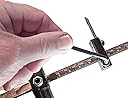
Let me explain why I think this is the best tool for cutting speaker holes. I cut a lot of holes for mounting speakers in custom cabinets I build. I cut a wide variety of materials like MDF, pine, maple, cherry, and a few exotics like bubinga and padauk. I very rarely need to cut drywall, but when I do, this adjustable cutter is what I use. First, I'll point out why I feel the other types of hole cutters are generally more troublesome. Over the years, I have owned and used several complete sets of the old inverted cup-type hole cutters, including some rather expensive brands which were advertised to work much better than the other brands. I have come to realize cup-type hole cutters are the absolute worst way to cut a hole. Even when the workpiece is clamped between sacrificial boards, the cup-type cutters often cut ugly ragged holes with so much tear-out that you need to spend a bunch of extra time trying to clean up (or hide) the edges of the holes. Plus, due to the friction of the cutting edge contact area, they put far more strain on your equipment than any other type of hole cutter. The friction they produce at the cutting edge can easily stop a belt drive drill press dead in its tracks, damaging the belt which stops moving while the motor keeps turning. The extreme friction can even cause a fire. It is common to see smoke rising out of the hole you are cutting with a cup-type cutter. I have also owned a few sets of Forstner bits. If you get the really good brands, Forstner bits are much smoother cutting and honestly do a fairly good job, as long as you are only cutting small holes. Just spend an afternoon attempting to find an 8 inch Forstner bit, if you want to understand why Forstner bits aren't the ideal solution, either. Plus, just like the cup-type bits, the bigger the Forstner bit is, the more strain it puts on your equipment. Cutting big holes with these types of cutters requires immense torque be transmitted through the drive system of your equipment. That's assuming you can even find a Forstner bit large enough for your task. Now, let's talk about why I believe this adjustable hole cutter is superior to those. This twin-blade adjustable cutter makes better use of the torque provided by your equipment. At any given hole size, your drill only has to exert the amount of force necessary to push two small blades through the wood. The size of those two small blades never changes, so there isn't a large jump in contact friction when you start cutting larger sized holes. This design only requires slightly more force to turn, when moving the blades further apart to cut a larger hole. That extra required force simply offsets the reduction in mechanical leverage which occurs when the blades are moved further apart. The important difference is that the frictional resistance to cutting remains constant regardless of the hole size. So, a 10-inch hole requires only slightly more power than a 5-inch hole. Using a cup-type hole cutter might require 8-16 times the force to go from cutting a hole that is 5 inches in diameter up to cutting a hole that is 10 inches in diameter. Having used all of these types of cutters for years, I can attest to this being a huge factor in successfully cutting a large hole. The huge reduction in required force to cut the hole is only one benefit. This hole cutter also cost me a lot less than the huge pile of cup-type and Forstner cutters I've purchased over time. In fact, I have one largish Forstner bit which cost more than this entire adjustable cutter kit when purchased alone. Anyone who thinks this adjustable bit is expensive should look at the cost of buying large sets of Forstner bits to cut all of the same hole sizes this cutter can make. In reality, buying all of those Forstner bits could cost as much as you spent on your car. And you would likely never find a 11-3/8" Forstner bit at ANY price so that multi-thousand dollar Forstner collection would still fall short of what this bit can do. Just to be clear, I'm not saying this will replace all the other hole cutters you use. For quick small holes, it is still more time-efficient to pop in a Forstner and drill it. This two-blade adjustable cutter requires you to accurately set the distance from the center to both blades in order to cut the desired hole size. That makes it supremely flexible but takes a little extra time to prepare to make your cut. When you're cutting large and/or unusual sized holes in plaster, drywall, plywood, MDF, particleboard, plastic, acrylic, polystyrene, or dozens of other similar materials, this is really the tool you want to use. BUT keep in mind that this is not a cutter designed for use on any type of even slightly hardened metal. Never try to use it for ferrous or hardened metal unless you want to destroy and replace your blades every 15 seconds. Luckily, the replacements are not expensive in case you forget my warning and try to cut an extra porthole in the side of your personal submarine. To sum it up, if you cut a lot of medium to large-sized holes, buy this tool. It's honestly no exaggeration when I say this cutter should really be seen as a crazy good bargain for the time and effort it will save you over its lifetime.