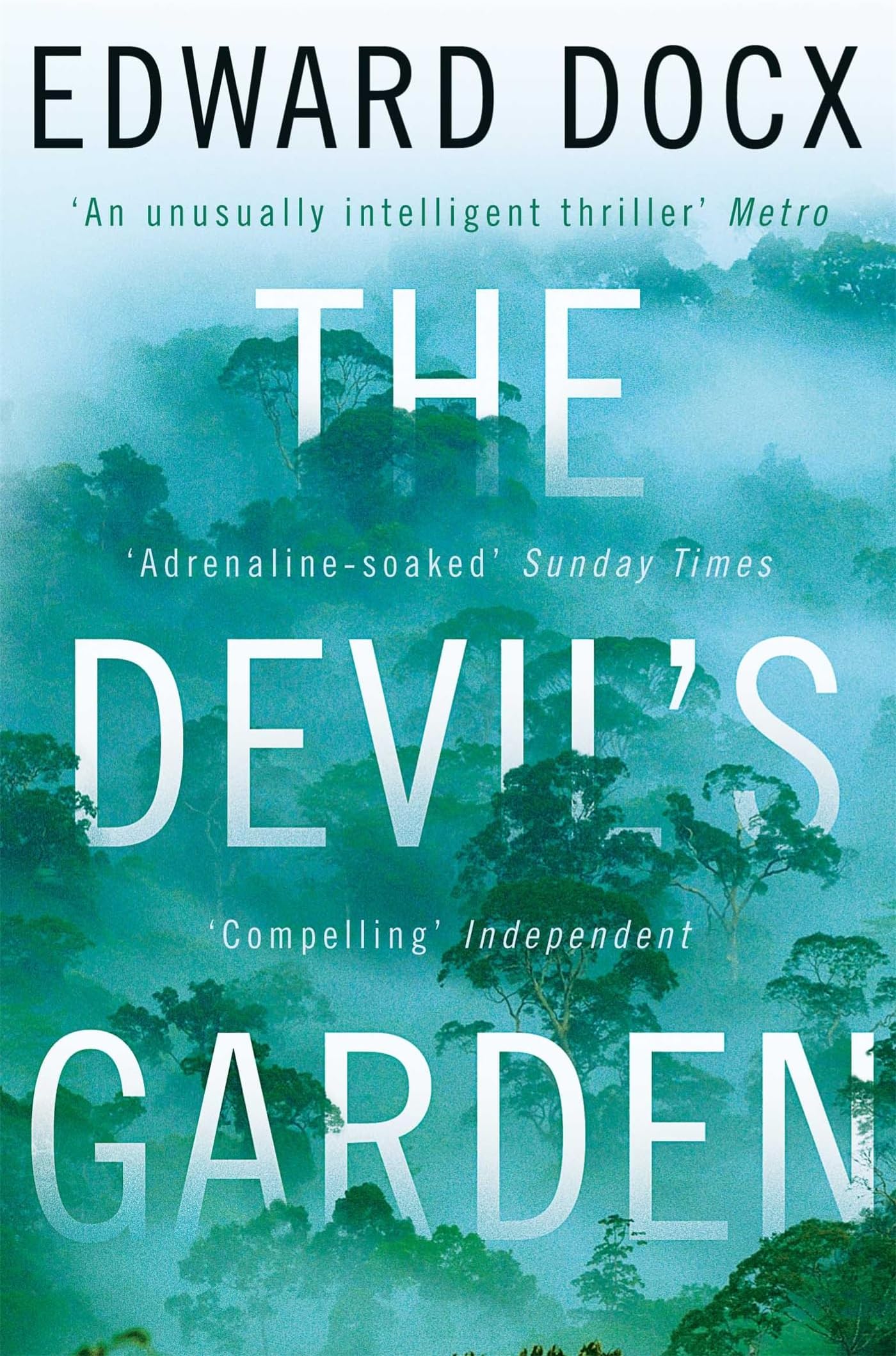
The Devil's Garden
Product ID: 62521714
Buy anything from 5,000+ international stores. One checkout price. No surprise fees. Join 2M+ shoppers on Desertcart.
Desertcart purchases this item on your behalf and handles shipping, customs, and support to Italy.
Buy The Devil's Garden by Docx, Edward from desertcart's Fiction Books Store. Everyday low prices on a huge range of new releases and classic fiction. Review: a trip to the jungle - Having visited this part of the world a few years ago, reading Docx's novel was just like taking a trip back. The exciting intrigue kept me on my toes throughout and the descriptions of smells, characters and atmosphere were so vivid it took me a while to get back down to earth once I'd put the book down. A great read - just beware of being trapped in the Devil's Garden's... Review: Instant disconnect - We join Dr Forle and his colleagues at a remote research station tucked away in the virgin tropical jungle. Following a bereavement, he throws himself in to the study of ants and the 'Devil's Gardens' they create, hoping to unlock secrets which will challenge the very principle of human existence, the theory of evolution. However, the life of Dr Forle and his crew is turned upside down when the sinister Colonel and the eccentric Judge take up residence at their station, using the cover story of registering the indigenous population for the vote. He soon finds himself drawn into the murky criminal underworld where it is never clear where government policy ends and organised crime begins. One of the main obstacles getting in the way of me enjoying this book is Dr Forle - He is a one-dimensional and colourless character who inspires no loyalty or empathy in the reader at all. He even comes across as a coward at times, hiding in the shadows when bullies pick on weaker individuals. Where he could seem mysterious and haunted he comes across as introspective and gloomy, making me tire quickly of his narrative voice. In fact, all the characters suffer from the same lack of personality, making it hard to tell them apart and even harder to care what happens to them. To make matters worse, most of the dialogue is clunky, contrived and unnatural. I get the impression that Docx uses dialogue between the characters to air his anthropological musings, but people simply don't talk like that. All he succeeded in producing was constant artificial and synthetic dialogue which made me disconnect at once. I also found the plot messy and strange - Who the Colonel and the Judge work for and what they are trying to achieve is never really cleared up, which made the whole thing seem rather pointless. I still don't know if the conflict was created by organised crime from cocaine barons, a corrupt government trying to clear away local tribes so they can move loggers in, or if it has something to do with oil or if it's simply just the tribes fighting amongst themselves. Either way, we are treated to some graphic scenes of grotesque violence which seem gratuitous and unnecessary. Despite all of this, the one thing I loved was the jungle. Without a doubt the jungle is the main character - a huge, hot, living, breathing thing constantly humming in the background. Every paragraph dedicated to the jungle is intensely atmospheric, it practically buzzes and simmers with strength and ruthlessness. And it is filled to the brim with insects which I could practically feel creeping on my skin. What an amazing book this would have been if Docx had applied the same talent throughout! But unfortunately he has not, and the result is boring and disappointing.
| Best Sellers Rank | 1,458,778 in Books ( See Top 100 in Books ) 66,209 in Contemporary Fiction (Books) 69,870 in Literary Fiction (Books) |
| Customer Reviews | 3.6 out of 5 stars 42 Reviews |
E**M
a trip to the jungle
Having visited this part of the world a few years ago, reading Docx's novel was just like taking a trip back. The exciting intrigue kept me on my toes throughout and the descriptions of smells, characters and atmosphere were so vivid it took me a while to get back down to earth once I'd put the book down. A great read - just beware of being trapped in the Devil's Garden's...
B**1
Instant disconnect
We join Dr Forle and his colleagues at a remote research station tucked away in the virgin tropical jungle. Following a bereavement, he throws himself in to the study of ants and the 'Devil's Gardens' they create, hoping to unlock secrets which will challenge the very principle of human existence, the theory of evolution. However, the life of Dr Forle and his crew is turned upside down when the sinister Colonel and the eccentric Judge take up residence at their station, using the cover story of registering the indigenous population for the vote. He soon finds himself drawn into the murky criminal underworld where it is never clear where government policy ends and organised crime begins. One of the main obstacles getting in the way of me enjoying this book is Dr Forle - He is a one-dimensional and colourless character who inspires no loyalty or empathy in the reader at all. He even comes across as a coward at times, hiding in the shadows when bullies pick on weaker individuals. Where he could seem mysterious and haunted he comes across as introspective and gloomy, making me tire quickly of his narrative voice. In fact, all the characters suffer from the same lack of personality, making it hard to tell them apart and even harder to care what happens to them. To make matters worse, most of the dialogue is clunky, contrived and unnatural. I get the impression that Docx uses dialogue between the characters to air his anthropological musings, but people simply don't talk like that. All he succeeded in producing was constant artificial and synthetic dialogue which made me disconnect at once. I also found the plot messy and strange - Who the Colonel and the Judge work for and what they are trying to achieve is never really cleared up, which made the whole thing seem rather pointless. I still don't know if the conflict was created by organised crime from cocaine barons, a corrupt government trying to clear away local tribes so they can move loggers in, or if it has something to do with oil or if it's simply just the tribes fighting amongst themselves. Either way, we are treated to some graphic scenes of grotesque violence which seem gratuitous and unnecessary. Despite all of this, the one thing I loved was the jungle. Without a doubt the jungle is the main character - a huge, hot, living, breathing thing constantly humming in the background. Every paragraph dedicated to the jungle is intensely atmospheric, it practically buzzes and simmers with strength and ruthlessness. And it is filled to the brim with insects which I could practically feel creeping on my skin. What an amazing book this would have been if Docx had applied the same talent throughout! But unfortunately he has not, and the result is boring and disappointing.
J**H
Read at a sitting
Gripping and mysterious from page one. this exotic, baleful tale of cynical corruption, gruesome violence and politico-industrial machinations in the heart of a South American rain forest pits the idealism of a group of scientists, examining ant behaviour, against malign human antagonists who prove to be even more lethal than the forest itself. My supreme delight was in the beautifully worked-out sub-plot of the scientific project: the study of altruistic behaviour among a particular species of ant. If altruism can be proved, the basis of neo-Darwinism is undermined, if not overthrown, and a mighty challenge raised against the modern religion of Scientific Materialism. The author cunningly (and properly, because this is literature not polemic) leaves the issue unresolved. But as the story heads unputdownably towards its ghastly - but also uplifting - conclusion,a delicious question mark hovers: are the ants better than we are? After all, they have the potential to take over and destroy the whole forest but for some reason (never discovered) they do not. And it seems that they may be kinder to one another than we are.
R**D
Curate's egg
This book has stayed with me since I finished it a couple of weeks ago, but I can't honestly say I thought it was brilliant. Set in the Amazon (although there's no explicit reference to the location), Dr Forle is an entomologist who has travelled to the area to study the behaviour of ants, specifically in areas called The Devil's Gardens. However, this work is a backdrop to the unseemly politics of the area, as local, corrupt government officials come along to try to register and ultimately bribe indigenous tribes with drugs and Westernisation, all the time acting in a threatening manner towards and around Dr Forle and his team. Docx's writing is certainly evocative and I had exceptional vivid scenes of the settings in my head, but the story failed to grab me, as it probably should. I desperately wanted to know more about the behaviour of the ants they were studying and less about the frankly odious government officials. Good, but just not great.
H**N
Tense and menacing jungle tale...
This is a story which is both about nature and the nature of mankind. Dr. Forle is a scientist, researching the behaviour of ants and ant colonies in the South American jungle - which is vividly portrayed in terms of sound, heat and discomfort and the growing presence of dangerous unfamiliar elements. Located primarily in a scientific camp, the environment, like the story, becomes more claustrophobic and threatening as the tale unfolds like the dense undergrowth of the forest itself - one moment lighter, more open, the next darker and harder to penetrate. I enjoyed the sense of underlying menace that is well portrayed by Docx. In some ways it is almost stifling. Although some parts of the writing felt slightly disjointed actually they fit well with the rhythm of the story. All said and done however the story itself does not really take off - there is a central theme which though compelling does not develop greatly. In terms of character development I'm not sure that I cared hugely more for Forle by the end of the book than I did when I started.
T**X
Jumble in the Jungle
There are too many themes and the result is muddled. Ants, Darwinism, rainforest destruction, remote tribes, scientific study are jumbled together in a plot that pits 'civilised' westerners against the brutality of everyone else. Sometimes, as in the utterances of the judge, I sensed a hint of Conrad and the ability to peer into the human soul but this theme gets lost in the mayhem of the main plot. By the end, the brutality begins to look like a racist caricature of various groups of South Americans. The westerners flee for their lives and forget their supposed altruism but then maybe the altruistic ants would do the same in a panic. Beneath the muddle of themes there lies nothing profound.
J**E
Homo Fabulans, Homo Mendax, Homo Necans
If the Amazon rain forest is the last paradise, then it is one which mankind is intent on thoroughly ruining, turning into a hell on earth. The complex imagery of this fascinating novel, from the double meaning of its title to the subtle interplay of religion of all kinds with evolutionary science, exercise a slowly tightening grip which is almost mesmerising. This jungle is a busy place, the stage for research scientists, indians of various degrees of western influence, the brutal soldiers of the state, those representing cocaine producers, oil prospectors, ecological spies, evangelical missionaries, and hovering somewhere in the background, the Uncontacted. There is murder and suspected murder, brutal torture, a hazy war among the trees which is never clarified. There are rave parties on jungle beaches, clapped out post gold rush shanty towns, satellite dishes on huts in the depths of the forest, and a long death dealing drought - and everywhere the pernicious decay created by western civilisation. The unreliable narrator, Dr J Forle (we do not learn what the J stands for until near the end) is not so much deceptive as careless with his story. Characters are mentioned whom we know nothing about. A disreputable past is hinted at ('the old lassitude' 'He tells everyone he is a scientist' 'I am not a doctor'). His debates with the unnamed Judge, a suave Satan, are a pleasure to read and really bring the story alive. Characters speak in aphorisms ('like so many whose lives pass busily and who in the end do nothing'). There are echoes of Conrad here, a kind of redemption in apocalyptic and cathartic violence, some sort of hope, the cooperative and selfless ants who will inherit the earth contrasted with the 'selfish gene' of homo sapiens, homo fabulans, homo mendax, homo necans, man the story teller, man the liar, man the killer.
O**S
average
This is one of my few forays into general fiction and I left feeling underwhelmed. The Devil's Garden was billed as an action packed book of The Heart of Darkness mould, but lacked that book's intensity. The location was good but I think it was touched on a little too lightly, and I think the politics could have been used a bit more - here it was mainly off scene. Also I didn't get the connection with the ants, were they a metaphor for something, if they were then they were also underused. All in all the book touches on things but offers very little.-- this book is readable but unspectacular.
Trustpilot
4 days ago
1 month ago