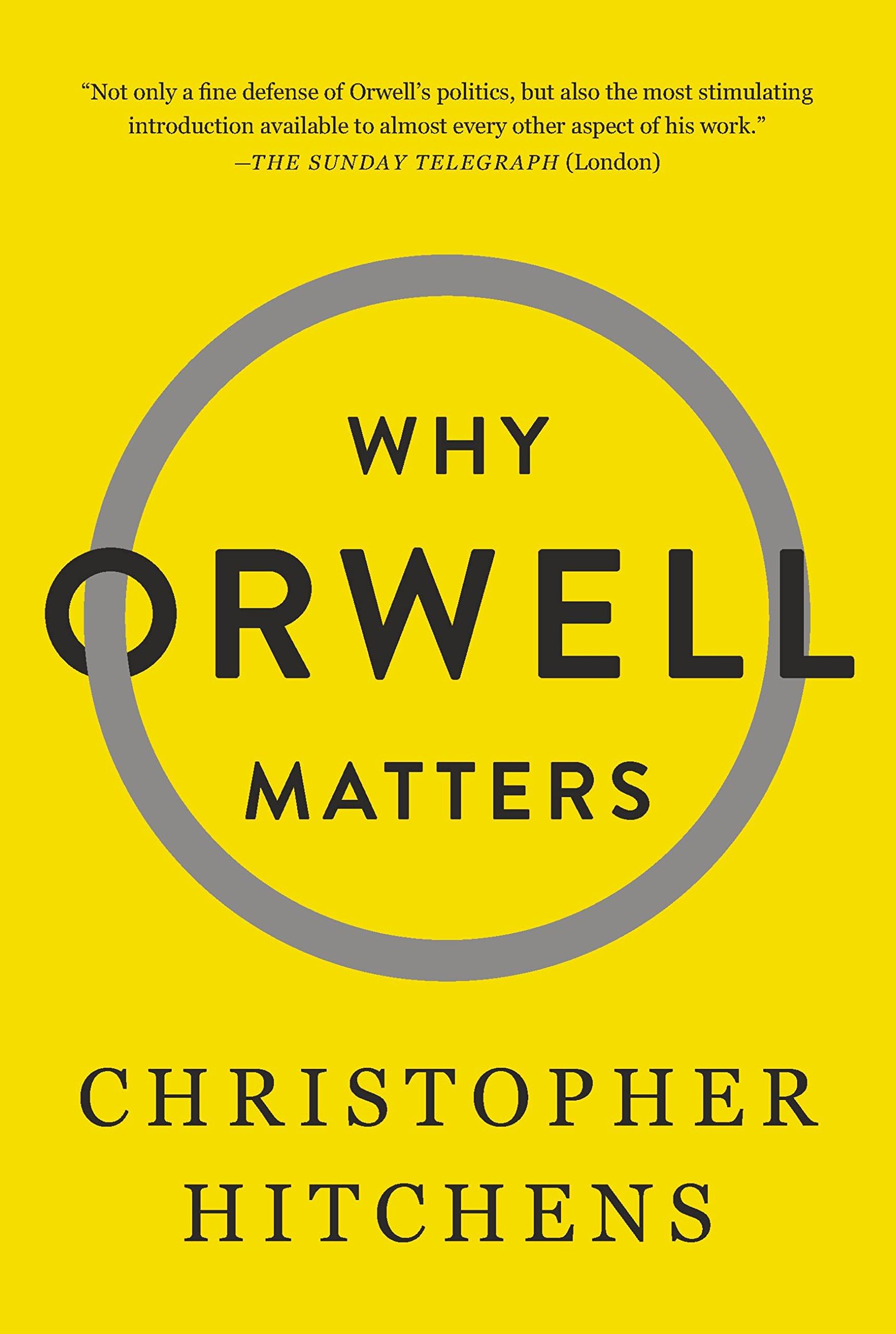
Why Orwell Matters
Product ID: 5581470
Buy anything from 5,000+ international stores. One checkout price. No surprise fees. Join 2M+ shoppers on Desertcart.
Desertcart purchases this item on your behalf and handles shipping, customs, and support to Italy.
desertcart.com: Why Orwell Matters: 9780465030507: Hitchens, Christopher: Books Review: witty, historical, intriguing - I bought the ebook/Kindle edition and love it. Bravo to desertcart for carrying what the iBook store doesn't!! There are two people who figure prominently in this book. George Orwell (the subject) and Christopher Hitchens (the author) But first: Why read this book? This book attempts to answer the question, why should George Orwell -- his life and writings -- matter to us anymore? This book succeeds amazingly in making Orwell seem relevant Not just relevant, Orwell is totally fascinating and intriguing. Who is "us"? Probably, primarily, the English speaking parts of the world, But it is by no means limited to this. It is made imminently clear to us that Orwell matters to the U.S.S.R, to modern Russia, to Eastern and Western Europe, to Inida and the sub-continent, to Africa, to Spain, to intellectuals, to non-intellectuals, to anti-intellectuals. George Orwell: most of us know him merely as the author of 1984 and Animal Farm (this would include me). He is ever so much more. And he is considered in such high regard in so many other cultures (aside from the U.K. and the U.S.A) for so many compelling reasons. Reading this makes me want to reread the books mentioned above... and i will. Christopher Hitchens: is an amazing writing. Lest I be guilty of too much subjectivity, I'll provide some specifics so you can decide for yourself. The author is not necessarily easy to read. His vocabulary is inexhaustible, and he brings it all to bear on his subject. He contends -- like a bullfighter -- with the other authors who have written about George Orwell. He also reveals Orwell in his historical and cultural context so that we can better understand him. Consequently, this is a tour de force of England and Europe during the first half of the 20th century. Explored are topics that include the two world wars, colonialism, imperialism, capitalism, socialism, marxism, absolutism, tyranny, bigotry, slavery, ideology, feminism, and religion. I highly recommend this book and the digital format that I bought. I hope this helped. Review: Must read for the curious - Great classic book. Extremely well-written. Buy it and read it.


| Best Sellers Rank | #135,019 in Books ( See Top 100 in Books ) #82 in British & Irish Literary Criticism (Books) #278 in Essays (Books) #353 in Author Biographies |
| Customer Reviews | 4.6 4.6 out of 5 stars (889) |
| Dimensions | 5.3 x 0.8 x 8.05 inches |
| Edition | Reprint |
| ISBN-10 | 0465030505 |
| ISBN-13 | 978-0465030507 |
| Item Weight | 2.31 pounds |
| Language | English |
| Print length | 224 pages |
| Publication date | September 11, 2003 |
| Publisher | Basic Books |
| Reading age | 18 years and up |
D**8
witty, historical, intriguing
I bought the ebook/Kindle edition and love it. Bravo to Amazon for carrying what the iBook store doesn't!! There are two people who figure prominently in this book. George Orwell (the subject) and Christopher Hitchens (the author) But first: Why read this book? This book attempts to answer the question, why should George Orwell -- his life and writings -- matter to us anymore? This book succeeds amazingly in making Orwell seem relevant Not just relevant, Orwell is totally fascinating and intriguing. Who is "us"? Probably, primarily, the English speaking parts of the world, But it is by no means limited to this. It is made imminently clear to us that Orwell matters to the U.S.S.R, to modern Russia, to Eastern and Western Europe, to Inida and the sub-continent, to Africa, to Spain, to intellectuals, to non-intellectuals, to anti-intellectuals. George Orwell: most of us know him merely as the author of 1984 and Animal Farm (this would include me). He is ever so much more. And he is considered in such high regard in so many other cultures (aside from the U.K. and the U.S.A) for so many compelling reasons. Reading this makes me want to reread the books mentioned above... and i will. Christopher Hitchens: is an amazing writing. Lest I be guilty of too much subjectivity, I'll provide some specifics so you can decide for yourself. The author is not necessarily easy to read. His vocabulary is inexhaustible, and he brings it all to bear on his subject. He contends -- like a bullfighter -- with the other authors who have written about George Orwell. He also reveals Orwell in his historical and cultural context so that we can better understand him. Consequently, this is a tour de force of England and Europe during the first half of the 20th century. Explored are topics that include the two world wars, colonialism, imperialism, capitalism, socialism, marxism, absolutism, tyranny, bigotry, slavery, ideology, feminism, and religion. I highly recommend this book and the digital format that I bought. I hope this helped.
D**I
Must read for the curious
Great classic book. Extremely well-written. Buy it and read it.
B**J
Interesting semi-biography of Orwell
Hitchens was obviously writing to the academic crowd and not to a wider audience--I have a graduate degree but had to sit with a dictionary at hand because he uses so many archaic and/or little-used words. Though I do not believe he ever got to the point of why Orwell matters (only indirectly) it was an interesting take on Orwell's life. One downside is that Hitchens was obsessed with Orwell's so-called "unexamined and philistine prejudice against homosexuality" including some similar remark in nearly every chapter. Why? Just because Orwell was English does automatically infer he should have either been a homosexual or accepting of the practice of it. How does Hitchens know it was an unexamined prejudice? And why is a mid-twentieth century position absolutely normal for the entirety of history (up until a few years ago) considered "philistine"? Interesting take, but I am not impressed with Hitchens--especially after all the build-up about him I read from various sources.
D**S
Hitchens Cites Orwell To Warn On Freedom's Fragility
In my youth, having read, digested and fervently believed in the wisdom expressed in classics such as Animal Farm and Huxley's Brave New World about the fragility of freedom, it was a particular pleasure to find, as I so often have, similar opinions as those so eloquently expressed by the late Christopher Hitchens in his short non fiction 2002 book, Why Orwell Matters. Robert Conquest's 1969 poem written to Orwell in the heart of the Cold War introduces Hitchens to his realistic assessment of Orwell, the mere mortal, not the saint, but he quickly teaches us Orwell's seminal theme, his "decision to repudiate the unthinking imperialism that had been his family's meal ticket..." As the basic human rights far too many Americans take for granted today are being systematically chipped away by our empire building industrial military complex, one needs to understand that this is a fatal mania, one which brought down Rome and other empires. As for Orwell's screeds against Hitler, Mussolini and Franco, Hitchens calls that part of his work "not among his best", but notes that "His one special insight was to notice the frequent collusion of the Roman Catholic Church and of Catholic intellectuals with this saturnalia of wickedness and stupidity". Suggest one read, "Hitler's Pope" as ample example. How about present day influences by the RCC and the evangelicals on personal freedom and basic human rights. Hitchens lauds Orwell as "vividly contemporary" citing his concerns with language such as "political correctness" his worry about the environment and his "acute awareness of the dangers of `nuclearism' and the nuclear state". Orwell died in 1950 before the US had fully established its empire building role, and before our basic freedoms were seriously eroded by our growing militarism. A George Washington University Public Interest Law Professor named Jonathan Turley in his January 13, 2012 Washington Post OP Ed recently listed "10 reasons the US is no longer the land of the free", which perfectly mirrors the Orwellian erosion of rights depicted in Animal Farm. [...] Turley's list offers this synthesizing comment: "In the decade since Sept. 11, 2001, this country has comprehensively reduced civil liberties in the name of an expanded security state. The most recent example of this was the National Defense Authorization Act, signed Dec. 31, which allows for the indefinite detention of citizens. At what point does the reduction of individual rights in our country change how we define ourselves? While each new national security power Washington has embraced was controversial when enacted, they are often discussed in isolation. But they don't operate in isolation. They form a mosaic of powers under which our country could be considered, at least in part, authoritarian. Americans often proclaim our nation as a symbol of freedom to the world while dismissing nations such as Cuba and China as categorically unfree. Yet, objectively, we may be only half right. Those countries do lack basic individual rights such as due process, placing them outside any reasonable definition of "free," but the United States now has much more in common with such regimes than anyone may like to admit." Do Americans realize we have now lost the right of Habeas Corpus? Be sure to read this Hitchens classic as it will disturb you, but likewise prepare you better to vigorously oppose the drift of our nation further into the tyranny of its growing authoritarianisms.
D**I
Hitchens is quintessential reading on any level
If Hitchens wrote it, then you can be assured that it is meticulously researched. He was a big fan of Orwell, who, sadly, is only remembered by most for 1984 and Animal Farm which is required reading in most High Schools. The underpinnings of both books is the passion for totalitarian rule, fascism and euphemism espoused by the tyrants of Orwells day and vehemently opposed by the author at time when he was not the voice of the majority. Orwell is as relevant today as he was in the 40's and 50's. A little knowledge of him, his books, his history of fighting regimes and his essays such as Politics and the English Language, will help to shine a light on our current political struggles.
S**O
Very interesting read.
S**S
As clear, reflective and informed as all of Hitchen's writings. This book applied the fairness Orwell applys to his own writings in general and uses clearly backed up arguments. Enlightening and balanced critique, I have only recently discovered Christopher Hitchens and have no higher praise than to recommend an erudite writer whose content is equal to his style. A brilliant read.
"**"
My bias is that I have been a long time admirer of George Orwell both as a writer and a socialist/humanist. At school in the late sixties both Animal Farm and 1984 were required reading. Even at 14, we got the politics of Animal Farm. Later in my early teenage years, it was Homage to Catalonia and Road to Wigan Pier that resonated. Lately it has been re-reading articles, essays and reviews for the enjoyment of his writing clarity and analysis. So I was not expecting Mr Hitchens' book to increase my thinking about Orwell. But it did. Yes, there was an initial salvo of bombast but this is a well constructed appreciation and test of Orwell as a writer, political person and human being. It is informative, critical thought at its best! Through this emerges Eric Blair, with flaws but a mighty heart and appetite for thought and people. Although it would be expected that George Orwell might well be a historical anachronism by now, he still remains relevant, if only by demonstrating the value of having a mind that tests orthodoxy and calling the unacceptable-unacceptable and telling you why. After reading this I went back and read Animal Farm and will revisit George Orwell's novels.
Q**S
Well it is Hitchens, and I am a huge fan still…
J**R
An argument for George Orwell's work. It's not a biography of Orwell though there are some tantalising snippets of information about the man and his politics. Orwell hated being a policeman (in Burma) and resigned rather abruptly, maintaining a distrust of police generally for the rest of his life, as well as a dislike of colonialism. For this he seemed ahead of his time except for a dislike of homosexuality. The book is loaded with great observations: 'Conquering nations use racism as a way of pushing exploitation beyond the point that is normally possible by pretending that the exploited are not human beings.' It's interesting to note when he worked at the BBC the room where editorial meetings for the Eastern Services were held was Room 101. The lengthening shadow of Nineteen Eighty-Four was everywhere: 'Totalitarianism, if not fought against, could triumph anywhere' he says, having taken a bullet in the neck fighting the fascists in the Spanish Civil War. In a 1947 essay Orwell concluded: 'A socialist United States of Europe seems to me the only worthwhile political objective today'. Oh dear, not since the 2016 Brexit vote. 'England was a family with the wrong members in control with rich relations who are horribly kowtowed to, and poor relations who are horribly sat upon' he said. In May 1946 he wrote something quite pertinent for today's Jeremy Corbyn Labour Party: ' The main danger from any Communist-led split in the Labour movement was that it could hardly result in a Communist controlled government, but it might bring back the Conservatives'. An interesting read.
Trustpilot
1 month ago
3 days ago