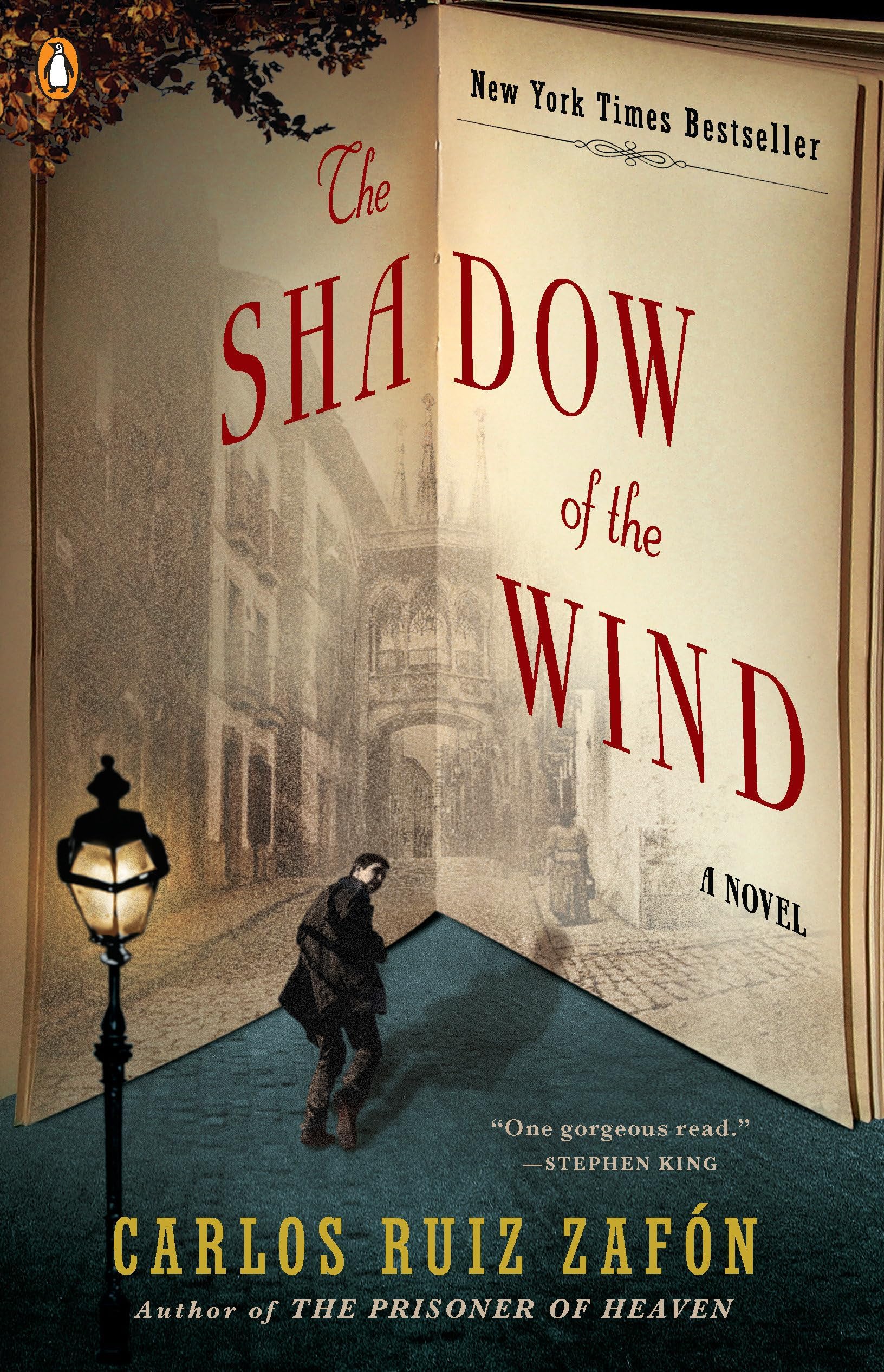
The Shadow of the Wind
Product ID: 5354493
🌆Vivid post-war Barcelona setting
🏆Top #20 Historical Mystery
📚Epic literary journey
Desertcart purchases this item on your behalf and handles shipping, customs, and support to Italy.
📖 Unlock the secrets of Barcelona’s darkest tales — don’t miss the book everyone’s whispering about!
The Shadow of the Wind is a bestselling novel by Carlos Ruiz Zafón, blending mystery, romance, and historical fiction set in post-war Barcelona. Praised for its richly drawn characters and atmospheric storytelling, it ranks in the top 20 Historical Mystery books and has captivated over 26,000 readers with a 4.5-star average rating. This literary treasure invites readers into a haunting quest filled with love, loss, and the enduring power of literature.


| Best Sellers Rank | #5,171 in Books ( See Top 100 in Books ) #19 in Historical Mystery #96 in Contemporary Literature & Fiction #330 in Literary Fiction (Books) |
| Customer Reviews | 4.5 out of 5 stars 26,686 Reviews |
D**R
A beautiful and haunting work of art
After finishing "The Shadow of the Wind" by Carlos Ruiz Zafon it is difficult for me to stop thinking about it. Rarely do I read a book that can be a well written literary work and a page turner at the same time. The Shadow of the Wind is one of those novels where Zafon has crafted an enchanting story while paying tribute to his hometown, Barcelona. He describes the city and its mysterious environment with such beautiful detail. Zafon's world feels magical, yet realistic told in a tale profoundly expressed through themes we suffer from everyday including heartbreaking romance, internal revenge, and dealing with the loss of a loved one. The Shadow of the Wind connects all of these themes by the power literature has on us. The novel's hero is young Daniel Sempere who suffers from not being able to remember the death of his mother. One day his father takes him to the Cemetery of Forgotten Books where he finds a book called "The Shadow of the Wind" by Julian Carax. After falling in love with the book Daniel becomes obsessed with discovering who the mysterious Julian Carax is and what happened to him. As Daniel digs deep into Carax's past he discovers one of Barcelona's most disturbing secrets and at the same time his own drifting innocence. Zafon creates a unique and moving tale with Daniel and Julian, where the young book reader begins to realize that his own life is paralleling the author he has grown to admire. Here the novel reveals a great tragedy that becomes a horror to read and Zafon handles it delicately between Daniel and Julian concerning broken friendship, forbidden love, and a malicious evil with a history that plans to join their destinies. "The Shadow of the Wind" is a real pleasure to read from its fast paced mystery to its wonderfully drawn characters including Daniel, his lovable retired secret agent sidekick Fermin Romero De Torres, his love interests, Bea Aguilar and Clara Barcelo. I enjoyed how Zafon weaved his romances into the story, developing Daniel's struggles with growing up between the two women he has affection for. He is nine years old when he falls for Clara, the gorgeous blind niece of the bookseller Gustavo whom he visits her to read to. It felt so true to life when Daniel learns how foolish his crush is when he witnesses Clara's affair with another man. His second love is when he is seventeen and has become a mature young man as he grows more intimate with Bea Aguilar who is his best friend's sister. Through the time he spends with Bea, Daniel learns what it means to fall in love in someone. In the end the novel is a moving story about love between two men, Daniel and Julian who venture through their own darkness to give each other the strong measure of peace they desire and hope to achieve. Zafon handles every sub plot well in this book including the adventure Daniel must embark on to discover Julian and himself turning the story into a well crafted epic. From the moment Daniel discovers The Shadow of the Wind in the Cemetery of Forgotten Books to the climax with Julian Carax's adversary Inspector Franciso Javier Fumero, the story is a rare wonder. I will not spoil anymore for you beyond that Inspector Fumero is one of the most evil villains you will ever read in fiction. For those of you readers who want to read a stand alone tale "The Shadow of the Wind" is a single novel that brings every character and sub story to a fulfilling end. It is a book that everyone should give chance if you love to read; a beautifully woven story of adventure, romance, friendship, family, death, and spiritual redemption. Zafon has written a wonderful story that has something for everyone while faithful to the message that literature is powerful and can affect our perception of the world whether its through our eyes or the author's. This is one of those books that can turn a person who despises reading into a devoted bibliophile. Gorgeous from start to finish and one of my favorites next to "Lonesome Dove" by Larry McMurtry and "The House of the Scorpion" by Nancy Farmer.
P**E
This GREAT read sometimes gets lost in the translation
I understand why this book series has gotten such good press. It must be a gorgeous read in Spanish. The only trouble is: I read in English. I hate to say something so negative here but the translation is awful. I mean, this translator never wrote a sentence without at least one unnecessary 'that.' Some short paragraphs had as many as nine 'thats.' Yeah, I counted at one point... I am a firm believer the written word should be just a tad better than everyday speech. I don't buy into the modern dictionary's nine or more definitions for 'that.' Ridiculous! It is a pronoun one should use VERY sparingly. Anyone getting past a beginning writing course should know to watch how many times they use it. It is NOT a helping verb. When used with a verb it should trigger use of the gerund instead. Does any writer anywhere know what a gerund is anymore? AI editing will do that for us someday, I do hope. And don't get me started on punctuation. I think Amazon is running everything through a punctuation program automatically adding a comma before every conjunction. The programmer skipped class when the lessons were on commas. You don't need a comma between the two sides of every compound sentence. You don't need a comma before every so, every but, every and. Every, single, one! A comma every single time an oral reader takes a breath. It is enough interruption to make me nuts! I want to read for enjoyment, not do their editing with one finger through a Kindle screen with no way of knowing whether anyone actually ever sees the ERROR corrections. Okay, setting all that aside, I do have to say these books are some of my absolute favorites from a story standpoint. I picked it up (in print, in English) in a Madrid hotel and I reread them every few years. Fermin is one of the best characters I've encountered in many years of avid reading. He is hilarious and tragic, too. The story of Julian and his friends always sticks with me. Somehow they are very believable and understandable to me. Barcelona is a city I love to hate. It has its beautiful side and is fun to envision in the timeframe of the books. I can imagine the city streets and do enjoy the mention of landmarks in a city I know a little. I don't mind reading the teenage boy angst. My imagination goes wild with the scenes and settings in the new and the old parts of the city. If you can overlook some terrible translation faux pas I highly recommend this series of books! And DO read them in Spanish if you can!
S**R
A Truly Amazing Novel
Book Review: The Shadow of the Wind by Carlos Ruiz Zafón ⭐️⭐️⭐️⭐️⭐️ (5/5) Few novels capture the sheer magic of storytelling the way Carlos Ruiz Zafón’s The Shadow of the Wind does. Set in post–Civil War Barcelona, this haunting literary mystery is part coming-of-age tale, part gothic romance, and part love letter to books themselves. Zafón’s writing envelops the reader in a world where stories are living things—fragile, dangerous, and immortal. The novel opens when a young boy named Daniel Sempere is taken by his father to a secret, labyrinthine place known as the Cemetery of Forgotten Books—a repository for works lost to time. Daniel selects a single novel, The Shadow of the Wind by Julián Carax, unaware that this choice will alter the course of his life. As he grows up, Daniel becomes obsessed with uncovering the fate of Carax, whose books have been systematically destroyed by a mysterious figure. What begins as literary curiosity soon unravels into a web of intrigue, passion, revenge, and tragedy. Zafón’s prose, even in translation, is breathtaking—lyrical yet accessible, cinematic in scope but intimate in emotion. He evokes the dark beauty of Barcelona with sensory precision: the damp cobblestones, the decaying mansions, the fog that seems to breathe secrets. The city itself becomes a character—moody, enigmatic, full of shadow and whisper. The novel’s structure is masterful, interweaving past and present, fact and fiction, as Daniel’s search mirrors Carax’s own doomed journey. Every revelation feels earned; every coincidence, fated. The characters—Daniel, his witty companion Fermín Romero de Torres, the elusive Carax, and the malevolent Inspector Fumero—are unforgettable. Fermín, especially, provides both comic relief and profound wisdom, grounding the story’s darker elements in humanity and warmth. At its heart, The Shadow of the Wind is a meditation on memory, obsession, and the enduring power of books to preserve truth and emotion long after their authors are gone. It’s about how stories connect lives across time—and how love, though often tragic, is what gives them meaning. For readers who cherish The Name of the Rose, The Book Thief, or The Night Circus, this novel offers that same intoxicating mix of mystery, melancholy, and magic. It’s a book to get lost in—a story about stories, where every page seems to murmur a secret of its own.
V**A
Stunning and Unlike anything I have ever read
I have always believed that a book finds you, if it wants you to read it. I think that happens to most of us - to the reader who waits patiently for the book to come along and take him or her on a ride that cannot be forgotten. Two people and very different people at that told me to read, "The Shadow of the Wind". I had the book in my possession, however had not read it till then. I always wanted to, but did not. I guess my time had to come on its own. I had to wait for the book and it has been a wait worth it like no other. "The Shadow of the Wind" by Carlos Ruiz Zafon is everything you expect from a well-written book. The plot makes you turn the pages. The sentences and language make you fall in love with the writer's thought process. The characters make you connect with them at all levels of human emotions and more than anything else, this book is about love for literature and reading, and not letting the written word die. The book is about the search of a boy, Daniel Sempere for the truth about the fate of Julian Carax, the author of a mystery novel (also named The Shadow of the Wind). Daniel adopts the book when his father, a bibliophile and a bookseller takes him to the metaphorical (or real) Cemetery of Forgotten Books and it is there that he owns the book and gets embroiled in its author's life. He sets out to search for more books written by him and to know what happened to him. In all of this, he learns of someone who is named after one of Carax's characters and has set out to burn every single copy of Carax's books and will not stop at anything. Daniel gets involved with him as well and the story thickens. It is one tale after another, intertwined and encompassing the length and breadth of great storytelling, till the reader with bated breath reaches the end of the book. The book is about Barcelona's deepest and darkest secret that is about to be revealed, which of course the reader has to discover for himself or herself. Zafon's characters are haunting and well thought after. He is the master of mood setting. Every page speaks of scenes with mists, clouds, evenings, darkness, the pale lamplight, thunder, rain and Zafon brilliantly so makes the reader a part of his atmosphere and setting, so much so that I actually thought I was living all of it in Barcelona (where the story is set). Zafon speaks of books like living beings, which I also think they are and he makes them real for the readers in his book. To a very large extent, the book is extraordinary because of the way the author is treating every word - with great caution and love. When this happens in a book, it is but natural that the reader will also read every word with great love and joy. With reference to the setting, which is Barcelona before the Spanish Civil War, Zafon talks of politics and life with great passion and almost wants the reader to know how important the setting is to the story. Books about books have always fascinated me and this was also one of those reads. It is very difficult to classify "The Shadow of the Wind" in one genre and yet to a large extent I think the book belongs to Literary Fiction as it covers almost every aspect of life and living. There is courage, intrigue, love, fairy tale quality, Goth, redemption, politics, love, hate, passion and almost every other emotion and characteristic that you can think of in the book. The quality of writing, the old school setting, the power of storytelling, the characters and the plot, all come together and speak of books and reading and the love for them. I could go on and on about this book and the writing, but you know what I mean when I say: Read this book soon or let it find you the way it found me.
R**B
Fantastic book; Didn't want to put down.
For a fantastic mystery and adventure, read this book. It is a complex plot with many wonderful characters that you have a chance to get to know. If so inclined, you become the investigator trying to solve the mystery that the story presents. The characters are well-developed and in-depth and connected with a very deep and extensive web of circumstances. It was great to get to know the characters. The plot was extensive and clearly developed. The author used used the chapters to evolve the plot in a clear and enticing manner. He also did this from different character's points of views. I would get to the end of one chapter and immediately want to go to the next. The style of writing and structure of the book and chapters make this an easy book to read. The author used some "uncommon" words. It was helpful to have a dictionary to make sure of understanding. Also, there were times I used a translation service. It makes it easy on the Kindle as it is built into the system. Barcelona set the stage for this story. Details in the book helped pique my interest and desire to visit this city at some point in the future. I also took away messages from the author about life. Those messages came from observing the actions that each character took in their life and the consequences that resulted from those actions. They really had me reflecting about my life. This was a surprising and welcome result from reading the book. Cheers, R
I**S
Glad I Finally Made Time For This One
As a fan of Southern Gothic Literature I didn’t find it too hard to enjoy this piece of Gothic Lit, but I found myself immensely enjoying the writing as well. When I read a line or paragraph in a novel that I enjoy I usually make a little dog-ear on the page, and for this novel, it looks like dozens of people are sharing one copy and have randomly stopped at different places. So, I have to recommend this novel on the beautiful prose alone. However, the story is fantastic in that there is mystery, devotion, murder, love, hopelessness, sadness, redemption, and vengeance all woven throughout plots, subplots, and unique characters. Even in cases where I couldn’t stand a character, I can empathize with them, feel sorry for them, or even hate them with a glorious passion that had me continually turning pages in the hopes that these poor souls are able to lift themselves up, solve a mystery that haunts them, break free from their love of a lackluster life, and in some cases, get what they have coming. What kept this from being a 5 start rating was that, since a great deal of backstory is needed, there are sections where characters will wax eloquent about scenes from their past which sheds light for both our main characters and the reader, but I didn’t like how questions were quickly answered in these flashbacks. These stories from the characters are wonderfully written and capture your attention, but my only complaint is rather than getting a few slices of our literary pizza here and there, in some cases, the delivery person just kicks down the door and throws the whole plot-pizza on the table. I can overlook this though as I also hate a story where a character or characters could solve mysteries, clear up misunderstandings, or generally stop a series of unfortunate events by simply sitting down and talking, but never get around to it since that doesn’t allow a book to be drawn out. So the mystery-solving-storytelling is not a huge problem. Read this book because the characters are beautifully flawed--as are we all--the story is wonderful in its complexity, and the overall book is one that I enjoyed and will come back to over the years.
C**1
Entertaining But Flawed
I almost never read novels which are New York Times Bestsellers. I feel - perhaps snobishly, I admit - that wide praise and acceptence is a negative. To make the List alongside Patterson, Clancy, and Bozo The Clown is a dubious acheivement at best. This book was recommended by a dear friend, so I made the plung. I lived in Spain, am fluent in Spanish, and love Barcelona. I say this to demonstrate some credulity in evaluating TSOTW. I can sense the author's passion - it is the classic Spanish passion for life and all things wondrous. This is a mavelous thing. The translation is good, but nuances are carried over which should have been edited more properly into English. This is a minor flaw. The author can truly turn a magical phrase. The soliloquies of Fermin are, for example, priceless. Ruis Zafon's ability to paint a scene is masterful. The story, at it's heart, is novel and fresh. These qualities are laudible. To my reading, however, the negatives out-wieghed the positives. I finished the book not out of burning desire, but simply to see how it ended - if it ever ended. This is not an aspect of an opus an author should want to cultivate. For me, the very clever wit and colorful writing techinque became burdensome. The text was, if you will, over-flowery. It's kind of like those high notes Mariah Carey can hit. One is impressive, but ten in one song would be poisonous. Yeah, like that, Ruiz Zafon hit way too many high notes and it left me spying for the exit. Also, the core story, the human interplay, is repeated and speculated upon WAY too much. By the time the actual truth is told, I didn't really care. Further, the book is too predictable, which is a bad thing. I guessed the devil-character's identity half way though. Everything and everyone ends up so very happy (exept for the evil villain and those brutily murdered). Eh. Plot gaps abound. Why would the protagonist place his family and friends at mortal risk to continue his investigation based on his curiosity? The basis of this illogical motivation is never clear. Why didn't the devil character simply kill the evil guy when it was apparent it needed to be done and save all the brutal murders? Hum? Why didn't the evil guy kill the protagonist and Fermin midway through the book, like a good sociopath? I could go on, but will spare you the tiraid. Finally, can anyone say "anti-climax"? Seriously, TSOTW could and should have ended anywhere from page 449 - 487. It would have been a great mercy! I hate those tortured, staggering endings. It's like when the actor shot in a B movie keeps kicking and spurting and speaking when he should rightfully be silent as the grave. Bottom line, this is a well written, to an extent, and a passionate book. Is it worth reading? Perhaps but not definitely. That's the best I can advise.
L**R
Zafón, Eco and Mercier - books, regimes and ideas
Last week, I finished Night Train to Lisbon by Pascal Mercier. A thoughtful, erudite book, to be enjoyed at one’s own pace. For me, it has a distinctive European approach to storytelling, which reminded me of two other wonderful works – The Mysterious Flame of Queen Loana by Umberto Eco and Carlos Ruiz Zafón’s The Shadow of the Wind. Each of these novels takes the concept of books as portals – a gateway, door or rabbit-hole through which our narrator explores someone else’s story. All contain a compelling ‘what if?’. In Night Train, a chance meeting with a Portuguese woman on a bridge provokes Gregorius, a Swiss teacher of Classics, to follow his curiosity. It leads him to a book, ‘Um Ourives das Palavras’ (A Goldsmith of Words), written by Amadeu de Prado. In an uncharacteristic act of spontaneity, Gregorius walks away from his life and boards a night train to Lisbon, just to discover more about the author. Eco’s premise in The Mysterious Flame hooked me instantly. An antique book dealer from Milan has lost his personal memory but recalls every book he ever read. Yambo journeys back to his youth through his books, searching for that mysterious flame to illuminate his sense of self. His memories return, along with those of his country’s recent history, including some he’d rather forget. The Cemetery of Forgotten Books is where ten-year-old Daniel encounters The Shadow of the Wind. He is charged with protecting that copy as the only one in existence. The book enthrals him and he wants to find out more about the author. But Julián Carax is dead and Daniel’s commitment to the book is attracting enemies. Not least a mysterious man seeking out all Carax’s work with the aim of total eradication. The novels mentioned above pull the reader into those other books, into other stories, and deliver more than one tale. A story within a story is a device I loved as a child, growing up with Celtic tales filled with diversions and tangents. Suspense and narrative drive is put on hold while another character takes the stage and changes the pace. There is a huge satisfaction in how the narratives meet, inform one another and return to pick up where they left off. I read all three of these European works in translation. And an uncomfortable echo resonates through every one. The cruelty, persecution, misery, torture and brutality meted out by the dictatorships of Salazar, Mussolini and Franco respectively add a tone of horror and heroism, courage and conscience, but most of all, fear. Many of the individuals who bear the scars – João Eça, Gragnola, Fermín Romero de Torres – represent aspects of human dignity under intolerable suffering. I could talk about the books’ locations and beautiful use of language at length, but what really absorbed me in each novel was the willingness to tackle ideas. Mercier (pseudonym for Peter Bieri, Swiss philosopher) employs Prado’s words to riff on appearances, faith and belief, time, travelling, homesickness, familial love and its influence. Eco explores memory, consciousness and identity through unpacking what shapes a person’s mind. Zafón, by dint of empathy with many characters, asks questions about honour, justice, loyalty and of course, love. The three books are extremely different in tone and style, yet surely the one of the richest and most pleasurable ways to explore Europe, its history, its storytelling traditions and its ideas. Some even involve trains.
B**J
The Shadow Of The Wind
Some books grab your attention by its title, some enthrall you by its story, a few by the beauty of the language, yet others by the setting, then others by the characters and certain others by the narration or plot. When all these come together in a book, you lose your heart to it,totally. It wouldn't be an exaggeration to say I haven't read something like this in a long time. Young Daniel wakes up one morning screaming for his long lost mother, and his father , who runs a bookshop that specializes in 'rare collectors' editions and secondhand books', takes him to a run down palatial building. As the large wooden door is opened and Daniel is ushered in to 'A labyrinth of passage-ways and crammed bookshelves rose from base to pinnacle like a beehive, woven with tunnels, steps, platforms and bridges that presaged an immense library of seemingly impossible geometry.' His father welcomes him to the place.... "Welcome to the Cemetery of Forgotten Books, Daniel......This is a place of mystery, Daniel, a sanctuary. Every book, every volume that you see here, has a soul. The soul of the person who wrote it and of those who read it and lived and dreamed with it. Every time a book changes hands, every time someone runs his eyes down its pages, its spirit grows and strengthens. This place was already ancient when my father brought me here for the first time, many years ago. Perhaps as old as the city itself. Nobody knows for certain how long it has existed, or who created it. I will tell you what my father told me, though. When a library disappears, or a bookshop closes down, when a book is consigned to oblivion, those of us who know this place, its guardians, make sure that it gets here. In this place, books no longer remembered by anyone, books that are lost in time, live forever, waiting for the day when they will reach a new reader's hands. In the shop we buy and sell them, but in truth books have no owner. Every book that you see here has been somebody's best friend. Now they only have us, Daniel. Do you think you'll be able to keep such a secret?" I was hooked. A wine-coloured leather bound book choses Daniel, one that he had never heard of before . He hadn't heard of the author, either. 'The Shadow of the Wind' by Juilan Carax. The ten year old's life is never the same again. Daniel is so captivated by the book that he wants to get hold of other books by the author. Not many had heard of the author and the strangest fact is that someone else also seems to be searching for Carax's books only to destroy them. As Daniel grows up and as he tries to learn more about Julian, his life seems to mirror that of the elusive author. The multitude of characters that have gone through Julian's life seem to be connected to Daniel as well, in one way or the other. The impish Fermin, Miquel and Jorge who were once Julian's best friends, Fumero who is manically unscrupulous, Isaac the guardian of forgotten books and his ill fated daughter Nuria, the ethereal Penelope who is Julian's only true love - each one of them has their own story that is inevitably bound in some way or other to Julian and each one is so strongly etched , they remain with you long after you have finished reading the book. This a story within a story , imperceptibly ties to each other. Julian's life, is set mostly in the background of the Spanish civil war .in the author's own words, "As it unfolded, the structure of the story began to remind me of one of those Russian dolls that contain innumerable diminishing replicas of themselves deep inside. Step by step the narrative split into a thousand stories, as if it had entered a gallery of mirrors, its identity fragmented into endless reflections." If stories have colors, this one would be a dak brown, with shades of light in between. There are many plots and so many characters and each is linked to the other like the weaves of a lovely and complicated tapestry. Almost throughout the book, you feel as though you are walking down the dark and gloomy streets of a war torn Barcelona with buildings around you that seem to house ghots and vampires, the imagery is that vivid. There is intrigue, revenge, murder, cruelty, mystery and passion. Then there is also love, compassion, passion and hope. It would not be out of place to say that it is almost Shakespearean in plot and characterization. The book is also a treasure house for quotation lovers. Here are a few.. "There are yokels out there who think that if they touch a woman's behind and she doesn't complain, they've hooked her. Amateurs. The female heart is a labryinth of subtleties, too challenging for the uncouth mind of the male racketeer. If you really want to possess a woman, you must think like her, and the first thing to do is to win over her soul. The rest, that sweet, soft wrapping that steals away your senses and your virtue, is a bonus.” “Television, my dear Daniel, is the Antichrist, and I can assure you that after only three or four generations, people will no longer even know how to fart on their own. Humans will return to living in caves, to medieval savagery, and to the general state of imbecility that slugs overcame back in the Pleistocene era. Our world will not die as a result of the bomb, as the papers say - it will die of laughter, of banality, of making a joke of everything, and a lousy joke at that.” “The words with which a child's heart is poisoned, whether through malice or through ignorance, remain branded in his memory, and sooner or later they burn his soul.” The icing on the cake is that its all set in the background of books, old bookshops, ancient libraries and most of all people who adore the written word. Verdict: A must read for anyone who loves well laid out plots, strong characters and captivating narration , in short for anyone who loves a well written tale. For me, this is a 'to be read again' one.
M**A
Fantastic first book in the series
I absolutely loved this first book. The story is beautifully written, full of mystery, memorable characters, and an atmosphere that pulls you in from the very beginning. I enjoyed it so much that I immediately bought the other three books in the series. If you’re looking for a novel that’s hard to put down, this is it.
D**S
Brand new but with imperfection
Brand new but some imprefection as shown in my photo.
ア**ナ
Excited!
Amazing read.
F**L
ممتاز
الكتاب سليم جدا لكن وصل بدون اي تغليف غير كيس امازون الخارجي!
Trustpilot
1 month ago
2 weeks ago