We remain fully operational. Our teams are working around the clock to ensure your deliveries continue safely.

DOWNLOAD THE APP


Customer Services
Copyright © 2025 Desertcart Holdings Limited
DOWNLOAD THE APP
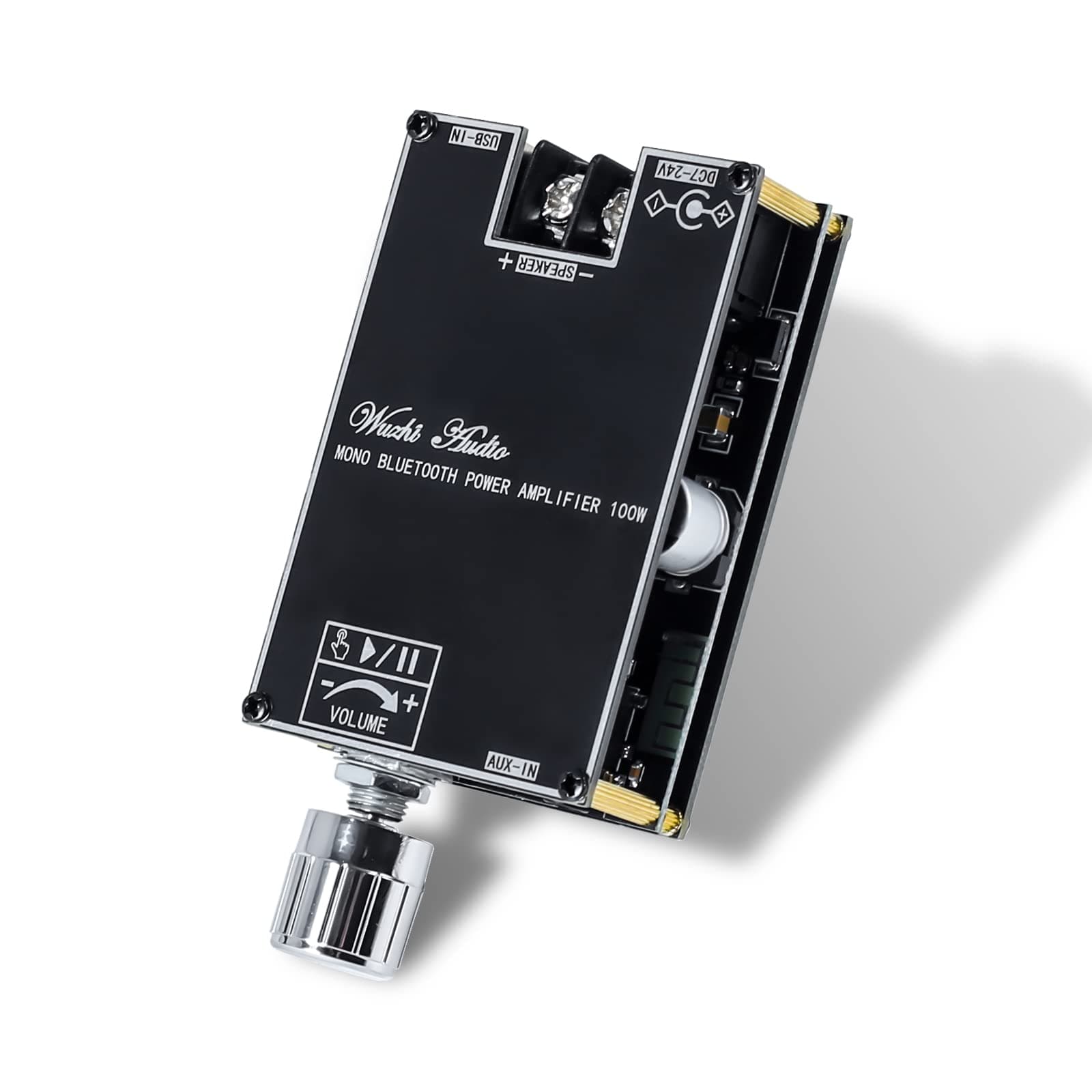


🎶 Elevate your sound game—wireless power meets DIY freedom!
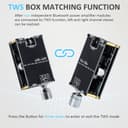
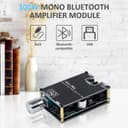
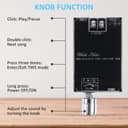
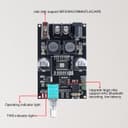
The PEMENOL TWS Bluetooth Mono Amplifier Module delivers up to 100W of clear, distortion-minimized audio powered by the efficient TPA3116D2 chip. Featuring True Wireless Stereo pairing, multi-input support (Bluetooth, USB, AUX), and a user-friendly multifunction knob, it operates across a wide 7-24V DC range, making it ideal for custom car and home audio projects. Compact yet powerful, it offers professional-grade sound performance with flexible connectivity and intuitive control.


| ASIN | B0BYJNYDGD |
| Best Sellers Rank | #106,988 in Electronics ( See Top 100 in Electronics ) #698 in Audio Component Amplifiers |
| Brand Name | PEMENOL |
| Customer Reviews | 4.4 4.4 out of 5 stars (103) |
| Item Dimensions | 2.36 x 1.57 x 0.79 inches |
| Manufacturer | PEMENOL |
| Minimum Supply Voltage | 24 Volts |
| Model | GY20961-2 |
| Mounting Type | Surface Mount |
| Number of Channels | 1 |
| Output Power | 100 Watts |
| Package Type Name | box |
| Voltage | 24 Volts |
W**T
Versatile with excellent sound quality
These amplifiers earn a solid 5 stars. I have used these for prototyping panel speakers, as well as run my home theater! I use two of these paired together to connect from my TV via Bluetooth. I power them with 24v, and they sound great! I have them also feeding high level inputs into my powered subwoofer and it works great! I just leave them on 24/7, and as a bonus any time I want to hear music, anyone can connect their phone to "Wuzhi". Some tips: 1) Wuzhi shows up as two different bluetooth devices, a speaker and headphones, I use the headphone broadcast! 2) I had to update my TV Firmware to connect. 3) I originally powered these with a battery pack, as voltage dropped, the amps would cut out... so use a good 12-24v power supply!
J**N
Surprisingly good
I used old laptop chargers for the right voltage and amperage. It has built-in flexibility for watts and amps, thank goodness. I bought a couple and paired them easily. My project was just connecting these to home McIntosh ML-1C speakers. Surprisingly awesome, and I didn't have to buy an equalizer. I just used the equalizer on my phone and it works perfectly.
J**E
Powerful little amp
Great little amp for a DIY bluetooth speaker. Pretty simple assembly, and mounting. My only ding is that its rated for 100W, if you go with a 150-160W speaker at full volume you'll get a little distortion. Might need to go with a 200W instead.
N**N
Perfect for a budget/ mid range Bluetooth speaker build
Could be in a more esthetic looking box but that's only because its in our living room other than that this little thing puts out loud, clear sound. I have it pushing just one 8" skar marine speaker and that thing screams. The bt is easy and quick to pair with a good range, I can go from where it is into the master bedroom, close the door, and into the bathroom, and close that door going through 2-3 walls and the washer and dryer and still be connected. Great clarity, no distortion, PLENTY of power. Highly recommend for a budget Bluetooth speaker build.
P**.
Tws instructions
Although it doesn't come with the instructions on how to connect two together (TWS Mode), I found what I believe is that resolve. Connect One amp to a bluetooth source (phone, mp3 player, etc), and leave the other disconnected from said bluetooth source. Click the potentiometer (volume knob) three times on the amp that is connected to the source. Then click the second/other (disconnected) potentiometer three times. Both amps should show a rapid flashing blue/red light indicating they have activated 'pairing mode'. In 1-5 seconds you should hear an audio sound from both amps/speakers. The flashing lights will then show synchronized slow flashing. Note: Although they are now in 'tws mode' volumes are still individually maintained. I have purchased a total of 19 of these amps over the course of 2 years (used in bluetooth speaker boxes). Every Single One is still in perfect working order. When using the correct power and speakers, these things are monsters of sound. I highly recommend. Buy one or two, and make up your own mind.
B**R
not a fan
not a fan. withought the bass and treble knob you cannot fine tune this amp. making it a bad choice for me
I**V
Very good Class D Amplifier for this price
Very good Class D Amplifier for this price This is class D amplifier (sometimes it is called “digital” amplifier. The advantage of class D is very high efficiency >90%. The disadvantage is higher distortions, but in most applications, it wouldn’t matter, and people wouldn’t hear it. I powered the amplifier from the bench Power Supply and tested it at different voltages, measuring the input power (Pin, W) and the output power (Pout, W) at 4 Ohm load, using sinewave generator at my phone over Bluetooth, as the input signal. Two Oscilloscope channels were connected to two output terminals (this is a “bridge” amplifier and load is connected between two active outputs). The output peak-to-peak voltage (Vp-p) was measured. The output power was calculated Pout = ((Vp-p) * 0.7)^2 / 4. Volume was adjusted to provide maximum output amplitude without clipping. Results (1kHz, 4 Ohm): Vin = 12V, Iin = 1.3A, Pin = 15.6W, Pout = (11.0*0.7)^2 / 4 = 14.8W, Efficiency = Pout / Pin * 100% = 95% Vin = 16V, Iin = 1.6A, Pin = 25.6W, Pout = (14.0*0.7)^2 / 4 = 24W , Eff = 94% Vin = 20V, Iin = 1.95A, Pin = 39W, Pout = (17.0*0.7)^2 / 4 = 35.4W, Eff = 91% Vin = 24V, Iin = 2.25A, Pin = 54W, Pout = (19.8*0.7)^2 / 4 = 48W, Eff = 89% • Note: The Amplifier output was shutting down after 10 seconds and coming back in a few seconds as a result of over-temperature protection., because the Test was conducted with the continues sinewave and the amplifier is not designed for this condition. Normal audio signal has significantly lower average power. Result (1kHz, 3 Ohm): Vin = 24V, Iin = 2.98A, Pin = 71.5W, Pout = (19.6*0.7)^2 / 3 = 62.7W, Eff = 88% • Note: Over-temperature protection was shutting down the output after 1 second and coming back in a few seconds. • Frequency Response: 20Hz – 18kHz • Note: My Generator lowest frequency is 20Hz and I couldn’t test it below. • There is no output signal above 18kHz. What I like: Small size Quality Efficiency BT and analog input What can be improved: The heatsink is attached with double-sided tape, which is not very secure and doesn’t provide good heat transfer. Conclusion: Very good class D amplifier for the money
A**R
Powerful little amp
Worked perfect for making my home arcade cabinet louder.
Trustpilot
1 month ago
2 months ago