We remain fully operational. Our teams are working around the clock to ensure your deliveries continue safely.

DOWNLOAD THE APP


Customer Services
Copyright © 2025 Desertcart Holdings Limited
DOWNLOAD THE APP
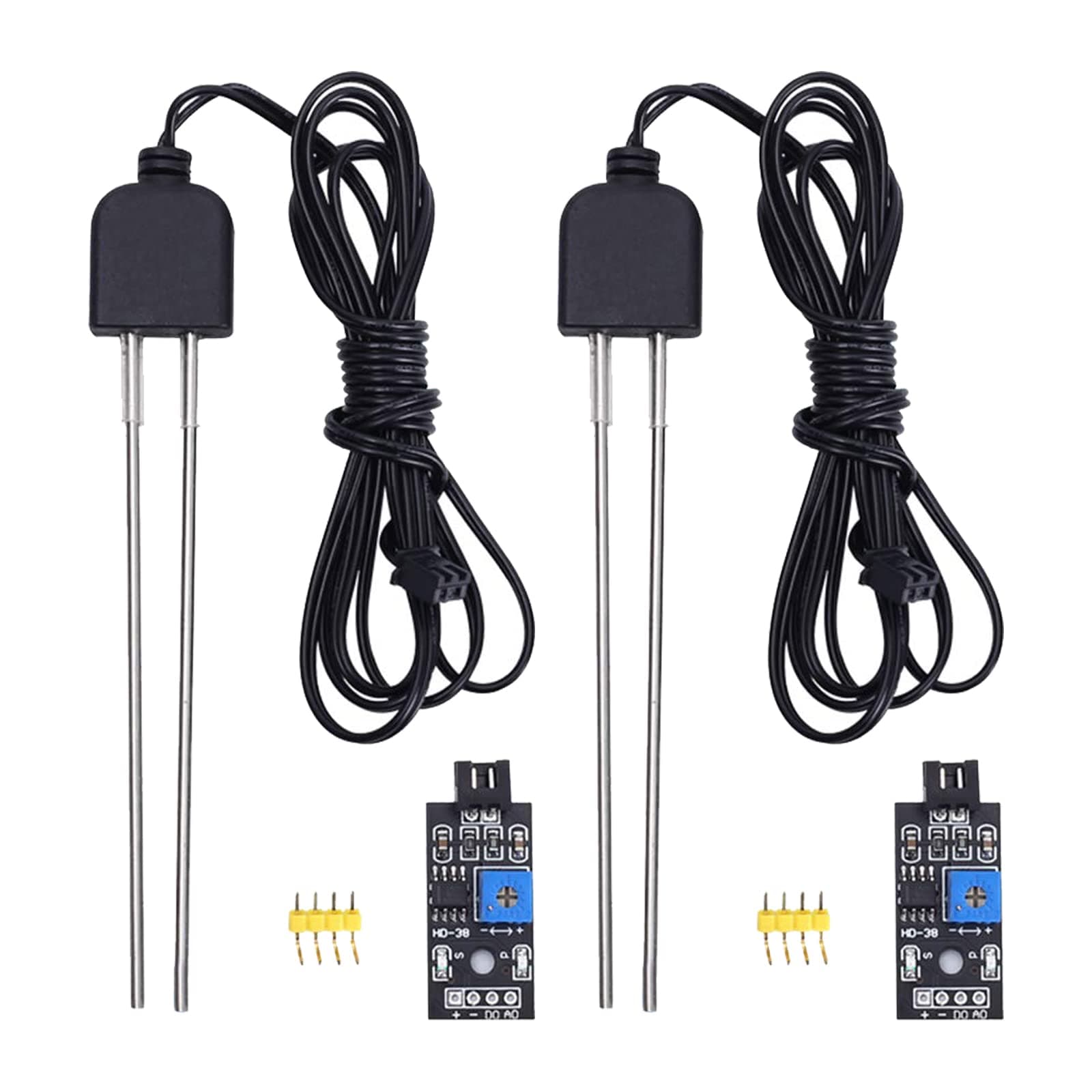
🌱 Cultivate smarter, not harder — your garden’s new digital green thumb!
This 2-set resistive soil moisture meter kit from Icstation features corrosion-resistant probes and outputs both digital and analog signals compatible with Arduino and Raspberry Pi. With a compact design and adjustable detection threshold, it enables precise soil hydration monitoring and automation, powered efficiently under 20mA. Ideal for millennial tech-savvy gardeners aiming to optimize plant care with smart, real-time feedback.


| ASIN | B076DDWDJK |
| Brand | IS |
| Color | Black |
| Compatible Devices | Single-board computers (Arduino, Raspberry Pi) |
| Control Method | App |
| Customer Reviews | 4.3 4.3 out of 5 stars (72) |
| Item Dimensions L x W x H | 36L x 15W x 6H millimeters |
| Item Weight | 0.09 Kilograms |
| Manufacturer | Icstation |
| Mounting Type | Floor Mount |
| Power Source | Corded Electric |
| Sensor Technology | Resistive Sensor |
| Voltage | 12 Volts |
S**O
R**T
This product does what it says. I is easy to use to detect the moisture condition in plant soil, either to set off an alarm, turn on automatic watering, or display an analog moisture value using an Arduino or purpose-built circuitry. The down side is, that using a DC current to measure moisture drives an electrolytic action between the probes. Long-term, this can cause surface erosion and deposits on the electrodes, which degrades resistance measurements, making automatic monitoring or watering control problematic. There are several ways to overcome this: 1: Insert the probe only briefly for measurement, then remove and wipe off before the next measurement. 2: Arrange to swap probe polarity frequently, via a reversible plug, DPDT switch, relay, or similar. 3:Change your Resistance measuring method to use (Floating) Alternating Current instead of Direct Current - this requires more elaborate electronics but should enable long-term unattended monitoring. As a fun project or occasional tool, this device is handy. Quality is good enough to make a long-term automated system, if some modifications are made.
V**O
In today’s world of microcontrollers, there have been many inventions and designs concerning the communication over a Wi-Fi network between 2 or more gadgets. Since the appearance of the ESP8266, the Wi-Fi communication between 2 (or more) µC has never been easier. **(search for esp8266 and smartphone)** it will give information and a basic example of the NodeMCU-version of the ESP866 . All pieces necessary are available on Amazon. This wonderful piece of technology can be easily programmed in the Arduino IDE and works together with the Blynk-software. To understand and make use of it, I assume you need the basic knowledge of the Arduino µC & Arduino IDE. This purchase came with 2 of the soil moisture sensors. They can be controlled (monitored) by an esp8266 wifi microcontroller. This in turn can control your irrigation system. Using amicrocontroller, makes it extremely flexible whether you just want to keep the indications local (imagine 3 LEDs one red one yellow, and one green) that you set for each point on a defined scale. Or with the ESP 8266 to your smart phone to let you know it has reached the level. Investigate ESP8266 and smartphone for any code help
K**S
Good quality that wont corrode over time. Was easy to use once you figure out how to use it. There is no instructions on connecting to Arduino module through Analog or exactly what the adjustment pot does. Both mine was also missing the plastic tubes that is supposed to water-proof it.. The description shows pictures and clearly says it has "Two Transparent rubber sleeves to prevent water from entering..." - these rubber sleeves are not present and missing. Also once, integrated, there is heavy drift on the readings over time.. it takes at least 5-10 minutes to reach a stable reading, so if you turn the probe off in between readings, its very inaccurate.
A**4
Used these as part of a project to automate my garden irrigation this grow season. The readings were nearly as accurate after ~6 months in soil, with no cleaning of the probes. They key is to NOT keep power applied 24/7. I only checked soil moisture a few times a week, giving them about an hour for the measurement to settle after applying power. So, I only ran these for a few hours a week.
Trustpilot
3 weeks ago
1 week ago