We remain fully operational. Our teams are working around the clock to ensure your deliveries continue safely.

DOWNLOAD THE APP


Customer Services
Copyright © 2025 Desertcart Holdings Limited
DOWNLOAD THE APP
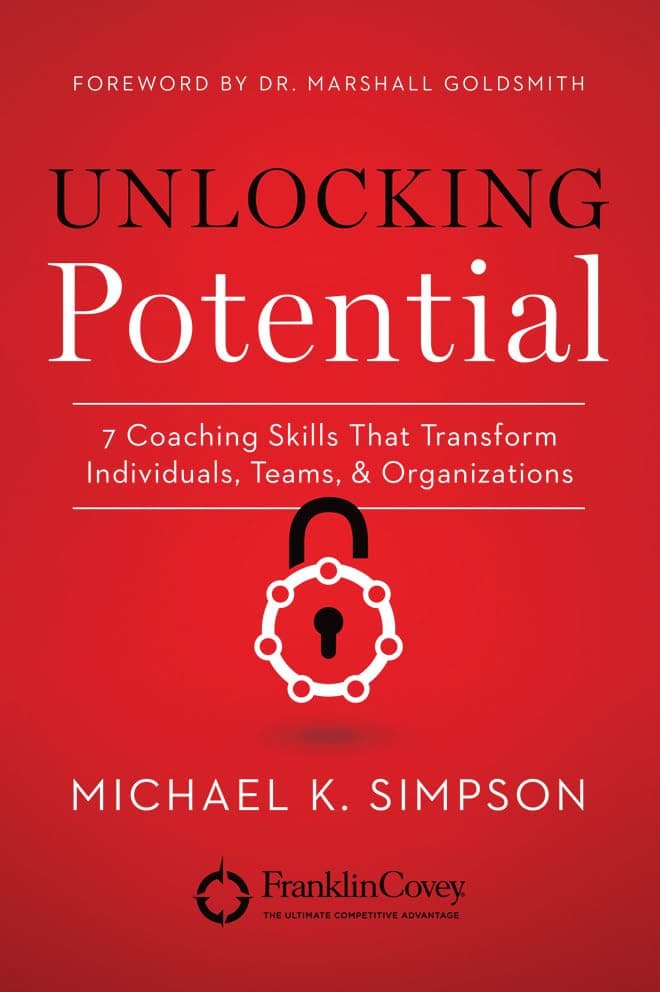

Buy Unlocking Potential: 7 Coaching Skills That Transform Individuals, Teams, & Organizations Illustrated by Simpson, Michael K., Goldsmith, Dr. Marshall (ISBN: 9781477824009) from desertcart's Book Store. Everyday low prices and free delivery on eligible orders. Review: Great read - Lots great ideas, tools and questions to support individuals and organisations fulfil their potential. Great to keep as a reference for supporting coaching. We all need this in our toolkit. Review: At the deep end - This is a challenging book from a top performing coach. It has some powerful insights but is a tough book for the average coach. It lacks a sense of fun and humanity, as it is geared for high end peak performance where winning and achieving come at a cost. There are some useful tools and insights to be had but I suspect most coaches are aiming for better not best, steering not driving. It is a good wake up call and a challenge and has some sound observation and great examples elevating the book in some respects but tend to speak at you more than to you. My preference is more warmth and less heat.
| ASIN | 1477824006 |
| Best Sellers Rank | 1,636,671 in Books ( See Top 100 in Books ) 46,063 in Business, Finance & Law |
| Customer reviews | 4.3 4.3 out of 5 stars (587) |
| Dimensions | 13.97 x 2.54 x 20.96 cm |
| Edition | Illustrated |
| ISBN-10 | 9781477824009 |
| ISBN-13 | 978-1477824009 |
| Item weight | 1.05 kg |
| Language | English |
| Print length | 160 pages |
| Publication date | 12 Aug. 2014 |
| Publisher | Grand Harbor Press |
A**A
Great read
Lots great ideas, tools and questions to support individuals and organisations fulfil their potential. Great to keep as a reference for supporting coaching. We all need this in our toolkit.
S**N
At the deep end
This is a challenging book from a top performing coach. It has some powerful insights but is a tough book for the average coach. It lacks a sense of fun and humanity, as it is geared for high end peak performance where winning and achieving come at a cost. There are some useful tools and insights to be had but I suspect most coaches are aiming for better not best, steering not driving. It is a good wake up call and a challenge and has some sound observation and great examples elevating the book in some respects but tend to speak at you more than to you. My preference is more warmth and less heat.
M**O
Well structured, clear and with some very good points
Really enjoying this book. I'd rather call it a "manual", a good list of steps to make you and your organization /team /personal life focus.
T**R
Ok
It was ok, but nothing extraordinary in my opinion. I'm still happy I read it, got some knowledge out of it
M**B
Lots to work with
Lots of really useful tips and tools outlined. Most sujects are covered in enough detail to give inexperienced leaders a foot on the ladder.
E**O
Great coaching book!
I liked the way is described how to do coaching and the powerful questions on each chapter. The sequence, the content, the flow, terminology, framework and strategies. I will definitely keep it as reference guide.
R**R
Five Stars
Excellent Product / Service ........
G**K
Great book!
Very good book for all leaders and managers
D**L
So chocked full of hard hitting, no-nonsense information and practical steps and examples to transform yourself, individual employees (it did not say, but I believe even fellow employees among non-leadership role workers), all levels of management all the way to the top-most leadership of any company, large or small; from a sole proprietorship where its just you, to midsized companies to giants like Amazon or Google, or non-profit organizations, clubs and guilds, sports teams, churches and related ministries... parts could even be adapted to family life. So much to digest - am getting a hard copy, perhaps several to give away, to underscore and put sticky note tabs into, as I will be referring back to this text for the foreseeable future. Really a fantastic read for leaders, employees, parents, students... pretty much everyone!
S**V
An interesting & an insightful book. Must read if you are aspiring to climb to the top of corporate ladder
T**N
What a great read. Uses real life experiences and teaches how to apply the necessary skills to develop great coaching relationships.
M**I
Nice book
I**N
Leaders’ success is measured by the success of those working in their teams. The best analogy for a leader is an orchestra conductor. This is because the conductor, superb musician though he may be, doesn’t make a sound. His success is getting others to make beautiful music. Every leader/manager must know how to coach, because coaching is how you get the best out of your people. Coaching is more than consulting or advising, and it certainly isn’t trying to “fix” a person. The authors Simpson and Goldsmith define coaching as “unleashing or unlocking the potential of another human being.” A coach does not have to be a manager: your coach could be your spouse, partner, co-worker, or friend. But every manager must be able to be a coach, and this is where Unlocking Potential adds value. It is an excellent guide for managers who understand the need they have to coach their people. The authors identify four foundational principles that form the basis of their coaching approach: trust, potential, commitment, and execution. They ask: “Consider how successful a coach would be who is unreliable, fails to tap into the potential of the team, doesn’t trust others, doesn’t know how to get the team to commit, and presides over a team that fails to execute and achieve its most important goals.” The late Stephen Covey believed that coaches are neither born nor made, rather great coaches choose to be great coaches. Coaching starts with ‘trust’. People trust leaders who genuinely care about their welfare and future. People trust leaders who always demonstrate personal integrity, honesty, and sincerity. People trust leaders who keep confidences. Trust takes time to earn, but once earned it can be accepted by others. But trust is also easy to lose. It takes only one broken promise, display of indifference or manipulation, one broken confidence, for trust to be ruined. Identifying ‘potential’ in people is the second coaching fundamental. This does take time and requires that the coaches give the person their full, undivided attention in the coaching session. Information is gathered by “listening with the heart for feelings, listening with the ears for content, listening with the eyes for visual cues” to what is not being expressed. Empathy, feeling the person’s feelings, is achieved and demonstrated by accurately reflecting what is being said, experienced, and felt. This is important because great coaches need to create a feeling of safety for people. In this safe environment, the individuals can be helped to change a point of view that is holding them back. This is a delicate and sensitive process, but one necessary for growth. Many people, for example, consider a setback as an omen of failure, and changing this belief can be deeply liberating, and even open the way for realizing one’s potential. When a person learns to align their paradigms to reality, many of the barriers to realizing their potential begin to fall away. People are easily motivated, but this rarely lasts. The third fundamental of coaching is moving way beyond motivation, all the way to real ‘commitment’ to the work. Genuine commitment cannot be demanded, but the authors believe a manager-coach can create conditions that will encourage people to commit to goals they realize they want to achieve. This commitment is beyond requiring the person to do specific things as that opens the way for the person to claim: “I did what you told me to do and how you told me to do it, and it didn’t work—and now what do you want me to do?” Individuals never own what they haven’t committed themselves to. Commitment can be discovered through questioning by the coach: What specifically brings you to coaching? What are the most important outcomes you need to accomplish? What do you see as your ‘best self’ in the future? To help people identify what they can commit to, requires that coaches are more than very capable conversationalists. They must intend to advance to both logical and emotional commitment. For any organization and for every individual, the goal of coaching is to improve ‘execution’ the fourth coaching fundamental. If everything mentioned to this point is successful but there is no improvement in execution, the manager has failed as both a coach and a manager. “All successful coaching conversations need to link directly to actually meeting key performance indicators, measures, and objectives,” the authors explain. These are the fundamentals of coaching, and so the fundamentals of good management, too. The second part of the book is a description of the seven skills required to actualize these four fundamentals. Coaching is far more than counselling, giving pep talks, consulting, advising, or telling people what to do. This part covers how you build trust, challenge paradigms, and help your staff clarify their goals. It describes how to assist your people to execute their goals flawlessly. To do this you will need to give feedback that is effective in helping the person move forward, and not feel complacent. There is advice on how to tap into the talent so many people possess, and how this can be developed. This part includes advice to coaches on how to avoid getting distracted by focusing only on the talented at one end, and the trouble-makers at the other, while forgetting to grow those in the middle. Even experienced coaches will derive benefit from this book, if only to remind themselves of skills they already have, but may not be using. Managers certainly will. Readability Light -+--- Serious Insights High --+-- Low Practical High +---- Low *Ian Mann of Gateways consults internationally on leadership and strategy, and is the author of the recently released ‘Executive Update.
Trustpilot
1 week ago
2 weeks ago