We remain fully operational. Our teams are working around the clock to ensure your deliveries continue safely.

DOWNLOAD THE APP


Customer Services
Copyright © 2025 Desertcart Holdings Limited
DOWNLOAD THE APP
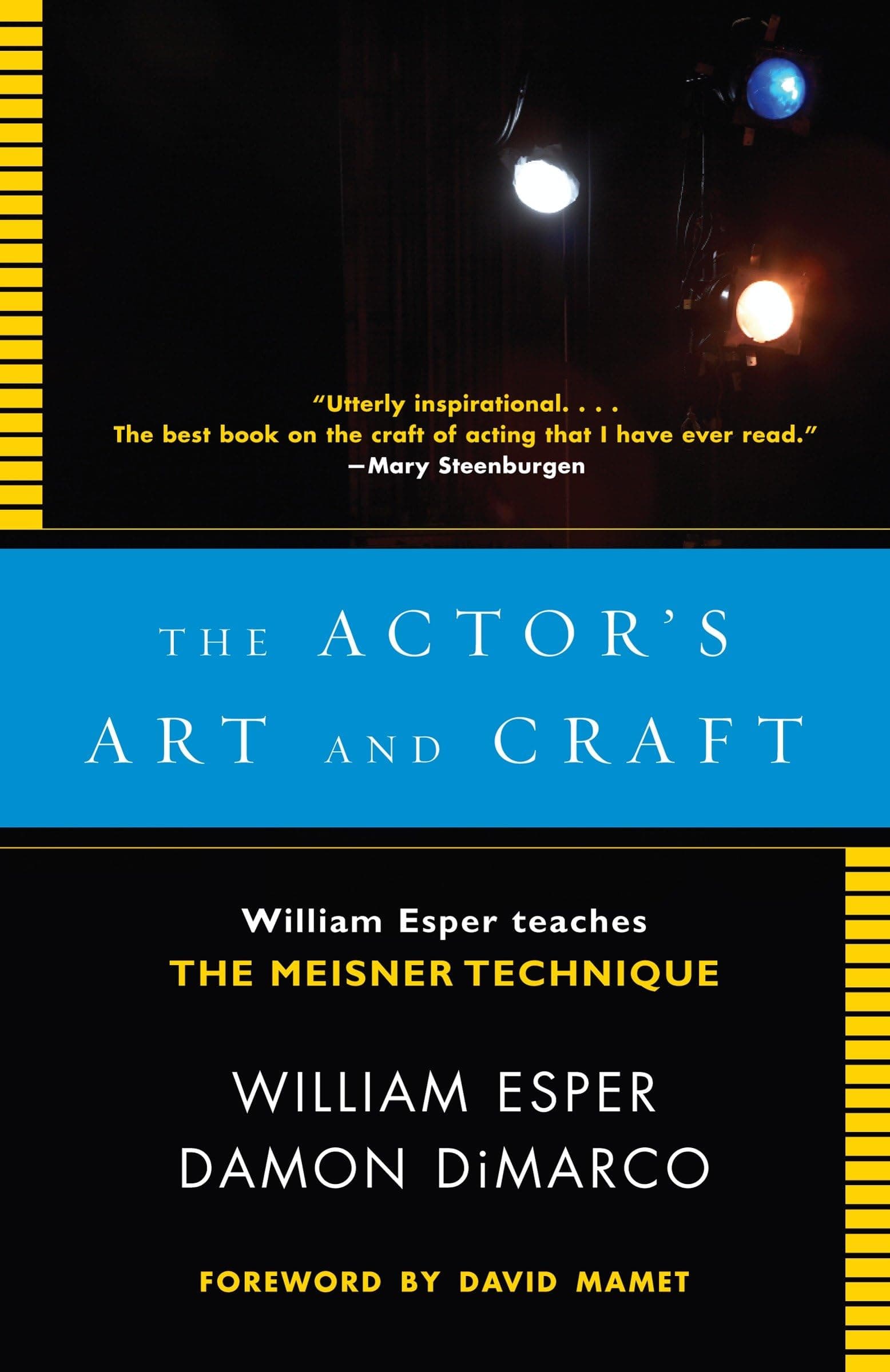
The Actor's Art and Craft: William Esper Teaches the Meisner Technique [Esper, William, DiMarco, Damon, Mamet, David] on desertcart.com. *FREE* shipping on qualifying offers. The Actor's Art and Craft: William Esper Teaches the Meisner Technique Review: Engrossing, inspiring, full of humanity - This book came around at a strange time in my life...which I suppose is still happening. Although I was never part of the BFA or MFA program at Rutgers, I did take a few acting classes there as well as get involved in some college theatre. Bill Esper was an icon even back then but I completely took for granted what it is he did and more importantly, who he is. Since getting out and pounding the pavement for some real work, I've had moments of brilliance, some of which has garnered me a handful of (minor) speaking roles on notable television shows. Gradually, I began to regress in my preparation and in my respect for the craft because in my mind, I didn't see it as a necessity anymore. After all, who needs an applicable technique when you've booked work on Law & Order, Fringe, etc.? I became increasingly arrogant and felt entitled to success, all because I've had a little taste of it, probably from luck or what have you. In the past two years or so, I've been making big investments on casting director/agent workshops, all designed to get you seen, as long as you're willing to pay the price. One night, not too long ago, we had to watch our playback auditions at one of these "classes". I was certain I had nailed it because I "felt good" about what I did. I was in for a rude awakening when I saw my work. I was stiff, lacking life...natural perhaps but uninteresting. In the past, I would always respond by preparing harder the next time and I would continue to take more acting seminars. This time, for whatever reason, I was willing to admit to myself that whatever technique I had was unfocused. That I was easily assuaged by complimentary notes by casting directors and peers so that I can move on with my life. I believe it was a good friend of mine who recommended me this book. And now I realize how naive and foolish I've been these past couple of years. The Actor's Art and Craft taught me that while commercial success should be commended, it's not worth sacrificing your very being for it. After a while, from audition to audition, you start to make choices that you THINK people want to see, regardless of how inorganic. But like all forms of art, one must be dedicated in his/her pursuits and strive for the perfection of the craft. I've read a handful of other acting books, but none as engrossing as this one. It covers the first year of Meisner and that includes repetition work, activities, criminal action problems, having an objective. The format is such that you feel that you are in the classroom with Bill and the company he teaches. There are characters you can easily identify with because you probably know them in real life. Some of the students are new to the craft, others have been pursuing the arts for a while. For me, though, the highlights of this book are the beautifully simple yet poetic words from William Esper himself, his notes to the class, his views on how important it is to LIVE. Really LIVE. It surprised me that at times I was brought to tears by some of the quotations because they were really moving and cathartic. One in particular had to do with how disconnected our modern society can be, what with all the iPods, gadgets, social networking sites etc. Nobody lives in the moment anymore. Esper and DiMarco have put together a wonderful book that attacks the myths of what the Meisner technique can do for someone. It's not about emoting, it's about doing as well as being. You can't control how you feel, however you can allow yourself to be AFFECTED by what is going on around you. He talks about the importance of the precipitating circumstance: the one event that causes the two (or more) people on stage to come together in this time, in this place. Of course, before all of that, he teaches the importance of being yourself, to unlearn what society has taught you, to empty the garbage so to speak. Only then can you truly be free to follow your instincts. There is so much more I'd like to talk about in detail as far as specific exercises but I suggest you read it yourself if you're serious about learning the craft, or even reinvigorating your passion for it. When you're out in the real world, you'll hear people throw around the word "Meisner" and "objective" as if they really understand what it all entails. Many of them probably do and that is commendable. But there is a large majority who don't REALLY get it. I was one of them. I hope to continue my studies now that I've been humbled, and I hope to acquire practical skills and technique that's based on higher principles. If you're as jaded as I was, you may be rolling your eyes at this gushfest. But I know what I want from all this: when I'm on stage or in front of a camera, I want to feel truly alive. When I'm NOT on stage or in front of the camera, I want to realize how remarkable it is to BE alive. This book is my first step towards my own salvation and my admission of cynicism and laziness. I hope to study with him one day. -------- Update: It is February 20th, 2011. I'm currently in my 2nd year at the Esper Studio. Although I haven't had Bill as a teacher, I've had the pleasure of being taught by other inspirational instructors there. I'm grateful for all that this training has given me, especially with respect to my life. I believe one of the biggest things I've learned is "don't be afraid to ACT"! My current teacher David says that a lot. You see, while I was auditioning for on-camera projects, I became convinced that the only thing required to impress a casting director was to "be natural", to be capable of "conversational reality". It is only recently that I realized that it's not enough to say the lines as if you'd "say them in real life" if there is no life or behavior behind it. That's the path to generality. Many actors are afraid to act and commit to their actions fully for fear of over-acting or being untruthful. Much of this perception, at least from where I stand, probably comes from this modern indie faux-indie film culture. I've seen many of those kinds of films: critics rave about the movie where the actors don't really do much but just throw away their lines, while most of the stylistic touches are provided by the director and editors. Looking back, that was what held me back the most when I was auditioning. I never fully got behind the circumstances or even bothered to understand the specifics of the moment before and what everything meant to me in the scene (which can only come alive from your body, not your mind). Review: Good insight into the "Meisner" approach - I'm deeply interested in HONEST acting (with affectation, pushing and demonstrating) and this book gets you off and running. I think these are great techniques to use with actors, and can quickly separate the wheat from the chaff, and get to the heart of open, honest acting, BUT they are deceptively simple exercies, and you need to know what you are looking for when things go awry, and how to address them. This books goes much further in revealing the goals behind the exercises than does Sandy's book. I think it is truly enlightening. That being said, my frustrations are this: 1.), Bill and Damon stop after the first year of (arguably) foundation work. In short, they stop before getting into the "next level stuff." I honestly hope they put together year 2 of this training technique and not keep all the "in depth" goodies to themselves. 2.) My fear is that this approach discourages shaping a character that is an honest revelation of what is in the text. Not all instincts are ARTFUL instincts (another beef I have with Bill about encouraging actors to "let go" in real life - human nature is, by instinct, SELFISH), and not every actor inclination is going to be true to the text. Hopefully, an actor who is worth their salt will marry this approach with serving the text and a playwright worth their salt will have crafted a script that reveals vibrant characters, but as an ART form, I don't want to trust a performance to the whims of an actor who may, in any given moment, be struck with something funny their partner has done and runs with it. It may be engaging, but it won't necessarily be true to the play. That is my fear and question to Bill - how do you keep actors from running afoul of a simpler instinct? Perhaps your book on year 2 is the answer I await.


| ASIN | 030727926X |
| Best Sellers Rank | #142,221 in Books ( See Top 100 in Books ) #36 in Acting & Auditioning (Books) #5,073 in Reference (Books) |
| Customer Reviews | 4.8 4.8 out of 5 stars (660) |
| Dimensions | 5.2 x 0.65 x 8 inches |
| Edition | 1st |
| ISBN-10 | 9780307279262 |
| ISBN-13 | 978-0307279262 |
| Item Weight | 7.8 ounces |
| Language | English |
| Print length | 304 pages |
| Publication date | April 8, 2008 |
| Publisher | Vintage |
J**B
Engrossing, inspiring, full of humanity
This book came around at a strange time in my life...which I suppose is still happening. Although I was never part of the BFA or MFA program at Rutgers, I did take a few acting classes there as well as get involved in some college theatre. Bill Esper was an icon even back then but I completely took for granted what it is he did and more importantly, who he is. Since getting out and pounding the pavement for some real work, I've had moments of brilliance, some of which has garnered me a handful of (minor) speaking roles on notable television shows. Gradually, I began to regress in my preparation and in my respect for the craft because in my mind, I didn't see it as a necessity anymore. After all, who needs an applicable technique when you've booked work on Law & Order, Fringe, etc.? I became increasingly arrogant and felt entitled to success, all because I've had a little taste of it, probably from luck or what have you. In the past two years or so, I've been making big investments on casting director/agent workshops, all designed to get you seen, as long as you're willing to pay the price. One night, not too long ago, we had to watch our playback auditions at one of these "classes". I was certain I had nailed it because I "felt good" about what I did. I was in for a rude awakening when I saw my work. I was stiff, lacking life...natural perhaps but uninteresting. In the past, I would always respond by preparing harder the next time and I would continue to take more acting seminars. This time, for whatever reason, I was willing to admit to myself that whatever technique I had was unfocused. That I was easily assuaged by complimentary notes by casting directors and peers so that I can move on with my life. I believe it was a good friend of mine who recommended me this book. And now I realize how naive and foolish I've been these past couple of years. The Actor's Art and Craft taught me that while commercial success should be commended, it's not worth sacrificing your very being for it. After a while, from audition to audition, you start to make choices that you THINK people want to see, regardless of how inorganic. But like all forms of art, one must be dedicated in his/her pursuits and strive for the perfection of the craft. I've read a handful of other acting books, but none as engrossing as this one. It covers the first year of Meisner and that includes repetition work, activities, criminal action problems, having an objective. The format is such that you feel that you are in the classroom with Bill and the company he teaches. There are characters you can easily identify with because you probably know them in real life. Some of the students are new to the craft, others have been pursuing the arts for a while. For me, though, the highlights of this book are the beautifully simple yet poetic words from William Esper himself, his notes to the class, his views on how important it is to LIVE. Really LIVE. It surprised me that at times I was brought to tears by some of the quotations because they were really moving and cathartic. One in particular had to do with how disconnected our modern society can be, what with all the iPods, gadgets, social networking sites etc. Nobody lives in the moment anymore. Esper and DiMarco have put together a wonderful book that attacks the myths of what the Meisner technique can do for someone. It's not about emoting, it's about doing as well as being. You can't control how you feel, however you can allow yourself to be AFFECTED by what is going on around you. He talks about the importance of the precipitating circumstance: the one event that causes the two (or more) people on stage to come together in this time, in this place. Of course, before all of that, he teaches the importance of being yourself, to unlearn what society has taught you, to empty the garbage so to speak. Only then can you truly be free to follow your instincts. There is so much more I'd like to talk about in detail as far as specific exercises but I suggest you read it yourself if you're serious about learning the craft, or even reinvigorating your passion for it. When you're out in the real world, you'll hear people throw around the word "Meisner" and "objective" as if they really understand what it all entails. Many of them probably do and that is commendable. But there is a large majority who don't REALLY get it. I was one of them. I hope to continue my studies now that I've been humbled, and I hope to acquire practical skills and technique that's based on higher principles. If you're as jaded as I was, you may be rolling your eyes at this gushfest. But I know what I want from all this: when I'm on stage or in front of a camera, I want to feel truly alive. When I'm NOT on stage or in front of the camera, I want to realize how remarkable it is to BE alive. This book is my first step towards my own salvation and my admission of cynicism and laziness. I hope to study with him one day. -------- Update: It is February 20th, 2011. I'm currently in my 2nd year at the Esper Studio. Although I haven't had Bill as a teacher, I've had the pleasure of being taught by other inspirational instructors there. I'm grateful for all that this training has given me, especially with respect to my life. I believe one of the biggest things I've learned is "don't be afraid to ACT"! My current teacher David says that a lot. You see, while I was auditioning for on-camera projects, I became convinced that the only thing required to impress a casting director was to "be natural", to be capable of "conversational reality". It is only recently that I realized that it's not enough to say the lines as if you'd "say them in real life" if there is no life or behavior behind it. That's the path to generality. Many actors are afraid to act and commit to their actions fully for fear of over-acting or being untruthful. Much of this perception, at least from where I stand, probably comes from this modern indie faux-indie film culture. I've seen many of those kinds of films: critics rave about the movie where the actors don't really do much but just throw away their lines, while most of the stylistic touches are provided by the director and editors. Looking back, that was what held me back the most when I was auditioning. I never fully got behind the circumstances or even bothered to understand the specifics of the moment before and what everything meant to me in the scene (which can only come alive from your body, not your mind).
J**I
Good insight into the "Meisner" approach
I'm deeply interested in HONEST acting (with affectation, pushing and demonstrating) and this book gets you off and running. I think these are great techniques to use with actors, and can quickly separate the wheat from the chaff, and get to the heart of open, honest acting, BUT they are deceptively simple exercies, and you need to know what you are looking for when things go awry, and how to address them. This books goes much further in revealing the goals behind the exercises than does Sandy's book. I think it is truly enlightening. That being said, my frustrations are this: 1.), Bill and Damon stop after the first year of (arguably) foundation work. In short, they stop before getting into the "next level stuff." I honestly hope they put together year 2 of this training technique and not keep all the "in depth" goodies to themselves. 2.) My fear is that this approach discourages shaping a character that is an honest revelation of what is in the text. Not all instincts are ARTFUL instincts (another beef I have with Bill about encouraging actors to "let go" in real life - human nature is, by instinct, SELFISH), and not every actor inclination is going to be true to the text. Hopefully, an actor who is worth their salt will marry this approach with serving the text and a playwright worth their salt will have crafted a script that reveals vibrant characters, but as an ART form, I don't want to trust a performance to the whims of an actor who may, in any given moment, be struck with something funny their partner has done and runs with it. It may be engaging, but it won't necessarily be true to the play. That is my fear and question to Bill - how do you keep actors from running afoul of a simpler instinct? Perhaps your book on year 2 is the answer I await.
M**T
Clear and Engaging
As an actor I'm always interested in reading good books on the craft of acting, learning about different techniques, and seeking ways to improve my work. The last word, "improve", is perhaps the most difficult to quantify as that improvement necessitates both an objective method of judgement and a standard toward which "improvement" can be made (something that might seem fairly hard to come by when discussing the arts, and perhaps most especially the art and craft of the actor). But when it comes right down to it, it's really not all that hard to understand what makes acting good or bad. To paraphrase Esper, "No one comes out of a play or movie saying 'Wow, those actors were so good! I didn't believe a thing they said.'" Therefore we can say that in all most all contemporary contexts "good acting" is acting that is indistinguishable from truly living and doing. To paraphrase Stella Adler in a different book: "You must never appear to be acting". So if we say that good acting is acting that appears to be real and genuine living and doing, than a book that promotes Stanford Meisner's famous statement that "acting is living truthfully under imaginary circumstances", or Esper's version that clarifies "living" as "doing", and transports you into the midst of a group of artists seeking to learn how to do it must be a pretty good place to start when seeking out improvement or a strong foundation. I have taken a short (i.e. less than one year) Meisner based acting class before, and left feeling as if I had experienced only minimal success, learned only a little bit, struggled...and perhaps not in a good way, and ultimately felt confused. I wondered if maybe the Meisner technique, although wonderful for many people, was perhaps just not for me. Then I read THE ACTOR'S ART AND CRAFT and I saw everything differently. William Esper's fictional acting class is so CLEAR and inspiring! Reading this book helped me understand everything about the Meisner technique that had seemed so ambiguous and down right illogical before! I want to state very clearly that this book "pinched" me (to use a Meisner term) in and of itself and has inspired me to try and get back into Meisner training again. This is one of the best books of the craft of acting I have ever read. If you want to act the way I have described at the beginning of this review then hear this: This is precisely the hope provided by the Meisner technique and I suggest that there may be no one better than William Esper to learn it from. The book is very well written and engaging. The content is truly first rate. Five stars!!! Highly recommended to actor, directors, or anyone wanting insight into the acting training process!
D**A
Whether you are actually practicing acting or you are simply interested in the subject, this book has a lot of gems that are truly inspiring, and it’s a fantastic look into the Meisner / Esper technique
S**8
Fabulous fabulous book. Book page quality could have been a bit better though.
G**I
Senza entrare nel merito di quale metodo sia il migliore (strasberg, adler, meisner...) questo libro è un'introduzione perfetta sull'arte della recitazione, e sfata molto miti comuni su cosa faccia l'attore. È anche un punto di partenza imprescindibile per aspiranti attori che vogliano iniziare a muovere i primi passi. Il resto è lavoro, lavoro, lavoro... (ma senza mai dimenticare i concetti fondamentali di questo libro)
G**L
Ce livre ré-apprend cet art de se mettre dans la tête de quelqu'un d'autre, du changement de perspective... Le format de cours à petit nombre permet de s'exercer à bien identifier le masque que l'on porte déjà en soi-même pour mieux exprimer les émotions que l'on a pu réprimer jusqu'ici. Ce livre oblige à utiliser son imagination: faites bien attention aux tropismes qu'il utilise. Malheureusement, on se sent obligés d'acheter la séquelle... il manque le "travail" d'appropriation d'un personnage qui n'est pas soi-même.
A**R
Good
Trustpilot
1 week ago
3 weeks ago