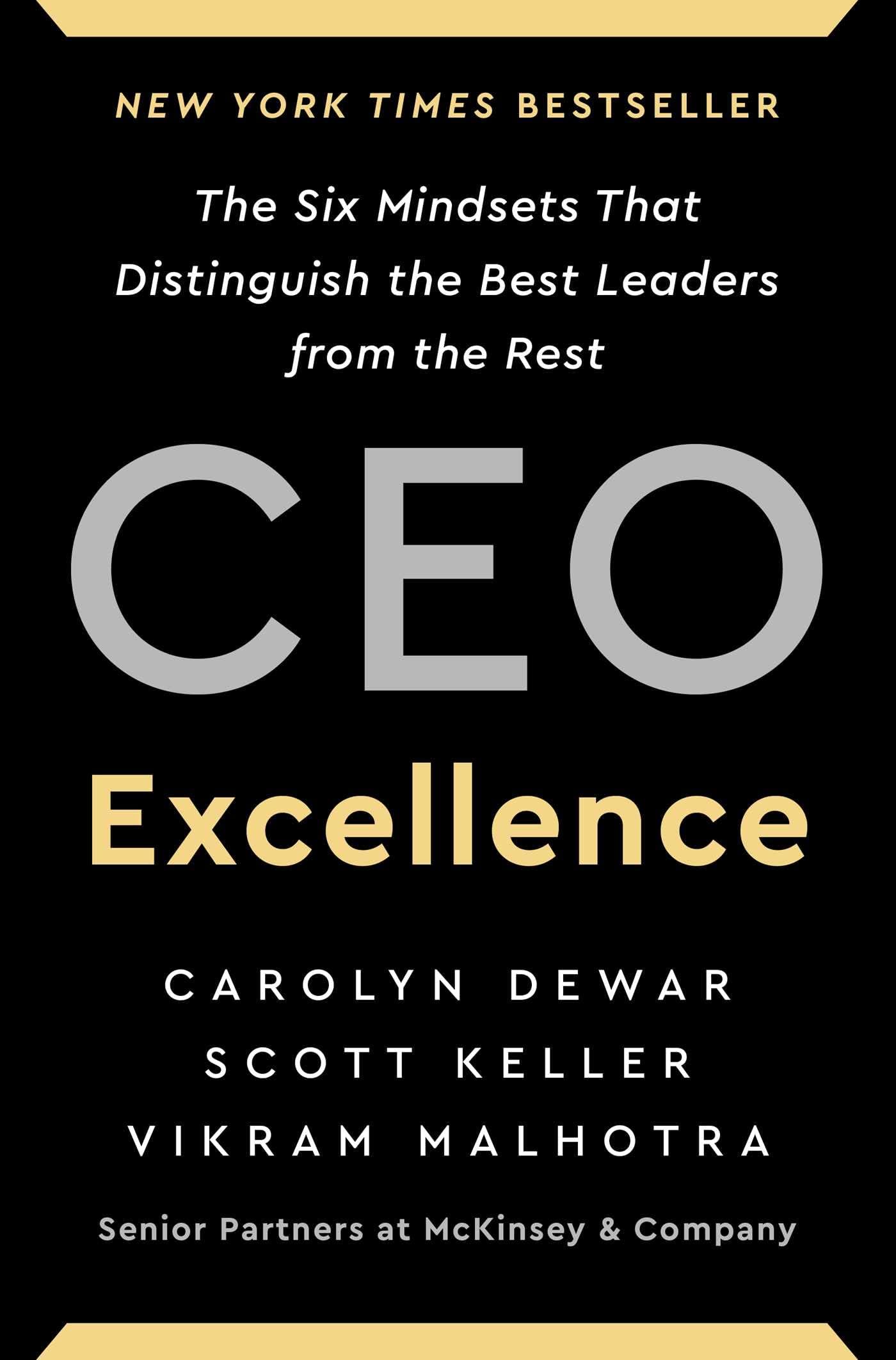
CEO EXCELLENCE: The Six Mindsets That Distinguish the Best Leaders from the Rest
Product ID: 340248049
Buy anything from 5,000+ international stores. One checkout price. No surprise fees. Join 2M+ shoppers on Desertcart.
Desertcart purchases this item on your behalf and handles shipping, customs, and support to Italy.
New York Times Bestseller Wall Street Journal Bestseller From the world’s most influential management consulting firm, McKinsey & Company, this is an insight-packed, revelatory look at how the best CEOs do their jobs based on extensive interviews with today’s most successful corporate leaders—including chiefs at Netflix, JPMorgan Chase, General Motors, and Sony. Being a CEO at any of the world’s largest companies is among the most challenging roles in business. Billions, and even trillions, are at stake—and the fates of tens of thousands of employees often hang in the balance. Yet, even when “can’t miss” high-achievers win the top job, very few excel. Thirty percent of Fortune 500 CEOs last fewer than three years, and two out of five new CEOs are perceived to be failing within eighteen months. For those who shoulder the burden of being the one on whom everyone counts, a manual for excellence is sorely needed. To identify the 21st century’s best CEOs, the authors of CEO Excellence started with a pool of over 2400 public company CEOs. Extensive screening distilled that group into an elite corps, sixty-seven of whom agreed to in-depth, multi-hour interviews. Among those sharing their views: Jamie Dimon (JPMorgan Chase), Satya Nadella (Microsoft), Reed Hastings (Netflix), Kazuo Hirai (Sony), Ken Chenault (American Express), Mary Barra (GM), and Peter Brabeck-Letmathe (Nestlé). What came out of those frank, no-holds-barred conversations is a rich array of mindsets and actions that deliver outsized performance. Compelling, practical, and unprecedented in scope, CEO Excellence is a treasure trove of wisdom from today’s most elite business leaders. Review: Excellent framework on CEO excellence - It is often said that single digit companies grow in double digits. In a fiercely competitive world, few companies manage to survive and thrive, generating healthy shareholder returns. Lot of work has been done on companies that are ‘Built to Last’, ‘Good to Great’ and the likes of those who find their names ‘In Search of Excellence’, to decipher the DNA of outstanding companies. This book focuses on the role of select CEOs who make the difference at the top. This book is an outstanding piece of research and insights, McKinsey standards. It outlines the hypothesis and methodology very clearly in the introduction. CEOs who rank in the top 20 percent of financial performance generate, on average 2.8 times more TRS (Total Shareholder Returns) during each year of their tenure than average performers’. This sets the agenda for the rest of the book. Tons of data from 1000 largest companies (covering 2400+ CEOs) over 15 years, with at least 6 years in role, and recognized in ‘best CEO’ Industry Lists. To give a fair representation, while maintaining high bar of performance across industries, gender, races, geographies and ownership structures, further data is added to generate a list that can be considered most credibly, the best CEOs in the world in the twenty-first century. The economic value created by these 200 leaders, in excess of their peers is approximately $ 5 Trillion, equivalent to the gross GDP of Japan. Like the 7-S framework in ‘In Search of Excellence’, this book discusses ‘The Six responsibilities of the CEO. The excellent CEOs practice these six aspects rigorously and very differently than the rest who don’t make the cut. The book then goes on to discuss each of these six ‘mindsets’, in abundant measure, with concepts and cases. The first mindset ‘Set the Direction’ consists of Vision, Strategy and Resource Allocation, and a chapter that elaborates on each. Every chapter begins with a beautiful quote, followed by crisp outline and discussion on salient points. Other five mindsets are Align the Organization, Mobilize through Leaders, Manage Personal Effectiveness, Engage the Board and Connect with Stakeholders. Excellent CEOs are ‘Servant Leaders’. They lead to serve. They are humble, and humility is ‘freedom from pride and arrogance’ and is ‘not thinking less of yourself; it’s thinking of yourself less’ as aptly described in this book. They feel gratitude for ‘the deep responsibility and obligations’ and for ‘serving people on the frontline’. They are deeply grounded, thankful, and bless the people they work with. ‘It is not your work; you’re just doing your part. Give glory to God’. It is important to note that this book is useful for leaders at all levels in an organization. Every business leader, at national, divisional, regional, or product level has similar responsibilities, and are prospective successors to the CEO role. Appendix 1 is an excellent toolkit that acts as a concise summary and guide. Appendix 2 is a list of CEO biographies for quick reference. This book is certainly a masterpiece on leadership in the twenty-first century. Unmissable and unputdownable. Highly recommended. Review: Brilliant - An excellent book for anyone looking to gain insights on leadership skills. This isn’t just for the professionals looking to learn what the C suite does but has lessons in leadership which makes it a perfect read for anyone curious. Backed by pieces of research, this makes for a great weekend reading or a live learning doc to be kept on your work table (the cover and the publication is beautiful to be kept on bookshelves as well but this is a brilliant piece of incisive insights into the World of CEOs that those seeking to learn from it will keep it close)
| Best Sellers Rank | #665,448 in Books ( See Top 100 in Books ) #467 in Analysis & Strategy |
| Customer Reviews | 4.7 out of 5 stars 1,471 Reviews |
B**Y
Excellent framework on CEO excellence
It is often said that single digit companies grow in double digits. In a fiercely competitive world, few companies manage to survive and thrive, generating healthy shareholder returns. Lot of work has been done on companies that are ‘Built to Last’, ‘Good to Great’ and the likes of those who find their names ‘In Search of Excellence’, to decipher the DNA of outstanding companies. This book focuses on the role of select CEOs who make the difference at the top. This book is an outstanding piece of research and insights, McKinsey standards. It outlines the hypothesis and methodology very clearly in the introduction. CEOs who rank in the top 20 percent of financial performance generate, on average 2.8 times more TRS (Total Shareholder Returns) during each year of their tenure than average performers’. This sets the agenda for the rest of the book. Tons of data from 1000 largest companies (covering 2400+ CEOs) over 15 years, with at least 6 years in role, and recognized in ‘best CEO’ Industry Lists. To give a fair representation, while maintaining high bar of performance across industries, gender, races, geographies and ownership structures, further data is added to generate a list that can be considered most credibly, the best CEOs in the world in the twenty-first century. The economic value created by these 200 leaders, in excess of their peers is approximately $ 5 Trillion, equivalent to the gross GDP of Japan. Like the 7-S framework in ‘In Search of Excellence’, this book discusses ‘The Six responsibilities of the CEO. The excellent CEOs practice these six aspects rigorously and very differently than the rest who don’t make the cut. The book then goes on to discuss each of these six ‘mindsets’, in abundant measure, with concepts and cases. The first mindset ‘Set the Direction’ consists of Vision, Strategy and Resource Allocation, and a chapter that elaborates on each. Every chapter begins with a beautiful quote, followed by crisp outline and discussion on salient points. Other five mindsets are Align the Organization, Mobilize through Leaders, Manage Personal Effectiveness, Engage the Board and Connect with Stakeholders. Excellent CEOs are ‘Servant Leaders’. They lead to serve. They are humble, and humility is ‘freedom from pride and arrogance’ and is ‘not thinking less of yourself; it’s thinking of yourself less’ as aptly described in this book. They feel gratitude for ‘the deep responsibility and obligations’ and for ‘serving people on the frontline’. They are deeply grounded, thankful, and bless the people they work with. ‘It is not your work; you’re just doing your part. Give glory to God’. It is important to note that this book is useful for leaders at all levels in an organization. Every business leader, at national, divisional, regional, or product level has similar responsibilities, and are prospective successors to the CEO role. Appendix 1 is an excellent toolkit that acts as a concise summary and guide. Appendix 2 is a list of CEO biographies for quick reference. This book is certainly a masterpiece on leadership in the twenty-first century. Unmissable and unputdownable. Highly recommended.
R**H
Brilliant
An excellent book for anyone looking to gain insights on leadership skills. This isn’t just for the professionals looking to learn what the C suite does but has lessons in leadership which makes it a perfect read for anyone curious. Backed by pieces of research, this makes for a great weekend reading or a live learning doc to be kept on your work table (the cover and the publication is beautiful to be kept on bookshelves as well but this is a brilliant piece of incisive insights into the World of CEOs that those seeking to learn from it will keep it close)
T**A
Journey to becoming Best CEO decoded
Authors, Senior Partners at Mckinsey & Company have identified six mindsets that distinguishes Best CEOs from the rest, and supporting practices as adopted by these CEOs in their role, culled out of interactions with impressive list of CEOs across wide spectrum of industries and regions. Among the six mindsets ie Direction setting, Organization Alignment, solving for Team psychology, Board engagement, stakeholder connections and personal effectiveness, I found the one dealing with team and decision making quite through provoking. My takeaways from team management mindset and associated practices are as follows: 1. DACI often works better than RACI: No matter how much we use RACI, I often find people arguing between R & A and experiencing difficulty in allocating right actors to each category. DACI framework creates no such confusion. (A)approver is the person who approves the decision, (D)river is the one who proposes and also delivers what is approved, (C)ontributors are mainly team members and Informed are all those who are likely to be impacted from the decision and overall project. 2. Serious Reviews are primarily for those not doing well? Is it? There is not much to discuss as all results look good- really! DO we now the reason behind success? Is the success by design and deliberate effort or outcome of fortunate events? What is the likelihood of continuity of success? What if there is lot more potential as the assumptions behind target setting have gone wrong, and no one is revealing it? 3. Between Data and Dialogue, make SPEED an essential ingredient: Neither the advocates of data can ever be sure that all data has been collected, validated and analyzed, nor the experienced believers of intuition and gust are satisfied in their ability to articulate why they feel what they feel and convince others- and the situation keeps crying for decision. And this is where the decision timeline brings necessary closure to the issue. 4. Solid performers are not second class citizens: Do you prebook all the excellence rating slots for those you want to promote? Do you classify the excellent piece of work done by solid contributor, quarter after quarter, as nor worthy of praise as it has become norm for him to deliver at that level, given his tenure in this role? Imagine getting that quality from his replacement as pinch test! Do you dismiss those not matching your career ambition levels lethargic, lacking initiative and drag? 5. Drag between decision to let go and its execution serves no one: Yes, you have shared the expectations, you have provided performance feedbacks, you have proposed coaching and training support, but the outcomes are still not up to the mark. The inclination to give another chance and avoid delivering the verdict only leads to another drag on team performance, dent on your leadership credibility and one more quarter of anxiety to the person suffering underperformance. Whenever I have let someone go, my only regret has been that I should have done it earlier! 6. It is quality of cement not strength of individual bricks that decide how string the wall is: Leaders cements the team through clearly defining behavior charter, meeting norms, information sharing expectations, integrity and accountability standards and disagreement resolution process. CEO must be perceived as playing fair to all members, while accommodating for individual needs and aspirations in a transparent manner. No less important is the task allocation process, to ensure that tasks that deserves team efforts get teams and those that are delivered best through individual accountability are not thrust on the team. 7. Finally, who is welcome in the team: Someone who adds another dimension of competence to the team portfolio, has history of contributing in Team effectively through his conduct and has Character others can admire! Among the other mindsets, few practices that are worth reflecting and reiterating include: 8. Resource allocation practice: It is expected that CEOs would continually review and redistribute the resources allocated across businesses and units in response to changing context and opportunities – Best CEOs tend to do this three times more often! These CEOs have developed practice to sharply identify what to nurture and what to prune among opportunities that are not unfolding as per plan, and take necessary actions. 9. Pick only one thing to change in culture: Best CEOs identify one element of the work environment that makes biggest difference in delivering desired outcomes and needs to be changed. They use all levers including communications across forums, stories, personal conduct, measures, to bring change in that element. Key here is to identify the one element that needs to focus on (closely aligned with strategy), among many options, including temptation to change multiple elements at the same time. It is clear recognition of the effort required to make meaningful change and hence the need to concentrate energy. 10. Boards have their own reason to exist Best CEOs facilitate boards to do their duty, while leveraging them strategically to drive his/her own agenda as well. There are fairly known ways of engaging with board members, including exposing your management team to board and other practices that are well documented elsewhere - may be Best CEOs are able to practice them more astutely. 11. Making stakeholders interactions meaningful to all: CEO messages need to clearly explain his intent and decisions by relating to five segments ie self, colleagues, company, customer and society. And while doing so, it is important that underlying narrative stays the same, else any perceived inconsistency in messaging would create trust-deficit. 12. Manage your Personal effectiveness- Given the time and energy demands of the position, focus on doing what only you can do or should do? It is also good to prioritize within time allocated to each segment – say 30% to external parties than prioritizing across whole stakeholder segment. While books such as above are often questioned for their originality of ideas and newness, their real value lies in culling out differentiating practices from large swathe of options, supported by reference to CEOs who stand behind these suggestions. To that extent, it helps do self-assessment against what the Best CEOs are doing and if the reflection ends up provoking reader to experiment with one more practice, the time spent on book is worth it!
A**R
Good book on CEO mindset
I found this book is a pathway to understand, how top CEOs and business owners think.
N**N
Timeless Leadership: How CEO Excellence Proves Age-Old Business Principles Still Drive Success
CEO Excellence by Carolyn Dewar, Scott Keller, and Vikram Malhotra provides an exceptional blueprint for what distinguishes extraordinary CEOs. Based on interviews with 67 top-performing CEOs, including leaders from companies like Microsoft, Netflix, and Merck, the book identifies six core areas of success: corporate strategy, organisational alignment, team building, board engagement, personal leadership, and leadership values. A standout aspect of the book is its emphasis on timeless business principles. In an era dominated by startups and rapid technological disruption, it’s refreshing to see that age-old tenets such as clear vision, team cohesion, and value-driven leadership remain as relevant today as they were 100 years ago. This is exemplified through JP Morgan’s Jamie Dimon, who has navigated the bank through several crises, including the 2008 financial crash, by relying on tried-and-true leadership strategies—staying committed to long-term goals, building a resilient team, and always ensuring the company’s values remained at the forefront. The book also showcases Satya Nadella’s transformative leadership at Microsoft, where he fostered a growth mindset to revitalise the company’s culture, and Reed Hastings’ data-driven disruption of the entertainment industry at Netflix. Additionally, Ken Frazier of Merck exemplifies purpose-driven leadership, prioritising long-term research investments over short-term gains to ensure innovation remained central to Merck’s mission. CEO Excellence combines these inspiring stories with actionable lessons, making it a must-read for not only CEOs but also anyone in business leadership. It reinforces that while industries and technologies may evolve, the core principles of effective leadership—strategy, vision, and values—are timeless. Whether you’re a manager, entrepreneur, or student of business, this book offers a comprehensive guide to mastering leadership in any era.
G**R
CEO Takeaways
I liked the narration about the achievements. I recommend the book to all CEO aspirants especially all business leaders. There are many takeaways which could be implemented in every organisation.
M**K
Great book
Good for gifting to bosses.
A**R
Inspiring read for a leader
The collection of experiences is very inspiring, the presentation is insightful.
P**Z
Innovación organizacional
Una alternativa bien fundamentada para innovar la gestión.
A**A
Great read!
Super insightful! Worth the read!
A**O
amazing book
Its a great book for anybody who wants to be CEO or wants to create a legacy as a company.
A**H
Fantastic information
Great book , summarize all success stories for various CEOs. The book also provided great insights on valuable mindsets that can shift any organisation into perfection.
K**E
CEO Excellence
This is a must read book for people who want to make an impact to their organisation. Making transformation change for their company. I had been applying many of the mindset of this book as a new manager and could see the shift of the organization. Worth every cents, bought 3 books to share with other passionate leaders.
Trustpilot
2 weeks ago
2 weeks ago