Buy anything from 5,000+ international stores. One checkout price. No surprise fees. Join 2M+ shoppers on Desertcart.
Desertcart purchases this item on your behalf and handles shipping, customs, and support to Italy.
🎧 Elevate your sound game with power and precision in a compact package!
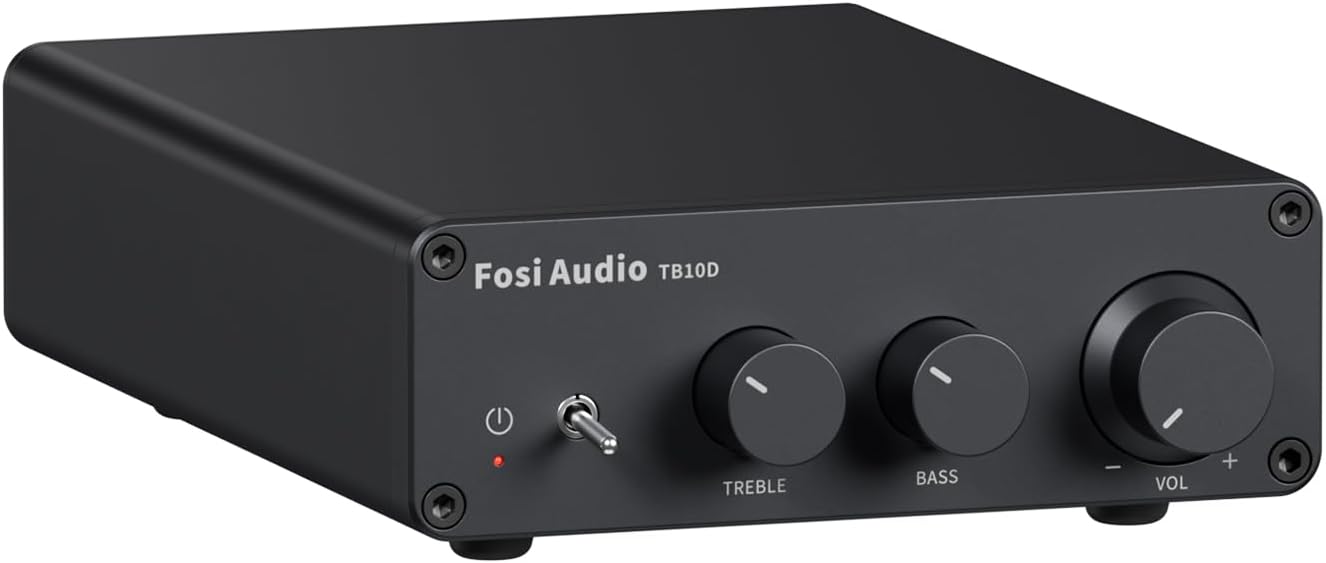
The Fosi Audio TB10D is a compact Class D stereo amplifier delivering 600W total power via the advanced TPA3255 chip. It supports 2-8 ohm passive speakers and bass shakers, featuring bass and treble controls for personalized audio tuning. With universal RCA inputs and built-in protection circuits, it ensures versatile connectivity and reliable, long-term performance across home audio, gaming, and studio environments.


| ASIN | B08MJBG53V |
| Best Sellers Rank | #6,515 in Electronics ( See Top 100 in Electronics ) #20 in Audio Component Amplifiers |
| Brand | Fosi Audio |
| Customer Reviews | 4.4 out of 5 stars 1,562 Reviews |
| Item Type Name | 2 Channel Amplifier |
| Item Weight | 2.42 Pounds |
| Manufacturer | Fosi Audio |
| Mfr Part Number | TB10D |
| Model Number | TB10D |
| Unit Count | 1.0 Count |
| Warranty Description | 24-month manufacturer |
M**R
A good choice, good value Class D stereo amplifier
If you are considering purchasing a stereo Class D amplifier and you don't require Bluetooth, digital inputs or balanced inputs then the Fosi Audio TB10D is a great choice. The TB10D stereo amplifier, when paired with a small music streaming device such as one of the WiiM music streamers (also available on Amazon), becomes half of a shoebox sized streaming audio system. You would just need to add a pair of passive (non-amplified) speakers. The bass frequency response of the TB10D was noticeably absent when first powered on. After about a half hour of operation the bass finally showed up and all was good. I leave the TB10D powered on as the standby power draw is very low. [Update: I measured the standby power consumption of the TB10D. Plugged in, not switched on, 1.0 Watt. Switched on, no input signal, power consumption is 2.5 Watts.] Even though I know that the location of the bass and treble tone controls on the TB10D are reversed, as compared with most other amplifiers and receivers with the treble control being on the left and the bass control on the right, I routinely forget and grab the wrong tone control. The speaker binding posts are small and close together. This is not an issue as I use banana plugs when connecting the speaker wires to the TB10D. Note that there is no headphone connection on the TB10D for wired headphones. If you need a small, inexpensive good sounding headphone amplifier for wired headphones consider the Fosi Audio P2 headphone amplifier. The TB10D's available output power, ~50 Watts per channel when used with 8 ohm speakers, with the included 32V/5A power brick is adequate for use in my kitchen audio system. The case and power supply of the TB10D remained cool to the touch even after extended listening (I measured 72F). If you have a large room, lower efficiency speakers, or desire audio levels exceeding ~85dB you should consider a more powerful amplifier. You can change the supplied external power supply for one rated for 48V, however this will increase the overall cost as well as increase the operating temperature of the TB10D. Within its limitations as far as output power, input options (one pair of RCA connections, no digital inputs, no balanced inputs), outputs (one pair of stereo speakers), no Mono mode switch, no BT, no Sub out, no headphone connection or remote control, the Fosi Audio TB10D is a very good choice. I found the sound of the TB10D when powering 4 ohm, 6 ohm and 8 ohm speakers to be consistently smooth, full sounding and non-fatiguing with a variety of music even after prolonged listening. I assembled a complete 2-channel audio system of exceptional value that can fit in a shoe box. Each of these products is currently available on Amazon. I chose the Fosi Audio TB10D amplifier that is the subject of this review. I added the well reviewed, amazingly compact WiiM Mini music streamer. [Update: I chose a pair of Saiyin Passive Bookshelf Speakers, 2-Way Passive Speakers, 3.5" Woofer & Silk Horn Tweeter that are sold on Amazon. I can't say enough good things about this small desktop speaker; see my separate review of the Saiyin DS6700M speakers.] This system is capable of filling almost any size room in a home with great sounding music. The TB10D amplifier's tone controls and the WiiM Home app's equalizer settings can be used to adjust the bass/midrange/treble output of the speakers.
J**N
Works great so far.
Saw a review of this updated amplifier and decided to buy it so that I can take a vintage Kenwood receiver out of service to see about replacing capacitors in the unit's power supply and output stages. Got it with the standard 32 volt power brick. For testing hooked it up to a pair of older Infinity 8 ohm bookshelf speakers and an older Sony DVD player for CD playback. Plenty of power output, no background noise with the volume turned up and no signal. 6-1/2" woofers supplied plenty of bass with this amp in a small room and the volume and tone controls were fine, apparently fixed what people were complaining about in the previous model. Played for about an hour at a very satisfying volume level (RUSH, Working Men CD) and the unit didn't even get warm during use. This Class D amp is acceptable to me, no noticeable harshness in the sound. Very basic amp and very compact, seems to be great for a starter music system, you'll need a source like a DAC and a Wiim or turntable that has it's own preamp, The Infinitys I had bought used $60 and the Sony DVD for like $10 at a thrift store, so for around $150 it was a basic sound system that sounded pretty good. You don't have break the bank.
B**N
Beginning with this TB10D, and subsequent FOSI Releases, the class D market is changing...
As a matter of background info, when these inexpensive Chinese-made Class D amps first started appearing, their sound characteristics were almost universally described as being thin, cold (in many cases, harsh in the upper frequencies), and fatiguing for long-term listening. But at the time, they were what they were, and they were selling like hot cakes due to their ridiculously low prices. As time went on, individual brands started producing models that slowly began improving - meaning, warmer with a fuller sound signature. Yet in the end, these models were still lacking in a number of areas. Fast-forward to now. We now have a wealth of updated class D models (most under $100 USD) that have begun to turn heads in a most positive way. The inexpensive class D sound has gradually experienced a metamorphosis - that is, audio reproduction now began to gradually take on a warmer overall tonality with a better overall balance. In addition, some of the newer releases began incorporating welcomed additions such as having removable/changeable Op-Amps - thus allowing the end users to improve the sound to their liking. Upgrading these Op-Amps, in particular, to the discrete, more expensive types (made by MUSES, Sparkos Labs, Burson, etc.), result in significant improvements to audio reproduction. Some of FOSI Audio's later releases such as the BT20A Pro and the wonderful V3, all feature removable/interchangeable Op-Amp capabilities and if you replaced the typical stock NE5532 Op-Amps with either the likes of the MUSES02, BURSON V5i or the Sparkos Labs SS3602 discrete versions, the sound qualities of those amps were advanced substantially. I've owned/used 20 different Asian-made Class D amp over the past years, and when I received this new updated version of the Fosi Audio TB10D, I immediately discovered that it has a sound signature similar to many of the models out there with the Texas Instruments TPA3255 amplifier chip - that is dynamic and a bit warmer and fuller. Like select models using this TPA3255 chip, the user has the ability to use power supplies ranging from 24-48V varieties and the higher you go, the more wattage the amp is capable of putting out. With this Fosi TB10D, I was stunned at how small it is. It is roughly 3/4 to 2/3 the size of the smallish Aiyima A07 (both can use 48V power supplies if needed). The Fosi is very well constructed and has a very solid feel, along with the knobs (not plasticky) - giving it a quality level feel that belies it's inexpensive price. The on/off switch in the front is very solid and convenient, to be sure. Now keep in mind that the TB10D does not have BT capabilities - it’s just a basic amp. As an aside, rather than use the supplied external power brick (32V), I had several high-quality linear power supplies on hand, which I could set to whatever voltage I wanted, up to 40V max. I set one of them to 40V and attached the Fosi TB10D. I then turned on the Fosi and let it warm up for 8 hours before I began listening. Having been an audiophile for well over 55 years now, I'm a firm believer in giving various audio components an initial time period to warm-up/break-in before doing any listening, because for most, sound qualities improve with a good warm-up/break-in period. As an aside, regardless of how long you have the TB10D powered on (I keep my gear on all the time), its case stays cool to the touch. I then connected the TB10D using 10 gauge professional cable (Blue Jeans Cables) terminated on the ends with banana connectors, to the KEF Q150 and Q350 speakers (alternating between the two). The TB10D was fed by a variety of DAC units using a custom-made 8-way in (1 out) RCA switcher custom-built by Maple Tree Audio Design from Canada. This enabled me to use a variety of attached DAC/Head-amp units to determine sound variations with the amp. OK - so let's discuss the audio reproduction characteristics of the TB10D: 1. Overall sound signature: Initially - like most other inexpensive class D amps - the sound is a bit thinner, slightly warm, but lacking in feel for that "you are there," immersive experience. As time went on, the overall sound signature warmed up a bit more, became fuller, and had a nice, overall feel to the music. In other words, it is a very "nice" sounding amp to be sure - especially for its ridiculously low price. However, does the term "nice sounding" imply that it is a highly immersive, musical, and accurate sounding amp? Well, no...please read on. 2. Sound-staging is wider than some amplifiers, but not in the best category. But given its price-point the sound-staging does not disappoint, considering it's low price. 3. Bass capabilities: Very dynamic and fully present (when it's in the recording). In fact, on some recordings, I had to back off on my power subwoofer to balance things out. So for bass heads - once the amp is warmed up - you won't be lacking in the bass department. Does the bass have air and separation like better class AB amps - well, no it doesn't. But there is plenty of bass to go around. 4. Midrange and Treble capabilities: Very nice and smooth, however, like all class D amps have a tendency to do at times (but becoming rarer with each new release), some instruments may still come through with a slight "steely" quality to them, like stringed instruments in a large symphony orchestra. However, the TB10D does a much better job than most in this department. 5. Depth and air around the instruments: The TB10D does an average job here - nothing exceptional, yet good enough. However, for class D amps in general, this particular intangible quality is often elusive. Audiophile Qualities: For informational purposes, there are some intangible characteristics of "better" amps (i.e. class AB and class A versions) that can best be described as having qualities which cannot be measured in the traditional sense, yet can be experinced when they are present. These intangible qualities include variables such as: a. Being able to accurately convey the ambience of the performing venue. b. Being able to showcase the depth and air around various instruments. c. Being highly immersive - that is, the last veils (regardless of how slight they may be) have been removed between the listener and the music. d. Having correct instrumental timbre - that is, each instrument's tonal qualities are accurately showcased, often-times also referred to as “being musical.” Now, remember - I said that the TB10D is a very good-sounding amp (like many other contemporary models on the market today). However, "Good" does not necessarily translate into being immersive or highly accurate. I say this because overall - again, like many other class D amps - there is a slight (warmish) veil/tonality (in particular with the myriad of instruments in a symphony orchestra) that detracts from the feeling of "being there." This is to be expected really, because after all, this TB10D only costs around $60 to $79 (depending on where you purchase it from). Now if they gave this amp the capabilities like some other Asian made class D amps have - that is, being able to remove and change out the Op-Amps, then that could change the game significantly. But it is not to be - everything is permanently attached inside the Fosi TB10D. The only thing you can upgrade with this TB10D are the power supplies (and the types used). Now here's an important aside - Fosi Audio recently released their much anticipated upgraded BT20A Pro, which is only a few dollars more, and just a few short months later, the highly reviewed and highly regarded FOSI Audio V3 (and by many audiophiles, no less). The difference here also (and it's major) is that there are now 2 dual channel Op-Amps inside both the BT20A and V3 that you can remove and upgrade! This will improve the sound substantially and bring it more in line with what you would hear with class AB amps. Getting back to the TB10D, based on its low price and what you get, I am giving this Fosi TB10D class D amplifiers a 4-star rating - had it the ability to change Op-Amps (thus improving the sound for the most part), I would have given it 5 stars. However, for its very low price, the TB10D punches far above its weight. It is a pleasant amp to listen to and its small size belies the power you get, and it can drive many a speaker - large or small. As I alluded to above, I do strongly suggest that folks invest in "linear" power supplies that make a huge difference with all of your audio components (those components with external power supply bricks). With a linear power supply, there are no hums or other noises. All you get is pure, quiet power that contributes significantly to your audio output. I have several of these with different voltages (link below) that I use, and I also have one that was custom-made to allow up to 40 volts. With this version you can power two devices on the back (not just one), so if you have two devices using the same power, this one linear power supply can power both of them, and it shows you the voltage on the front LCD screen. https://www.amazon.com/gp/product/B09SVK9CQF/ref=ox_sc_saved_title_4?smid=A39KK3JMT5S2I5&psc=1 So folks, if you are on a very, very limited budget, you can't go wrong with this Fosi TB10D class D amp. It's price, build-quality and musical pluses - all combine to make it a pleasant experience. However, now that the FOSI Audio BT20 Pro and V3 were released - all with improved internal components and interchangeable Op-Amps, I'd have to give them a much higher recommendation over the TB10D - just sayin.' Now, I realize that all reviews are subjective, and that no two people may agree. Your mileage may vary.
A**L
Great value
I bought this after listening to the review by Randy of the CheapAudioMan Youtube channel. He spoke highly of this amp, and I found his conclusions to be accurate. I bought this to use in my garage. I wanted a simple amp that didn't take up much space. In my garage, it's gonna get dusty...and it's going to have to compete with power tools, air filter, etc. That's not the place for mult-thousand dollar amps!! About the rated power...you have to be realistic. I know this amp says it's 600W, but it's not. Not in any practical sense, anyway. And none of the other cheap class D amps are going to be, either. The difference is that more expensive amps stay clean at or near their rated power. These cheap amps don't. They start to introduce distortion well before they get to their max power...That's not to say it's not a stout little amp...it is! But you can't compare this to a $2K+ amplifier with a rated output of a couple hundred wats, and think they're going to be equivalent! To put it in terms most folks can relate to, I'd say this amp will drive speakers to about the same level as a typical mid-level class AB receiver in the 50-70 watts per channel range. Beyond those levels, you start getting distortion that you can hear, and that can damage speakers. But that's shouldn't really discourage you...with moderately sensitive speakers, 50-70 watts is pretty darn loud! In my case, I used this amp to drive a pair of Klipsch KG2.2 speakers that I bought a while back on Ebay. KG 2.2 speakers have a sensitivity of 93db. That's a little bit higher than average, and this amp drives those speakers to very high volumes! If your speakers are less sensitive, the volume will be lower, which is the case no matter what amplifier you're using! If you're using this amp in a bedroom or small office, it's probably gonna be loud enough with any speakers you have. But if you're driving 87db speakers in an 800 square foot room, it's probably not going to get very loud. If you like to shake the walls and anger your neighbors, keep that in mind. One of the categories mentioned above is volume control, so I'll mention it. On this amp are three controls...volume, bass and treble. They all work great. Smooth controls, no static, and the tone controls add just the right amount of cut or boost to the bass and treble respectively. In my case, I set the tone controls the way I wanted them, and I put the volume control to about 75-80%, and I just leave the amp on 24/7. In normal use, I connect to the WIIM mini streamer using the app on my phone, and I control the volume that way. This works great, and gives me remote control over the volume. For the price, this thing is a steal! In fact, I'm going to buy another one, which I plan to use to power the outdoor speakers on my patio. Currently they're being driven by a very cheap JVC receiver left behind by the previous owners of my home, and I am confident this amp will do a better job than the JVC is currently doing!
K**S
Fantastic Amp for Dayton BST-1 Bass Shakers in a Sim Racing Cockpit
I’m extremely happy with the Fosi Audio TB10D as the amplifier for my Dayton BST-1 bass shakers in my sim racing cockpit. It delivers clean, robust power that brings out tactile detail beautifully engine rumble, road bumps, and tire feedback all feel much more immersive and natural. With the right tuning in SimHub, the TB10D drives my BST-1s without distortion or overheating, even in long sessions. Setup was a breeze, the compact design fits perfectly on my rig. Build quality feels solid and reliable. If you’re adding Dayton BST-1 shakers to your sim rig and need a capable yet affordable amp, this is a great choice.
M**T
Perfect little amp that fit my need. Pleasantly surprised by the power.
I bought this for the lanai by the pool. I have it hooked up to some Klipsch outdoor speakers and have it plugged into an Alexa as my source. This is a mighty little amp with the TI chip in it. It suits my needs by the pool. I have a nice audiophile system indoors so all I needed some cheap functionality and was surprised by how good it sounds. Highly recommend.
J**C
Recommended - a great little audio problem solver!
This little amp fits anywhere and sounds awesome driving a pair of vintage 8-ohm JBL bookshelf speakers in my bedroom. The sound quality is great - volume is more than enough to fill the room. Careful with the bass control - a little goes a long way. The simplicity of design means it super-easy to get setup and going with this little amp - just connect source and speakers and you're done.
E**M
Great option for the money
Disclaimer: I know almost nothing about speakers or amps. I've been doing some composing, and all my mixing has been done with headphones, which meant I wasn't mixing well for multiple scenarios. My bro-in-law offered me some Yamaha NS10s he wasn't using anymore, and I gladly accepted them, not totally realizing I'd need an amp to power them and interface with my computer. A bit of research had me eyeing $800+ amps, and my new-to-me monitors began collecting dust stacked in the corner for a few months before I stumbled upon a forum thread suggesting Class D amps like this one (a recommendation that stirred up much controversy on the forum, as I recall). With some skepticism, I gave this a try, wondering how a $70 thing could solve a problem that my research suggested would cost hundreds or even thousands of dollars. For my use case, this works great. My computer, scoring software, and DAW recognized the unit as an audio output option the moment I flipped on the power switch. It doesn't offer much in the way of EQ controls — just volume, bass, and treble — but for my use case, that's perfect. I also REALLY appreciate that the description is so clear — it explains that the unit can handle two channels, each 150W at 8 Ohms (so if I blow out my monitors, it's not going to be because they didn't give me exactly the info I needed to make a better decision... I hope I read the NS10M specs correctly!). Build quality is surprisingly good for cost. The power switch has a nice resistance and feels very solid, knobs rotate with some nice balance of glide vs. resistance as well. The switch and simple knob layout makes it easy to use by feel, since the unit is hidden under my desk. It also provides a few interface types (RCA and banana plugs style), although I wish it had an aux jack for my headphones and a way to toggle between output destinations mechanically vs. having to disrupt software workflows to go between speakers and headphones (and that would make for 1 wire out of my laptop vs. 2, which cuts down on clutter), but can't get everything you want at this price point, I suppose! It's routed through my thunderbolt dock, so when I switch the dock from my work laptop to my computer laptop and forgot to switch the unit off, there's a mildly alarming hum, but it's probably to be expected and a good reminder to turn off the unit when I'm not using it anyway. Definitely recommend as long as you check the specs on your speakers and also don't need it to have fancy bells and whistles for your use case.
L**G
Value for the price.
Worked exactly as expected…
T**A
Amp for Bose speakers
Bought it for my bose 301 Series V. I love it, the quality and the size of the device is perfect for my work desk
D**X
Topissime
Excellent et très puissant, très bon son , je l’ai installé pour mettre 8 enceinte de 150 W autour de la piscine il chauffe même pas et le son est extraordinaire. si vous cherchez un ampli puissant, de très bonne qualité, à un coût très modéré, n’hésitez pas une seconde.
A**S
Fantastic compact, clean and powerful no frills Stereo Amplification
Was actually really blown away by this amp. It's my first time buying Class-D amplification. This thing sounds so clean and flat in general. No noise detected, no hum, no heat from the amp and I can't believe how much power comes out of this tiny thing. Treble and Bass Controls sound nice. Completely replaced my old bulky Stereo Amplifiers so I'll definitely buy another one to have for my other pair of Passive speakers. Compact, Clean simple great power amplification.
A**P
Zuiver
Zuiver en een realistische weergave van stem en instrumenten, MITS je 24V voeding gebruikt.
Trustpilot
2 weeks ago
2 weeks ago