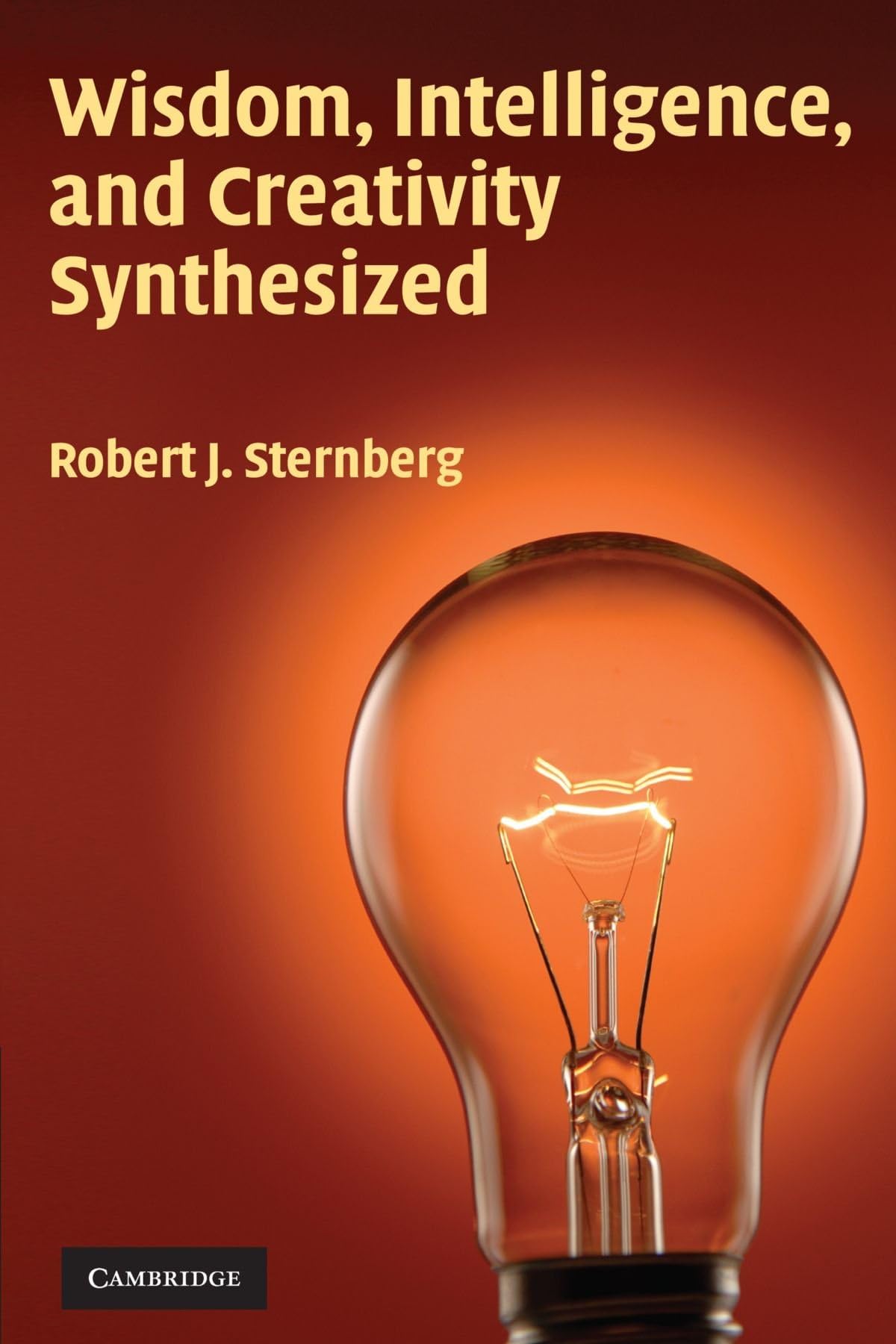
Wisdom, Intelligence, and Creativity Synthesized
Product ID: 31199300
Buy anything from 5,000+ international stores. One checkout price. No surprise fees. Join 2M+ shoppers on Desertcart.
Desertcart purchases this item on your behalf and handles shipping, customs, and support to Italy.
Wisdom, Intelligence, and Creativity Synthesized [Sternberg PhD, Robert J.] on desertcart.com. *FREE* shipping on qualifying offers. Wisdom, Intelligence, and Creativity Synthesized Review: A Seminal Work - This is a must read for any sincere scholarly inquiry into wisdom science. Sternberg's balance theory of wisdom is a foundation upon which many have built their own work. I would highly recommend this for not only wisdom studies, but leadership, and educational studies as well. A great read!!! Review: GOOD BUT WANTED MORE - A COMPREHENSIVE INTRODUCTION. BUT AS AN EDUCATOR I WOULD HAVE LIKED TO HAVE ACCESS TO THE TOOLS THAT HE USES TO MEASURE THE DIFFERENCE INTELLIGENCES - AS WELL AS MORE MATERIAL ON HOW TO USE THIS IN THE CLASSROOM - GUESS I WILL HAVE TO BUY ANOTHER OF HIS BOOKS FOR THIS... ONE DAY. Added Jan 2010 Perhaps the most useful reason to buy the book is that it broadens ones perspective of intelligence is... or could be. Sometimes those who are academically adept are not able to function when other aspects of intelligence are called upon to get the job done. Sternberg presents another way of looking at intelligence in terms of: Intelligence - more or less what one would expect it to be Wisdom- a type of social/organisational situational awareness where one assesses whether you should persist to bring about change, change yourself or exit an organisation/problem or situation Creativity - going beyond what currently is - various levels of this are discussed. Considering we are in an age dominated by educational testing, data collection and analysis to determine who should be promoted, or accepted into university, or who a good teacher is etc, this book is informative in that it challenges us to question the basic assumption behind all measures of 'intelligence' and the exams/test derived from such assumptions are valid. However even the very notion of the tri-archic intelligence promoted by Mr. Sternberg should also be in question. Basically intelligence is a construct developed by psychologists - and the notion of what it is and what it means has been a matter of considerable debate for a long time. Intelligence is in the eye of the beholder- and Sternberg has invented, tested and validated his own version of it... equally as valid I guess as many other notions.
| Best Sellers Rank | #1,860,948 in Books ( See Top 100 in Books ) #862 in Popular Psychology Creativity & Genius #2,145 in Popular Psychology Personality Study #5,888 in Medical General Psychology |
| Customer Reviews | 3.6 3.6 out of 5 stars (10) |
| Dimensions | 6 x 0.62 x 9 inches |
| Edition | 1st |
| ISBN-10 | 0521002710 |
| ISBN-13 | 978-0521002714 |
| Item Weight | 12 ounces |
| Language | English |
| Print length | 246 pages |
| Publication date | September 24, 2007 |
| Publisher | Cambridge University Press |
C**M
A Seminal Work
This is a must read for any sincere scholarly inquiry into wisdom science. Sternberg's balance theory of wisdom is a foundation upon which many have built their own work. I would highly recommend this for not only wisdom studies, but leadership, and educational studies as well. A great read!!!
P**J
GOOD BUT WANTED MORE
A COMPREHENSIVE INTRODUCTION. BUT AS AN EDUCATOR I WOULD HAVE LIKED TO HAVE ACCESS TO THE TOOLS THAT HE USES TO MEASURE THE DIFFERENCE INTELLIGENCES - AS WELL AS MORE MATERIAL ON HOW TO USE THIS IN THE CLASSROOM - GUESS I WILL HAVE TO BUY ANOTHER OF HIS BOOKS FOR THIS... ONE DAY. Added Jan 2010 Perhaps the most useful reason to buy the book is that it broadens ones perspective of intelligence is... or could be. Sometimes those who are academically adept are not able to function when other aspects of intelligence are called upon to get the job done. Sternberg presents another way of looking at intelligence in terms of: Intelligence - more or less what one would expect it to be Wisdom- a type of social/organisational situational awareness where one assesses whether you should persist to bring about change, change yourself or exit an organisation/problem or situation Creativity - going beyond what currently is - various levels of this are discussed. Considering we are in an age dominated by educational testing, data collection and analysis to determine who should be promoted, or accepted into university, or who a good teacher is etc, this book is informative in that it challenges us to question the basic assumption behind all measures of 'intelligence' and the exams/test derived from such assumptions are valid. However even the very notion of the tri-archic intelligence promoted by Mr. Sternberg should also be in question. Basically intelligence is a construct developed by psychologists - and the notion of what it is and what it means has been a matter of considerable debate for a long time. Intelligence is in the eye of the beholder- and Sternberg has invented, tested and validated his own version of it... equally as valid I guess as many other notions.
S**)
Five Stars
none
M**O
A synthesis of a contribution not a synthetic model
The book is a very good synthesis of Sternberg's work about intelligence, creativity and wisdom (a good option for someone who is not yet familiar with it) but it provides nothing but a combination of the previous contributions of the author. Its emphasis on the broadening of the concept of intelligence is not new in Sternberg's work. The main issue of the book is neither the relationships between the concepts, as I was expecting judging by the title, nor the new levels of analysis and explanation that could have emerged from those relationships. In the last chapter I felt really disappointed because it finished even before I thought it had started...
H**H
Useful history of the contested concept of "intelligence"
I enjoyed Sternberg's history of the concept & how people have fought over what to measure and how to measure it. "Intelligence" turns out to be quite a loaded notion! I found Sternberg's distinction between analytic, creative,and practical intelligence very helpful. It helped me understand why people with a high measured analytic intelligence sometimes fall short of what we think they could achieve.
G**T
About bored me to death
This book is a wordy walk through on various theories of intelligence, including Sternberg's own theory of triarchic intelligence in which he weighs and analyzes the differences in analytic, creative,and practical intelligence. I think the book is a good listing of nearly ever major work on intelligence theory, but in the end it falls flat and boring. There's not enough anecdotes, practical application, or examples or insight into the testing that is used to determine each. It's a very interesting subject, but if my sole introduction to it had been through this book, facing years of study in the subject, I think I might suddenly get very creative on how to drop out of school or change my major without my parents killing me. Chapter 6 has a lot more merit and was more interesting. It is moving towards a model of wisdom. giving a good background on these models. Chapter 7 then discusses foolishness, and breaks it down into fallacies that derail even intelligent people to act foolishly - for instance, when one's thinking becomes overly self-centered, or concerned with omniscience or omnipotence, the intelligence faults into foolishness. Can this be avoided? Can wisdom be taught? The teaching of wisdom is also discussed. I wasn't at all convinced that this is really describing foolishness in an objective context. It seemed a bit ethnocentric to me. As content though, it oozes with possibility, and so this section of the book was much easier to bear than the rest. I'm not sure that the book really added much to my understanding of the nature of mind. Rather, I understand models that are being tossed around a lot more.
Trustpilot
4 days ago
2 months ago