A Little Life
Product ID: 262219070
Buy anything from 5,000+ international stores. One checkout price. No surprise fees. Join 2M+ shoppers on Desertcart.
Desertcart purchases this item on your behalf and handles shipping, customs, and support to Italy.
Buy A Little Life by Yanagihara, Hanya from desertcart's Fiction Books Store. Everyday low prices on a huge range of new releases and classic fiction. Review: One of the finest novels I've read - Quite possibly one of the finest novels I've had the pleasure of reading. Epic, devastating, enduring, challenging, deeply moving. Such confident prose that unravels the innermost thoughts of these beautifully-drawn characters while also achieving an acute sense of sonder; and also written with admirable, aching restraint of deeply challenging and confronting topics; the effects of which I feel will be impressed upon me for a long time. I've come away thinking of the astonishing depths of depravity of humanity (and especially reading this in the context of the Epstein files which is desperately resonant) but more significantly of the enduring power of human companionship and kindness, with the nuance that you must extend kindness to yourself if you find that, after all, sometimes kindness isn't enough. Don't be intimidated by its length; if anything, I almost wished it was longer with how attached I became to the characters! The pacing, developments, and revelations unfold with care, confidence, and with seeds whose significance produce immense emotional power in time, and you will be rewarded for it. Highly recommend. Review: A Moving and Memorable Book - I first discovered Yanagihara through her divisive first novel The People in the Trees. I found the story it told to be a grim yet fascinating one and when I heard about A Little Life I immediately wanted to read it. I ordered a paperback (I'm not a lover of hardbacks) from the States and waited with barely contained anticipation for it to arrive. The book follows the life of four best friends all the way from college to their later adult lives. The first third of the book is equally split between the four as they struggle through the years after college and look to forge their way in life. JB is an artist with a number of personal issues, Willem a kindly aspiring actor, Malcolm an insecure architect and Jude, a brilliant yet damaged man, who could do many things yet decides on a life in law. Essentially Jude is the crux of this friendship as, owing to an utterly horrific youth, his friends rally round to protect him and support him through the disabilities and fragilities he acquired along the way. After a point the book begins to focus solely on the relationship between Willem and Jude and JB and Malcolm become, for the most part, peripheral characters. They are replaced by Harold and Julia, a man and wife who meet Jude while he is at college and grow extremely fond of him. Although this shift in direction disappointed me at first (I especially enjoyed reading about JB's life and his problems in the first section of the novel) I soon slipped into this new groove and quickly began to enjoy the new narrative possibilities this change created. As a result of these changes, the end of the book comes as no surprise to the reader but, nonetheless, I found it difficult to fight back the tears. A Little Life is similar in some regards, yet greatly different to, The People in the Trees. In A Little Life, Yanagihara again confronts many of the harsh and unpalatable traits of the human condition (child abuse, self-harming, graphic violence) that turned many readers away from her first novel. However, many of the characters she writes about here display an abundance of enviable human qualities - patience, love, loyalty - that were sorely lacking in the ones she created for The People in the Trees. This book evokes strong emotion - just like People in The Trees did - but this time those emotions are more favourable than the utter contempt and disgust I felt towards the protagonists of her first novel. I won't lie, the book almost had me on the verge of tears a number of times and I'm usually a hard and unfeeling person. From the reviews I've read, many people found the book forced and schmaltzy but I found it genuinely affecting - perhaps I am getting soft in my old age. Yanagihara writes so cleverly and touchingly of the men's friendship that it genuinely helped me create a brilliantly vivid image of the friends in my mind's eye; an image which stayed with me throughout the entirety of the book. I was also able to strongly connect with the feelings of many of the characters within its pages and perhaps this helped me appreciate and enjoy them more than other readers were able. Sure, the book is long and can at times be repetitious, and in it Yanagihara has a tendency to reuse words too closely together (over and over, cried and cried, struggled and struggled, argued and argued, etc) but for me, strangely, the very mundanity of the book is one of its most endearing traits. Real-life friendships are often valued on how comfortable companions feel around each other through the more tedious aspects of our co-existence and I think Yanagihara conveyed these uninspiring moments with such skill that they became enjoyable. I will admit that there is a level of over sentimentality present, especially concerning Jude, which I can understand will turn some people off. And, speaking of Jude, his unwavering self-loathing and total inability to even begin to accept his friends' feelings about him did grate occasionally but, overall, these elements rarely bothered me that much. Although the book was long I never found it a chore and I devoured huge chunks of it in single sittings, something I always associate with powerful books that resonate with me. Before I wrap up, a warning to potential buyers: there are, just as in The People in the Trees, some very shocking scenes within this book's pages. There are graphic depictions of sexual abuse (some involving children) and brutal violence. Yanagihara does not shy away from these unpalatable acts and actions and her no holds barred approach to these scenes may rear discomfort or indeed disgust in some readers. There are also a number of intense scenes involving bodily disfigurement and self-harm that people with a queasy disposition might find repulsive and, as such, should bear this in mind when considering a purchase. I'd highly recommend this book to anyone thinking about reading it - despite A Little Life clocking in at over 800 pages long I was sorry for it to end. Hanya Yanagihara is an accomplished and emotive writer and she is quick becoming one of my favourite authors; I am excited to see what she produces in the future. For me this has been one of the most memorable, moving and engrossing books I've read in a long time. I'm off to check out the actual Man Booker Prize winner now as, if it managed to best this novel, it must be some book.
| Best Sellers Rank | 48,010 in Books ( See Top 100 in Books ) 9 in Coming of Age 83 in Literary Fiction (Books) 145 in Contemporary Fiction (Books) |
| Customer reviews | 4.5 4.5 out of 5 stars (87,456) |
| Dimensions | 13.34 x 3.68 x 20.32 cm |
| Edition | Reprint |
| ISBN-10 | 0804172706 |
| ISBN-13 | 978-0804172707 |
| Item weight | 599 g |
| Language | English |
| Print length | 832 pages |
| Publication date | 28 Aug. 2024 |
| Publisher | Knopf Doubleday Publishing Group |
S**R
One of the finest novels I've read
Quite possibly one of the finest novels I've had the pleasure of reading. Epic, devastating, enduring, challenging, deeply moving. Such confident prose that unravels the innermost thoughts of these beautifully-drawn characters while also achieving an acute sense of sonder; and also written with admirable, aching restraint of deeply challenging and confronting topics; the effects of which I feel will be impressed upon me for a long time. I've come away thinking of the astonishing depths of depravity of humanity (and especially reading this in the context of the Epstein files which is desperately resonant) but more significantly of the enduring power of human companionship and kindness, with the nuance that you must extend kindness to yourself if you find that, after all, sometimes kindness isn't enough. Don't be intimidated by its length; if anything, I almost wished it was longer with how attached I became to the characters! The pacing, developments, and revelations unfold with care, confidence, and with seeds whose significance produce immense emotional power in time, and you will be rewarded for it. Highly recommend.
H**S
A Moving and Memorable Book
I first discovered Yanagihara through her divisive first novel The People in the Trees. I found the story it told to be a grim yet fascinating one and when I heard about A Little Life I immediately wanted to read it. I ordered a paperback (I'm not a lover of hardbacks) from the States and waited with barely contained anticipation for it to arrive. The book follows the life of four best friends all the way from college to their later adult lives. The first third of the book is equally split between the four as they struggle through the years after college and look to forge their way in life. JB is an artist with a number of personal issues, Willem a kindly aspiring actor, Malcolm an insecure architect and Jude, a brilliant yet damaged man, who could do many things yet decides on a life in law. Essentially Jude is the crux of this friendship as, owing to an utterly horrific youth, his friends rally round to protect him and support him through the disabilities and fragilities he acquired along the way. After a point the book begins to focus solely on the relationship between Willem and Jude and JB and Malcolm become, for the most part, peripheral characters. They are replaced by Harold and Julia, a man and wife who meet Jude while he is at college and grow extremely fond of him. Although this shift in direction disappointed me at first (I especially enjoyed reading about JB's life and his problems in the first section of the novel) I soon slipped into this new groove and quickly began to enjoy the new narrative possibilities this change created. As a result of these changes, the end of the book comes as no surprise to the reader but, nonetheless, I found it difficult to fight back the tears. A Little Life is similar in some regards, yet greatly different to, The People in the Trees. In A Little Life, Yanagihara again confronts many of the harsh and unpalatable traits of the human condition (child abuse, self-harming, graphic violence) that turned many readers away from her first novel. However, many of the characters she writes about here display an abundance of enviable human qualities - patience, love, loyalty - that were sorely lacking in the ones she created for The People in the Trees. This book evokes strong emotion - just like People in The Trees did - but this time those emotions are more favourable than the utter contempt and disgust I felt towards the protagonists of her first novel. I won't lie, the book almost had me on the verge of tears a number of times and I'm usually a hard and unfeeling person. From the reviews I've read, many people found the book forced and schmaltzy but I found it genuinely affecting - perhaps I am getting soft in my old age. Yanagihara writes so cleverly and touchingly of the men's friendship that it genuinely helped me create a brilliantly vivid image of the friends in my mind's eye; an image which stayed with me throughout the entirety of the book. I was also able to strongly connect with the feelings of many of the characters within its pages and perhaps this helped me appreciate and enjoy them more than other readers were able. Sure, the book is long and can at times be repetitious, and in it Yanagihara has a tendency to reuse words too closely together (over and over, cried and cried, struggled and struggled, argued and argued, etc) but for me, strangely, the very mundanity of the book is one of its most endearing traits. Real-life friendships are often valued on how comfortable companions feel around each other through the more tedious aspects of our co-existence and I think Yanagihara conveyed these uninspiring moments with such skill that they became enjoyable. I will admit that there is a level of over sentimentality present, especially concerning Jude, which I can understand will turn some people off. And, speaking of Jude, his unwavering self-loathing and total inability to even begin to accept his friends' feelings about him did grate occasionally but, overall, these elements rarely bothered me that much. Although the book was long I never found it a chore and I devoured huge chunks of it in single sittings, something I always associate with powerful books that resonate with me. Before I wrap up, a warning to potential buyers: there are, just as in The People in the Trees, some very shocking scenes within this book's pages. There are graphic depictions of sexual abuse (some involving children) and brutal violence. Yanagihara does not shy away from these unpalatable acts and actions and her no holds barred approach to these scenes may rear discomfort or indeed disgust in some readers. There are also a number of intense scenes involving bodily disfigurement and self-harm that people with a queasy disposition might find repulsive and, as such, should bear this in mind when considering a purchase. I'd highly recommend this book to anyone thinking about reading it - despite A Little Life clocking in at over 800 pages long I was sorry for it to end. Hanya Yanagihara is an accomplished and emotive writer and she is quick becoming one of my favourite authors; I am excited to see what she produces in the future. For me this has been one of the most memorable, moving and engrossing books I've read in a long time. I'm off to check out the actual Man Booker Prize winner now as, if it managed to best this novel, it must be some book.
G**S
An amazing story, but depressing, dark and extremely tough reading.
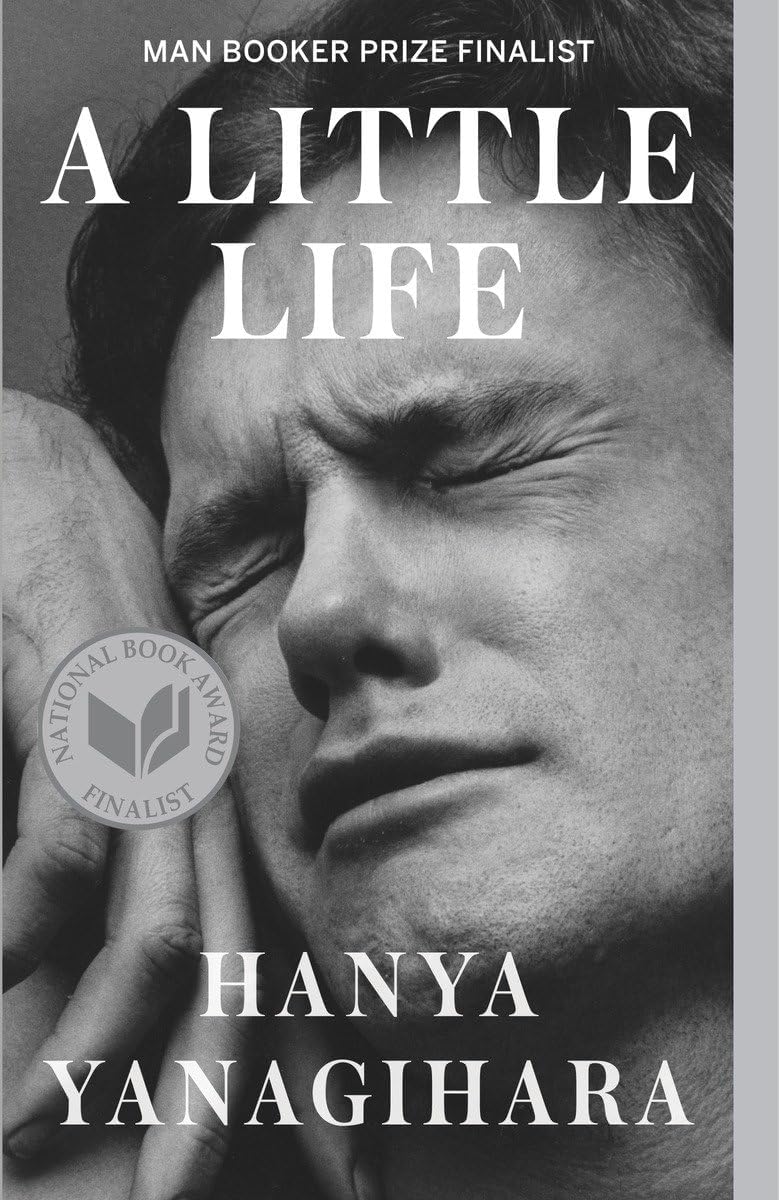
There’s so many reviews of this novel, and it has been so widely critically acclaimed, that it is difficult to come up with anything new and a review almost seems pointless. I am no literature expert; I just say what I think without in depth analysis. Moreover, I tend to only write reviews when I have found a novel extremely good or very bad. If it was just “so-so” then I tend not to comment. For me, this was neither brilliant nor bad, but I do feel a need to comment. I have no doubt that this could have been one of the most magnificent stories that I had ever read; in parts it felt like that. There were periods of wonderfully rich writing, combined with moving story lines that I found engrossing. I can see why it is so critically acclaimed. Unfortunately, however, I found too many parts really hard going. There was a particular section, from about halfway through, that was extremely difficult reading, both in terms of the writing style, that became monotonous, and in terms of the narrative or action (or lack thereof). I get the deep and horrendous complexities being covered, but I very, very nearly discarded it; however, by that time, I was so far through I just felt that I must persevere. I was glad I did, because, although deeply upsetting the final few chapters were well worth the effort of getting through the tough parts. If I was to make a couple of specific criticisms, they would be that I found the shifting timeline hard to follow. I also did not like the technique of starting chapters by leaving the reader unaware of where we were in time and space and who the narrator was. This does not make writing great in my book; it is just annoying. I also wondered if someone could really self-harm to this extreme degree whilst still being able to hold down a hugely high-profile job, working ridiculous numbers of hours each day, sometimes barley sleeping, and perform apparently brilliantly in court. It stretched my imagination. I also marvelled at the proportion of gay people in the story. I know this sounds trite, but everyone’s brother seemed to have a boyfriend and everyone’s sister a girlfriend. This was an unfamiliar world. These are banal points, I realise that. But hey, we can all have our say. The last two things I want to say is that, in totality, this book is deeply depressing and upsetting. It happens that I read it at a time when my own mental health was not strong, occasioned by an ageing body and a life which began badly and was punctuated by mistakes and failures. Anyone in a similar position should avoid this novel. I cried a lot reading this. Secondly, I first bought a version of this book with the still image “Orgasmic Man” on the front cover. After a week of seeing this, I could stand it no longer and I had to turn to Amazon to buy this version as shown above. The images of what I take to be a representation of Lispenard Street are benign and evocative. Orgasmic Man is malignant and brutal, a bit like the story I suppose, and I get the paradox of orgasm and pain, but I still think such a cover was a very bad idea.
E**R
I’ll be blunt upfront. A LITTLE LIFE (2015) by Hanya Yanagihara is the most soul-wrenching novel I have perhaps ever read. In the novel Yanagihara follows in minute detail the lives of four men who become friends, “a clique,” in college and continue to be close into their late fifties. JB Marion begins his work life as a “receptionist at a small but influential magazine based in SoHo that covered the downtown art scene,” with ambitions to become an artist. Fatherless since he was three, JB is of Haitian descent, tends toward being overweight, and is gay. Willem Ragnarsson, handsome and “liked by everyone” starts out as a waiter, but has his eye set on becoming a professional actor on stage and screen. In ways, Malcolm Irvine is the outlier of the group, still living at home with his parents who are a couple of mixed-race. He is wealthy and determined to become an architect. Malcolm appears to be oblivious of his appeal to others, even naïve, somewhat confused about his sexuality, and unmindful of his financial situation although generous to his friends and others when they are in need. At the core of the four friends is Jude St. Francis who holds the group together—not so much by what he does even though he is considerably bright, loyal, and hard-working, as well as determined to become a prosecutor, but because his friends care about him and Jude has needs. Parentless and with a mysterious past all of which he never speaks about and never having “a girlfriend or a boyfriend,” Jude has trouble with his legs and is frequently in pain. Although he never complains nor asks for help, his friends are very aware of his situation and go out of their way to assist Jude in as tactful of a manner as possible. Mainly set in New York City, as A LITTLE LIFE unfolds, Yanagihara brings into the fold other characters of importance including a doctor, Andy Contractor, and a former law professor, Harold Stein and his wife Judy, all of whom play important roles in in the novel, as well as a host of minor characters. It is, however, the four friends who remain central to the story, especially Jude and Willem, roommates in college and who remain the closest of the friends. The bulk of Yanagihara’s novel is told in chronicle order, but as the novel progresses, there are more flashbacks and memories, some of which get repeated with added detail as they surface, most of them revolving around Jude who becomes more and more the novel’s central character. When thinking about tragic characters in prose fiction, no one comes my mind as being more tragic than Jude Fawley from Thomas Hardy’s JUDE THE OBSCURE (1894/1895) which may be the motivation for the author’s name for her main character—Jude, “the patron saint of lost causes.” Although readers soon come to the realization Jude is a physically and emotionally scarred individual, Yanagihara’s revelations about the details of Jude’s history are painfully slow in coming—mirroring the complexity and rawness of those very memories which haunt and torment Jude. They are memories which have shaped, or rather distorted, his life. In one flashback the author reveals twenty-five years in the past, Ana, Jude's now deceased “first and only social worker” warning Jude during a hospital stay, “…you have to talk about these things while they’re fresh. Or you’ll never talk about them… and it’s going to fester inside you, and you’re always going to think you’re to blame. You’ll be wrong, of course, but you’ll always think it.” There are relatively few highs in Jude’s life and when they occur, the reader is bound to find them tearful moments of joy. The increasingly close friendship between Jude and Willem with both of them at the zenith of their careers is complex—filled paradoxically with the bounty which human relationships can contain along with enormous peril. Unfortunately, most of Jude’s life is a series of unrelenting, dreadful, terrifying, shattering lows and betrayals accompanied by self-destructive impulses which become worse and worse, adding to a man’s already burdensome childhood, youth, and life-long post-traumatic stress. Jude’s is a portrait of suffering beyond comprehension and the brutal perpetrators of his torments throughout his life are the epitome of unfathomable, monstrous human behavior. Thus, A LITTLE LIFE does not make for easy reading. It is emotionally jolting and at the same time riveting. So vivid are Yanagihara’s expose of the quartet of characters, the reader becomes one with them, making it a quintet. The author’s characters are real to life, the dialogue is vivid and genuine, and the quality of the writing as well as the tone of the novel is unswerving. Although Yanagihara’s central characters meet with sometimes staggering personal and professional successes, there are also failures and tragedies, both past and present, and always a dire cloud which encircles them all, especially Jude. Due to her immense and encompassing narrative skills, readers will eventually brace themselves so that whenever a horrifying revelation is made about Jude’s secret past or his present, there is likely worse to come. A narrative trick Yanagihara pulls a little over a quarter of the way into the novel and again at the half-way point, moving from an omniscient narrator to what clearly is a first person although not readily identifiable narrator, is bound to strike the reader as both curious and possibly even portentous. It is left up to the reader to recognize and interpret for themselves the meaning of the author’s temporary changes in point of view. She does the same switch near the book’s conclusion which eventually brings the work to its shocking climax and even more emotionally numbing, traumatic end. Clearly, A LITTLE LIFE is not for everyone. even though the novel is a modern masterpiece of writing and prose fiction and a work which will haunt the reader for a long time. The most resilient reader may very likely find there are times when they simply must close the book and exit the bleakness of the world Yanagihara creates before picking the book up again. Others may discover there are times when they simply want to throw the book across the room. Some readers may find the book impossible to finish because it is so emotionally draining. Regardless of the reader’s reaction to the novel, A LITTLE LIFE is an incredible accomplishment and a work which haunt the reader for a long time. [NOTES: (1) A LITTLE LIFE has recently been declared one of “The 20 Best Novels of the Decade” by Emily Temple for The Literary Hub on December 23, 2019. (2) The book’s cover photo is from a series of photos taken in the 1960s by Peter Hujar. The photo is titled “Orgasmic Man.” The photo is purposefully ambiguous. Is the man depicted experiencing joy or pain? (3) A stage adaptation of A LITTLE LIFE ran in Amsterdam in 2018 and 2019 with limited runs, only, most of which were in Dutch.]
J**A
First things first, I think this is the best written book I've ever read (maybe that doesn't say a lot because I mostly read YA romances or thrillers - but still, the writting on this book is amazing and anyone can attest to that). Second, oh where to begin... I can see why people either hate or love this book. In life, you encounter people with different approaches to life - some may choose to look at the positive side of things, others get a little stuck on the negatives - with this book is no different. Yes, there's a sequence of tragedies and inimaginable horrors and you can get stuck on that, but, like myself, you can extract SO MANY great things from this book, I chose to look at it as story about love (and not necessarily romantic love). The author managed to put into words thoughts that I had throughout my life about relationship, friendship, adulthood, parenthood, death and, as a lawyer, even the law. All the characters are well built, even if you don't go too deep in their past, there's background enough to understand why they are the way they are, why they struggle with what they struggle. I went in prepared to cry, but by the last page I was sobbing so hard I felt like I was going to throw up. Since then I carry the characters close to my heart and think about them every single day. I'm grateful for the opportunity to know their story. Jude, you will stick with me forever.
Ü**I
Daha okumadım Umuyorum ki güzel bir kitaptır☺️✌🏻
K**.
Snel geleverd
S**G
Det är inte lätt att öppna.
Trustpilot
2 weeks ago
2 weeks ago