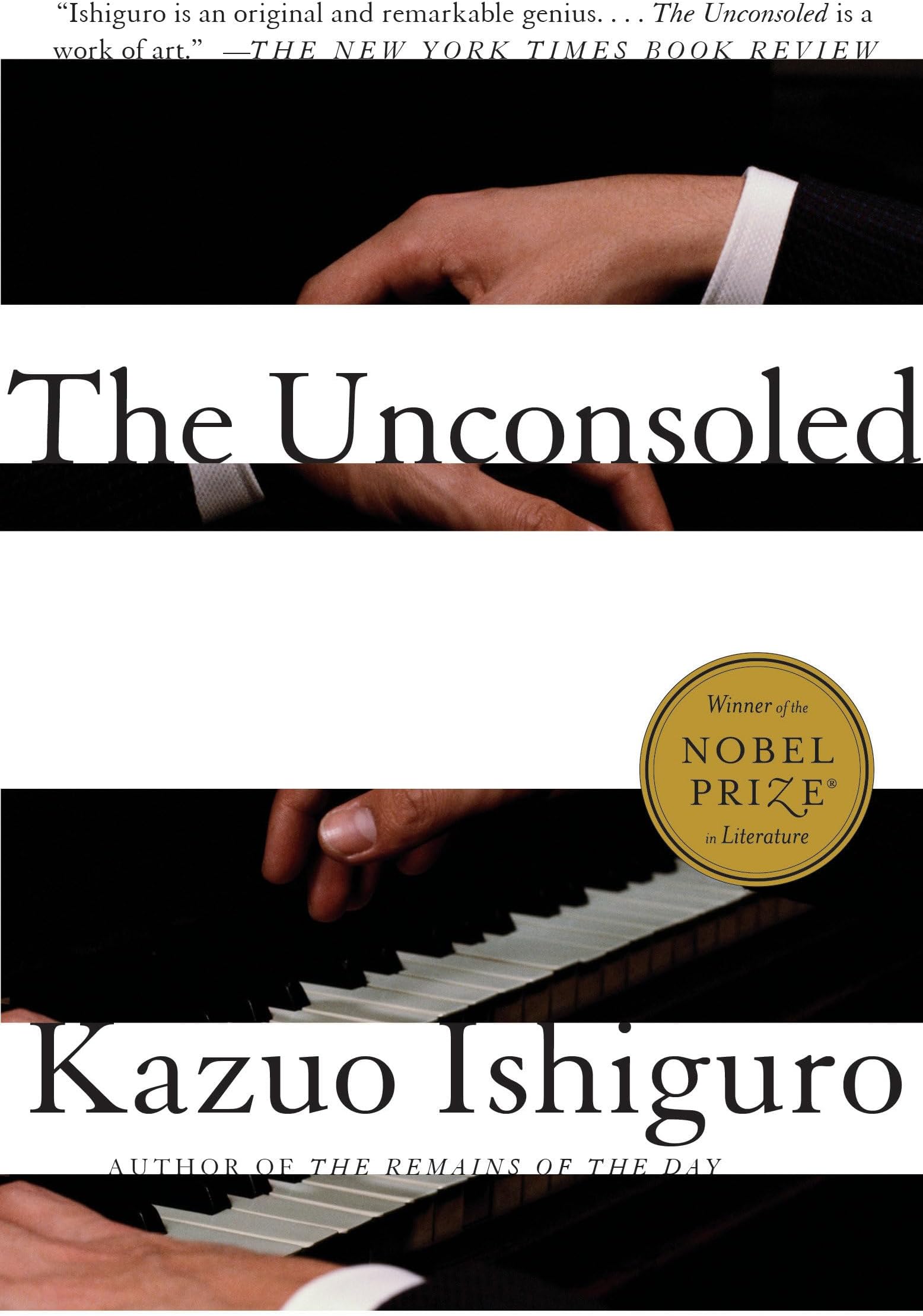
The Unconsoled
Product ID: 257472602
Desertcart purchases this item on your behalf and handles shipping, customs, and support to Italy.
From the winner of the Nobel Prize in Literature and author of the Booker Prize–winning novel The Remains of the Day , here is a novel that is at once a gripping psychological mystery, a wick Review: A mysterious journey - I’m not done the book yet as it’s the largest of the five of the authors I’ve read this year. I really enjoy his writing style and this one is quite the journey of unveiling who he is and where he is and why. Every encounter leads to another person and place needing his time and attention. It feels like the anxiety ridden life we all live with so many to dos and so little time and so exhausted. I want to keep reading to the next chapter but I keep staying up until 3-4 am reading and I need to stop this lol Review: Cover different from what is shown here. - It was in good condition. But the cover is different from what is advertised - it sort of matters to me given it now doesn't match the rest of my set and needs to be given away and is thus a waste of money.
| Best Sellers Rank | #395,222 in Books ( See Top 100 in Books ) #462 in Psychological Thrillers #1,671 in Contemporary Literature & Fiction #3,224 in Literary Fiction |
| Customer Reviews | 4.2 out of 5 stars 305 Reviews |
A**A
A mysterious journey
I’m not done the book yet as it’s the largest of the five of the authors I’ve read this year. I really enjoy his writing style and this one is quite the journey of unveiling who he is and where he is and why. Every encounter leads to another person and place needing his time and attention. It feels like the anxiety ridden life we all live with so many to dos and so little time and so exhausted. I want to keep reading to the next chapter but I keep staying up until 3-4 am reading and I need to stop this lol
A**E
Cover different from what is shown here.
It was in good condition. But the cover is different from what is advertised - it sort of matters to me given it now doesn't match the rest of my set and needs to be given away and is thus a waste of money.
S**U
A surreal read. Teeth grinding but worth it!
The Unconsoled tells the story of Ryder, an acclaimed pianist, who comes to play in an European town as part as what looks like a tour. And that's -or is it???- about the only clear cut fact of the book. From Ryder's arrival to his hotel, we are -reader and Ryder- embarked in a roller coaster of events, thoughts, interactions, with a narrative following a dream pattern. The sense of time and space are suspended, as are logic and rationality. Streets lead to hotel rooms, minds are read, places magically connect, childhood friends appear, family ties are blurry, to say the least and the anxiety is rising. The dream quickly turns into nightmare as we are trying to make sense of the what, when, who and where. Many parts reminded me of a When we were orphans gone mad, with common themes and characterization. Ryder needs to play a huge part in many events leading to a key performance - the famous Thursday night- but has no idea of any of it. He tries to get a sense of his schedule but is always a step behind, pulled out of his unknown main tasks by constant side line emergencies. Ryder never seems to be acting, but only reacting to external events, pushing him around like a leaf in the wind. No continuity in thoughts or goal is present and he is permanenty jumping from one thing to the next in a chaotic dance that leaves us breathless and on the brink of a claustrophobia attack! That's the teeth grinding bit... Yes, some parts are quite frustrating and you wish Ryder would just suddenly wake up and get on with a "normal" life. Kazuo Ishiguro is literally plunging us in this never ending bad dream and the sense of absolute lack of control is quite something to experience. On the other hand, some parts are downright funny, whether it be the childish -and numerous-outbursts from Ryder (he has so many responsibilities!) or some of the characters' monologues, like Brodsky's. Embodiment of surreal literature, the Unconsoled echoes of course Kafka, but also Sartre and Vian . The main difference though, seems to be that the story symbolic is never truly uncovered. There's no "ah ah" moment here. Moreover, many tantalizing hypothesis seem to disappear as you go on reading. To start with, I wondered if Ryder was in a coma... Then if he was dead and living in his own personal hell. Then if he was in a highly dissociated state and experiencing simultaneously all his personae. And then again, if he was meeting his own self at different stages of his life. Or I f the story was experienced from the perspective of a 2 years old. I hoped the ending would provide some kind of answers, but grew less and less hopeful as I went on reading. And no, it didn't. There is no neat red ribbon tying everything nicely together. The interpretation is only down to us, readers. What is truly masterful though, is that for Ryder, all the events he goes through do not constitute a journey. He seems to be exactly the same at the very end and at the very start. There's no learning. Events just pass through him and he remains unchanged. Upsetting things are forgotten, replaced by what comes next, hurt and emotions give way to present needs. Without spoiling the end, the last few pages are such a vivid demonstration of the latter... The same apply to all the characters, there is NO resolution, they start the story being miserable and end up as miserable, as if they were all acting in a forever circular pattern. When it came to giving it some sense, I chose to think that this work of literature was an allegory of our own mind. That it shows how we get caught up in things lacking utter relevance to help us live our present. How we obsess about trivia and are self obsessed. How we can be prisoner of our own concepts, ways, limitations.That we are made of dozens of contradictory pieces, pulling us in different ways and making clear vision and action difficult. Or may be, it's all about letting go of our mental pieces of luggage, which would put Gustav and his porter job in a interesting new light! So, a very original read, to embark on with an open mind...
H**N
A book about not being contact with reality
Once you have read the first chapter you can get a thrilling insight when you realize that what is going on in the book is very much the same as what you can experience in a dream where you continuously get lost. Then the whole book repeats itself chapter after chapter which makes it very boring unless you have an autistic diagnosis. In such a case the book can provide you with a mirror of your own life.
S**I
An absolute masterwork
***Contains Spoilers*** I have read this novel a dozen times and I will never tire of it. It is so bold in its vision that it's difficult to imagine any other author managing to pull it off. Ostensibly, a world class pianist called Mr. Ryder arrives to give a concert, albeit somewhat unprepared, in a mysterious European city, and finds himself subject to increasingly unreasonable demands on his time. He meets a succession of bizarre people of whom he often has unexplained knowledge - a flustered woman named Sophie and her obstreperous young son Boris, a hotel manager who seems to delight in setting people up to fail, a drunken old man trying to reclaim his role as a concert conductor. On the face of it, little of this makes sense, until you twig the underlying narrative: Mr. Ryder, in reality, was never a world class pianist. Raised by toxic, self-absorbed parents - a mother who demanded perfection and a father who delighted in seeing him fail - he later turned to drink and his career stagnated. He married but felt compelled to travel the world, neglecting his new wife and step-son in order to pursue fame, that one moment in which his genius would be recognised, but which never came. His wife divorces him and eventually he finds himself at the end of his life where, at the moment of death, he has a vision. The vision is this novel. Every major character in the book represents either Ryder himself at different stages of his life or members of his family. Boris, for instance, is Ryder's stepson, Sophie is his wife in her younger years. Brodsky is Ryder in old age, Brodsky's ex-wife Miss Collins is Ryder's ex-wife in her latter years. Stephan is Ryder as a young man, the hotel manager is Ryder's father, his wife Ryder's mother; Gustav is Ryder's father-in-law, and so on. When you realise this (it didn't happen on the first reading), everything falls into place and you see just how incredibly well plotted this novel is. Every character has a purpose, every scene tells you more about Ryder and his life - his real life - and in the end you find you know his entire story without a single minute of it actually being told. Remarkable writing, and certainly the most ambitious novel I've ever read.
Trustpilot
1 month ago
1 month ago