We remain fully operational. Our teams are working around the clock to ensure your deliveries continue safely.

DOWNLOAD THE APP


Copyright © 2025 Desertcart Holdings Limited
DOWNLOAD THE APP
Buy anything from 5,000+ international stores. One checkout price. No surprise fees. Join 2M+ shoppers on Desertcart.
Desertcart purchases this item on your behalf and handles shipping, customs, and support to Italy.
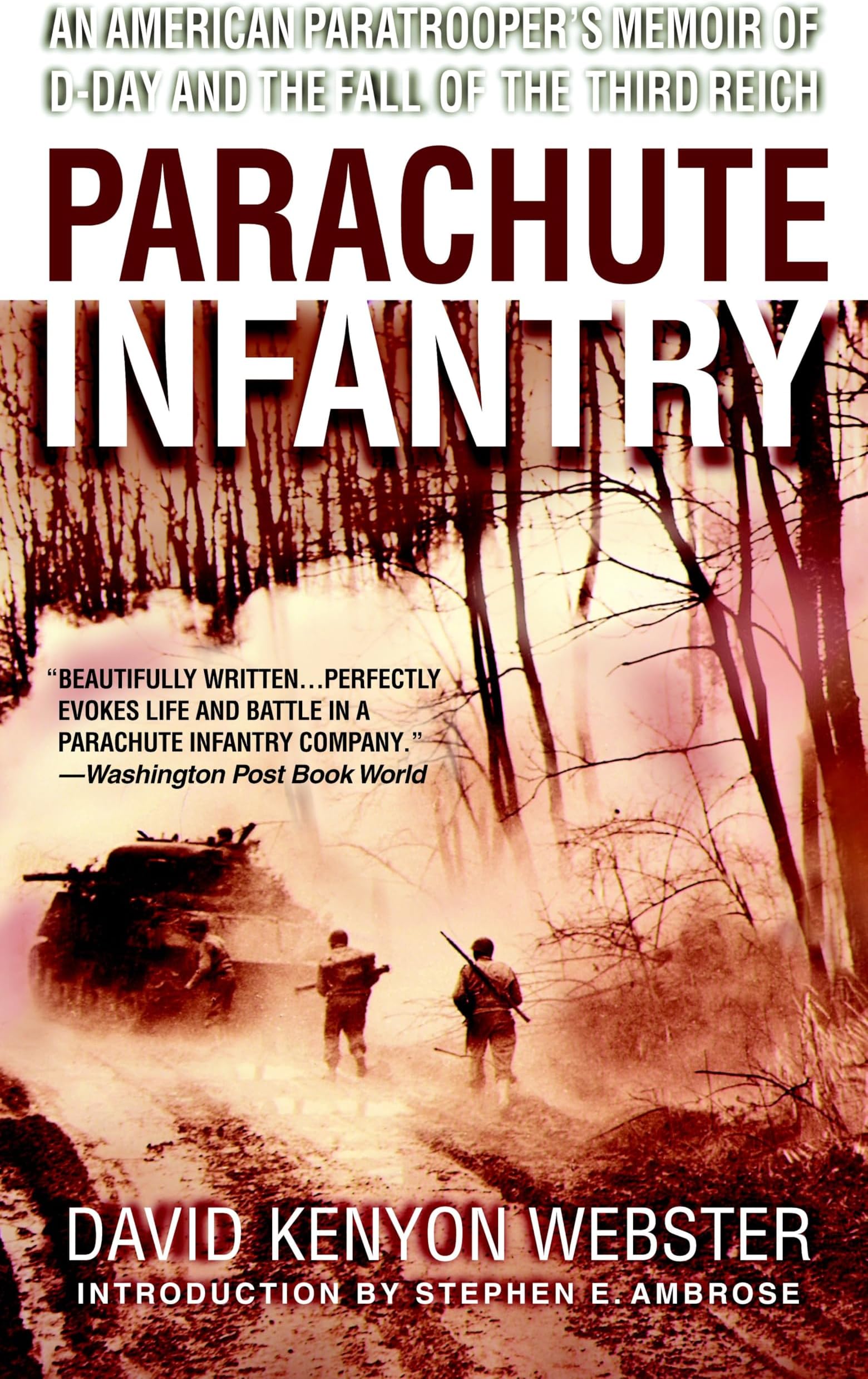
Parachute Infantry: An American Paratrooper's Memoir of D-Day and the Fall of the Third Reich [David Kenyon Webster, Stephen E. Ambrose] on desertcart.com. *FREE* shipping on qualifying offers. Parachute Infantry: An American Paratrooper's Memoir of D-Day and the Fall of the Third Reich Review: This is a Pre Band of Brothers Book Great Read - This is a Pre Band of Brothers book. Webster wrote this in the 60’s about his experiences. Ambrose read this book and you can tell in the book and series the stuff he used. Very down to earth book. Its first hand accounts with letters he wrote. He doesn’t try to glorify himself or war. Webster is very honest in this book. Read this book great read!!!! Review: The less heroic side of "Band of Brothers", written in the 1950s, well ahead of its time - I liked this book. It was not the best reading ever, but it fills out more fully the story of the `Band of Brothers", the WWII exploits of E Company of the 101st Airborne division. It is one of several books that came out after the success of "Band of Brothers". To read "Parachute Infantry" is to look at the flip side of the story of E Company. David Kenyon Webster, a Harvard student, was not an original member of E Company at Toccoa, jumping on D-Day as a member of the HQ Company. He later joined and became a completely unaccomplished member of E Company, and had a very limited role in its storied successes during WWII. He was a self-admitted "goldbrick", and refused to volunteer for anything. He was not a coward but did have a strong sense of self-preservation which served to severely limit his opportunities for doing anything heroic. Webster barely seems to have even gotten to know Major Dick Winters, the central character of E Company in the BoB story. Throughout his time with E Company, Webster was so good at keeping his head down that he rarely was able to see the bigger picture of what his unit was trying to accomplish beyond a very tightly focused small objective. Webster would end his autobiography of his WWII experience with this lament: "I have accomplished nothing, achieved no rank, seen almost no action". Why would anybody interested in WWII, in the story of E Company, be interested in this book? Why would Stephen Ambrose be so interested in it that he would help get it published in 1994, after it had been initially rejected in the 1950's, when it was first written? For BoB aficionados, it does fill out some more details about several members of E Company, such as Joe Liebgott, Donald Hoobler, Burton Christenson, George Luz, John Janovek, Ronald Speir, Lieutenant Thomas Peacock, and the Camera Killer Lieutenant. The other books about E Company concentrate on the most active members of E Company, the "heroes", the "killers" (Dick Winters's term). This book is about the other guys in the company, the faceless GIs of E Company who were only trying to get by and survive the war. And to that extent, this book is full of the rich details of the daily grind and trivia of Army life during WWII. We get abundant details about food and Army rations out in the field, about the cooks, about the looting, about the sex, about the civilians in the countryside. We find out additional details such as the fact that towards the end of the war, George Luz had left E Company to go to the HQ Company. From this book came the scene of German prisoners being shot by the roadside by a French soldier (Webster's account is much more striking than the movie version - you'll have to read it), as well as the scene of Webster chatting with the German MP at the roadside checkpoint from the HBO series. Other scenes from the HBO series involving David Webster are not in this book, and so it remains unclear whether these came only from the imagination of the writers. These include the conversations between Webster and Joe Liebgott in the truck (where Liebgott talks about his dreams after the war is over), Webster's rant at the passing columns of surrendering German soldiers, the scene at the concentration camp involving Webster and Liebgott, and Webster's involvement in the Last Patrol (he actually stayed in one of the outposts to cover the patrol while Liebgott went as the translator - Webster's account does have a more detailed description of what happened to the dying German soldier left behind by the American raiding party). The HBO depiction of Webster getting snubbed by E Company members when he rejoins them is completely contrary to his account of a warm reception by E Company in this book. It was good to read this book to find out more about what was true and what was Hollywood in the scenes involving Webster, and to get such a different viewpoint of "Band of Brothers" beside the ones focusing on the heroes of E Company. This was a book written well before its time. The ethos of the 1950s simply could not handle its raw honesty about life in the military. It is not unlike "Jarhead", a book about the first Iraq War, and it also is similar to many other Vietnam era and post-Vietnam era war autobiographies. The only part that's really different, that has changed completely, is that this book describes a time when students at elite universities like Harvard would volunteer to serve with the military, with the paratroopers of the U.S. Army.

| Best Sellers Rank | #63,510 in Books ( See Top 100 in Books ) #29 in United States Military Veterans History #112 in WWII Biographies #251 in World War II History (Books) |
| Customer Reviews | 4.5 4.5 out of 5 stars (1,212) |
| Dimensions | 4.18 x 1 x 6.67 inches |
| Edition | Reprint |
| ISBN-10 | 0440240905 |
| ISBN-13 | 978-0440240907 |
| Item Weight | 2.31 pounds |
| Language | English |
| Print length | 441 pages |
| Publication date | March 1, 2008 |
| Publisher | Dell |
K**C
This is a Pre Band of Brothers Book Great Read
This is a Pre Band of Brothers book. Webster wrote this in the 60’s about his experiences. Ambrose read this book and you can tell in the book and series the stuff he used. Very down to earth book. Its first hand accounts with letters he wrote. He doesn’t try to glorify himself or war. Webster is very honest in this book. Read this book great read!!!!
D**D
The less heroic side of "Band of Brothers", written in the 1950s, well ahead of its time
I liked this book. It was not the best reading ever, but it fills out more fully the story of the `Band of Brothers", the WWII exploits of E Company of the 101st Airborne division. It is one of several books that came out after the success of "Band of Brothers". To read "Parachute Infantry" is to look at the flip side of the story of E Company. David Kenyon Webster, a Harvard student, was not an original member of E Company at Toccoa, jumping on D-Day as a member of the HQ Company. He later joined and became a completely unaccomplished member of E Company, and had a very limited role in its storied successes during WWII. He was a self-admitted "goldbrick", and refused to volunteer for anything. He was not a coward but did have a strong sense of self-preservation which served to severely limit his opportunities for doing anything heroic. Webster barely seems to have even gotten to know Major Dick Winters, the central character of E Company in the BoB story. Throughout his time with E Company, Webster was so good at keeping his head down that he rarely was able to see the bigger picture of what his unit was trying to accomplish beyond a very tightly focused small objective. Webster would end his autobiography of his WWII experience with this lament: "I have accomplished nothing, achieved no rank, seen almost no action". Why would anybody interested in WWII, in the story of E Company, be interested in this book? Why would Stephen Ambrose be so interested in it that he would help get it published in 1994, after it had been initially rejected in the 1950's, when it was first written? For BoB aficionados, it does fill out some more details about several members of E Company, such as Joe Liebgott, Donald Hoobler, Burton Christenson, George Luz, John Janovek, Ronald Speir, Lieutenant Thomas Peacock, and the Camera Killer Lieutenant. The other books about E Company concentrate on the most active members of E Company, the "heroes", the "killers" (Dick Winters's term). This book is about the other guys in the company, the faceless GIs of E Company who were only trying to get by and survive the war. And to that extent, this book is full of the rich details of the daily grind and trivia of Army life during WWII. We get abundant details about food and Army rations out in the field, about the cooks, about the looting, about the sex, about the civilians in the countryside. We find out additional details such as the fact that towards the end of the war, George Luz had left E Company to go to the HQ Company. From this book came the scene of German prisoners being shot by the roadside by a French soldier (Webster's account is much more striking than the movie version - you'll have to read it), as well as the scene of Webster chatting with the German MP at the roadside checkpoint from the HBO series. Other scenes from the HBO series involving David Webster are not in this book, and so it remains unclear whether these came only from the imagination of the writers. These include the conversations between Webster and Joe Liebgott in the truck (where Liebgott talks about his dreams after the war is over), Webster's rant at the passing columns of surrendering German soldiers, the scene at the concentration camp involving Webster and Liebgott, and Webster's involvement in the Last Patrol (he actually stayed in one of the outposts to cover the patrol while Liebgott went as the translator - Webster's account does have a more detailed description of what happened to the dying German soldier left behind by the American raiding party). The HBO depiction of Webster getting snubbed by E Company members when he rejoins them is completely contrary to his account of a warm reception by E Company in this book. It was good to read this book to find out more about what was true and what was Hollywood in the scenes involving Webster, and to get such a different viewpoint of "Band of Brothers" beside the ones focusing on the heroes of E Company. This was a book written well before its time. The ethos of the 1950s simply could not handle its raw honesty about life in the military. It is not unlike "Jarhead", a book about the first Iraq War, and it also is similar to many other Vietnam era and post-Vietnam era war autobiographies. The only part that's really different, that has changed completely, is that this book describes a time when students at elite universities like Harvard would volunteer to serve with the military, with the paratroopers of the U.S. Army.
V**R
A great complement to Band of Brothers
This is a very well written book from a unique perspective, a Private First Class in Easy Company, 506th. If you have read Ambrose's "Band of Brothers", watched the HBO Mini-series with the same name, or simply want to read a "grunt's" perspective on his time serving on the front lines in WWII, this is a great resource. I highly recommend it, and am surprised it hasn't become more popular. Ambrose said he drew heavily from this book and Webster's letters home (also included as an addendum to this book) when writing "Band of Brothers". It was also a major resource for the HBO series, evident by the fact that Webster is a prominent character and narrator in multiple episodes. It is easy to see why. I'm guessing there are not many book so well written by men at the bottom of the Army's food chain - the privates who took and followed orders from virtually everyone else in the Army, made few independent decisions, generally hated the army due to their lack of status and authority, and who generally did the hardest work in the worst situations that ultimately won the war. I highly recommend the book!
D**Y
Great supplement to the TV series
I had the opportunity to watch the series again. Love the production. I found out about Web’s book and knew I had to read it. A thoroughly worthwhile book to read. My dad was a paratrooper and like Web was a “goldbricker” while in the states but, as he told me, he was deadly serious when he was in the ETO. It’s sad that Web met an untimely death. This is a great first person account and is not to be missed. Like Ambrose has written Web’s prose is worth reading cause he’s such a good writer and story teller. He does a great job of portraying Army life in the field of battle and in the field of “chickenshit.” I strongly recommend this book.
D**N
how can i return this and get the book which is what i thought i bought?
R**A
Perfeito!
G**M
Excellent read the book goes into detail of what they went through I thoroughly enjoyed reading it finished the book within a few short days.
S**D
The author wrote the book just after WW2 ended and his recall of events is amazing! He is with the famous Easy company re: "Band of Brothers" As one reads the little details, we feel we are there with him! Unknown activities such as finding food in abandoned houses and cooking on wood stoves, the details of fear and trying to sleep in wet fox holes. He even admits to crying while trying to escape mortar shells and machine gun fire. Most WW2 books are all about action; this one fills in the quiet thoughtful times as well. A fine resource for those who have seen the "Band of Brothers" film.
S**M
Estoy disfrutando mucho de este libro.
Trustpilot
1 week ago
4 days ago