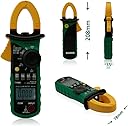
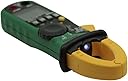

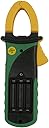


The newly released Mastech MS2108 is a versatile and invaluable tool for electricians, technicians, professionals and alike. It's small in size and can be easily be used with one hand. You can use it to measure AC/DC voltage and current, resistance, capacitance, frequency, duty cycle, continuity and even diode test. This true RMS clamp meter has inrush current measurement, which is designed to capture inrush current accurately and , most importantly synchronously and provide readings that accurately depict what the circuit protector experiences. Other features include back-lit LCD display, jaw lighting, MAX/MIN, data hold and etc. Review: So far, So Great.... - I purchased this meter to use in less than perfect conditions. Because I also own and use a Fluke and a Greenlee for various jobs, I have a little experience with which to evaluate this meter. For the last year or so I have had several occasions to use a clamp meter under a house and inside a large wet vat/container. I really did not want to expose my Fluke to those conditions, so after some thought I decided to take a chance on a less expensive alternative. I chose the Mastech MS2108 for two reasons. First, my Fluke does not have a way to measure Inrush current and the Mastech does. Second, The Mastech is a "true RMS" meter. With both of these parameters met, I was amazed at the price for this meter. Amazed, and a little sceptical as well. Well, I shouldn't have been sceptical, but I am still amazed.!! This meter is very well thought out, and apparently well made. I have been using it almost continuously since purchase, and it has showed no signs of a fault anywhere inside of its usage parameters. That doesn't mean that that it won't fail at some point. It might in fact fail tomorrow, but until it does I am going to consider it a fine instrument and a tremendous value. The clamp opens smoothly, but holds firmly in use. The plastic body appears to be well made and solid with all screen printing and settings plain and legible. All switches are firm and positive and there are no misnamed or misapplied designations. Everything works on this meter exactly like I expected it to. I checked this meter against my Fluke with common measurements and they were within tiny fractions of each other....well within the margin for error that I would allow on any instrument. So, if this meter is inaccurate, so is my Fluke. There are a couple of things that I wonder about though (not worry about..). I can't understand why the rotary switch has two "off" positions.?? Maybe convenience..?? I don't know, but I am not going to worry about it. The second thing is why the A/C and D/C voltage settings are combined on one switch setting, causing you to have to push a select button to toggle between them....and therefore the always present possibility of making a mistake..??? It would seem that one of the "off" positions could have been used instead for one of the Voltage measurement positions..??? Anyway, that's all I can say about this meter that could have been done a little differently. So five stars for a meter that performs like a champ....With INRUSH for around $80.00.!!!!! That's unheard of.... :-) Review: Maybe for Generator Sizing and Planning - Accuracy Questionable - I bought this for the primary purpose of measuring inrush current on a variety of applications as part of generator sizing. This is a cheap, partial (and questionable) solution (see the end of this review), not a perfect solution, but it does what it says and I'm happy with it. Beyond that, it's a utilitarian device and I like the convenience. I also have a Fluke 117, and checked a couple of battery and household voltages with both and the variances where in the final digit, close enough for my work. I also purchased an Extech AC line splitter to use with this for convenience. To measure peak inrush current, turn the meter on, "SEL" inrush current and clamp the meter around the load. Wait, the meter will detect the inrush current and save the value. So, if you're checking something like a refrigerator or water pump, it's easy to wait for it to cycle. For example, on one water pump, running current is 10.8 amps, peak inrush is 63 amps, which settles to someplace between 20 and 30 amps for a couple of seconds. Ideally, you would have a full profile on both the device and the protection on a generator, but that data costs a lot more money unless the vendor will provide it. Usually, they don't have a way of finding it for a retail consumer. Some generators can handle short, high peak inrush, others, like Honda generators (inverters) have circuitry that trips much faster than conventional breakers and can only handle modest inrush. The Honda 2000i for example, is rated for 120v, 13.3 amps continuous duty, but won't start the water pump that draws 10.8 amps continuous. Not criticizing Honda, the 2000i is reliable, quiet and I have 2 of them. The point is, you need data to size generators and the Mastech MS2108 is a relatively inexpensive source of that data. (that also doesn't mean you need a 6,000 watt generator to handle a 63 peak amp inrush, it will depend on the generator, but someplace between 3,500 watt and 4,500 watt is probably adequate). At this point, I've had the meter for two weeks and used it for a total of 40 measurements. It has paid for itself in "rightsizing" a generator, rather than "oversizing" to be safe. The problem with oversized generators is in part the first cost, but the bigger problem is the fuel use at idle. When you're using a generator, fuel is precious. Added edit: The manual specifies the inrush current accuracy as follows: It says "below 60 amps, use only for reference" (whatever that means) For above 60 amps, is says "+/- 10% + 60 digits" (yeah, "60" digits) That makes it nearly worthless for measuring inrush current for household devices.
| ASIN | B0017WRH7O |
| Brand Name | Mastech |
| Color | MS2108 |
| Customer Reviews | 4.0 4.0 out of 5 stars (106) |
| Item Dimensions | 3 x 5 x 10 inches |
| Item Weight | 0.75 Pounds |
| Manufacturer | Mastech |
| Model | MS2108 |
| Part Number | MS2108 |
| Power Source | Corded Electric |
| UPC | 796299908645 |
T**N
So far, So Great....
I purchased this meter to use in less than perfect conditions. Because I also own and use a Fluke and a Greenlee for various jobs, I have a little experience with which to evaluate this meter. For the last year or so I have had several occasions to use a clamp meter under a house and inside a large wet vat/container. I really did not want to expose my Fluke to those conditions, so after some thought I decided to take a chance on a less expensive alternative. I chose the Mastech MS2108 for two reasons. First, my Fluke does not have a way to measure Inrush current and the Mastech does. Second, The Mastech is a "true RMS" meter. With both of these parameters met, I was amazed at the price for this meter. Amazed, and a little sceptical as well. Well, I shouldn't have been sceptical, but I am still amazed.!! This meter is very well thought out, and apparently well made. I have been using it almost continuously since purchase, and it has showed no signs of a fault anywhere inside of its usage parameters. That doesn't mean that that it won't fail at some point. It might in fact fail tomorrow, but until it does I am going to consider it a fine instrument and a tremendous value. The clamp opens smoothly, but holds firmly in use. The plastic body appears to be well made and solid with all screen printing and settings plain and legible. All switches are firm and positive and there are no misnamed or misapplied designations. Everything works on this meter exactly like I expected it to. I checked this meter against my Fluke with common measurements and they were within tiny fractions of each other....well within the margin for error that I would allow on any instrument. So, if this meter is inaccurate, so is my Fluke. There are a couple of things that I wonder about though (not worry about..). I can't understand why the rotary switch has two "off" positions.?? Maybe convenience..?? I don't know, but I am not going to worry about it. The second thing is why the A/C and D/C voltage settings are combined on one switch setting, causing you to have to push a select button to toggle between them....and therefore the always present possibility of making a mistake..??? It would seem that one of the "off" positions could have been used instead for one of the Voltage measurement positions..??? Anyway, that's all I can say about this meter that could have been done a little differently. So five stars for a meter that performs like a champ....With INRUSH for around $80.00.!!!!! That's unheard of.... :-)
T**D
Maybe for Generator Sizing and Planning - Accuracy Questionable
I bought this for the primary purpose of measuring inrush current on a variety of applications as part of generator sizing. This is a cheap, partial (and questionable) solution (see the end of this review), not a perfect solution, but it does what it says and I'm happy with it. Beyond that, it's a utilitarian device and I like the convenience. I also have a Fluke 117, and checked a couple of battery and household voltages with both and the variances where in the final digit, close enough for my work. I also purchased an Extech AC line splitter to use with this for convenience. To measure peak inrush current, turn the meter on, "SEL" inrush current and clamp the meter around the load. Wait, the meter will detect the inrush current and save the value. So, if you're checking something like a refrigerator or water pump, it's easy to wait for it to cycle. For example, on one water pump, running current is 10.8 amps, peak inrush is 63 amps, which settles to someplace between 20 and 30 amps for a couple of seconds. Ideally, you would have a full profile on both the device and the protection on a generator, but that data costs a lot more money unless the vendor will provide it. Usually, they don't have a way of finding it for a retail consumer. Some generators can handle short, high peak inrush, others, like Honda generators (inverters) have circuitry that trips much faster than conventional breakers and can only handle modest inrush. The Honda 2000i for example, is rated for 120v, 13.3 amps continuous duty, but won't start the water pump that draws 10.8 amps continuous. Not criticizing Honda, the 2000i is reliable, quiet and I have 2 of them. The point is, you need data to size generators and the Mastech MS2108 is a relatively inexpensive source of that data. (that also doesn't mean you need a 6,000 watt generator to handle a 63 peak amp inrush, it will depend on the generator, but someplace between 3,500 watt and 4,500 watt is probably adequate). At this point, I've had the meter for two weeks and used it for a total of 40 measurements. It has paid for itself in "rightsizing" a generator, rather than "oversizing" to be safe. The problem with oversized generators is in part the first cost, but the bigger problem is the fuel use at idle. When you're using a generator, fuel is precious. Added edit: The manual specifies the inrush current accuracy as follows: It says "below 60 amps, use only for reference" (whatever that means) For above 60 amps, is says "+/- 10% + 60 digits" (yeah, "60" digits) That makes it nearly worthless for measuring inrush current for household devices.
J**R
This is a very nice, basic AC/DC clamp meter
This is a very nice, basic AC/DC clamp meter. Documentation was okay, and the usual oddly worded translation I've come to expect from Chinese import products. I'm a telecom engineer, and I had purchased this meter so I could always have one in my bag for measuring current on our central office devices (which are DC powered). I used a couple of our much more expensive DC clamp meters here to compare it against, and I'm very happy to report that it is just as accurate (as it measured the same current) as our higher end-meters. This is well worth it to purchase if you need to measure DC current (including peak current) and you need it to be fairly accurate. The included probes work well, even if they're rather short on the tips (I'll be replacing them with a set of Klein probes I have spare). All in all, a good value for the price.
C**T
Function selector dial on mine doesn't work
If it happens to work for you then it is a great value. However, on mine the selector dial does not work when selecting the continuity setting. Unfortunately I did not realize this until just now (over a year of owning it). I had bought it to use as a clamp meter, and that functionality was fine. Today I tried to use the continuity function and it just won't select properly. If I apply downward pressure on the dial in just the right way it works, but only as long as I keep pressing it down. I opened it up to see if I could fix the internal contact points, but I was unable to fix it. After trying to position them to make better contact, one of the springy copper things broke. So it is going in the garbage and I'll buy a different product that is more reliable. Very frustrating experience.
B**A
The product sold at reasonable price while same quality product are sold above 10K.
Trustpilot
1 month ago
1 week ago