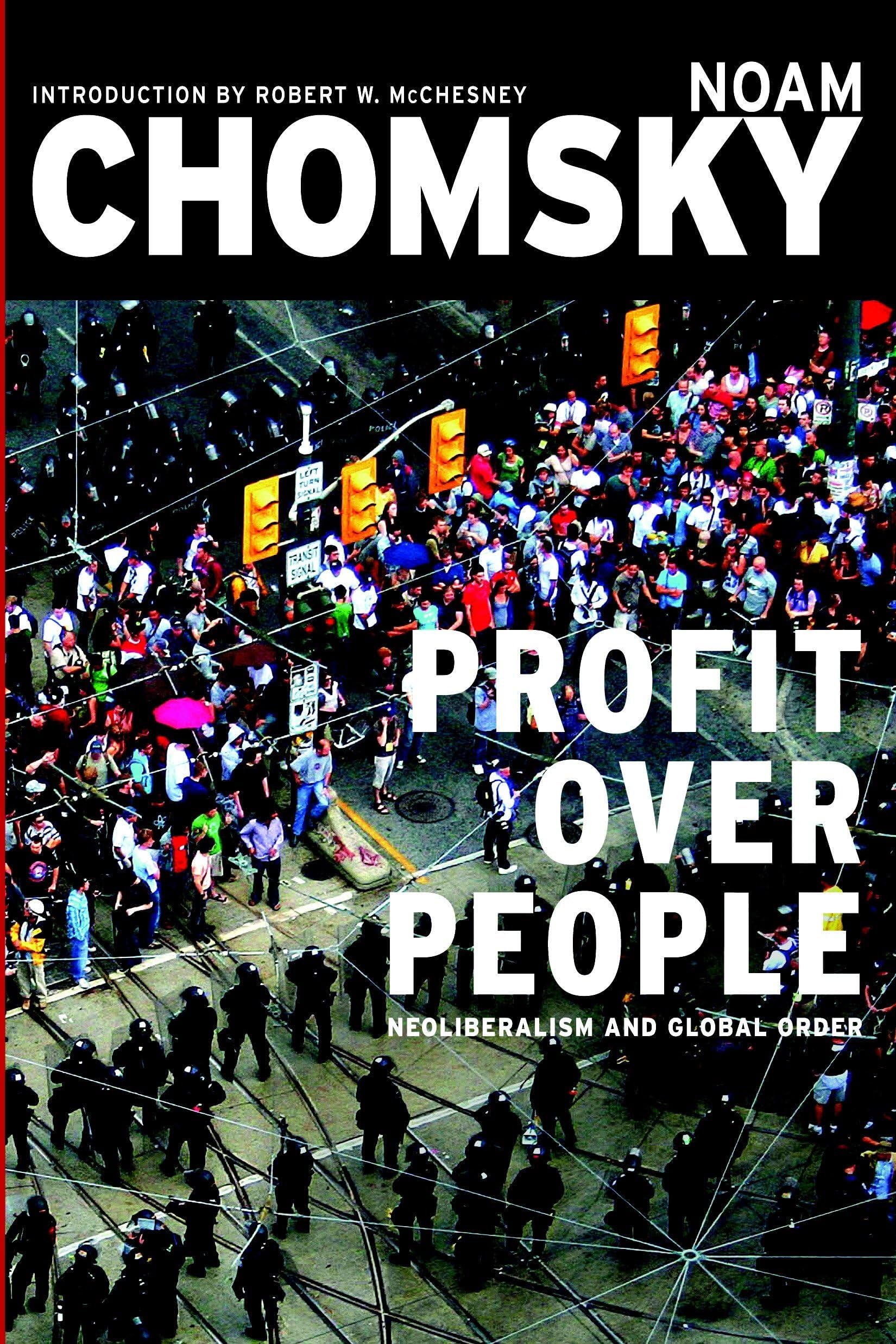
Profit Over People: Neoliberalism & Global Order
Product ID: 2063740
Buy anything from 5,000+ international stores. One checkout price. No surprise fees. Join 2M+ shoppers on Desertcart.
Desertcart purchases this item on your behalf and handles shipping, customs, and support to Italy.
Profit Over People: Neoliberalism & Global Order [Noam Chomsky, Robert W. McChesney] on desertcart.com. *FREE* shipping on qualifying offers. Profit Over People: Neoliberalism & Global Order Review: Chomsky on "Neoliberalism" and the takeover of the world by corporate interests - I don't suppose another review of Noam Chomsky's excellent expose, of the international cabal that is turning over control of the world to corporatists, is needed, but this book (actually a collection of speeches and short publications from the 1990's) is one that everyone who is interested in the fate of the U.S. as well as the rest of the world should read, especially now that so much of what Chomsky predicted has come to pass. After an excellent intro by Robert McChesney, the chapters that follow describe how the international "free trade" movement, starting with NAFTA and GATT and expanding to the World Trade Organization (WTO), the World Bank, and the International Monetary Fund (IMF), has effectively taken over the economic running of most of the world's countries. As Chomsky points out, the "free trade" that these organizations tout is not really "free," it is designed to allow international corporations to move into resource rich countries and exploit them while impoverishing the local population. Chomsky gives several examples of this: in Brasil, Mexico, Haiti, and elsewhere. He predicted that the same fate would eventually befall the U.S., and we're much closer to that happening here today. Jobs move to the cheapest labor market with the laxest regulations in a veritable race to the bottom, and that's how the big corporations want it to be --- plenty of cheap labor and a minimum of overhead for societal needs. Chomsky can be tendentious --- he does have his biases --- but the story that he tells of secret agreements, market manipulation, riding roughshod over local governments, and exploiting native populations is not only frightening but has very much the ring of truth. The book, mostly put together from previously published material, could have used more careful editing. There are a lot of careless typos in some chapters. Chomsky provides long lists of references for each chapter, designed for those who wish to get further into the details of how these semi-secret, unelected organiztions carry out their dirty work. The book was published in 1998 but is more relevant than ever today. I suppose that counter-arguments could be made, that international corporatism is bringing us more goodies at cheaper prices than ever before. That may be so, but at the expense of our jobs, our welfare, and our standard of living, while the corporations and those who run them become obscenely rich. It brings up the old argument about "democracy;" is it really for all the people, or only a sham to allow the few to enrich themselves at the expense of the rest of us? Chomsky has a lot to say about this as well. This book is available on Kindle, and I strongly recommend getting and reading it at this crucial time in our country. Review: Practical, Objective, and Pertinent - This book is full of interesting ideas of what makes the seemingly overwhelming influence and control the "neoliberalism" or de-regulated capitalism mixed with state power, tick. I am through the 2nd chapter now, and he may be wrong about some conclusions he's come to about US and world history events, but in my opinion his explanations make a lot of sense. He states numerous times, events, and documents. As with anytime reading, look them up to verify what he says. What Noam does here is try to explain what political economy we're in, how it works, and why things happen the way that they do. He is not perfect in all of his conclusions, as no one could be, since one person could not possibly explain the inner-workings of such a complex global economic system to exact detail. He sure comes close in this book. Just looking objectively at the practical effects of the political economic system we're in such as racial issues, terrorists, violent oppressive regimes, human rights ignorance, police brutality, etc. one could see how most if not all of the ideas Noam brings up just COULD be the explanation for it all even IF they are not all correct. I found it very applicable to the times we live in today. If he's right about what he claims this political economy style is and where it is going, we have much to fear and need to stand up and do something about it.
| ASIN | 1888363827 |
| Best Sellers Rank | #639,796 in Books ( See Top 100 in Books ) #337 in Globalization & Politics #477 in Political Philosophy (Books) #2,006 in History & Theory of Politics |
| Customer Reviews | 4.5 4.5 out of 5 stars (876) |
| Dimensions | 5.43 x 0.51 x 8.23 inches |
| Edition | 42784th |
| ISBN-10 | 9781888363821 |
| ISBN-13 | 978-1888363821 |
| Item Weight | 5.6 ounces |
| Language | English |
| Print length | 288 pages |
| Publication date | January 1, 1999 |
| Publisher | Seven Stories Press |
M**N
Chomsky on "Neoliberalism" and the takeover of the world by corporate interests
I don't suppose another review of Noam Chomsky's excellent expose, of the international cabal that is turning over control of the world to corporatists, is needed, but this book (actually a collection of speeches and short publications from the 1990's) is one that everyone who is interested in the fate of the U.S. as well as the rest of the world should read, especially now that so much of what Chomsky predicted has come to pass. After an excellent intro by Robert McChesney, the chapters that follow describe how the international "free trade" movement, starting with NAFTA and GATT and expanding to the World Trade Organization (WTO), the World Bank, and the International Monetary Fund (IMF), has effectively taken over the economic running of most of the world's countries. As Chomsky points out, the "free trade" that these organizations tout is not really "free," it is designed to allow international corporations to move into resource rich countries and exploit them while impoverishing the local population. Chomsky gives several examples of this: in Brasil, Mexico, Haiti, and elsewhere. He predicted that the same fate would eventually befall the U.S., and we're much closer to that happening here today. Jobs move to the cheapest labor market with the laxest regulations in a veritable race to the bottom, and that's how the big corporations want it to be --- plenty of cheap labor and a minimum of overhead for societal needs. Chomsky can be tendentious --- he does have his biases --- but the story that he tells of secret agreements, market manipulation, riding roughshod over local governments, and exploiting native populations is not only frightening but has very much the ring of truth. The book, mostly put together from previously published material, could have used more careful editing. There are a lot of careless typos in some chapters. Chomsky provides long lists of references for each chapter, designed for those who wish to get further into the details of how these semi-secret, unelected organiztions carry out their dirty work. The book was published in 1998 but is more relevant than ever today. I suppose that counter-arguments could be made, that international corporatism is bringing us more goodies at cheaper prices than ever before. That may be so, but at the expense of our jobs, our welfare, and our standard of living, while the corporations and those who run them become obscenely rich. It brings up the old argument about "democracy;" is it really for all the people, or only a sham to allow the few to enrich themselves at the expense of the rest of us? Chomsky has a lot to say about this as well. This book is available on Kindle, and I strongly recommend getting and reading it at this crucial time in our country.
V**3
Practical, Objective, and Pertinent
This book is full of interesting ideas of what makes the seemingly overwhelming influence and control the "neoliberalism" or de-regulated capitalism mixed with state power, tick. I am through the 2nd chapter now, and he may be wrong about some conclusions he's come to about US and world history events, but in my opinion his explanations make a lot of sense. He states numerous times, events, and documents. As with anytime reading, look them up to verify what he says. What Noam does here is try to explain what political economy we're in, how it works, and why things happen the way that they do. He is not perfect in all of his conclusions, as no one could be, since one person could not possibly explain the inner-workings of such a complex global economic system to exact detail. He sure comes close in this book. Just looking objectively at the practical effects of the political economic system we're in such as racial issues, terrorists, violent oppressive regimes, human rights ignorance, police brutality, etc. one could see how most if not all of the ideas Noam brings up just COULD be the explanation for it all even IF they are not all correct. I found it very applicable to the times we live in today. If he's right about what he claims this political economy style is and where it is going, we have much to fear and need to stand up and do something about it.
M**N
Wide-ranging but powerful
In this collection of essays that examines the dynamics of globalization and democracy, Chomsky makes clear that the "profit" imperative of private corporations are clearly triumphing over the needs of the vast majority of "people" in the world. The superb intro written by Robert McChesney discusses how neoliberalism threatens democractic institutions. McChesney lauds Chomsky for his many contributions to public understanding of how the economic system works and for whom, and for encouraging citizens to demand greater accountability from the unelected corporate elites. Chapter one is a brief history of the modern world order. Chomsky explains that protectionism has been often used by the U.S. and Britain to nurture their nascent industries to health and prosperity. Yet, Chomsky points out that the dogma of "free trade" has been used to economically colonize weaker countries. For example, Great Britain helped impoverish India's citizens by enforcing trade restrictions, but the captive Indian market served to greatly enrich investors in Britain. In Chapter two, Chomsky asserts that despite repeated attempts to condition the people to accept the neoliberal doctrine, opinion polls consistently show that people still believe in democratic principles such as fair levels of taxation, ample spending on public programs, etc. This article suggests that people cherish democractic ideals and therefore might have the capacity to successfully demand and win change -- even against entrenched corporate interests with far greater resources at their disposal. Chapter three examines inconcistencies in U.S. policy with respect to free trade. Chomsky claims that Ronald Reagan was the most protectionist of all U.S. presidents (despite his rhetoric to the contrary). In short, the U.S. supports free trade when it is seen as a benefit but against it when foreigners have comparative advantage (such as when the Japanese automakers had superior high-mileage cars on the market in the early 1980s). Chomsky also discusses U.S. policy with Cuba. The author argues that the real motivation for the U.S. embargo is not to encourage democracy in Cuba but to stifle the appeal of Cuba's redistributive policies and prevent them from spreading to other countries. Chapter four examines U.S. policy throughout the hemisphere. Chomsky reveals a consistent pattern of preference for protecting the rights of investors and repressing the human rights of citizens in countries that dare to opt for greater democracy. In Chapter five, Chomsky links the Zapatista rebellion in Chiapas, Mexico with the declining living standards wrought by unregulated corporate access to third world resources and labor markets. Chapter six discusses the MAI agreement. Chomsky stresses that this misguided treaty was negotiated in secret in order not to alarm democratic populations of the treaty's overt favortism to private capital over people and the environment. The seventh and final article was written after the MAI proposal was defeated by concerned citizens groups, who made the secret text of the proposal public using the Internet. Chomsky cites this victory as evidence that democracy is "the ultimate weapon" that can be used to protect the rights of the people. However, Chomsky warns that the people must be forever vigilant if we want to prevent further concentration of wealth and power in private corporations. Throughout, Chomsky ties his lessons back to the Founding Fathers to show how far our country has strayed from its original ideals. Whether you agree or disagree with the conclusions drawn, Profit Over People should at least give readers pause to consider the state of our democracy and what might be required to fix it. Highly recommended.
L**Z
Great read.
This books clarifies true intentions behind propaganda and disinformation campaigns focus to undermine true democracies and rights that should be universal for all human beings.
N**M
reality read to know
S**E
To be a book from a socialist libertarian it just cost too much. 16eur for 160 pages. is a little crazy. For the rest chomsky don't need presentation i think
A**N
First of all, I am not against neoliberalism. But I do wan to drill in the rationale behind and try to understand economical policies made all those years. And this book does its job. The best part is that it explained in very clear way how market democracy works in the name of democracy but doing the opposite. All the hash criticism in this book landing on the fact that the capitalism world still was purely driven by profit and money in 1990s, and still unchanged at all now.
C**E
Anything by Chomsky is a great read, informative and educational. Would recommend any of his books, especially this one.
P**O
This is another amazing work of the greatest American public intellectual land linguistic ever
Trustpilot
1 month ago
3 weeks ago