We remain fully operational. Our teams are working around the clock to ensure your deliveries continue safely.

DOWNLOAD THE APP


Customer Services
Copyright © 2025 Desertcart Holdings Limited
DOWNLOAD THE APP
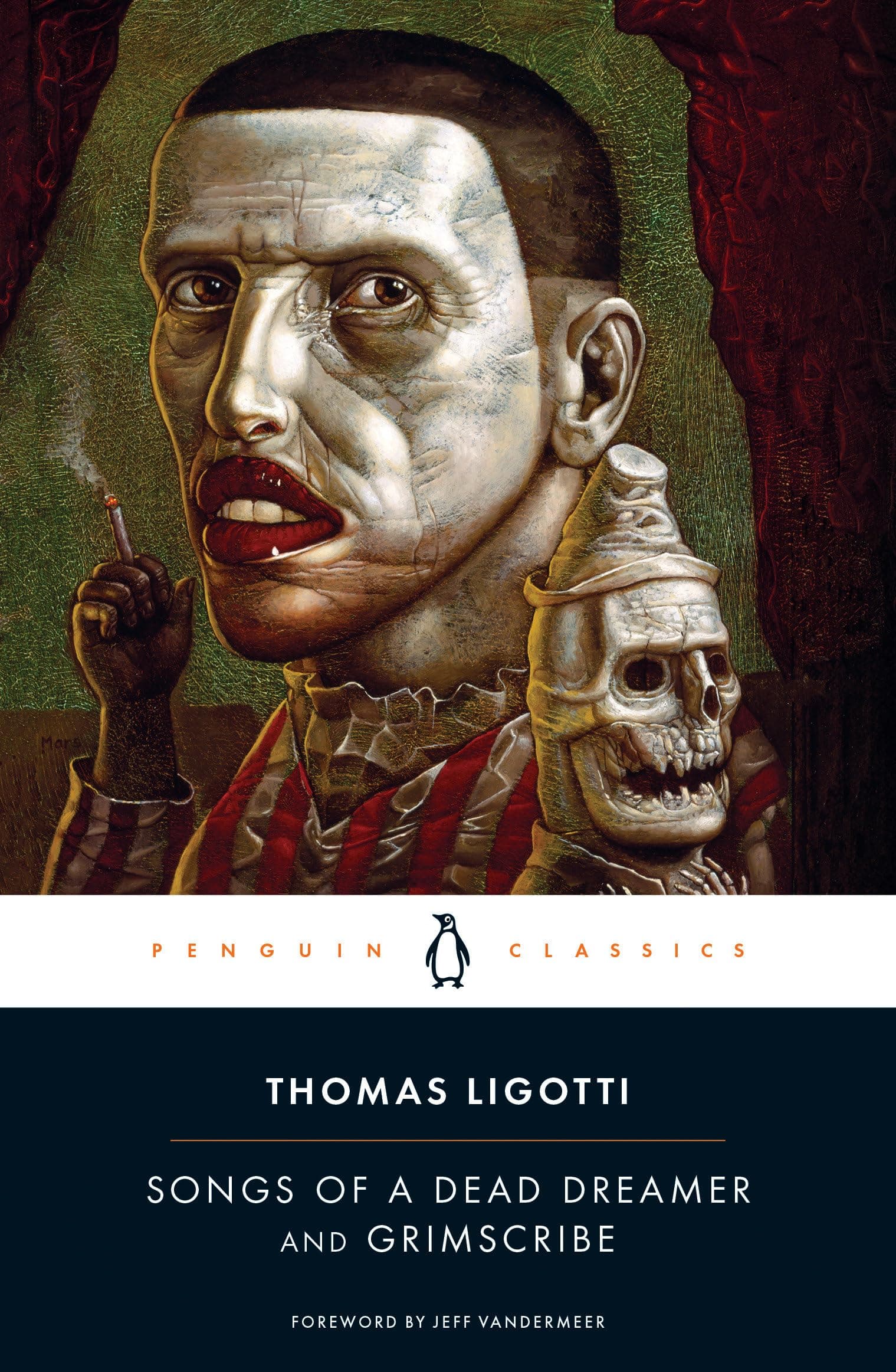
Songs of a Dead Dreamer and Grimscribe [Ligotti, Thomas, VanderMeer, Jeff] on desertcart.com. *FREE* shipping on qualifying offers. Songs of a Dead Dreamer and Grimscribe Review: A challenge, a delight, a treasure! - This is a fabulous book of strange, disconcerting tales from the shadowy realm of Thomas Ligotti. The stories aren’t about jump scares or monsters in closets but take on decaying cities and lurid dreamscapes in a mode ranging from rich, ornate prose to cold, clinical detachment. They unfold in refined, antique grace: laden with intricately woven, haunting beauty that explores dread and decay in a style both subtle, sublime, and suggestive. Ligotti’s characters drift offstage, and events lurk in shadow, leaving meaning implied in fragmentary exposition and a single offhand comment. The phrasing is elegant and unsettling, layering grotesque imagery with lyrical nuance that requires the gentle reader to sometimes reread to fully grasp what is being conveyed. Some might lazily label his work as ‘gothic fiction,’ but it’s more accurately described as ‘philosophical horror’ or ‘cosmic horror,’ where dread is not just a mood but a metaphysical truth: "the dark might be all there is.” These challenging stories deal with an indifferent universe; unknowable, and perhaps even hostile to meaning. Ligotti’s method, like that of his predecessors Poe and Lovecraft, comprises ornate, complex syntax along with a very vivid use of description. Although it may turn off readers used to more fast-paced, leaner prose, for seekers of baroque horror stories, Ligotti is a delight. If you’ve found this book, know that it’s not just horror—this work has a philosophical depth, setting it apart from conventional horror. The stories don’t just aim to scare—they probe the very foundations of reality, identity, and meaning. This book a treasure for me—intriguing, and a permanent keeper in my library. Review: Like Poe and Lovecraft - First off, you get alot of bang for your buck in Thomas Ligotti's "Songs of a Dead Dreamer" and "Grimscribe" -- and the "bang" here is masterful horror storytelling, with a goodly number of short stories to tell. It's hard to tell if the "and" in the title of the volume is intrinsic; that is, if "Songs of a Dead Dreamer" and "Grimscribe", tho published separately originally, are, by spirit and theme, meant to be married. For there is a common thread of a dreamlike nebulosity in these stories. They invariably meld one with the rest, with their oil-slick colors, sickly smells, and even sicker mental patterning. No hero, in the cases where there is one, is immune from morphing, slowly or quickly, but always seamlessly into a socio- or psycho-pathic observer, participant, or even instigator, of the murderous chaos taking place. Ligotti's writing comes down directly from the line and style of Poe and HP Lovecraft -- as the author himself openly indicates and celebrates by his dedication to the latter. I would add Conrad to this branch of literary lineage as well, even tho the last-mentioned did not write overt Horror; but insofar as Ligotti's stories are laced with abstract adjectives and adverbs to the point of giving them an impressionistic feel, where *feeling* itself is as much the means of conveying the story as the verbs and nouns are for the narrative aspect. The stories are prettymuch estrogen-free, so I doubt they would garner much interest for the majority of women readers (while this factor alone may do quite the opposite in the case of their male counterparts, especially these days: the trouble seems to start indeed, in contemporary storytelling in any mode, when the sexes converge; but that is a topic to go into more deeply elsewhere). But in fact no demographic need take Ligotti's style personally because it is consistently, supremely impersonal: This by itself is something of an achievement; for even by our time (Ligotti, at 64, is a year younger than I), writers were beginning to be urged to "write what they know", and "avoid adjectives and especially adverbs!" amongst other formulae for fictional writing (and there's an oxymoron if you ever want one!) -- the result ever since around 1970 being mountains of pulp, wherein "I", far from being shunted to the sidelines of proximal observation where she should be, is center-ring protagonist who is somehow also either utterly passive, or else mamas-boyishly heroic, both worthy of naught but a book-tossing at that point the reader is instinctively sure is the moment for it. (I call it the "Stephen King page".) While Ligotti is exceptional; taking impersonal, de-centering to hypnotic heights -- and abysses. Like Poe and Lovecraft, he writes with an antique elegance such that we're never sure when or even where we are: We could be in the author's homeland of the USA in, say, his homestate Florida of the present, or in Europe in the year 1650. We never findout, but -- and here is the Ligottian genius at work -- we don't need to! Ligotti's settings, tho usually claustrophobic, do address that outward world, no matter how near the walls be closing in, as well as the inward. For immediately behind both the outer and inner worlds -- both flimsy, teetering totems to Survival in Ligotti -- lies the Pessimist Nightmare. Pessimist here being the capital-P kind in Philosophy: Nothing means anything, you *will* die and the universe does not care how you feel about it, and "self"-consciousness is just a very, very unfortunate byproduct of the human brain, the terrible deal with the devil made by the first man. Ligotti goes into Pessimism per se -- Schopenhauer and his modern heirs, with a bonus section on how it relates to Horror-writing -- in his masterful and tragic non-(unfortunately!)-fiction, "The Conspiracy Against the Human Race". And while his fiction may be finally, hastily and quite deliberately, confined in memory to "some pretty scary horror stories!" -- the reader has no such easy option with the "Conspiracy". The latter, while not for the faint of heart -- and especially not for those who experience a horror of fainting! -- I would recommend reading, even before "Songs of a Dead Dreamer and Grimscribe" or other of his fiction. Either way, tho, whether glancingly across the spine, or as a full stab in the heart, the reader will not emerge unscathed by Thomas Ligotti's poison, frozen knife of Pessimism in its natural milieu: Horror.










| Best Sellers Rank | #34,134 in Books ( See Top 100 in Books ) #50 in Short Stories (Books) #139 in Horror Occult & Supernatural #454 in Literary Fiction (Books) |
| Customer Reviews | 4.4 4.4 out of 5 stars (1,270) |
| Dimensions | 5.12 x 0.79 x 7.68 inches |
| Edition | Reprint |
| ISBN-10 | 0143107763 |
| ISBN-13 | 978-0143107767 |
| Item Weight | 11.3 ounces |
| Language | English |
| Print length | 464 pages |
| Publication date | October 6, 2015 |
| Publisher | Penguin Classics |
| Reading age | 18 years and up |
J**K
A challenge, a delight, a treasure!
This is a fabulous book of strange, disconcerting tales from the shadowy realm of Thomas Ligotti. The stories aren’t about jump scares or monsters in closets but take on decaying cities and lurid dreamscapes in a mode ranging from rich, ornate prose to cold, clinical detachment. They unfold in refined, antique grace: laden with intricately woven, haunting beauty that explores dread and decay in a style both subtle, sublime, and suggestive. Ligotti’s characters drift offstage, and events lurk in shadow, leaving meaning implied in fragmentary exposition and a single offhand comment. The phrasing is elegant and unsettling, layering grotesque imagery with lyrical nuance that requires the gentle reader to sometimes reread to fully grasp what is being conveyed. Some might lazily label his work as ‘gothic fiction,’ but it’s more accurately described as ‘philosophical horror’ or ‘cosmic horror,’ where dread is not just a mood but a metaphysical truth: "the dark might be all there is.” These challenging stories deal with an indifferent universe; unknowable, and perhaps even hostile to meaning. Ligotti’s method, like that of his predecessors Poe and Lovecraft, comprises ornate, complex syntax along with a very vivid use of description. Although it may turn off readers used to more fast-paced, leaner prose, for seekers of baroque horror stories, Ligotti is a delight. If you’ve found this book, know that it’s not just horror—this work has a philosophical depth, setting it apart from conventional horror. The stories don’t just aim to scare—they probe the very foundations of reality, identity, and meaning. This book a treasure for me—intriguing, and a permanent keeper in my library.
W**W
Like Poe and Lovecraft
First off, you get alot of bang for your buck in Thomas Ligotti's "Songs of a Dead Dreamer" and "Grimscribe" -- and the "bang" here is masterful horror storytelling, with a goodly number of short stories to tell. It's hard to tell if the "and" in the title of the volume is intrinsic; that is, if "Songs of a Dead Dreamer" and "Grimscribe", tho published separately originally, are, by spirit and theme, meant to be married. For there is a common thread of a dreamlike nebulosity in these stories. They invariably meld one with the rest, with their oil-slick colors, sickly smells, and even sicker mental patterning. No hero, in the cases where there is one, is immune from morphing, slowly or quickly, but always seamlessly into a socio- or psycho-pathic observer, participant, or even instigator, of the murderous chaos taking place. Ligotti's writing comes down directly from the line and style of Poe and HP Lovecraft -- as the author himself openly indicates and celebrates by his dedication to the latter. I would add Conrad to this branch of literary lineage as well, even tho the last-mentioned did not write overt Horror; but insofar as Ligotti's stories are laced with abstract adjectives and adverbs to the point of giving them an impressionistic feel, where *feeling* itself is as much the means of conveying the story as the verbs and nouns are for the narrative aspect. The stories are prettymuch estrogen-free, so I doubt they would garner much interest for the majority of women readers (while this factor alone may do quite the opposite in the case of their male counterparts, especially these days: the trouble seems to start indeed, in contemporary storytelling in any mode, when the sexes converge; but that is a topic to go into more deeply elsewhere). But in fact no demographic need take Ligotti's style personally because it is consistently, supremely impersonal: This by itself is something of an achievement; for even by our time (Ligotti, at 64, is a year younger than I), writers were beginning to be urged to "write what they know", and "avoid adjectives and especially adverbs!" amongst other formulae for fictional writing (and there's an oxymoron if you ever want one!) -- the result ever since around 1970 being mountains of pulp, wherein "I", far from being shunted to the sidelines of proximal observation where she should be, is center-ring protagonist who is somehow also either utterly passive, or else mamas-boyishly heroic, both worthy of naught but a book-tossing at that point the reader is instinctively sure is the moment for it. (I call it the "Stephen King page".) While Ligotti is exceptional; taking impersonal, de-centering to hypnotic heights -- and abysses. Like Poe and Lovecraft, he writes with an antique elegance such that we're never sure when or even where we are: We could be in the author's homeland of the USA in, say, his homestate Florida of the present, or in Europe in the year 1650. We never findout, but -- and here is the Ligottian genius at work -- we don't need to! Ligotti's settings, tho usually claustrophobic, do address that outward world, no matter how near the walls be closing in, as well as the inward. For immediately behind both the outer and inner worlds -- both flimsy, teetering totems to Survival in Ligotti -- lies the Pessimist Nightmare. Pessimist here being the capital-P kind in Philosophy: Nothing means anything, you *will* die and the universe does not care how you feel about it, and "self"-consciousness is just a very, very unfortunate byproduct of the human brain, the terrible deal with the devil made by the first man. Ligotti goes into Pessimism per se -- Schopenhauer and his modern heirs, with a bonus section on how it relates to Horror-writing -- in his masterful and tragic non-(unfortunately!)-fiction, "The Conspiracy Against the Human Race". And while his fiction may be finally, hastily and quite deliberately, confined in memory to "some pretty scary horror stories!" -- the reader has no such easy option with the "Conspiracy". The latter, while not for the faint of heart -- and especially not for those who experience a horror of fainting! -- I would recommend reading, even before "Songs of a Dead Dreamer and Grimscribe" or other of his fiction. Either way, tho, whether glancingly across the spine, or as a full stab in the heart, the reader will not emerge unscathed by Thomas Ligotti's poison, frozen knife of Pessimism in its natural milieu: Horror.
J**Y
Very much a mixed bag
I was settling down for a creepy good time after the first story "The Frolic" chilled my blood. Much appreciated was Ligotti's vocabulary and sentence structure evocative of the 19th century, making these stories feel genuinely timeless. He's a much classier writer than you usually find in the horror genre. I also highly respect that there's no vulgarity; no cuss words, almost no sex, and - believe it or not - very little blood. How odd for modern horror to be so ... wholesome. The first collection, Songs of a Dead Dreamer, really impressed me. Totally original, unlike anything I have read before. It felt like an artifact from another world. The stories got into my head and started to really creep me out. Every one of them felt new, every one insane in a slightly different way. A darkness of dread so deep I have not felt in a long time. Some of the technical experiments blew my mind, especially the dizzying narrative flipflops of "Notes on the Writing of Horror: A Story." I kept thinking - this is amazing, this guy has figured out how to be Lovecraftian without imitating Lovecraft. I wondered how come I had never heard of him before this book randomly popped up in an Amazon recommendation a year ago. And then I got to Grimscribe. Oh. This is why I never heard of him. What happened?? Ligotti really fell off. The lead story, "The Last Feast of Harlequin" is nothing but a retelling of "The Shadow Over Innsmouth" with a different skin but all of the same plot beats. And sadly, it's the best of the bunch! The prose style, which in the previous collection was charming, has become laborious and pretentious. And the Lovecraft imitation is off the charts. Ligotti has aped all of the worst habits of the Old Man of Providence, cramming his stories with Eldritch Adjectives, lazily using them to give Damnable Hints without actually describing anything. The result is a dull wash of verbal vagueness which leaves the reader unsure of what, if anything, is going on. What's happening in the story? I don't know, but I'm told it is shadowed and unspeakable! The only horror I felt was the fear of boredom as I slogged through a series of uneventful tales all focused on the same theme: (SPOILER!) The unnameable, dead, formless, alien, dark, inhuman, (etc) crawling chaos that underlies our conventional reality and is ever awaiting a chance to seep through (but thankfully is never described in such a way as to make you actually afraid of it .. as if this was some kind of HORROR story, perish the thought). Character learns of this all-pervasive shadow in one way or another, starts to see it (in some cases deliberately pursues it), discovers to his dismay that he can't STOP seeing it, gradually is consumed by it, end of story. Next story: Same thing again, like a one-note symphony. Come on now. This is very disappointing. Grimscribe by itself I would probably give 3 stars. It's merely okay, not great. If I had not read the previous collection, maybe my expectations wouldn't have been so high, and I'd be a little more generous. Songs of a Dead Dreamer by itself would get 5 from me; it was amazing. Split the difference; this book is a respectable 4 stars. Now I'm debating with myself whether I should get Teatro Grottesco. Did Ligotti improve in the next collection, or did he continue along the downward trajectory I can see indicated in these first two books?
C**A
Amazing collection of horror and magical stories, Ligotti is definitely a master of the genre. Also not a book for everyone because the mystical or supernatural atmosphere can come as very marvelous to some people, but if you are the imaginative kind you’ll get hooked instantly.
K**.
Item was as expected and arrived quickly and in good condition. Possibly the best weird author of our time. Great read, thanks!
A**A
The stories are fantastic. No one writes like Ligotti. No more really needs to be said that hasn't been said already. However *this* paperback copy is very poor quality, and people should talk about that more. The cover is nearly as fragile as the book leaves, and the paper is of poor, thin quality. A very easily damaged book that I don't expect will stand the test of time. If you want a good copy you can dip back into years into the future or can just withstand getting knocked around in a backpack and pulled out for a lunch read without worrying about it becoming substantially damaged, look for a sturdier copy. This isn't the mass market paperback of old.
E**O
Dopo aver letto "Nottuario" e "Cospirazione contro la razza umana" (consigliatissimi), ho deciso di approcciarmi a queste due raccolte di racconti in lingua originale (complice anche il prezzo, sbalorditivo, di 10 euro). Pur avendo apprezzato la traduzione di L. Fusari nelle edizioni italiane (Il Saggiatore), è qui che mi sono innamorato della prosa di Ligotti, suggestiva come poche altre. Il suo "non detto" crea spazi immensi nella mente del lettore e lascia all'immaginazione il compito titanico di colmarne le distanze.
O**A
Das Buch ist nicht für jeden. Sehr bildgewaltig, verträumt (was auch die Idee des Autos war, und es ist ihm gelungen), und nicht jede Geschichte gleich mitreißend, einige teilweise sehr verwirrend. Aber, wow, für Horror-Liebhaber ein must! Ein wahrer Kunstwerk. Persönlich, liebe ich es (das muss aber niemanden interessiert, weil sowas schreibt man eigentlich nicht in Reviews.)
Trustpilot
1 week ago
1 month ago