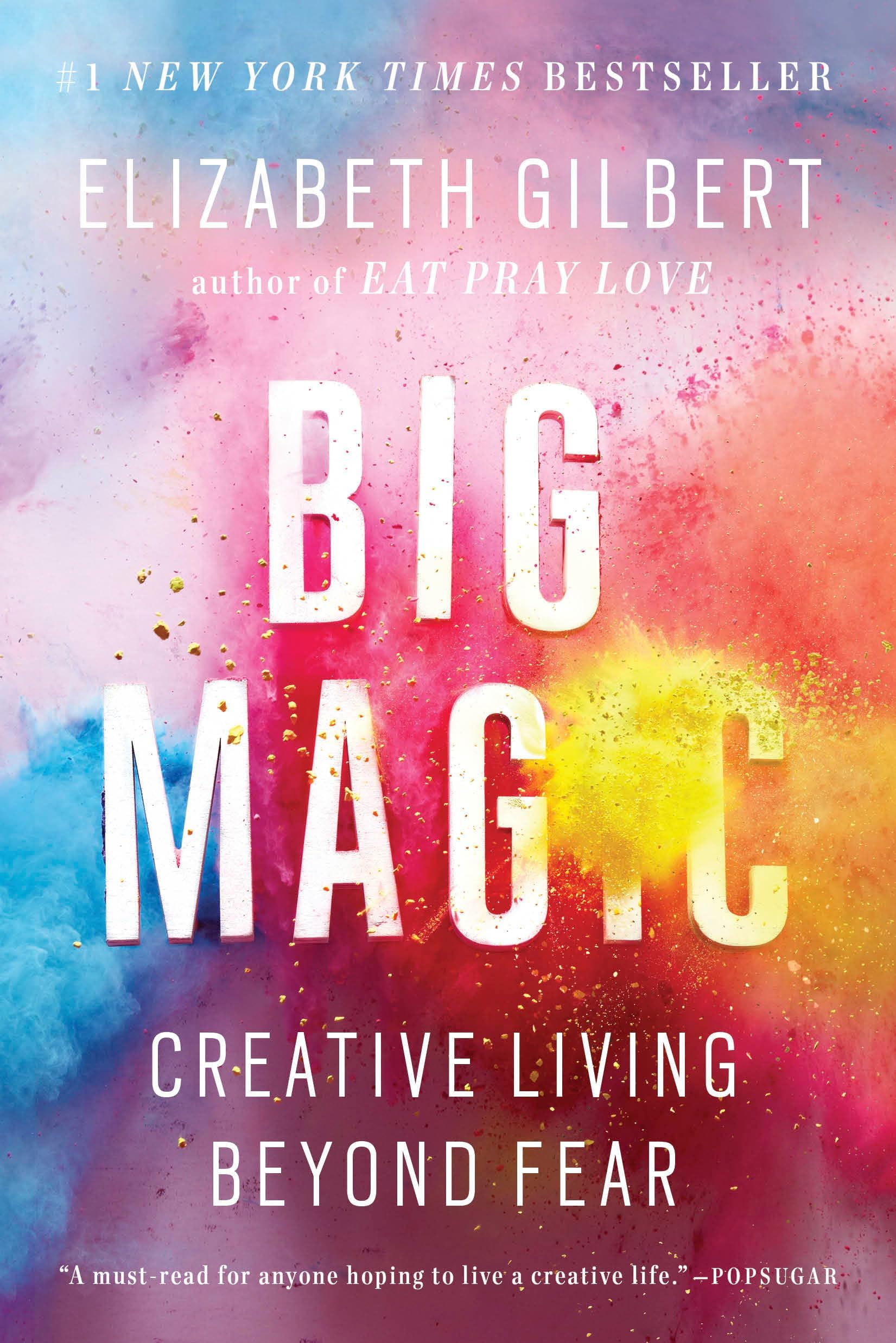
Big Magic: Creative Living Beyond Fear
Product ID: 33724910
Buy anything from 5,000+ international stores. One checkout price. No surprise fees. Join 2M+ shoppers on Desertcart.
Desertcart purchases this item on your behalf and handles shipping, customs, and support to Italy.
The instant #1 NEW YORK TIMES Bestseller "A must read for anyone hoping to live a creative life... I dare you not to be inspired to be brave, to be free, and to be curious.” —PopSugar From the worldwide bestselling author of Eat Pray Love and City of Girls : the path to the vibrant, fulfilling life you’ve dreamed of . Readers of all ages and walks of life have drawn inspiration and empowerment from Elizabeth Gilbert’s books for years. Now this beloved author digs deep into her own generative process to share her wisdom and unique perspective about creativity. With profound empathy and radiant generosity, she offers potent insights into the mysterious nature of inspiration. She asks us to embrace our curiosity and let go of needless suffering. She shows us how to tackle what we most love, and how to face down what we most fear. She discusses the attitudes, approaches, and habits we need in order to live our most creative lives. Balancing between soulful spirituality and cheerful pragmatism, Gilbert encourages us to uncover the “strange jewels” that are hidden within each of us. Whether we are looking to write a book, make art, find new ways to address challenges in our work, embark on a dream long deferred, or simply infuse our everyday lives with more mindfulness and passion, Big Magi c cracks open a world of wonder and joy. Review: Incredibly liberating; an uplifting read for creative people of all stripes - Honestly, there's nothing revolutionary in this book as far as what Gilbert is saying. She hasn't found some magical new formula for unlocking your creativity. Instead, what she has done is create a dialog, as if you were sitting down to coffee with a friend and confessing that you really wanted to be creative but... Gilbert deals with the variety of things that could follow that "but", and she pulls apart each and every one. Will everyone appreciate this book? Probably not. Gilbert does slay some pretty sacred cows, including the notion of the "tortured" artist, but I think she makes a very compelling case for all the cows she slays. The bottom line of this book, really, is do you want to be a creative person because you want the sense of accomplishment and transcendence that creativity can inspire, or do you want to be a creative person because you're hoping to make millions and be lauded by the masses? If it's the second, Gilbert basically tells you that you need not apply, and I agree with her. Creativity may pay off monetarily or in the form of social approbation, or it may not, but if all you really want is to create, who cares? Gilbert holds up all the fears that commonly hold people back and says, "So what?" While I'm not a religious person, I got where she was going by likening creativity to a sort of religious calling. As she says, she doesn't advocate for people moving out to a mountain and living a life of solitary devotion to creativity--unless that's your thing, in which case you should do it. Instead, she's advocating for creativity as a form of not just self-expression, but as a way for people to make something beautiful solely for the sake of making something beautiful. As she says, it's both essential and non-essential. At heart, I think that's what makes us human: that we create things that aren't necessary merely because we like the look of them, or the sound of them, or the taste of them, or the way they feel when we wear them. It's in the act of creating--even if our creation is bad or misunderstood or unloved--that we are able to get outside of our own heads for a bit. We can forget about our mundane worries and struggles and we can experience moments of pure joy. Not that she's saying that all this can come about without some fear and struggle and some sense of pain. What she advises is that we learn to live with these things without allowing them to control us. I know this seems simplistic, but she does such a great job of laying out how to avoid being controlled by your fears. What she's revealing here is that what holds most people back is themselves. What does it matter if people dismiss your creativity or think you're strange? The best kind of creativity, Gilbert says, is the kind that's done entirely because *you* want to do it, not because you're trying to appeal to the masses. The Big Magic, really, is experiencing the joys of creativity for yourself and not for some nebulous, unknown consumer market. If you're fortunate, the market may follow. If not, it won't. Either way, you'll have created something and will have the pride of knowing that it's yours. And when you're done, you'll let it loose, acknowledge that it may not be perfect, and go on to make something else. You can do all this with a sense of awe that you're doing something that fulfills a need deep within yourself. It won't feed you or clothe you or put a roof over your head (unless your creative outlet is something like farming or weaving or carpentry, in which case you may well fulfill some of these essential needs as well), but it will provide you with experiences that you can hoard like treasures, to be pulled out and admired and marveled at whenever you so desire. Reading this book was so good for me because it helped me to see how counterproductive some of the nagging voices in the back of my head are. It encouraged me to take creative leaps and to be philosophical when those leaps sometimes fail, as they inevitably will. Gilbert has helped me to see that, no matter what, I will always long for that creative outlet, so why bother denying it to myself? I can engage with it for the pure joy of engaging with it, and if anything else comes of it, great. If not, well, I'll have been living the life I want to live, and that really counts for more than anything else. Review: A MUST READ! Big Magic is Working Big Time in My Life - Big Magic by Elizabeth Gilbert was not exactly what I was expecting when I purchased the Kindle version on the day of its release. I have been a huge fan of Ms. Gilbert since Eat, Pray, Love and have devoured all of her books up to and including The Signature of All Things that I purchased a signed copy of. This is how much I adore the author. I feel that she speaks volumes to me through her writing and have learned so much about life and myself from her words. When I started reading Big Magic, I was excited after waiting for months following all of the hype on her Facebook page and website. I was thrilled to get it on the day of its release. After the first few pages, though, I was disenchanted and rather disappointed. I am not sure why, but the words in the first chapters did not immediately resonate with me and I, hesitantly and unceremoniously, returned the book for a refund. I know, I know, this is a sin and unheard of for a true fan of this wonderful author to return her book. Then something MAGICAL happened. Seriously, folks, I cannot make this stuff up ... desertcart normally removes the title and its contents from my device when I return an e-book. When I went to sync my Kindle application, Big Magic was still on it. My conscience (or something bigger than myself?) kept prompting me to read the book and give it one more chance. I kept telling myself that it just wasn't going to get better and to not bother... After a few days, I relented to this continually nagging voice and started reading the book where I had left off a few days earlier. Mind you, I had already received a refund on the book and certainly was going to have desertcart manually remove it from my digital orders if I still could not get into the book with giving it a second look. I kept reading past the first few chapters and before I knew it, I had read over half of the book - ingesting every word, every sentence and every paragraph. I lost some sleep last night reading it into the wee hours of the morning. After reading over half the book and realizing that desertcart was not auto-magically removing it from my device, I went back and re-purchased the book. Because, 1) that was absolutely the right thing to do - to pay for a book that I was, indeed, reading and 2) since I am an author as well, I know how difficult it is to release a book and get returns and/or negative reviews when you work your heart out on a new release - so repurchasing it was a no-brainer for me. I am a person who has a difficult time with being creative or allowing creativity to flow within me and Big Magic opened my eyes to the creative process (or at least the author's creative process) of writing. I struggle with giving myself permission to take the time to write and also with giving myself permission to fail. The chapter on perfectionism is a gold-mine of information and truly spoke directly to me. The other analogies and lessons in the book are geared towards writers, artists and the like, but can easily be applied to any occupation in life. The key is to apply these principles in everything that you attempt in life and watch the results turn into positive experiences. The biggest realization from the book is that all of us are creators or makers, no matter what our occupations are and we need to own whatever it is in life that makes us who we are. I see now how this makes a difference in my own life. I have to whole-heartedly say that I was completely WRONG about the book after reading the first few pages and am so glad that the Universe tugged at me to try the book again. I am happy that I did go back a second time as the words finally resonated with me even after my initial resistance to them. Big Magic was working Big Time and I am thankful that I listened! Thank you Ms. Gilbert for writing Big Magic!


| Best Sellers Rank | #4,366 in Books ( See Top 100 in Books ) #6 in Creativity (Books) #125 in Motivational Self-Help (Books) #140 in Personal Transformation Self-Help |
| Customer Reviews | 4.5 out of 5 stars 23,770 Reviews |
B**E
Incredibly liberating; an uplifting read for creative people of all stripes
Honestly, there's nothing revolutionary in this book as far as what Gilbert is saying. She hasn't found some magical new formula for unlocking your creativity. Instead, what she has done is create a dialog, as if you were sitting down to coffee with a friend and confessing that you really wanted to be creative but... Gilbert deals with the variety of things that could follow that "but", and she pulls apart each and every one. Will everyone appreciate this book? Probably not. Gilbert does slay some pretty sacred cows, including the notion of the "tortured" artist, but I think she makes a very compelling case for all the cows she slays. The bottom line of this book, really, is do you want to be a creative person because you want the sense of accomplishment and transcendence that creativity can inspire, or do you want to be a creative person because you're hoping to make millions and be lauded by the masses? If it's the second, Gilbert basically tells you that you need not apply, and I agree with her. Creativity may pay off monetarily or in the form of social approbation, or it may not, but if all you really want is to create, who cares? Gilbert holds up all the fears that commonly hold people back and says, "So what?" While I'm not a religious person, I got where she was going by likening creativity to a sort of religious calling. As she says, she doesn't advocate for people moving out to a mountain and living a life of solitary devotion to creativity--unless that's your thing, in which case you should do it. Instead, she's advocating for creativity as a form of not just self-expression, but as a way for people to make something beautiful solely for the sake of making something beautiful. As she says, it's both essential and non-essential. At heart, I think that's what makes us human: that we create things that aren't necessary merely because we like the look of them, or the sound of them, or the taste of them, or the way they feel when we wear them. It's in the act of creating--even if our creation is bad or misunderstood or unloved--that we are able to get outside of our own heads for a bit. We can forget about our mundane worries and struggles and we can experience moments of pure joy. Not that she's saying that all this can come about without some fear and struggle and some sense of pain. What she advises is that we learn to live with these things without allowing them to control us. I know this seems simplistic, but she does such a great job of laying out how to avoid being controlled by your fears. What she's revealing here is that what holds most people back is themselves. What does it matter if people dismiss your creativity or think you're strange? The best kind of creativity, Gilbert says, is the kind that's done entirely because *you* want to do it, not because you're trying to appeal to the masses. The Big Magic, really, is experiencing the joys of creativity for yourself and not for some nebulous, unknown consumer market. If you're fortunate, the market may follow. If not, it won't. Either way, you'll have created something and will have the pride of knowing that it's yours. And when you're done, you'll let it loose, acknowledge that it may not be perfect, and go on to make something else. You can do all this with a sense of awe that you're doing something that fulfills a need deep within yourself. It won't feed you or clothe you or put a roof over your head (unless your creative outlet is something like farming or weaving or carpentry, in which case you may well fulfill some of these essential needs as well), but it will provide you with experiences that you can hoard like treasures, to be pulled out and admired and marveled at whenever you so desire. Reading this book was so good for me because it helped me to see how counterproductive some of the nagging voices in the back of my head are. It encouraged me to take creative leaps and to be philosophical when those leaps sometimes fail, as they inevitably will. Gilbert has helped me to see that, no matter what, I will always long for that creative outlet, so why bother denying it to myself? I can engage with it for the pure joy of engaging with it, and if anything else comes of it, great. If not, well, I'll have been living the life I want to live, and that really counts for more than anything else.
S**I
A MUST READ! Big Magic is Working Big Time in My Life
Big Magic by Elizabeth Gilbert was not exactly what I was expecting when I purchased the Kindle version on the day of its release. I have been a huge fan of Ms. Gilbert since Eat, Pray, Love and have devoured all of her books up to and including The Signature of All Things that I purchased a signed copy of. This is how much I adore the author. I feel that she speaks volumes to me through her writing and have learned so much about life and myself from her words. When I started reading Big Magic, I was excited after waiting for months following all of the hype on her Facebook page and website. I was thrilled to get it on the day of its release. After the first few pages, though, I was disenchanted and rather disappointed. I am not sure why, but the words in the first chapters did not immediately resonate with me and I, hesitantly and unceremoniously, returned the book for a refund. I know, I know, this is a sin and unheard of for a true fan of this wonderful author to return her book. Then something MAGICAL happened. Seriously, folks, I cannot make this stuff up ... Amazon normally removes the title and its contents from my device when I return an e-book. When I went to sync my Kindle application, Big Magic was still on it. My conscience (or something bigger than myself?) kept prompting me to read the book and give it one more chance. I kept telling myself that it just wasn't going to get better and to not bother... After a few days, I relented to this continually nagging voice and started reading the book where I had left off a few days earlier. Mind you, I had already received a refund on the book and certainly was going to have Amazon manually remove it from my digital orders if I still could not get into the book with giving it a second look. I kept reading past the first few chapters and before I knew it, I had read over half of the book - ingesting every word, every sentence and every paragraph. I lost some sleep last night reading it into the wee hours of the morning. After reading over half the book and realizing that Amazon was not auto-magically removing it from my device, I went back and re-purchased the book. Because, 1) that was absolutely the right thing to do - to pay for a book that I was, indeed, reading and 2) since I am an author as well, I know how difficult it is to release a book and get returns and/or negative reviews when you work your heart out on a new release - so repurchasing it was a no-brainer for me. I am a person who has a difficult time with being creative or allowing creativity to flow within me and Big Magic opened my eyes to the creative process (or at least the author's creative process) of writing. I struggle with giving myself permission to take the time to write and also with giving myself permission to fail. The chapter on perfectionism is a gold-mine of information and truly spoke directly to me. The other analogies and lessons in the book are geared towards writers, artists and the like, but can easily be applied to any occupation in life. The key is to apply these principles in everything that you attempt in life and watch the results turn into positive experiences. The biggest realization from the book is that all of us are creators or makers, no matter what our occupations are and we need to own whatever it is in life that makes us who we are. I see now how this makes a difference in my own life. I have to whole-heartedly say that I was completely WRONG about the book after reading the first few pages and am so glad that the Universe tugged at me to try the book again. I am happy that I did go back a second time as the words finally resonated with me even after my initial resistance to them. Big Magic was working Big Time and I am thankful that I listened! Thank you Ms. Gilbert for writing Big Magic!
C**E
When creativity is both mystical and tangible...
Q: What is creativity? A: The relationship between a human being and the mysteries of the universe. Thus proclaims the epigraph of Elizabeth Gilbert's Big Magic: Creative Living Beyond Fear. Immediately, the reader is invited into a space not only for practical help and encouragement but also for playful exploration of Gilbert's creative mythos. Still, the book grounds itself in reality as much as mysticism, and with each essay she reminds us of the eternal paradox of creative living: that creativity means nothing, but it also means everything. In Gilbert's mythology, ideas--as literal spiritual manifestation--seek those of us who would be willing to listen to them, and then urge us onward to bring them into the world through our own creative energies. It is up to us whether we would accept that urging. The overall sentiment reads a bit like the description of classical muses without the necessity of religious dogma. Unsurprisingly, this collection of interrelated essays reads more as spiritual text than it does as a management or self-help manual (although a reader may find plenty of help within its pages). Gilbert's gift for parables shines in each of the essays in the collection. She intersperses poetic tributes to Ideas and Inspiration with down-to-earth stories about failure and success and about letting oneself go in service of a higher creative power. Within these stories she weaves a framework of creative morality by which she encourages all people to live. Mysticism aside, Gilbert's storytelling and energetic recasting of long-recited platitudes into a distinctly playful mold make for entertaining reading. For instance, Gilbert often waxes poetically on serving creativity solely for itself, and on using it as a source of joy rather than misery. One of my favorite moments comes in the essay "Have an Affair," in which she suggests sneaking off with your creativity in the middle of the workday as you would to engage in an illicit rendezvous. (I have every intention of taking her advice and dressing myself up for just such an affair in the near future.) Yet right on the heels of Gilbert's playful but spiritually-meaningful revelry comes a healthy dose of cynicism. She defines creativity as a mystical and magical process through which inspiration becomes manifest in the world, but reminds her readers that, at the end of the day, what is brought forth may be worth nothing more than the experiences you learn making it. She warns against spending excessive time or money on formal education and dismisses them as an often injudicious quest for validation of our own creativity. The artistic life, she argues, is one far more likely to bring poverty than riches. She discourages incurring unnecessary (and oftentimes useless) debt in the name of a career that may never fully blossom. She likewise reminds her readers that she herself continued working full-time at a variety of jobs before the bestseller Eat, Pray, Love became a hugely successful phenomenon. In some ways I feel as if Gilbert is my long lost evil twin: while I'm a skeptic and a cynic who desperately wants to believe in magic, she has the heart of the truest believer while keeping a foothold on the realities of artistic struggle. (Perhaps then I am the evil one.) Though the book did not enthrall me to the point of racing from the beginning to the end, the end of each essay left me afraid to put the book away, lest I miss another one of Aunt Elizabeth's wonderful and wonder-filled stories. At the very least, Gilbert reminds all of us that creativity is more a work of heart and of soul than of intellect, and that it should always be an act of play rather than a source of struggle. She argues that the path of the miserable alcoholic artist as a romantic image needs to be swept away. Instead, we must engage with our creativity the way you might a friendly sprite in the darkest of nights. You sneak away with it to do something fun, wonderful, even magical, and when it fills your soul no more you set it free. In many ways, this book says nothing that we haven't heard before. Creativity is for everyone. Anyone can be an artist, but not everyone should make it a career. Hard work and diligence are as important as inspiration. Be creative for yourself and not for anyone else. But no matter how many times we've heard these stories, we've not yet heard Gilbert tell them, and for that reason alone the book is worth the read. Her mission, as she herself states it, is to remind us that we need no one's permission to live a creative life. We just have to have the courage to live it.
F**K
Your 101 manual for Creative Living
"And you have treasures hidden within you - extraordinary treasures - ... And bringing those treasures to light takes work and faith and focus and courage and hours of devotion, and the clock is ticking and the world is spinning, and we simply do not have the time anymore to think so small." And thus begins your journey into Big Magic and creative living beyond fear. An exquisite book that I am making required reading material for my entrepreneur group programs. It's THAT good! Liz Gilbert has the best take on creative living that I have read in the dozens of books, hundreds of blogs and interviews and research. She steers you away from drama, addictions to pain and suffering, loneliness, black & white way of looking at your art, artist martyrdom, making such a big deal and not doing all the right things if you truly want to be an artist. Gilbert has the audacity to question your quest - be it writing, drawing, painting, sculpting, composing, and everything else in between - and she gets to the very bottom of the truth - are you really in it for the love of it? Or are you addicted to the IDEA of it, the perfection of it, the fame and fortune and recognition that may - but likely won't! - come from your art? In other words, dear reader, are you here for the rewards and outcomes of your art or for the journey, the process, the sheer pleasure of doing it and getting to do it again, the ride, the high (and the low), and are you taking yourself too seriously, because you must tread this path ever so lightly. I love LOVE the way she gives all permission to pursue their art - even if it's awful, even if it's ugly and far from the high 'standard' they may have for their own creation, and in fact, she urges you to create art, for there are so many rewards to reap just by creating it, by starting it and finishing it, come what may. I wish I'd read this book 5 years ago, even 10, but alas, not only was Big Magic not around, but I would not have appreciated it. To be able to appreciate this book, it would make more sense if you've gone about the journey of creative living all wrong. It's nice and all to do the right thing proactively but we humans are hardly suckers for prevention. We love to solve our misery - that's much sexier - and if your misery is that your art makes you unhappy in the least, then read this book. There are six parts in this book: Courage, Enchantment, Permission, Persistence, Trust and Divinity. Each part has wisdom for any artist - and by artist, I mean YOU because Gilbert believes we were ALL born to create and to live a creative life if we so choose to do so. So yes, the wisdom is aplenty. Perhaps the most powerful concept in the book is one that she has also shared in a past speech and that is the flow of ideas through us, the spark of genius from the universe rather than from within you, and the liberation that you can experience if you weren't so pressured to be such a genius, but instead to care and nurture the genius ideas that go through you.
A**.
Highly recommend to Everyone, not just self-identified artists or creatives!
“Are you considering being a creative person? Too late, you already are one,” Gilbert asserts. In Big Magic, living a creative life means living a life driven by curiosity over fear and this life is accessible to all who seek it. She breaks down creativity into five essential ingredients: courage, enchantment, permission, persistence, and trust. Whether readers believe in a magical world or not, her description of ideas, why they choose us, and when and why they leave is inspiring to no end and her roadmap through the twists, turns, and potential pitfalls of creativity are applicable to all who dare to venture on their own creative journey. Gilbert tackles our biggest creative fears and inner demons head-on with delicious humor, wit, and grace. She allows fear a spacious spot in the car on our creative road trip, but never allows it to give us directions and certainly not take the driver’s seat. Time and again, she effectively and effortlessly silences our inner critic on such universal experiences as: worrying about what others think of us and our creations, bowing to perfectionism instead of completion, evaluating our art as low or high, as brilliant or a disaster, the struggle to declare ourselves worthy of living a creative life, the desire to be fearless or passionate when all we need is courage and curiosity, and much more. She also explores various paradoxes of creativity: the desire for permission and the fact that we never needed it to begin with, that creativity takes persistent hard work on our part and also moments of divine inspiration that come from something else entirely, that no creation is entirely original and yet authentic expressions are always original, and the ultimate paradox: that our creative expression must be the most important thing in the world and it also must not matter at all. Written in easy to digest, bite-size chapters, readers will feel as if they’re chatting over a glass of wine with their amusing and insightful bestie, Liz, as she masterfully weaves together numerous stories from her personal and professional life with hard-earned creative wisdom, always with an endearing self-awareness that at times borders on self-deprecation, and with a charm that is nearly flirtatious. The lessons are so powerful and relatable that if one were to learn this much about their creative life in a year of therapy, they could consider it a great investment. Big Magic ultimately provides readers with the necessary courage and inspiration to live bigger, happier, and more interesting lives, coaxing out of us our own unique hidden treasures. -- Lisa Blair, MA
A**K
If you’ve always wanted to do something creative, but held back for fear of not being good enough, this may be the book for you.
I find Elizabeth Gilbert interesting. But I only partially agree with her. I bought and read Eat, Pray, Love (after the movie—which I never saw—came out). Then I took it to my local secondhand bookstore and traded it for credit. Some of you know I am a bookaholic (*cough* hoarder). Two new books arrived at my house today. My daughter says, “Why do you still buy books? Duh, you can borrow them from the library for free.” I did my share of traipsing back and forth from the library with shopping bags full of books every two weeks from the time I was six until my kids were grown. I’ve bought books at garage sales for ten cents. I still buy used books, but if there’s a book I want to read now and I can’t find it used or on sale, I’ll gladly pay $24.95 for it, anticipating a long-term relationship. I like to devour them, and then come back to them again and again to re-digest them. But one time through Eat, Pray, Love was enough. It didn’t earn space on my bookshelf (or in my closet, or in a box on the floor of my study…). I enjoyed the intimate look at Gilbert’s life and the glimpse of how her brain works, but I’ll never read it again. Her worldview is foreign to me. She credits the universe with the power to answer prayer. I can’t relate. The universe is a created thing. The Creator is the One Who answers prayers. When Big Magic came out, I wanted it because it is subtitled Creative Living Beyond Fear. Elizabeth Gilbert is nothing if not interesting and creative. Yet, as I read Big Magic, I found myself longing for The Artist’s Way by Julia Cameron. Katie, my youngest (but all grown up) daughter, visited and found Big Magic in my study. “I read this,” she said. “Yeah, I’m a little disappointed in it,” I said. “Me, too. But why?” “I bought it hoping that it would take me to the next level in my writing. But it’s not that helpful.” “That’s because you’re already creative. This book is for beginners.” Katie’s evaluation is right on the nose. If you’ve always wanted to do something creative, but held back for fear of not being good enough, this book may be just the kick-start you need. So, the mini-review of Big Magic is: it’s not The Artist’s Way; it’s more Creative Lite. But let’s go a little deeper. On page 86, Gilbert says, You do not need anyone’s permission to live a creative life. I’m disappointed in that, because most books on creativity start out by granting readers permission to express themselves. Gilbert characterizes ideas as being entities having lives and agendas of their own. Their main agenda is to be given birth as art. So they go around suggesting themselves to likely hosts. In other words, the idea approaches you. You can squash it or ignore it. You can let it wait until the spark dies. You can suggest it move on. Or you can run with it. Then Gilbert tells the story of a wonderful novel she began writing about a spinster from Minnesota who falls in love with her boss and goes to the Amazon. Gilbert had a contract for the book and did extensive research. She invested a great deal of time and effort into it. Unfortunately, events in her personal life intervened, and she temporarily set aside the novel. When she went back to it after a two-year hiatus, it was dead. Though she tried to resurrect it, nothing she tried could bring it back to life. One day, when telling her friend Ann Patchett about it, Patchett told her she was currently writing that book. In fact, she got the idea right around the time they first met each other. Gilbert says the idea transmitted itself to Patchett when she gave her a kiss. Interesting. But total b.s. Not that people don’t independently come up with the same original idea as someone else all the time. Gilbert says in her book, "When the nineteenth-century Hungarian mathematician Janos Bolyai invented non-Euclidean geometry, his father urged him to publish his findings immediately, before someone else landed on the same idea, saying, “When the time is right for certain things, they appear at different places, in the manner of violets coming to light in early spring.” In the late 1990s to early 2000s I wrote a novel which never saw light of day. I am in the process of rewriting it, but I’m keeping several scenes from the original manuscript. One pivotal scene that I can’t (or don’t want to) leave out is going to seem ripped-off from The Hunger Games, even though I wrote it a decade before Suzanne Collins and she never kissed me. Sigh. Gilbert tells some great stories in this book. If you like Lindsey Sterling’s story about being The Only Pirate at the Party, you’ll love the section called Walk Proudly (pages 260-264). Some good advice Gilbert gives in Big Magic: Stop complaining if you want to live a more creative life (page 117). Don’t quit your day job. Most artists don’t make a living from their art and must have a back-up job to free themselves from the burden of expecting art to pay the bills (pages 151-156). Don’t think that success looks like money or acclaim. If you love what you’re doing, that’s success (pages 182-184). It’s not what you know, it’s who you know. Translation: get an agent (page 193). When you have no inspiration, follow curiosity (pages 237-239). However, in my opinion, some of her advice is flawed. She also says, “Whenever anybody tells me they want to write a book in order to help other people, I always think, Oh, please don’t…I would so much rather you wrote a book in order to entertain yourself than to help me” (pages 98-99). I suspect most of Big Magic was written for Elizabeth Gilbert’s own entertainment. It certainly wasn’t her intention to help me, and she succeeded. Big Magic will get traded in for credit next time I go to the used bookstore.
J**E
A unique, almost spiritual, take on creativity and our fractured relationship with it
Big Magic was a book that many of my writing friends talked about as a breakthrough to writing motivation, and I can always use more of those types of books. To be honest, I have not read any of her other books, despite aware that Eat, Pray, Love existed. I’m always up for more writing and creative motivation books, as I felt my relationship with creativity fractured and want to make it the best it can be so I can make my craft the best it can be. Elizabeth Gilbert brings a unique take on creative arts, almost taking a mystical and magical approach to it at times, and changed some of my beliefs that held me back for years. The book is divided into six parts: Fear, Enchantment, Permission, Persistence, Trust and Divinity. Each part has a series of short stories and lessons from Gilbert’s life or something a friend of hers learned. She starts with how fear holds us back as well as help us. Enchantment talks about how creativity has a magical component, and while I don’t agree with all of it, it’s something to at least chew on. Permission talks about how we restrain ourselves (especially women) because we feel that we have to have to have these standards first before we do anything, and it’s the section that spoke the most to me. Persistence deals with how we have to evaluate how much we want our creative goal, good and bad. Trust is about how we must have a two way street with our creative mind, not just one way, and that emotional turmoil doesn’t make ourselves more creative and “trickster” as she calls it instead of these altars of the “tortured artists” that go nowhere. Divinity is short, but talks about how it has a spiritual component. For a very long time, I believed that I had to be this popular figure, writing the popular style, be bookish and shun everything else and way and my writing had to be bulletproof to be a published author. But after this, I’m willing to throw all of those pre convinced notions aside for good. There was so many breakthroughs in this book, I didn’t expect to have highlighted so many lines from this book. She brings a unique and almost mystical perspective about the creative arts, mainly writing (as she’s a writer and published author), but it can relate to anyone that creates anything. I’ll be reading this again and taking a look at my notes, especially if I stumble back! I highly recommend this to any creative that feels stuck in their creative goals!
L**I
Inspiring & Uplifting Guide to Creativity
Big Magic: Creative Living Beyond Fear by Elizabeth Gilbert is a must-read for anyone looking to embrace their creativity without fear or self-doubt. With her warm, conversational tone, Gilbert offers insightful advice, personal anecdotes, and motivational wisdom on how to live a creative life—whether you're an artist, writer, or simply someone who wants to pursue passions without fear holding you back. ✅ Pros: Encouraging & Uplifting: Inspires readers to create without fear of failure. Relatable & Engaging Writing: Feels like a conversation with a supportive friend. Practical Advice: Helps shift your mindset around creativity. Perfect for All Creatives: Whether you’re a beginner or experienced, this book resonates. ⚠️ Cons: Not a Step-by-Step Guide: More philosophical than instructional. Some Ideas Feel Repetitive: Certain concepts are emphasized multiple times. Final Verdict: Big Magic is a beautiful, empowering book that encourages you to embrace curiosity, let go of fear, and create freely. If you need a push to pursue your passions, this book is the perfect inspiration! Highly recommended!
G**N
Loved this book!
I highly recommend this book - it is inspiring and encouraging, and really helped me embarking on my creative journey. Lots of tipps and little hacks that can actually be applied in real, busy life.
J**B
lees dit
inspirerend
G**A
Life changing!
I read all of the major books on creativity, yet this one is a true life-changer. It will transform the way you look at creativity, your artistic career and even your world view about work, creativity and personal life. Many books on the subject try to show to how to "succeed" in a creative career. This one instead does a revolution by freeing you from the result and detaching success & creativity. Highly recommended masterpiece on its field.
N**N
Magical
Lovey, fun, enjoyable, relatable. Giggles, amazement, hope. Love the book for anyone looking for the magic of creation they once had. A book to read over and over and over again. Thank you Liz :)
M**A
Buen libro
Muy inspirador!
Trustpilot
1 week ago
2 weeks ago