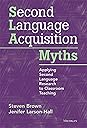
Second Language Acquisition Myths: Applying Second Language Research to Classroom Teaching (The Myths Series)
Product ID: 17370706
Desertcart purchases this item on your behalf and handles shipping, customs, and support to Italy.
This volume was conceived as a first book in SLA for advanced undergraduate or introductory master’s courses that include education majors, foreign language education majors, and English majors. It’s also an excellent resource for practicing teachers. Both the research and pedagogy in this book are based on the newest research in the field of second language acquisition. It is not the goal of this book to address every SLA theory or teach research methodology. It does however address the myths and questions that non-specialist teacher candidates have about language learning. Steven Brown is the co-author of the introductory applied linguistics textbook Understanding Language Structure, Interaction, and Variation textbook (and workbook). The myths challenged in this book are: § Children learn languages quickly and easily while adults are ineffective in comparison. § A true bilingual is someone who speaks two languages perfectly. § You can acquire a language simply through listening or reading. § Practice makes perfect. § Language students learn (and retain) what they are taught. § Language learners always benefit from correction. § Individual differences are a major, perhaps the major, factor in SLA. § Language acquisition is the individual acquisition of grammar. Review: Practical, Easy to Read, and Super Helpful! - It is by far one of the most practical SLA books I've come across. Unlike many other books in the field, it's an easy read, and the clear explanations of common myths make it a great reference to come back to whenever you need a refresher. Highly recommend! Review: Excellent overview of SLA research (found exactly what I was looking for in an easy read) - The organization of this books is excellent. Each chapter starts out with a "In the real word" then progresses to "What the research says" and ends with a "What we can do". The information presented is accessible to those new to SLA field. It's 100% sufficient in what the book sets out to accomplish - no more, no less - which makes it an "easy" academic read. If there is a topic you'd like to explore further their are plenty of references within to satisfy your palate for SLA research. If you have some experience in the field already, you may find that you already know "this or that"; however, I still find the information beneficial as it reaffirms that my own observations in the field are supported by research. The author is also very good at letting the reader know what research is still inconclusive. Overall, it's an excellent overview of SLA research that also provides actionable steps based on the existing data toward better L2 acquisition.
| Best Sellers Rank | #983,861 in Books ( See Top 100 in Books ) #502 in Arts & Humanities Teaching Materials #1,899 in English as a Second Language Instruction #2,336 in Economics (Books) |
| Customer Reviews | 4.6 out of 5 stars 125 Reviews |
A**S
Practical, Easy to Read, and Super Helpful!
It is by far one of the most practical SLA books I've come across. Unlike many other books in the field, it's an easy read, and the clear explanations of common myths make it a great reference to come back to whenever you need a refresher. Highly recommend!
M**C
Excellent overview of SLA research (found exactly what I was looking for in an easy read)
The organization of this books is excellent. Each chapter starts out with a "In the real word" then progresses to "What the research says" and ends with a "What we can do". The information presented is accessible to those new to SLA field. It's 100% sufficient in what the book sets out to accomplish - no more, no less - which makes it an "easy" academic read. If there is a topic you'd like to explore further their are plenty of references within to satisfy your palate for SLA research. If you have some experience in the field already, you may find that you already know "this or that"; however, I still find the information beneficial as it reaffirms that my own observations in the field are supported by research. The author is also very good at letting the reader know what research is still inconclusive. Overall, it's an excellent overview of SLA research that also provides actionable steps based on the existing data toward better L2 acquisition.
C**4
Easy Read, Practical, and Up-to-date
I bought this for a colleague whose teacher training never included anything specific to teaching a second language. I ordered and read a lot of similar types of books before settling on this one. I was worried about giving her something long that she wouldn't bother to read or something so technical she wouldn't get anything out of it, and this was the perfect choice. It's a quick and easy read and hits all the major misconceptions about SLA, along with some basic advice about what it all means in practice. It is totally approachable even if you don't know all the SLA terminology. This would make a great choice for a staff development book study or for anyone just looking to make sure they are up to date on current research. Probably not the best if you already know quite a lot about SLA. The Oxford Handbooks "How Languages Are Learned" is a better option if you are looking for something more in-depth.
A**D
At last, a book that connects SLA research to practical advice
Another book in the 'myths' series, this one offers a relatively accessible introduction to findings in SLA, and (as in my case) can serve as a useful review and update for those in the language teaching and learning field. There are indeed popular myths around learning a language. Children pick up languages naturally but for adults it's a great effort. Bilinguals speak both languages equally well. Brown and Larson-Hall succinctly pull together research that gives the lie to such myths. Or rather, what they show is that the situation is much more nuanced than the myth suggests. For example, given an abundance of input and opportunities, adults can make progress in a second language at least as quickly, if not more so, than children. The difference is that children are more likely to reach a higher level of proficiency in the end, and this is particularly noticeable in pronunciation when children start learning before a certain age (precise age still TBD). It is also refreshing to read that "there is no board to certify anyone as a "true" bilingual," (p. 23) and that specialists generally include in the definition anyone who has attained some conversational ability in a second language. Equally importantly, the authors explore some of the implications for real-world practice. A common belief that children can pick up languages easily drives policy on ELLs in public schools, which in many cases pushes a sink-or-swim approach with the expectation that children will be fine after a year of ESL classes. As the authors point out, kids may be able to pick up what Cummins called Basic Interpersonal Communication Skills (BICS) in that period of time, but are unlikely to master the Cognitive Academic Language Proficiency (CALP) they will need to succeed academically. Holding onto the myth that children can learn a language quickly and easily does a disservice to ELLs. In a similar way, other SLA topics are introduced through the idea of the myth. Practice makes perfect? It depends on the nature of the practice. Learners learn what teachers teach? This ignores what we have come to know about order of acquisition and developmental constraints. Correction works? Some forms of correction (prompts that cause learners to notice what they did wrong and fix it) are better than others (recasts). And the crowning strength of the book: each chapter ends with a What Can We Do section that includes (mostly) practical implications for teaching practice. Some weaknesses, though they are quibbles: the writing style is a little uneven, veering from conversational and informal to somewhat dry literature review-style description of the research. (To be fair, I haven't yet come across a gripping review of the SLA literature, though I live in hopes.) In some cases, the implications of a myth might have been more fully explored. For example, the knowledge that learners don't master language in sequence and on a prescribed timetable has enormous implications for the ongoing insistence of educational policy makers and accreditors on outcomes-based curricula, an approach driven by a bureaucratic desire for accountability that appears to be utterly wrongheaded given the research findings. Finally, I would like to have seen one or two of the topics excluded (do we really need to keep talking about Krashen?) and others included. Two myths I'd like to see discussed are "Immersion is the best way to learn a language," and "The goal is to become like a native speaker." Overall though, this is an engaging overview of some of the big topics in SLA, and one of the few I've read that makes the research directly relevant to teachers and administrators.
J**T
Great book
I needed this book for a college class. I learned a lot from the myths related to language. It was very thorough and informative.
F**O
EXCELLENT BOOK
It's the third Myths series book that I read. Both Steven Brown and Jenifer Larson Hall wrote everything easy to be understood. Meanwhile, the book provides many key words that can be research.This book could be for SLA beginners cuz it displays extreme content, and when I read the references, I noticed that these references are valuable for further research. It's worth to buy it.
J**.
Great for classroom and ELL teachers, admin
Using for a college course and have found the text to be very informative and easy to read.
A**S
good quality
It's a easy entrance book, required for Ling 640. It talks about some myths about second language acquisition. It inspires critical thinking. Good quality.
L**Y
Well-used second-hand book
It arrived on time and it is really worthy because the book is well-used. It is clean. Only 1 chapter has some markings but I can erase the pencil one. That's really worthy.
Trustpilot
1 month ago
5 days ago