


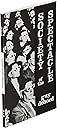


Society Of The Spectacle
Product ID: 1699598
🌍Global perspectives
📖300+ pages
🖋️Influential author
Buy anything from 5,000+ international stores. One checkout price. No surprise fees. Join 2M+ shoppers on Desertcart.
Desertcart purchases this item on your behalf and handles shipping, customs, and support to Italy.
📚 Unlock the Secrets of Society's Spectacle!
Society Of The Spectacle by Guy Debord is a seminal text that critiques the pervasive influence of media and consumer culture on social relations. Spanning over 300 pages, it offers a profound analysis of how images and representations shape our understanding of reality, making it a must-read for anyone interested in sociology, media studies, and cultural theory.
| Best Sellers Rank | #31,173 in Books ( See Top 100 in Books ) #23 in Social Philosophy #68 in Political Philosophy (Books) #90 in History & Theory of Politics |
| Customer Reviews | 4.6 4.6 out of 5 stars (969) |
| Dimensions | 5.25 x 0.5 x 8.5 inches |
| ISBN-10 | 0934868077 |
| ISBN-13 | 978-0934868075 |
| Item Weight | 5.6 ounces |
| Language | English |
| Print length | 132 pages |
| Publication date | June 1, 2000 |
| Publisher | Black & Red |
P**E
In liber veritas.
I used this in my college thesis and decided to buy this for kindle—my college brain definitely did not process it like my adult brain does now. 🤯 A must-have/read for everyone. It’s short but every sentence is a mental punch but a masterpiece. You will self-analyze, reflect and engage, hopefully, with the world ENTIRELY differently. 🤷♀️ Enjoy!
G**G
A must-read for any post-modern thinker!
Debord’s genius comes in the fact that he says things in a way that, like Marx, retains relevance across history. To me, Society of the Spectacle is the Marxist version of Baudrillard’s Simulacra and Simulation. If I were you, I’d read both works to get a sense for two very different attitudes toward media and post-modernity. Debord is particularly upset with how powerful systems of coercion have become so central to our way of life today. For him, media should be responded to by seeing it for what it is: a spectacle meant to entrance and create an image we should want and be subservient to. For Debord, our current attitudes toward media (Debord saw, in just 10 years in his home country of France, the percentage of TV’s in homes rise in France alone from 13 to 83 percent) represent a failure to see an onslaught of coercive powers telling us how to live (which means to be capitalists, to love consumerism, celebrity, etc). For Debord, there is some sort of revolution-contingent escape; for Baudrillard there is not. You be the judge and read this SHORT but amazing book!
E**N
Spectacular critique of the Spectacle
This is an interesting book that draws subjects of late capitalism in to consider the work of images in our society, but it is a manifesto that seems to be a bit theory light. While it focuses the reader on some issues with movies, adds, books and how we visualize what life should be post 1980s, it does not speak as well to current times, and it does not create an interesting theoretical conversation without a bit of thoughtful work.
E**O
An Accurate Diagnosis of Today’s Post-Capitalist Society in the Internet Age of (anti) Social Media
Debord’s Society of the Spectacle (1967) is a prescient indictment of modern capitalism’s structural framework expressed as a ‘spectacle.’ Most people who read Society of the Spectacle confuse it with a critique of ‘mass media.’ They accept it on its face and ascribe a literalism to Debord which is not there: namely, that Debord critiques society’s obsession with ‘mass media.’ Although he does include mass media in his critique, it is merely a feature and outgrowth of the overall spectacle. In Chapter I:24, Debord writes of ‘mass media’ as the spectacle’s “most glaring superficial manifestation” that “seems to invade society as mere equipment…” One must read Debord’s subsequent work Comments on the Society of the Spectacle (1988) to learn of Debord’s nuanced distinction. Therein, Debord writes, “[r]ather than talk of the spectacle, people often prefer to use the term ‘media,’ and by this they mean to describe a mere instrument, a kind of public service.” The idea of ‘media’ as itself a mode of influence is more thoroughly explored by Marshall McLuhan, who in the same year of ‘Society of the Spectacle’ in 1967 wrote ‘The Medium is the Message’ which expands on his earlier work 'Understanding Media' (1964). Therein he describes how different media/medium embeds itself into the message it transmits, which thereby influences how the message is delivered and ultimately received by individuals. But, the ‘spectacle’ is much more than just media. The ‘spectacle’ that Debord is concerned with is based on capitalism’s all-encompassing ability to metabolize, overtake, and absorb every facet of life it contacts, including individuals. It thereby transforms the individual into an alienated passive spectator who watches the flow of life reduced to the movement of commodities, and a reification of life events in general. The ‘spectacle’ is thus the dominant regime which shapes and directs the ‘lived time’ of individuals, who become fetishistically ensnared within the daily struggle of commodified relations and things. It is captured by the opening line: “In societies where modern conditions of production prevail, all of life presents itself as an immense accumulation of spectacles. Everything that was directly lived has moved away into a representation.” This book not only denotes, describes and distills capitalism’s immense spread into every sinew of reality through the spectacle, but it also describes the spectacle’s tentacles spread to the present post-internet age embodied by so-called ‘social media.’ Debord foreshadows this when he writes that “the spectacle is not a collection of images, but a social relation among people, mediated by images.” Thus, Debord’s point is that as individuals we have been captured by capitalism’s method of operations embodied in the spectacle. The ‘spectacle’ in turn alters and transforms our relationships both with ourselves and others. Thus, we succumb to the influence of living mediated lives – mediated by technology, consumer goods, financialization, entertainment, etc. Our reality is thus interpreted for us and neatly presented in curated commodified narratives. Debord was no doubt influenced by Hegel, Marx and Lukacs. However, he attempted to transcend Hegel and Marx in that for Debord, both Hegel and Marx attribute history’s march to forces other than human agency – Spirit for Hegel and economy for Marx. For Debord, although the individual is captured by time, the individual is nonetheless capable of acting and shaping history through social actions within time. Ultimately, Debord’s work provides a slim sliver of hope. In light of Marcuse’s One Dimensional Man (1964), one can argue that radical/revolutionary critique was pacified and all opposition subdued by the material comforts which capitalism’s ‘spectacle’ offered. Thus, any attempt to critique, rebel or resist the march of post-capitalism’s desire was rendered impotent and absorbed within the spectacle. This is both an easy yet hard read in that some of the writing needs to be re-read by the reader to understand the meaning behind the text. Moreover, one needs to read this book in the context of the time – and Debord’s involvement with the Situationist International. Additionally, one should read Debord’s subsequent Comments on the Society of the Spectacle, as both inform each other for a more holistic understanding. Ultimately, this is a must read for anyone who seeks to question the received reality we are presented with and approach life critically.
J**R
The Theory of Everything
This book is amazing! This book is arraigned as a series of statements. The statements vary in complexity; some are simple, declarative statements, others are complex, with run-on sentences. There are no page numbers in Debord’s book. Debord’s text consists of some two hundred aphorisms, some simple, others tersely worded and complex, from which he analyzes the full spectrum of the surrounding society and world. Debord’s is a philosophical indictment of Capitalism. Debord’s primary thesis that Capitalism reduces society to a series of spectacle, images, which cloud reality and in which everything becomes a mere commodity. It is a topsy-turvy world, where the lie is Sacred and the truth reviled. The impact of Capitalism begins far earlier with Time and Space. Debord’s precise theory is that Capitalism corrupts humanity’s management and perception of Time and Space. Time and Space are divided into more and more discreet pieces, reduced to a commodity, affecting the quality of life. Society, everyday life is reduced to spectacle; from the corruption of society, the arts and sciences are corrupted. Debord’s book is a legitimate book of pure philosophy. The only difference is that Debord’s book bears a connection and relevance to everyday life. It will change yours.
D**I
unusualfullnessless
The real Stuff
N**N
Possibly the most important book of the 20th century. Cool edition. I love guy debord
A**S
I bought this for a gift for a history buff and he is really pleased with it. Already all read and keeps talking about it.
M**O
This edition features its most iconic cover; even though for new readers I would recommend Ken Knabb's translation, easier to read and including the original annotations.
A**H
This book is unique of its kind because of its subject. Author is knowledgeable and prolific writer famous for his intrigued thoughtfulness.
F**H
Great book nice cover design
Trustpilot
2 months ago
2 weeks ago