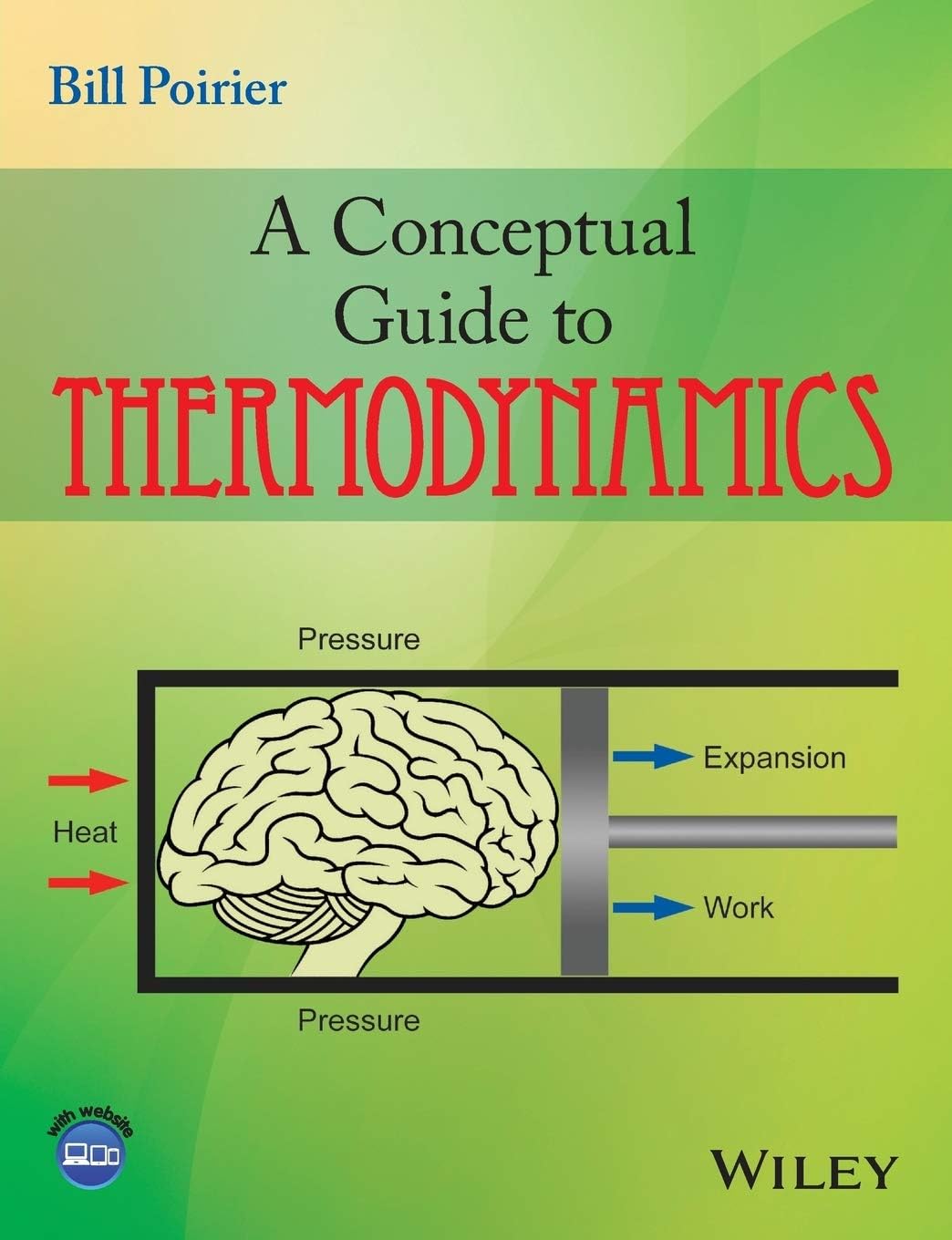
A Conceptual Guide to Thermodynamics
Product ID: 16873732
Desertcart purchases this item on your behalf and handles shipping, customs, and support to Italy.
Buy A Conceptual Guide to Thermodynamics on desertcart.com ✓ FREE SHIPPING on qualified orders Review: Thermal - Bought this for my daughter to have a basic understanding before she takes the class in college. She said it was easy to read and understand. Review: The Conceptual Guide to Thermodynamics is just that. - An interesting summary with references to very many other thermodynamics books. You will be hard pressed to find a thermodynamics book not referenced. And the brief summary over a wide range of topics - not so much in the Engineering Thermodynamics side though - makes it an excellent reference book.
| Best Sellers Rank | #828,055 in Books ( See Top 100 in Books ) #149 in Thermodynamics (Books) #173 in Mechanics |
| Customer Reviews | 4.5 4.5 out of 5 stars (14) |
| Dimensions | 7.5 x 0.35 x 9.65 inches |
| Edition | 1st |
| ISBN-10 | 1118840534 |
| ISBN-13 | 978-1118840535 |
| Item Weight | 12.8 ounces |
| Language | English |
| Print length | 192 pages |
| Publication date | September 22, 2014 |
| Publisher | Wiley |
K**R
Thermal
Bought this for my daughter to have a basic understanding before she takes the class in college. She said it was easy to read and understand.
F**K
The Conceptual Guide to Thermodynamics is just that.
An interesting summary with references to very many other thermodynamics books. You will be hard pressed to find a thermodynamics book not referenced. And the brief summary over a wide range of topics - not so much in the Engineering Thermodynamics side though - makes it an excellent reference book.
D**R
Wonderfully explained
I wish I had had this book when I took the course decades ago!
L**I
Good to read and study for college level students
a very concise book on Thermodynamics. Good to read and study for college level students.
J**N
"Try It!" you'll be glad you did
Just about every branch of science and engineering uses thermodynamics. Unfortunately, every branch of science and engineering emphasize their own concepts making it difficult, if not impossible, to find ONE book to help everyone studying thermodynamics. I think this book is that ONE book. First, the author includes a seemingly exhausting list of variables, their meaning, and the symbol they map to in many different textbooks. The list of textbooks is always growing and updated on the textbook's website. However, the book itself maps variables for more than 2 dozen textbooks from the fields of chemistry, physics, engineering, and biology. Second, the author focuses on the concepts, not derivations or problem solving. Often lecturers spend their time on derivations and the concepts are missed. In recitations problem solving is emphasized, but the concepts are again glossed over. I think this book is a great attempt at filling in the gaps left by many lectures and recitations. Third, this book is easy and fun to read! Yes, a book on thermodynamics which is easy to read. The concepts are explained using straight forward terms that are easy to understand. The fun comes from the author's sense of humor which comes through in many of the passages. While reading this book I actually laughed out loud while reading several passages. I would highly recommend this book for any undergraduate student who is taking a course that is heavily weighted in thermodynamics. This textbook is a supplement for my students in Physical Chemistry 1 this upcoming Fall semester. I'd also recommend this book to any graduate student who is using thermodynamics in a course or in their research. Finally, I'd recommend this book to anyone that is interested in the concepts of thermodynamics, whether you are an undergraduate student, graduate student, or simply a student of science.
T**S
" is an excellent companion to any class where classical thermodynamics is taught
This book, "A Conceptual Guide to Thermodynamics," is an excellent companion to any class where classical thermodynamics is taught. Those more advanced in the field of chemistry and other disciplines can also benefit from this book by reviewing "the big picture." I found the book engaging and there are a few explanations that illuminated some topics I had wondered about since my undergraduate days. One feature that I particularly like is that the book contains heuristics to solve thermodynamics problems that students will find very valuable. The subject of the book is classical thermodynamics. Reference is occasionally made to statistical thermodynamics, but no time is spent developing that field, only using the results of it when helpful to the discussion. This is not a drawback (it's not a textbook), but the reader should be aware that "only" classical thermodynamics is presented. One of the best things about this book is relaxed diction that makes it easy to read. As stated in the book, the point was not to write a textbook going over the nitty-gritty details and deriving all the formulae but rather to be in addition to the thermodynamics part of any physical chemistry textbook (and other classes, too, that teach thermodynamics, as mentioned in the book). The author has gone to great lengths to provide a Rosetta Stone to translate conventions (like the symbols chosen for variables) between common textbooks and this book. I would heartily recommend this book to any students taking a class involving classical thermodynamics. More than that, I recommend it to anyone who wants to know more about the concepts of thermodynamics or needs to tie up loose ends from the traditional approach.
C**T
Simple, Concise, and Effective
This book, along with a carefully crafted or selected set of exercises and problems, is sufficient material to attain mastery of the concepts that will be found in most university-level thermodynamics courses. Having often found myself in the situation of having purchased a costly textbook only to find it next to useless in improving my performance in the course, this book is certainly a breath of fresh air in comparison. For those students that find themselves grumbling at textbook price: I entered the thermodynamics semester of a physical chemistry course with an expectation to finish the course with the lowest possible passing grade. My poor understanding of thermodynamics left me with the worst grade of my college career in the second semester of general chemistry. This guide served to teach me how to think about this material, and in doing so, led me to an excellent score in the course, as well as an excellent score on the ACS thermodynamics exam (neither of which was I expecting at the outset of the course). In summary, I would like to emphasize that this book is in no way a substitute for hard work. It is, however, an indispensable tool for any student that finds themselves intimidated by this topic, and equally useful for that student who would like to find a way to actually enjoy the study of the subject covered here. Some students may actually find it an acceptable substitute for other, more expensive textbooks, a fact that should concern many authors of traditional textbooks.
Trustpilot
1 month ago
1 month ago