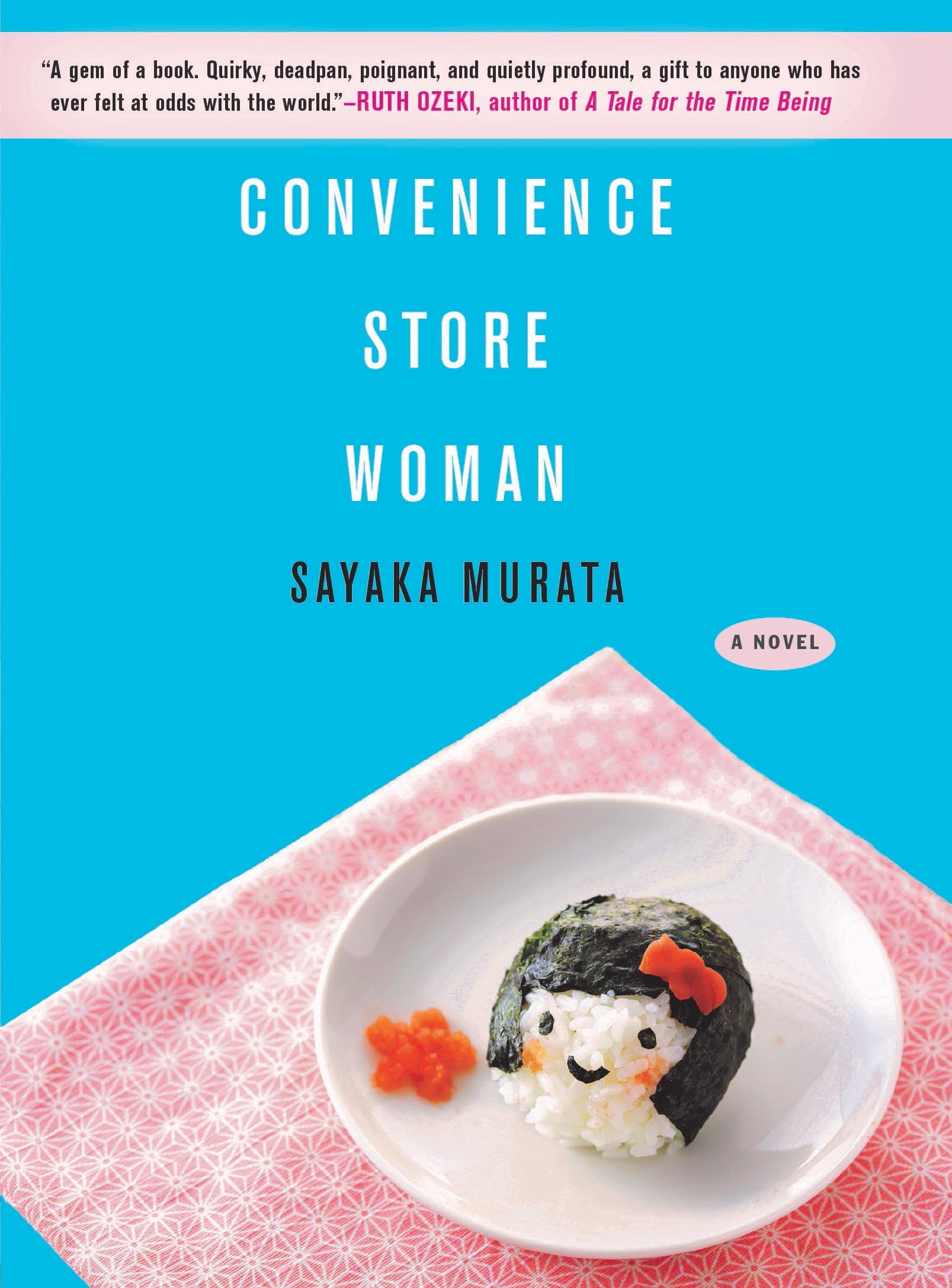
Convenience Store Woman: A Novel
Product ID: 167891408
🌍Cultural insights
📚200+ pages
🖊️Award-winning author
Buy anything from 5,000+ international stores. One checkout price. No surprise fees. Join 2M+ shoppers on Desertcart.
Desertcart purchases this item on your behalf and handles shipping, customs, and support to Italy.
📖 Discover the extraordinary in the ordinary!
Convenience Store Woman is a compelling novel by Sayaka Murata that follows the life of Keiko Furukura, a woman who finds solace and identity in her job at a convenience store, challenging societal norms and expectations in contemporary Japan.


| Best Sellers Rank | #6,624 in Books ( See Top 100 in Books ) #12 in City Life Fiction (Books) #27 in Cultural Heritage Fiction #415 in Literary Fiction (Books) |
| Customer Reviews | 4.0 out of 5 stars 20,559 Reviews |
S**W
Strangely Inspiring
I've worked a minimum wage retail or hospitality job since I was 17 (I'm 31 now), and I never really thought much about it. Those jobs were just something to do to pay the bills. I never had one fraction of the passion and dedication for my service jobs that Keiko-san has. But her dedication for her convenience store job is strangely inspiring. I've taken a new job three months ago at a coffee brewery, and while I like the job, the work is very very hard sometimes. The hours are long, there's lots to do and the labor can be physically demanding quite often. Just last week was very busy. There were many orders to fill for clients, which meant there was hundreds and hundreds of pounds of product to produce. I briefly had a moment of doubt, thinking to myself "I'm not cut out for this. I should quit, and find something else," but I stuck it out. Keiko-san single-minded, die-hard work ethic and adherence to her job, while obviously s bit strange and, some might say problematic, has inspired me to dedicate myself to my job (that I honestly love to be honest) more so than I have been. Thank you, Miss Sayaka Murata, and thank you Keiko Kurukura, for reminding me that there is merit in finding your niche in the working world, and carving it out further with a job well done.
P**D
A novella about someone not like us
Sayaka Murata’s brief, but to the point Convenience Store Woman took me more places than its 163 pages might promise. It is a very easy read and mostly family friendly admitting to a few ‘bad’ words and some mostly negative sexual suggestions. Then there is what happens when you let your mind delve into the depth of the novella. Highly recommend as a good use of a few hours. At various time I thought I knew the deeper meaning of the book only to realize there was more and more ways to think of it. On the surface we have a mid-thirties, underachieving woman who has failed to be much of what society (Japanese) expects of its friends, family and neighbors. Because she does not conform she is held as a sympathetic figure in need of curing or of suspicion. First stop: This is about a very Japanese middle-class suburban world but it is far more universal than one time and place. Anyone one too long single in most countries is going to garner some amount of suspicion. Try being the too long single Uncle and notice the almost unsaid concerns about you being around children. Listen to how you might speak about people who may not be striving for promotion, who are making do in jobs that appear to be beneath them and others who, on the surface do not seem like ‘us’. Our protagonist and narrator Keiko Furukura is, for the last eighteen years and has only ever been a part time employee of the Smile Mart Convenience Store. We cannot be sure that she is happy there as we can be sure she is using it as a safe place where she knows what she is doing and being who she is expected to be. She has never dated, been married has no children or pets. As far as we know she experiences no sexual interests, habits or even private thoughts. She did not complete her education and lives in polite squalor in a tiny apartment. She has family in the form of a very supportive sister and loving mother. Since her childhood people have wanted to cure her and help her become more like what they think would make her life a happy one. Her supportive sister would be relieved to find her sister dating, or seeking a better job. Everyone with whom Keiko comes into social contact either wants her to not be herself, or to get sufficient explanation to determine if she is a threat. If you read no more deeply than that the book is about the how unfair it is of us (Japanese or not) to expect others to live and believe and aspire as we do. But we also have evidence that Keiko is coldly analytical and not very empathetic. Some would place her on some scale of autistic. This point is deliberately left vague. It is possible to argue that left to her uncontrolled instincts, she would be dangerous. Given another theme of the book, it is an instinctive habit of humans and animals to spend a certain amount of time deciding if a stranger is a threat. This is not just a Japanese thing it is universal. The question of Keiko being happy in the Smile Mart is also subtle. What makes this a natural home for Keiko is that it comes with a written set of instructions. There is a correct time and place for everything. There is a evan a requirement to live outside work in such a way to insure you arrive ready and rested, for work. At some point the reader is expected to realize that living in a society also requires living by certain rules. Keiko ultimately realizes this, but the lack of written instructions is what might have left her coldly analytical personality unable to cope. Late in the short story she meets one of the most unsympathetic, unlikable characters in almost any story. Keiko does not like him, but her analytical mind understands that he is a mirror of herself. The ultimate conflict of this book is the problem or choice Keiko must make between a world of people like herself, or a world of people not like her. This is a very different thought problem for the reader than, why cannot we accept people for what they are. Least you conclude that this is a heavy book, darkly philosophical and cerebral- The story is told with a very light hand. We meet many people that we like. We can share Kieko’s frustrations and her victories. She is an admirable person and her world is one that, for all its lack of fairy tale trappings is one not that different from or hostile towards the one we inhabit.
J**C
Great quality and interesting read!
This quick read gives insight into the pressures of society. The unique perspectives in the book open a lot of conversations. If you're into grounded stories with interesting characters then this book is for you!
L**D
A Beautiful Obsession With The Mundane
Convenience Store Woman by Sayaka Murata is my first Japanese author. This story is unique in that you could just read it as a humorous, quirky tale about a strange woman in Japan, or delve into the underlying struggles of a Japanese woman who does not conform to the rigid standards of her culture regarding success and femininity. I resonated with the latter. The novel centers on Keiko Furukura, who has worked part-time at the same convenience store for 18 years. I think the author transforms what many would see as a mundane job into something beautiful. Through Keiko's eyes, the rigorous, standardized, and predictable routine of the store becomes a sanctuary where she finally fits in. The attention to detail about the store is wonderful - the sound of the scanner, the exact temperature of the refrigerated drinks, and the precise scripts for customer interactions. Keiko is unmarried, without typical ambition, and working in a seemingly dead-end job. She is constantly assailed by the pressure from expectations projected onto her by family and friends. This is the heart of the novel's conflict: Keiko is deemed "abnormal" by society for being content with her life outside of traditional milestones. She is expected to get married, have kids, find a better job, and be more sociable. She understands this expectation as she describes herself as “a foreign object”. She is content with her choices, but no one around her is. There is a turning point in the story where Keiko realizes that her sister is fine with Keiko being unhappy and “normal” rather than content and different. I believe Keiko is either just different or possibly a “normal autistic woman” who simply is unable to meet the expectations of society. She is forced to navigate between her own wants and the expectations from her close people. Some readers may think this is a sad story about a woman who is not “normal”. I saw humor and I laughed at the absurdities she sees all around her. But ultimately, Keiko was never sad and was fine with being different. This book is a MUST, vivid, quick and fascinating READ.
J**N
A short, unsettling novel that is worth your (brief) time if you can accept its unusual narrator
Convenience Store Woman is a slim, unsettling novel with a dark sense of humor that is largely one-note in its tone and premise: The novel represents the everyday life of Keiko Furukawa a single, middle-aged woman in one of Japan’s ubiquitous 24-hour convenience stores. She has been working as a basic employee for eighteen years, ever since graduating high school. Working at these stores has become the narrator’s reason for living, which seems to trouble almost everyone but herself. The novel does not have an elaborate plot and the drama and tension largely comes from the narrator’s observation of her own life and others as a convenience store employee. But for those who may be looking to read the book because of this conceit, the personality of the narrator may make or break how and whether or not you read the book. While I recommend the book, the book’s narrator main character Keiko Furukawa is depicted as a person who, to quote the character herself: "would no longer do anything of my own accord, and would either just mimic what everyone else was doing, or simply follow instructions." In both childhood flashbacks and repeated interjections throughout the novel it is repeatedly mentioned how “emotionless” Keiko feels she is and how she sees herself more as a vessel and a representation of the emotions and mores of her environment. Murata often makes it a point to frame Keiko's thoughts and behaviors in each scene to deliberately highlight how both emotionless and nonplussed Keiko can be toward life. Keiko's personality and the reader’s is tested when Keiko enters an unorthodox relationship with a toxic and verbally abusive man. This man is seen as a failure by family, former neighbors and coworkers. In his rage, he sees not just women but all people and the world itself as having personally wronged him. Her relentless tolerance of this poisonous individual and his abuse tests her patience and likely will for some readers as well. The novel’s sardonic humor and grim depiction of the constant pressure for women to get married and have children is a lasting one. I came to see the comedy from the drama of working as a cog in the 24/7 low-wage, high-turnover convenience store world as second to the determinedly emotionless way the narrator sees the world. At 163 pages in the compact hardcover, it is a quick read. I was able to finish the book in a single sitting. Ginny Tapley Takemori’s translation of Murata’s prose is unfussy and delivers the main character’s dry and often deadpan voice simply.
B**.
Lovably Quirky
The main character, Keiko Furukura, is someone whom society would consider a bit abnormal, someone who is misunderstood. We see the author press societal norms and present this through a perspective of Keiko’s different thought processes — she is probably a bit mentally unsound. Keiko finds functioning survival because she takes cues from observing others’ reactions to her behavior and mimics their speech patterns, and uses this gift of observation in her position as a convenience store employee, a job she happened on due to a wrong turning from a train station. She completely embraces the position: meeting the demands of the store, plus keeping herself fit for the job (long hours on her feet) enables her to survive, and this is how she lives — essentially wed to the store. The kicker is that even though societal expectations frown on her being unmarried and stuck in a dead-end job, she’s perfectly happy. There is some “punch” towards the end in which she finds herself challenged to find a different way of supporting herself, but she comes through it beautifully once she realizes that society’s traditional expectations are not for everyone, and that even people living on the fringe have a right to be happy and live their lives as they wish. This book was translated from the Japanese. I found certain passages fascinating in terms of word usage — it was understandable although not exactly how we might say certain things. But this added to its charm. It’s a quick read; I found it difficult to tear myself away. I bought another book by this author and look forward to reading it.
C**E
A little gem!
I was very fortunate with my immediate family. I knew from the age of eight that I didn't want to have babies. When I played house with the children across the street, I went to work and my "husband" stayed home with the kids. This feeling never changed, and no one in my immediate family ever tried to get me to "see sense". They were willing to let me be me even if it meant no husband and no babies. For several years in my working life, I supervised dozens of teenagers. Perhaps it was my way with them that made everyone think I was married and had at least six children. Even if it wasn't, at least no one bothered me about my lack of marital status and children; they already "knew" I was married. I was very lucky indeed because I saw many others being harassed by their families to conform. Poor Keiko Furukura was not as fortunate as I. She's spent her entire life being the square peg everyone tries to pound into the round hole. Keiko tends to take everything literally, and when Murata described some incidents in her childhood, they made me laugh-- which has to be another indication that I'm a fellow square peg. Keiko is perfectly happy, but her family insists on her being "cured", on her meeting their expectations for her life. Convenience Store Worker is a little gem of a novella that sucked me right in. I knew that Keiko would bow to her family's pressure, and I hated that. I hoped that she would be strong enough to survive her attempt to please others and that she'd be able to return to being her kind of happy. I can see why Sayaka Murata is such a popular writer in Japan, and I will be looking for more of her work. Now if only more people would abide by her message in Convenience Store Worker: Don't stick your nose in someone else's business. Square pegs do have a place and a purpose in this world.
A**Y
Easy read.
Started unfolding at a good pace and the ending seemed stale. I wouldn't recommend this to anyone
A**N
Light read that will keep you thinking
Good read. Light, but reflexive.
N**Y
Great story
A simple story and once we can all relate to.
Y**A
súper entretenido!!
Muy entretenido, de fácil lectura!!! Una historia muy interesante!!! Me gusto y me hizo reflexionar sobre la sociedad actual y sus reglas!!
A**S
Excellent book
The book was in excellent condition
P**P
Easy to read book
Easy to read book. As a first-time fiction reader, this was a great story for me to read and wanted to carry on with each page as I read.
Trustpilot
3 weeks ago
1 month ago