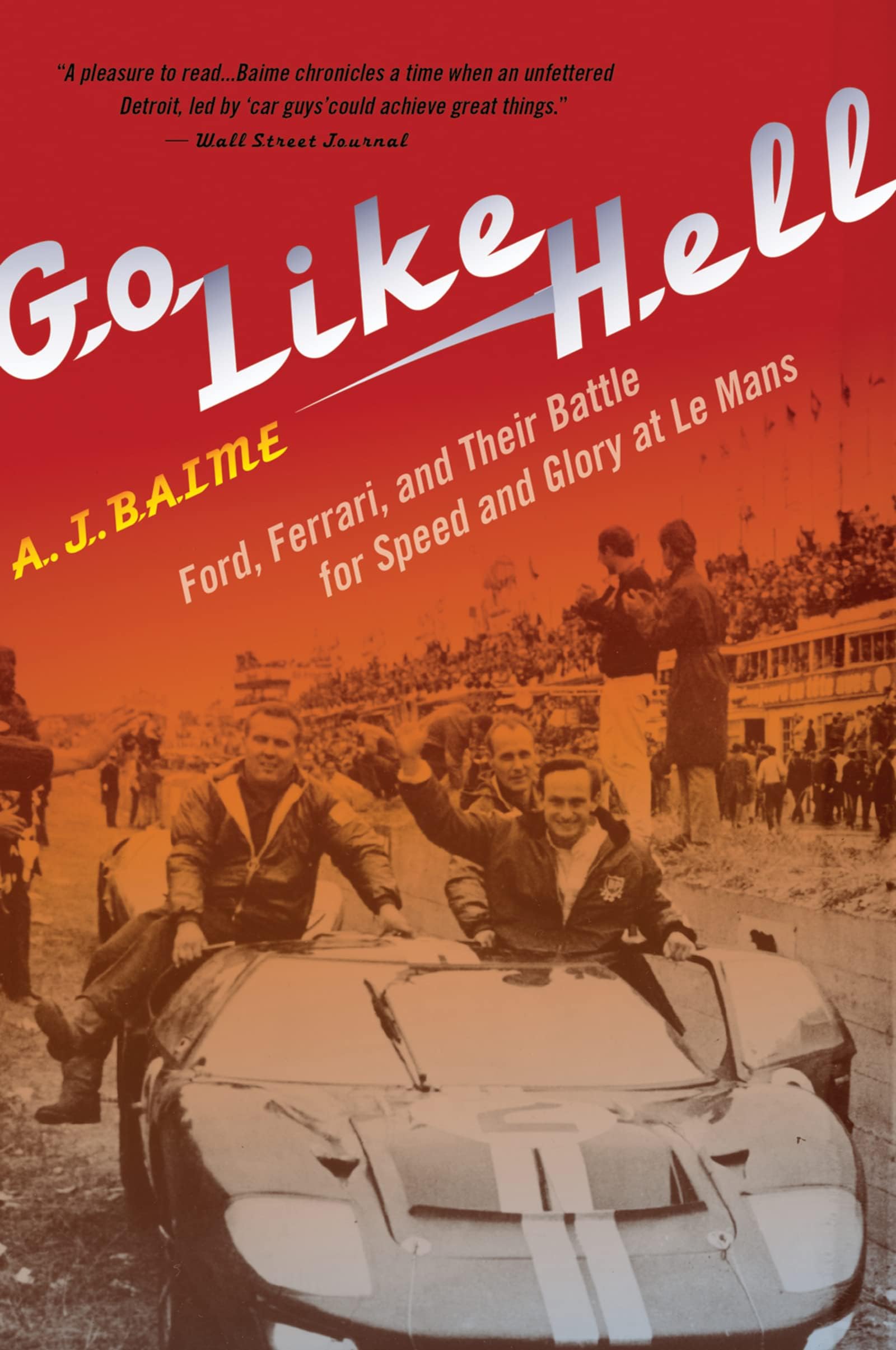
Go Like Hell: Ford, Ferrari, and Their Battle for Speed and Glory at Le Mans
Product ID: 1524410
Buy anything from 5,000+ international stores. One checkout price. No surprise fees. Join 2M+ shoppers on Desertcart.
Desertcart purchases this item on your behalf and handles shipping, customs, and support to Italy.
The epic story of automotive history also told in the film FORD V. FERRARI: By the early 1960s, the Ford Motor Company, built to bring automobile transportation to the masses, was falling behind. Young Henry Ford II, who had taken the reins of his grandfather’s company with little business experience to speak of, knew he had to do something to shake things up. Baby boomers were taking to the road in droves, looking for speed not safety, style not comfort. Meanwhile, Enzo Ferrari, whose cars epitomized style, lorded it over the European racing scene. He crafted beautiful sports cars, "science fiction on wheels," but was also called "the Assassin" because so many drivers perished while racing them. This riveting work of narrative nonfiction, Go Like Hell , tells the remarkable story of how Henry Ford II, with the help of a young visionary named Lee Iacocca and a former racing champion turned engineer, Carroll Shelby, concocted a scheme to reinvent the Ford company. They would enter the high-stakes world of European car racing, where an adventurous few threw safety and sanity to the wind. They would design, build, and race a car that could beat Ferrari at his own game at the 24 Hours of Le Mans, the most prestigious and brutal race in the world, something no American car had ever done. Go Like Hell transports readers to a risk-filled, glorious time in this brilliant portrait of the legendary Ford vs. Ferrari rivalry, a battle between two industrialists, the cars they built, and the "pilots" who would drive them to victory, or doom. Based on extensive research, this book puts you in the driver’s seat for one of the most thrilling showdowns in sports history. A Clash of Titans: Go inside the boardrooms and minds of two fiercely competitive men, Henry Ford II and Enzo Ferrari, as they wage a corporate battle for pride, glory, and market dominance. Legendary Innovators: Meet the brilliant and relentless team Ford assembled, including the visionary Lee Iacocca and the legendary Texan racing champion Carroll Shelby, tasked with building a car from scratch to dethrone a king. Engineering and Audacity: Discover the incredible true story of the engineering and risks behind the creation of an iconic car, a machine built with one singular and seemingly impossible purpose: victory at Le Mans. High-Stakes Racing History: Feel the tension and danger of 1960s European car racing, where courageous "pilots" pushed the limits of speed and sanity in pursuit of the checkered flag. Review: Exceptional Exploration of the Competition between Ford and Ferrari to Win Le Mans - A.J. Baime has written a fascinating and involving book about European race car life in the 1960's, some might offer the Golden Age of the sport, driven by the competition between Ford and Ferrari. AJB is a very solid writer and his prose is compelling and his research deep. In particular he delves into the two personalities that drove (no pun intended) the competition: Henry Ford the second, grandson of The Henry Ford and Ferrari himself, the creator of the most dynamic of European sports cars then and now. The story is more than just theirs, it is heavily shaped by many others ranging from the steel-nerved drivers of the day to the cadre of engineers and builders of the cars. Some of the characters are well fleshed out and re-occur throughout the story, such as Carrol Shelby. There are a few times when the mob of car designers, builders and racing stalwarts can get a little confusing. In addition there were some of the races that AJB glossed over. A few of the races in which he dug into were some of the more exciting passages of the book. I certainly understand why he didn't want to write hundreds of pages regurgitating car positions etc. but a few of the races he didn't explore other than share the results. It seemed the book was just a little lighter in this area than it should have been. With that flaw aside, it is a well written book and brings to life a time of sport and dynamic competition that I found fascinating. My guess is that you will find it invigorating as well. Review: Book version of Ford vs. Ferrari - I am not a racing fan; however, I enjoyed Go Like Hell by A. J. Baime. It is about the 1960s rivalry between Enzo Ferrari and Henry Ford II in the annual 24-hour Le Mans in France. The rivalry began when Henry Ford II tried to purchase the struggling Italian car manufacturing company but was turned down as he wouldn't agree to allowing Enzo Ferrari to control the racing activity of a Ford-owned-Ferrari enterprise. This led to continued attempts by Ford Motor Company's leadership to defeat Ferrari's dominance on the Le Mans race during the 1960s. Aside from Enzo Ferrari and Henry Ford II, the book also includes other racing greats and colorful characters such as Carroll Shelby, Bruce McLaren, John Surtees, and Mario Andretti. The author is also very descriptive of the individual races as well as the engineering of the automobiles. A recommended read enjoyable for both F1 and non-F1 fans.
| Best Sellers Rank | #37,981 in Books ( See Top 100 in Books ) #4 in Automotive History (Books) #8 in Motor Sports (Books) #14 in Automotive Racing |
| Customer Reviews | 4.7 out of 5 stars 3,574 Reviews |
W**B
Exceptional Exploration of the Competition between Ford and Ferrari to Win Le Mans
A.J. Baime has written a fascinating and involving book about European race car life in the 1960's, some might offer the Golden Age of the sport, driven by the competition between Ford and Ferrari. AJB is a very solid writer and his prose is compelling and his research deep. In particular he delves into the two personalities that drove (no pun intended) the competition: Henry Ford the second, grandson of The Henry Ford and Ferrari himself, the creator of the most dynamic of European sports cars then and now. The story is more than just theirs, it is heavily shaped by many others ranging from the steel-nerved drivers of the day to the cadre of engineers and builders of the cars. Some of the characters are well fleshed out and re-occur throughout the story, such as Carrol Shelby. There are a few times when the mob of car designers, builders and racing stalwarts can get a little confusing. In addition there were some of the races that AJB glossed over. A few of the races in which he dug into were some of the more exciting passages of the book. I certainly understand why he didn't want to write hundreds of pages regurgitating car positions etc. but a few of the races he didn't explore other than share the results. It seemed the book was just a little lighter in this area than it should have been. With that flaw aside, it is a well written book and brings to life a time of sport and dynamic competition that I found fascinating. My guess is that you will find it invigorating as well.
D**N
Book version of Ford vs. Ferrari
I am not a racing fan; however, I enjoyed Go Like Hell by A. J. Baime. It is about the 1960s rivalry between Enzo Ferrari and Henry Ford II in the annual 24-hour Le Mans in France. The rivalry began when Henry Ford II tried to purchase the struggling Italian car manufacturing company but was turned down as he wouldn't agree to allowing Enzo Ferrari to control the racing activity of a Ford-owned-Ferrari enterprise. This led to continued attempts by Ford Motor Company's leadership to defeat Ferrari's dominance on the Le Mans race during the 1960s. Aside from Enzo Ferrari and Henry Ford II, the book also includes other racing greats and colorful characters such as Carroll Shelby, Bruce McLaren, John Surtees, and Mario Andretti. The author is also very descriptive of the individual races as well as the engineering of the automobiles. A recommended read enjoyable for both F1 and non-F1 fans.
D**R
Ford versus Ferrari
This book is about the automotive competition between the large, sprawling, and bureaucratic Ford Motor Company and Ferrari of Italy to win the annual 24 hour long car race in Le Mans, France during the 1960s. There is much rich material in this story which gets underway in the early 1960s with Ford losing market share to General Motors and its leader, Henry Ford II, the grandson of the founder of the company, Henry Ford, deciding to withdraw from a 1957 agreement among auto manufacturers to refrain from linking their products to racing via advertising. Ford attempts to buy Ferrari, then the established leader in car racing worldwide and the repeat winner of Le Mans for many years, but the leader of the sports car maker, Enzo Ferrari, pulls out of the deal at the last minute. This leads Ford to spend millions of dollars and hire tons of talented racing drivers and engineers to develop an automobile that can win at Le Mans. Author A.J. Baime has a lot of interesting events and characters to deal with. On the one hand there is Enzo Ferrari, a European who is brilliant at building fast cars and holds a philosophy of cars that attributes human qualities to them - they are beings, their engines are souls. On the other hand there is Henry Ford II, a child of privilege who heads a massive corporation with his name on the building. It has factories, committees, and limitless testing facilities and resources. Ford was seduced by an attitude toward the automobile that is European but he brought an American fascination with technology to the art of racing. Baime is a journalist and the book reads like a long magazine article. There are many avenues where he could have gone deeper into some of the events and characters. I wish he had explored more the origins of the Ford Motor Company, especially where Henry Ford became obsessed with racing early in his first two failed companies, and the ways in which this influenced the DNA of Ford. I would have liked to learn more about Enzo Ferrari’s background and his company. Ferrari seems to have used racing as a kind of advertisement for his products but you won’t get any sales figures or financial information in this book, it doesn’t get into that much detail, sadly. That said, Baime has talked to many of the people involved in this story, at least those that are alive (a lot of race car drivers’ deaths are recounted in this book) and his research seems to cover a lot of contemporary newspaper accounts of the races and memoirs of the racers. Even if it is a somewhat shallow account, it does have a very interesting story to tell and Baime covers it from both the Ford and the Ferrari side pretty extensively. Car racing is an exciting sport to many and this episode in its long history has relevance beyond the racetrack as it involves business history, automotive technology, and the history of the automobile.
L**S
Fantastic read
I’m not into auto racing but it’s impossible not to completely find a love for racing while reading this book. The story is so well written that the reader feels they know the drivers and others thoroughly and one can smell the exhaust and sense the thrill of the racers. I have a new appreciation for the vision that Henry Ford II and Shelby had for changing the winners at LeMans. Ken Miles was a phenomenal racer! Hard to put this book down!
P**L
Worth a buy
Go Like Hell isn't quite what I was expecting, but it is certainly worth owning if you're any kind of gearhead. Pros: -Does a great job telling the overall story surrounding Ford's winning years at LeMans, particularly 1965 and the big win in '66. The writer is advertised on the jacket as being associated with Playboy, and that's the sort of writing you should expect. -Lost of human interest stories. The book focuses mainly on the people involved, and their businesses, rather than getting overly deep into mechanical aspects. You'll learn a lot about the people involved, from Ford executives, to drivers, to Mr. Ferrari himself. -Lots of very well-sourced quotes and factoids from a massive list of interviews. The book contains a bibliography and index which sum to a larger size than most chapters in the book. The level of research is really quite astonishing, and that's lovely to see for such an important historical work. Cons: -Lack of mechanical detail. Considering the Ford GT40mk.II will be considered by any gearhead to be the "real" hero of this story, you'd expect quite a bit more detail into its interior workings and development. While you do get a good general overview of the parts involved- particularly the massive engine- this isn't near the technical manual I would have liked it to be. A good example is that the book goes into the Ford "J-Car" program, which implemented a variety of experimental mechanical designs- none of which are even mentioned when discussing the car. I'll avoid spoilers, but anyone familiar with the story will know there are critical reasons why the new parts on the J-Car must be mentioned in any discussion of its history. -Feels a bit "broad" for a car book. Related to the point about the mechanical detail, the overall tone of the book seems to focus mostly on the people and the broad forces involved. Again, this is perfectly in line for a writer of Playboy, or perhaps think Salon. There's sufficient detail to get your car passion going, but you're probably going to want to get on Wikipedia for some of the finer details to really quench your thirst. Any true fan is going to wish this book came with a Popular Mechanics style cutaway blueprint of the Mk.II, and the fact that it doesn't have that level of mechanical detail is my only gripe. The human interest stories are top-notch. You'll climb inside the heads of Ferrari, Ford II, Iacocca, Shelby, and a host of drivers- and there's a long list of sources for further reading. Definitely pick this one up.
K**S
Unexpectedly great
The book outshone the movie—a task that once seemed impossible. No Hollywood drama, just real lives and real heroes of the mid-20th century, the golden age of postwar America.
C**E
Well-told, fast-paced story, with well-drawn characters.
"Go Like Hell" tells the story of the Ford Motor Company's mid-1960's assault on the 24 hours of Le Mans, an endurance race for production and prototype cars, considered by many then to be the ultimate auto race. The book covers the development of the Ford GT-40, a car whose sole reason for existence was to beat Ferrari at this storied event. A.J. Baime's tight narrative and excellent prose introduces us to the people - both on and off the track - behind the development of the car, taking us through each failure, and ultimately, success, cumulating in a 1-2-3 finish at the 1966 Le Mans. While a story where Ford's massive financial and engineering resources are pitted against that of small, boutique automaker like Ferrari may seem like a strange take on David vs. Goliath, when one considers that Ford - who had not officially competed in auto racing in four decades - was aiming for a win at Le Mans within three years, against Ferrari, who had won the race for seven consecutive years, it's not so difficult to see Ford as the "David" in such a seemingly lopsided rivalry, as what unfolds is a story as captivating as "The Right Stuff", only with racing cars in the place of rockets, and with a mercurial Italian in place of Khrushchev. The book features many names familiar to racing fans: Shelby, McLaren, Gurney, Phil Hill, and John Surtees, along with one unsung hero in the form of test driver and racer Ken Miles; a great read for both racing fans and those unfamiliar with the sport, and if you're one of those who never quite understood what exactly people see in racing, this a good a place to find out.
T**H
Electrifying experience
For the first time in years, I felt like my hand was literally getting electrified from a book. Go Like Hell is no mere telling of Ford and Ferrari's rivalry back in 60s. Above all it is a deep research about why some people are basically killing themselves for the most dangerous yet rewarding sensation that is the motor racing scene. While the book does agree with the safety regulations added since later 1970s, this book shows why the earlier age of racing was so much more exciting than it is right now. Not that the motor racing right now is boring - far from that - but the disregard of safety and life has its strange sensation to modern racing fans like us, and this story is dedicated to explaining that. I can't say exactly what it is, because that is what this book as a whole is all about. You are not going to find the exact truth as it is. There are lots of fictionalized lines and character developments that seems to be still based on the true story but is a fiction nevertheless, and if you are a Ferrari fan - what a relief that I'm a Porsche guy rather than Ferrari - you might not be completely satisfied with how Ferrari was portrayed in this book, since this book is primarily about the victory of Ford and America. But I guess this gives the book some sort of emotional depth. It gives a clearer understanding of what the competitors of this huge rivalry were thinking about in the midst of crazy process of preparing for Le Mans, and at some point you will feel really attached to some of the characters, while hating others, something that few novels achieve. Go Like Hell is the most exciting form of motor racing story I can think of, and it shows how true story can be much more interesting than most of the fictions.
م**ن
Good story but case is very bad quality
When i open it the cover does not close and only the pages close then the cover arrived wrinkled
B**E
go to hell
génial pour l'Histoire, génial pour la profondeur des enquêtes. un grand récit et une belle matière pour l'excellent film de Mangold.
I**A
Quality
Good service 👍
R**V
Very well written
Fantastic book. Should be on the reading list for every racing fan!
J**O
INTERESANTE RELATO DE LA MÁXIMA RIVALIDAD
Interesante historia sobre la gran rivalidad entre Ford y Ferrari, quizá la de mayor relevancia a nivel mundial en el deporte motor.
Trustpilot
1 week ago
1 week ago