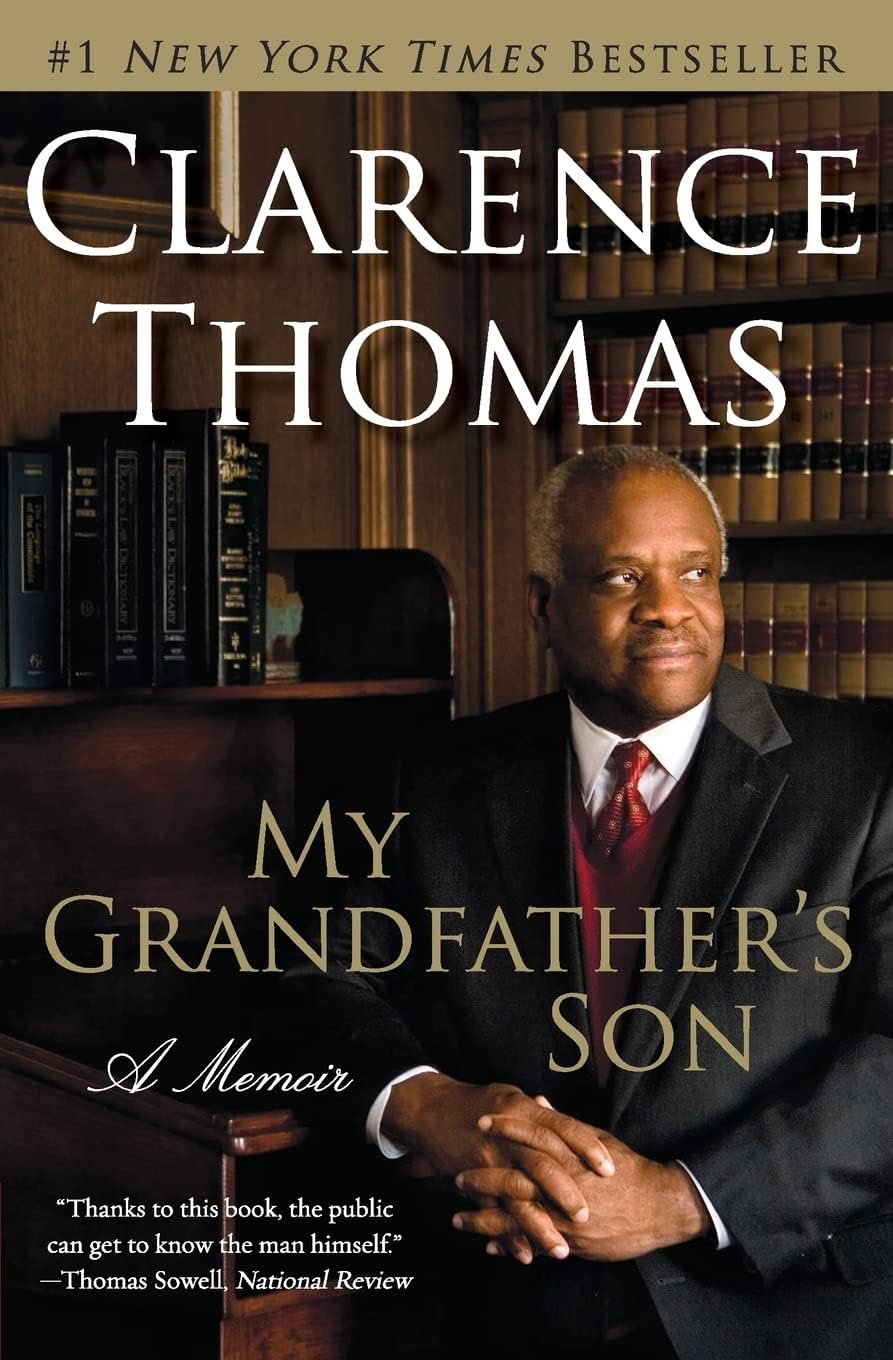
My Grandfather's Son: A Memoir
Product ID: 15009947
Provocative, inspiring, and unflinchingly honest, My Grandfather's Son is the story of one of America's most remarkable and controversial leaders, Supreme Court Justice Clarence Thomas, told in his own words. Thomas speaks out, revealing the pieces of his life he holds dear, detailing the suffering and injustices he has overcome, including the polarizing Senate hearing involving a former aide, Anita Hill, and the depression and despair it created in his own life and the lives of those closest to him. In this candid and deeply moving memoir, a quintessential American tale of hardship and grit, Clarence Thomas recounts his astonishing journey for the first time. Review: Riveting and Well Written - I read a lot of books with the sole purpose of learning something. I don't read much fiction and while I am described by some as rigid, I do enjoy a good story. I very much appreciate someone who can deliver information in a manner that is both engaging and enlightening. Clarence Thomas does all of that splendidly. I bought the book in an audio format and I am delighted that Justice Thomas personally read the book for the audio. There is much wisdom in this book, so I will also buy the printed version so that I can go back to some of my favorite passages. Justice Thomas lived a hard life that he is clearly grateful for. His family situation was less than ideal, but his family turned what most today would use as an excuse for failure into a reason for success. I was raised by my grandparents for long periods of time as a child, so I feel that I can relate to some of his situation, but my grandparents were more like Santa Claus than Clarence's grandfather. I loved my grandparents, but listening to Thomas made me actually yearn for discipline that I didn't receive. Clarence's grandfather clarified later in life why he was so strict and his reasoning reveals even further the depth of his character - a character that is missing in so many people today. This is a book that is clearly written by Thomas out of love and respect for his grandparents, with his grandfather (Daddy) dominating the relationship. The love and deep respect that Thomas has for this man is not cloaked or discounted. He makes no bones about once fearing the man who he has come to view as the greatest man he ever knew. I relate well to a relationship that seemed hard at the time but was peeled like an onion as Thomas matured and his life experiences accumulated. I will read this book many times in the future, despite owning an extensive library that has numerous volumes that I have yet to read and that is constantly expanding. This man is a decent man who clearly doesn't pander to anyone. He wrote this book to memorialize his life and he wrote it from his heart and his perspective. This book will anger many who read it, as Thomas walks step by step through what can only be described as a reluctant shift to the "conservative camp". I can relate to Thomas being true to his heart and being surprised to discover the company he was keeping. His journey from being an angry black to his current "position" is revealing in that he has always remained true to himself, despite his misgivings and despite who he alienated. Thomas did wrestle with alcohol and the fact that he admits it makes him all the more human. I found so much of his honesty refreshing, enlightening and encouraging. This is a man who has walked among us and made hard choices that ultimately took him to the highest court of the land. I found his financial challenges insightful, as he struggled with the traditional values of our grandparents of avoiding debt at all costs while achieving the "status" of a Yale law degree. His reflection on his core values has caused me to reflect on my own life. He reminded me that materialism and monetary gain are empty goals that can be extremely seductive, but still void of any intrinsic value. I also have to comment that it is extremely apparent that many of the negative reviews have been written by people who have not read any of the book, while other negative reviews seem to be cut and paste copies of one person's attack on the book. I will share with those whose lame attempt is so transparent that when I read your attacks I had to smile. I am certain that Justice Thomas would not waste a moment of his time nor lose a minute of sleep over your attacks. "Old Man Can't" is dead; play the hand that you were dealt and do your best every day at everything you do. Bravo Justice Thomas. I am inspired to take the time to read your briefs - a first for me. I also pray that you write more, as I think you have a great deal to offer those who are open to your message. Review: A Millennial who read this because of the Brett Kavanaugh hearings - For what it’s worth, I think the life of every American would be enriched by reading this book, regardless if they are a Democrat, Republican, or an Independent (like me). There is so much to be gained in this book—more than I ever expected to receive. I am embarrassed to admit that I didn't know about Clarence Thomas and Anita Hill until watching the Brett Kavanaugh hearings and hearing about "Clarence Thomas this" and "Anita Hill that," which, in turn, led me in curiosity to Youtube to watch what I could find of the Clarence Thomas hearings. I was a little girl when this all happened, so I had never so much as heard anyone talk about this case before. So when I saw Mr. Thomas give his speech for the first time, I was stunned. I got goosebumps when he called it a "high-tech lynching." He spoke with such heartfelt confidence and authority—I believed him. And then I watched Anita Hill. I instantly had compassion on her—relating with her in knowing how dirty men can be and how degrading and invasive it is to be talked to like that—and the belief I had in Clarence Thomas was quickly diminishing. That's why I read this book. I approached it knowing that no one (except Clarence Thomas and Anita Hill) will ever know exactly what happened, but the choice we, the people, have is to decide for ourselves what we believe the truth is. And nothing is more telling of the truth than the visible character of what a person is in their innermost core. That's why I wanted to get to know the character of this man, and judge this incident according to his character. Not that I think my judgment counts for anything—it certainly does not—the only judgment that really counts is God's, and only eternity will show who was telling the truth. Having previously known nothing about Clarence Thomas, I was so taken aback by his background. Not only did his poverty-stricken childhood surprise me, but what shocked me even more was his slow yet dramatic transformation from his politically radical and rebellious days in college to becoming the respectable Associate Justice of the Supreme Court that he is today. It caused a pause in me and allowed me to separate the Anita Hill case from the rest of his life. His journey from childhood to adulthood, and the way he conquered unfathomable obstacles, is inspiring, to say the least. For what he accomplished, what he overcame, what battles in his soul he had victory over, what he became—left me in silence. I haven’t faced a fraction of what this man has faced, so I don’t know if I will ever fully grasp the weightiness of his accomplishments, I just know that I respect him and admire his will to continue on, and I am proud to call him an American. As much as I have grown to respect Mr. Thomas after reading his book, I will admit that I didn’t quite feel that way half way through the book. He was very open about his struggles, about his alcohol abuse, about how he turned his back on God, and about how he left his wife and son, even though he swore he would never do to his son what his father did to him. It was in the midst of these trials going on in his personal life that Anita Hill claimed he sexually harassed her at work, and I found myself thinking (and telling my friends), “As much as his life was falling apart at that time, what would have stopped him from sexually harassing her!?” And then the further I read on in the book, the more I was troubled by my quickness to judge him, and I realized just how cynical I (and even other people in our society), have become of men, in general, today. Granted, it isn’t hard to be untrusting of men today, especially when it comes to sexual harassment—it is so commonplace and is something most women expect to deal with regularly, that it is too easy to think of all men, “of course he talks dirty to women.” But then that made me realize how many men, who are actually innocent of these charges, must get generalized and clumped in with all the guilty men. That’s not right, nor fair. And what will that do to our society if we keep running down the good men over and over again? This got me thinking of just how awful it would be if everyone was condemning you for sexual harassment, and you really were completely innocent. Could that be what Mr. Thomas was going through? Could it be that as much as his life may have been falling apart at that time, he still owned enough integrity and dignity to never stoop as low as sexually harassing a woman? The more I thought about it, the more I respected Mr. Thomas for not trying to paint himself in a good light in his book. I came to really appreciate his transparency of telling it as it is—telling us, complete strangers, about his alcohol abuse and divorce—knowing it would paint him in a bad light and stir up doubt in the mind of his readers. Well, I did see him in a bad light, and it definitely did stir up doubt in my mind about him, but it was upon further reading that I started to see a more complete picture of this man’s character—of his authenticity, truthfulness, and honesty, and of the redeeming power of forgiveness and grace in his life by the way he ended up becoming a good father to his son and a good husband to his second wife, as well as becoming sober and restoring his relationship with God. I felt ashamed that I was so quick to judge him, and it definitely caused me to keep a check on my cynicism of men (and careful to always keep my heart soft), realizing that the right and fair thing to do toward an accused man who says he is innocent, is to grant him the dignity, as a fellow human being, of the benefit of the doubt and to treat him as innocent until proven guilty. I also came to realize that even though it may seem justifiable for women to be cynical of men, it could really end up harming women in the long run. Cynicism can lead to resentment and hard bitterness, and bitterness can lead to outright hatred, and hatred is a dark and unhealthy place to be—it will sap all the good things in life out of you—the joy, the love, and the hope. So what does that mean for all the women who have been sexually abused by men? They matter, and my heart aches for them. Their innocence deserves continuous protection and justice. But being cynical or bitter or hateful toward men, or even unjustly condemning innocent men, will not help these hurting women, because what they need to find is something altogether different than that. They need to be made whole again and cherished, to be brought back to a place of honor and abiding value. That is how the Lord see’s them, and that is how we should always see them—doing all that we can to help them get to that place of restoration. Or what of the guilty men who were rightly and justly condemned then punished for the crimes and sins of sexual harassment or sexual abuse? I hope women’s desire is not for them to rot in jail, because they need help, as well. There is something dark, deranged, and dysfunctional within them that needs cleansing and restoring. They, too, need to be made whole. What really drove all of this home for me was an eerily similar circumstance that Mr. Thomas recounted in the following paragraph on pages 269-270 where he referenced the book "To Kill a Mockingbird" and made a correlation between Tom Robinson (who, although innocent, was condemned of rape simply because he was black), and himself: "I, too, took it for granted that nothing I could say, however eloquent or sincere, was capable of overcoming the evil assumptions in which my accusers had put their trust. I had lived my whole life knowing that Tom's fate might be mine. As a child I had been warned by Daddy that I could be picked up off the streets of Savannah and hauled off to jail or the chain gang for no reason other than that I was black...their point was the fear they instilled in southern blacks, a fear that had helped to keep segregation alive. My generation had sought to replace that fear with a rage that proved over time to be intoxicating, empowering, justifiable—and ultimately self-destructive. Yet we never forgot what it felt like to live in fear of the power of the mob. The mob I now faced carried no ropes or guns. Its weapons were smooth-tongued lies spoken into microphones and printed on the front pages of America's newspapers. It no longer sought to break the bodies of its victims. Instead it devastated their reputations and drained away their hope. But it was a mob all the same, and its purpose—to keep the black man in his place—was unchanged. Strip away the fancy talk and you were left with the same old story. You can't trust black men around women. This one may be a big-city judge with a law degree from Yale, but when you get right down to it, he's just like the rest of them. They all do that sort of thing whenever they get the chance, and no woman would ever lie about it. What does it matter that Anita Hill's story doesn't add up? Something must have happened. Case Closed." This left me speechless and caused me to put the book down and really think this through. Until I read this book, it never even occurred to me that Mr. Thomas would have lived his life with extreme caution in his treatment of women because of the damning stigma against black men. If ANYONE was careful to not be sexually inappropriate towards women (or even so much as APPEAR as being sexually inappropriate), especially in a prominent and public position as Chairman of the EEOC where all eyes are on you and your enemies are watching for one wrong move to take you down, it would have been Mr. Thomas. This brought flooding back to my mind writings from some of my favorite authors—Frederick Douglas, Carter G. Woodson, and Martin Luther King Jr., and we know all too well from them that over the centuries there have been untold thousands (if not hundreds of thousands) of unjust accusations and condemning cases against black men—cases purposely made about sexual misconduct because it's a sure-fire win—simply because they were black and easy to exploit. But it just never occurred to me that this is exactly what Mr. Thomas has had to deal with his whole life. It broke my heart all over again to think of the injustices black men, who were innocent of the accusations brought against them, have had to face for centuries because of racism. They matter. And Mr. Thomas matters. Not only did Mr. Thomas have the stigma against men to deal with, but he also had the stigma against African-Americans working against him. My generation probably would have used the weapon of sexism against Mr. Thomas, but, nevertheless, in his time he had the bitter weapon of racism (as well as sexism) trying to beat him down. If anyone had a reason to be cynical, bitter, or hateful towards others, it was Mr. Thomas. And, yet, many times in his book he talked about how he found in his own life the crucial need to fight against the rage to hate others that was warring within him, and he encouraged his readers to also fight that rage warring within them. He did fight the rage—not the people—so if anyone had the victory, it was Mr. Thomas. It was this paragraph toward the end of the book that really solidified his viewpoint in life, one which I think we all would gain from if we truly took it to heart (on page 279): "Perhaps the fires through which I had passed would have a purifying effect on me, just as a blast furnace burns the impurities out of steel. I already knew that they had brought me closer to God, and I asked Him, as I had so many times before, to help me resist the temptation to hate those who had harmed me." Could there be any better thought to close this book with? To pray that we resist the temptation to hate those who harm us—wow, how desperately we need this today. That goes deeper than him telling us something cliché like “don’t hate.” In the wisdom of his age and experiences, he encourages us to fight the hate while it is still in its seed form, before it grows and takes over our life, because by fighting the temptation to hate, no matter how many times a day we must do it, will ensure that we never hate another human being. What other type of world would we want to live in, other than one like that? I have, indeed, learned a lot from this book—and I will forever be grateful to Mr. Thomas for writing it and bringing me through that journey and having a hand in teaching me these important lessons. I’ve decided what I believe of Mr. Thomas, and now it is up to you, the reader, to read this book and decide for yourself what you believe the truth is.
| Best Sellers Rank | #3,281 in Books ( See Top 100 in Books ) #1 in Lawyer & Judge Biographies #3 in General Constitutional Law #17 in Political Leader Biographies |
| Customer Reviews | 4.8 out of 5 stars 2,222 Reviews |
A**S
Riveting and Well Written
I read a lot of books with the sole purpose of learning something. I don't read much fiction and while I am described by some as rigid, I do enjoy a good story. I very much appreciate someone who can deliver information in a manner that is both engaging and enlightening. Clarence Thomas does all of that splendidly. I bought the book in an audio format and I am delighted that Justice Thomas personally read the book for the audio. There is much wisdom in this book, so I will also buy the printed version so that I can go back to some of my favorite passages. Justice Thomas lived a hard life that he is clearly grateful for. His family situation was less than ideal, but his family turned what most today would use as an excuse for failure into a reason for success. I was raised by my grandparents for long periods of time as a child, so I feel that I can relate to some of his situation, but my grandparents were more like Santa Claus than Clarence's grandfather. I loved my grandparents, but listening to Thomas made me actually yearn for discipline that I didn't receive. Clarence's grandfather clarified later in life why he was so strict and his reasoning reveals even further the depth of his character - a character that is missing in so many people today. This is a book that is clearly written by Thomas out of love and respect for his grandparents, with his grandfather (Daddy) dominating the relationship. The love and deep respect that Thomas has for this man is not cloaked or discounted. He makes no bones about once fearing the man who he has come to view as the greatest man he ever knew. I relate well to a relationship that seemed hard at the time but was peeled like an onion as Thomas matured and his life experiences accumulated. I will read this book many times in the future, despite owning an extensive library that has numerous volumes that I have yet to read and that is constantly expanding. This man is a decent man who clearly doesn't pander to anyone. He wrote this book to memorialize his life and he wrote it from his heart and his perspective. This book will anger many who read it, as Thomas walks step by step through what can only be described as a reluctant shift to the "conservative camp". I can relate to Thomas being true to his heart and being surprised to discover the company he was keeping. His journey from being an angry black to his current "position" is revealing in that he has always remained true to himself, despite his misgivings and despite who he alienated. Thomas did wrestle with alcohol and the fact that he admits it makes him all the more human. I found so much of his honesty refreshing, enlightening and encouraging. This is a man who has walked among us and made hard choices that ultimately took him to the highest court of the land. I found his financial challenges insightful, as he struggled with the traditional values of our grandparents of avoiding debt at all costs while achieving the "status" of a Yale law degree. His reflection on his core values has caused me to reflect on my own life. He reminded me that materialism and monetary gain are empty goals that can be extremely seductive, but still void of any intrinsic value. I also have to comment that it is extremely apparent that many of the negative reviews have been written by people who have not read any of the book, while other negative reviews seem to be cut and paste copies of one person's attack on the book. I will share with those whose lame attempt is so transparent that when I read your attacks I had to smile. I am certain that Justice Thomas would not waste a moment of his time nor lose a minute of sleep over your attacks. "Old Man Can't" is dead; play the hand that you were dealt and do your best every day at everything you do. Bravo Justice Thomas. I am inspired to take the time to read your briefs - a first for me. I also pray that you write more, as I think you have a great deal to offer those who are open to your message.
H**S
A Millennial who read this because of the Brett Kavanaugh hearings
For what it’s worth, I think the life of every American would be enriched by reading this book, regardless if they are a Democrat, Republican, or an Independent (like me). There is so much to be gained in this book—more than I ever expected to receive. I am embarrassed to admit that I didn't know about Clarence Thomas and Anita Hill until watching the Brett Kavanaugh hearings and hearing about "Clarence Thomas this" and "Anita Hill that," which, in turn, led me in curiosity to Youtube to watch what I could find of the Clarence Thomas hearings. I was a little girl when this all happened, so I had never so much as heard anyone talk about this case before. So when I saw Mr. Thomas give his speech for the first time, I was stunned. I got goosebumps when he called it a "high-tech lynching." He spoke with such heartfelt confidence and authority—I believed him. And then I watched Anita Hill. I instantly had compassion on her—relating with her in knowing how dirty men can be and how degrading and invasive it is to be talked to like that—and the belief I had in Clarence Thomas was quickly diminishing. That's why I read this book. I approached it knowing that no one (except Clarence Thomas and Anita Hill) will ever know exactly what happened, but the choice we, the people, have is to decide for ourselves what we believe the truth is. And nothing is more telling of the truth than the visible character of what a person is in their innermost core. That's why I wanted to get to know the character of this man, and judge this incident according to his character. Not that I think my judgment counts for anything—it certainly does not—the only judgment that really counts is God's, and only eternity will show who was telling the truth. Having previously known nothing about Clarence Thomas, I was so taken aback by his background. Not only did his poverty-stricken childhood surprise me, but what shocked me even more was his slow yet dramatic transformation from his politically radical and rebellious days in college to becoming the respectable Associate Justice of the Supreme Court that he is today. It caused a pause in me and allowed me to separate the Anita Hill case from the rest of his life. His journey from childhood to adulthood, and the way he conquered unfathomable obstacles, is inspiring, to say the least. For what he accomplished, what he overcame, what battles in his soul he had victory over, what he became—left me in silence. I haven’t faced a fraction of what this man has faced, so I don’t know if I will ever fully grasp the weightiness of his accomplishments, I just know that I respect him and admire his will to continue on, and I am proud to call him an American. As much as I have grown to respect Mr. Thomas after reading his book, I will admit that I didn’t quite feel that way half way through the book. He was very open about his struggles, about his alcohol abuse, about how he turned his back on God, and about how he left his wife and son, even though he swore he would never do to his son what his father did to him. It was in the midst of these trials going on in his personal life that Anita Hill claimed he sexually harassed her at work, and I found myself thinking (and telling my friends), “As much as his life was falling apart at that time, what would have stopped him from sexually harassing her!?” And then the further I read on in the book, the more I was troubled by my quickness to judge him, and I realized just how cynical I (and even other people in our society), have become of men, in general, today. Granted, it isn’t hard to be untrusting of men today, especially when it comes to sexual harassment—it is so commonplace and is something most women expect to deal with regularly, that it is too easy to think of all men, “of course he talks dirty to women.” But then that made me realize how many men, who are actually innocent of these charges, must get generalized and clumped in with all the guilty men. That’s not right, nor fair. And what will that do to our society if we keep running down the good men over and over again? This got me thinking of just how awful it would be if everyone was condemning you for sexual harassment, and you really were completely innocent. Could that be what Mr. Thomas was going through? Could it be that as much as his life may have been falling apart at that time, he still owned enough integrity and dignity to never stoop as low as sexually harassing a woman? The more I thought about it, the more I respected Mr. Thomas for not trying to paint himself in a good light in his book. I came to really appreciate his transparency of telling it as it is—telling us, complete strangers, about his alcohol abuse and divorce—knowing it would paint him in a bad light and stir up doubt in the mind of his readers. Well, I did see him in a bad light, and it definitely did stir up doubt in my mind about him, but it was upon further reading that I started to see a more complete picture of this man’s character—of his authenticity, truthfulness, and honesty, and of the redeeming power of forgiveness and grace in his life by the way he ended up becoming a good father to his son and a good husband to his second wife, as well as becoming sober and restoring his relationship with God. I felt ashamed that I was so quick to judge him, and it definitely caused me to keep a check on my cynicism of men (and careful to always keep my heart soft), realizing that the right and fair thing to do toward an accused man who says he is innocent, is to grant him the dignity, as a fellow human being, of the benefit of the doubt and to treat him as innocent until proven guilty. I also came to realize that even though it may seem justifiable for women to be cynical of men, it could really end up harming women in the long run. Cynicism can lead to resentment and hard bitterness, and bitterness can lead to outright hatred, and hatred is a dark and unhealthy place to be—it will sap all the good things in life out of you—the joy, the love, and the hope. So what does that mean for all the women who have been sexually abused by men? They matter, and my heart aches for them. Their innocence deserves continuous protection and justice. But being cynical or bitter or hateful toward men, or even unjustly condemning innocent men, will not help these hurting women, because what they need to find is something altogether different than that. They need to be made whole again and cherished, to be brought back to a place of honor and abiding value. That is how the Lord see’s them, and that is how we should always see them—doing all that we can to help them get to that place of restoration. Or what of the guilty men who were rightly and justly condemned then punished for the crimes and sins of sexual harassment or sexual abuse? I hope women’s desire is not for them to rot in jail, because they need help, as well. There is something dark, deranged, and dysfunctional within them that needs cleansing and restoring. They, too, need to be made whole. What really drove all of this home for me was an eerily similar circumstance that Mr. Thomas recounted in the following paragraph on pages 269-270 where he referenced the book "To Kill a Mockingbird" and made a correlation between Tom Robinson (who, although innocent, was condemned of rape simply because he was black), and himself: "I, too, took it for granted that nothing I could say, however eloquent or sincere, was capable of overcoming the evil assumptions in which my accusers had put their trust. I had lived my whole life knowing that Tom's fate might be mine. As a child I had been warned by Daddy that I could be picked up off the streets of Savannah and hauled off to jail or the chain gang for no reason other than that I was black...their point was the fear they instilled in southern blacks, a fear that had helped to keep segregation alive. My generation had sought to replace that fear with a rage that proved over time to be intoxicating, empowering, justifiable—and ultimately self-destructive. Yet we never forgot what it felt like to live in fear of the power of the mob. The mob I now faced carried no ropes or guns. Its weapons were smooth-tongued lies spoken into microphones and printed on the front pages of America's newspapers. It no longer sought to break the bodies of its victims. Instead it devastated their reputations and drained away their hope. But it was a mob all the same, and its purpose—to keep the black man in his place—was unchanged. Strip away the fancy talk and you were left with the same old story. You can't trust black men around women. This one may be a big-city judge with a law degree from Yale, but when you get right down to it, he's just like the rest of them. They all do that sort of thing whenever they get the chance, and no woman would ever lie about it. What does it matter that Anita Hill's story doesn't add up? Something must have happened. Case Closed." This left me speechless and caused me to put the book down and really think this through. Until I read this book, it never even occurred to me that Mr. Thomas would have lived his life with extreme caution in his treatment of women because of the damning stigma against black men. If ANYONE was careful to not be sexually inappropriate towards women (or even so much as APPEAR as being sexually inappropriate), especially in a prominent and public position as Chairman of the EEOC where all eyes are on you and your enemies are watching for one wrong move to take you down, it would have been Mr. Thomas. This brought flooding back to my mind writings from some of my favorite authors—Frederick Douglas, Carter G. Woodson, and Martin Luther King Jr., and we know all too well from them that over the centuries there have been untold thousands (if not hundreds of thousands) of unjust accusations and condemning cases against black men—cases purposely made about sexual misconduct because it's a sure-fire win—simply because they were black and easy to exploit. But it just never occurred to me that this is exactly what Mr. Thomas has had to deal with his whole life. It broke my heart all over again to think of the injustices black men, who were innocent of the accusations brought against them, have had to face for centuries because of racism. They matter. And Mr. Thomas matters. Not only did Mr. Thomas have the stigma against men to deal with, but he also had the stigma against African-Americans working against him. My generation probably would have used the weapon of sexism against Mr. Thomas, but, nevertheless, in his time he had the bitter weapon of racism (as well as sexism) trying to beat him down. If anyone had a reason to be cynical, bitter, or hateful towards others, it was Mr. Thomas. And, yet, many times in his book he talked about how he found in his own life the crucial need to fight against the rage to hate others that was warring within him, and he encouraged his readers to also fight that rage warring within them. He did fight the rage—not the people—so if anyone had the victory, it was Mr. Thomas. It was this paragraph toward the end of the book that really solidified his viewpoint in life, one which I think we all would gain from if we truly took it to heart (on page 279): "Perhaps the fires through which I had passed would have a purifying effect on me, just as a blast furnace burns the impurities out of steel. I already knew that they had brought me closer to God, and I asked Him, as I had so many times before, to help me resist the temptation to hate those who had harmed me." Could there be any better thought to close this book with? To pray that we resist the temptation to hate those who harm us—wow, how desperately we need this today. That goes deeper than him telling us something cliché like “don’t hate.” In the wisdom of his age and experiences, he encourages us to fight the hate while it is still in its seed form, before it grows and takes over our life, because by fighting the temptation to hate, no matter how many times a day we must do it, will ensure that we never hate another human being. What other type of world would we want to live in, other than one like that? I have, indeed, learned a lot from this book—and I will forever be grateful to Mr. Thomas for writing it and bringing me through that journey and having a hand in teaching me these important lessons. I’ve decided what I believe of Mr. Thomas, and now it is up to you, the reader, to read this book and decide for yourself what you believe the truth is.
J**G
a most human story of growth and character
American life has produced some remarkable stories, that could happen in other places; but rarely with the speed and unique characteristics of a nation founded simultaneously on individual hard work, communal sacrifice, and a decentralized religious faith. Supreme Court Associate Justice, Clarence Thomas, is one of these stories, and he has provided a great resource for years to come by telling his story, which is as much about his character development as it is about his public career. In fact, what really makes this book unique is that Justice Thomas uses his career development as a background to how his character developed in the midst of the last half of the 20th century in America, especially as an independent black man in the gradually desegregating nation. The highlight of this book is Justice Thomas' story of his early years (the first 100 pages or so of this 250+ page book), around Savannah, Georgia. Born into rural poverty, endemic to the Gullah/Geechee people that were in slavery just a few generations before, Thomas as a boy, felt early the disruptions that would come to much of black America in years to come by not having a father and being forced to move into a more urban, welfare type of poverty that strangled men far more than the rural, coastal poverty which he was born to. His life savior was his grandfather, always referred to as "Daddy" by Thomas, who knew the narrow margins in life that Thomas and his brother had to succeed, and undertook a strict and uncompromising approach to raising these two boys. To some degree, Thomas, who is arguably been one of the most powerful black men in American history, still lives in the shadow of his poor, but proud independent businessman grandfather. Given the special privilege to study and move in circles far beyond his means, due to the kindness of the church and his academic ability, Thomas began a gradual process of moving away emotionally and philosophically as much as physically, from the lessons his grandfather taught him. Thomas became like so many of his generation: angry at the white man, angry at the government for the Vietnam War, angry at the academic establishment, and in many ways, he had all the ingredients to become just one more liberal radical, were it not for the continual imprint of "Daddy" on his life. His meteoric rise in the Federal government in the Reagan and Bush administrations certainly showed a good intellect and hard worker, willing to put the effort into fighting any phony attempt, from the right and especially the left, in hindering black Americans from rising above. But it was not until Thomas returned to the first principles of his life: family, faith, and hope, that his determined self effort finally meant anything to him. Justice Thomas has said in interviews that he intends for his memoir to give hope to others. The hope he offers is one of joy in life based on first principles of hard work, self-reliance, responsibility for your own life, faith and family. He has developed no real expectation in hope from the government, other than as a place to give justice. His confirmation to the Supreme Court, remembered for the Anita Hill testimony, remains a he said/ she said event, but what Thomas adds here is his emotional reaction to a liberal establishment that opposed him for what he stood for, more than what he might have done. This book would be of great value to young minority men, or just young men of any type, those looking for real hope in the American story, and those interested in a personal and discrete telling of a black man rising above political and legal American government in the aftermath of the Civil Rights era.
D**.
Incredible life
Great read. True rags to riches story
J**N
The life of a truly remarkable man in his own words
Needless to say, Clarence Thomas's daring to tell his story in his own words has the left-wing tied in knots. Thomas, who has been ruthlessly assaulted for his refusal to follow the dictates of coventional left-wing thinking about what is "good" for blacks, tells not only the story of his formative years here, but of his personal thoughts during what he so accurately described as the "high-tech lynching" of his confirmation hearings. Justice Thomas tells us where he came from, Pinpoint, Georgia in the heart of the segregated South and how his upbringing formed the views he holds today. Thomas and his brother were raised by their grandfather, the man they called "Daddy". Daddy was a remarkable man in his own right. With perhaps three months total schooling, Daddy operated several small businesses, believed in total self-reliance, doing good, his religion, his family and his community. The violence of the white community, while never visited upon the Thomas family, was never far away and Thomas became aware of the potential early in life through Daddy's warnings. Daddy and his wife scrimped to send Thomas to a Catholic school, where Thomas did well, but as children do, became aware of the contradictions in life. Originally feeling a calling to the priesthood, Thomas dropped out of the seminary and became something of a young radical. As the culture wars of the 60s raged, Thomas describes himself as becoming acutely aware of his blackness. It is surprising to read of his journey through the radicalism of the era when he perceived blacks as the eternal victims of racism to his more enlightened views where he recognized that blacks held the keys to their own future. The future Justice Thomas had, in fact, adopted the philosophy of Daddy, though it took him some time to realize it. There was nothing in Thomas's career that would have predicted his future appointment to the Supreme Court. In fact, Thomas's life seems a bit like Everyman's journey. Finding a job by happenstance, a marriage that never felt right, drinking too much, not enough money.The portrait Thomas paints of himself is not that of a wunderkind, not even that of a striver, but of a man who is dedicated to performing at the highest level he is capable of, while at the same time being filled with doubts about himself and his beliefs. It is one of the most touching self-descriptions I have read in a long, long time. Thomas more or less falls into the political life and far more through chance than design becomes head of the Equal Employment Opportunity Commission. Here we see the ideological opposition to Thomas hardening. He doesn't believe in the welfare state policies towards blacks advocated by the left-wing and they cannot tolerate that. Thomas is candid about the racist opposition he faced when first nominated to the D.C. Court of Appeals. It wasn't the old-fashioned racism, but rather the modern kind: no black was permitted to deviate from the thinking proscribed for them by white left-wingers. The chapters covering his EEOC career, his time on the DCCA bench and the nomination battle for the Supreme Court are, in a single word, riveting. The hypocrisy of Senators Biden, Metzenbaum, Kennedy and others smells to high heaven. The setting up of Anita Hill with her false story of "harassment" and its refutation is told in painful detail. Thomas does a superb job of describing the left-wing's debasement of the judiciary. I will engage in an argument of whether Thomas is "qualified" for the Supreme Court or not. Over the years, it is apparent that those nominated for the Supreme Court runs the gamut from those who became fine jurists to those who were nothing more than political hacks and remained so. The real story of Clarence Thomas is that of a black boy from segregated Georgia who rose to become an Associate Justice of the United States of America. As Justice Thomas himself has said "only in America". This is a truly worthwhile book and should be given to every young person to show them what the ordinary person can acheive. Jerry
S**N
Memoir of a Man... a black conservative
In this work, Justice Thomas bares his soul as to the man behind the robes, warts and all. Many critics have accused him of "whining" but I would disagree vehemently. By making it clear how much he personally felt the pain of the various incidents in his life, none so much as the vetting for the Supreme Court in the Senate, he becomes a "real person" and less a political persona. Many in his place would likely have glossed over the "getting there" and simply waxed philosophical about how noble the system is that allowed him to achieve his current position. Rather, Justice Thomas points out the surprising personal vitrol that he experienced, from both black and white liberals, as a "conservative" black man. His condemnation of modern liberalism and its impact on the African-American family and community is enlightening. It had to be, and no doubt continues to be, a lonely life as a black, conservative living in the liberal bastion that is our nation's capital. His unwillingess to become a token in any sense, coupled with a deep-rooted intellectual development into a social conservative (in the true sense of the word) provides an interesting read. His long-time relationship with John Danforth, and the insight into this well known political figure, was heartwarming and offered some hope that there may still be "honest" men and women among our elected Congress. All in all, Justice Thomas bares his soul as to the struggles of a young, southern, black man who was able to take advantage of his gifted intelligence, achieving a notable academic and professional career. The shadow of "quotas" that he acknowledges clouded his college and law school achievement are an unfortunate aspect of a society that mislabelled his successes. Justice Thomas was intellectually more than a match for both Holy Cross and Yale Law School. The personal doubts and societal stereotyping that he fought for years are illustrated graphically in his poignant illustrations of the financial, social, religious, marital, philosophical and emotional roller coaster ride of his life's story. This is a very real, non-politically correct memoir of a man fighting stereotype, personal doubt and slander for much of his adult life. He does not cry about it. He does not blame anyone for it. Rather, he points out how he has, with the help of a loving spouse and son as well as numerous close friends who have always believed in him and stuck by him, matured past these low points in his life. He simply seeks to identify himself as a man, a father, a husband, a Christian... and his grandfather's son. He has persevered. Any person (but I would argue that men will be better able to understand it) who has struggled with obstacles and has come out the other end a better person, remaining committed to the values and important people of his life will find this a refreshing, emotionally charged story. It may also provide insight into the judicial mind of this good man and outstanding jurist.
J**S
Know the Enemy
I bought this book after reading The Enigma of Clarence Thomas. I recall watching his nomination hearings when he was appointed to the Supreme Court, and being appalled at President's Bush's cynicism, the accusations of sexual misconduct, and Thomas's response. I also thought his qualifications for the office minimal, at best. Thomas's years of the Court have confirmed my bias that he should not be there. The Enigma of Clarence Thomas did not alter my views substantially, but humanized Thomas and articulated a modicum of intellectual consistency in his views. Surprising to me is that Justice Thomas appears to hold as a core view one of the foundational principles of Critical Race Theory, that is, he believes in the permanence of racism. Where this view leads Thomas, however, is vastly different than where it leads CR theorists. As the longest serving member of the Court at present, and soon the longest serving in history, Thomas's unusual views deserve more scrutiny than I have given them during the past decades. So, I bought this autobiography. My Grandfather's Son: A Memoir is eminently readable and entertaining. Thomas looks frankly and, it seems, honestly, at some of his early failures and prejudices against family members in authority. His own absent father left scars that will not heal, and the pain is clear in the narrative. This book is a tribute to the grandfather whom he credits as the most important influence on his life, and with whom he was never close. After years of resistance to his grandfather's rules and restrictions, he came to understand and cherish the values instilled by the man who raised him. He struggled to communicate these feelings to his grandfather, however. The book does a good job of describing this struggle. This is a heartwarming personal tale about (grand)fathers and sons, a universal theme. It is also a book that offers significant insight into the thought processes of perhaps the most conservative member of a very conservative Supreme Court. I recommend it, especially to those who, like me, disagree with Thomas's political commitments.
A**R
Candid story
I well remember sitting in front of the television watching Clarence Thomas' controversial SCOTUS confirmation hearing in 1991. The media's, and many Black organizations, unfounded portrayal of Thomas as an "Uncle Tom," a sexist and anti-semite; all which tainted the hearings as well as the integrity of a man far more honorable than any of his detractors. Having finally read his memoir and gleaning insight into his childhood and the life experiences that shaped him, I realize what a profoundly exceptional person he is. To be referred to as an "Uncle Tom" by anyone is ignorant and uninformed. He understands racism at a level few others are willing to discuss or acknowledge ~ that it lives and breathes via the continued involvement of the liberal white male who refuse to tolerate any black man who doesn't think their way or act accordingly. It is an eye opener. A must read for anyone who wants an honest view from a Black man who isn't puppeteered, but follows his heart, his head, and God.
M**S
I am glad that I have read this book
I knew a little about Clarence Thomas from watching news items on the BBC many years ago, around the time of the Anita Hall hearing. My impressions of him was more or less based on the 'liberal media' and thought of him as some type of kneejerk 'sellout'. I am glad that I have read this book, because it has given me a completely different perspective of him and how the MSM influences public opinion. An inspirational man
J**D
Fantastic Read!
I loved this book. Not only did he have to face the horrific racism that occurred in the United States during his upbringing, he also he also had to contend with extreme discrimination from Liberals for being a black Conservative. To get through it all, he never saw himself as a victim, and kept pushing through at a cost of nearly being destroyed personally and professionally. 5 stars!
G**R
MyGrandfathers son (a memoir)
I am half way through his honour Clarence Thomas's memoir, what a cracking read and insight into the man. I watched an interview on BBC 4 television from his old campus, with Q and As from students and I thought, "I need to know more about this man". Looking forward to finishing it and probably will look for more.
S**Y
Good.
Good
B**.
good person; an amazing life
This is a very strong, good person; an amazing life.
Trustpilot
1 month ago
2 weeks ago