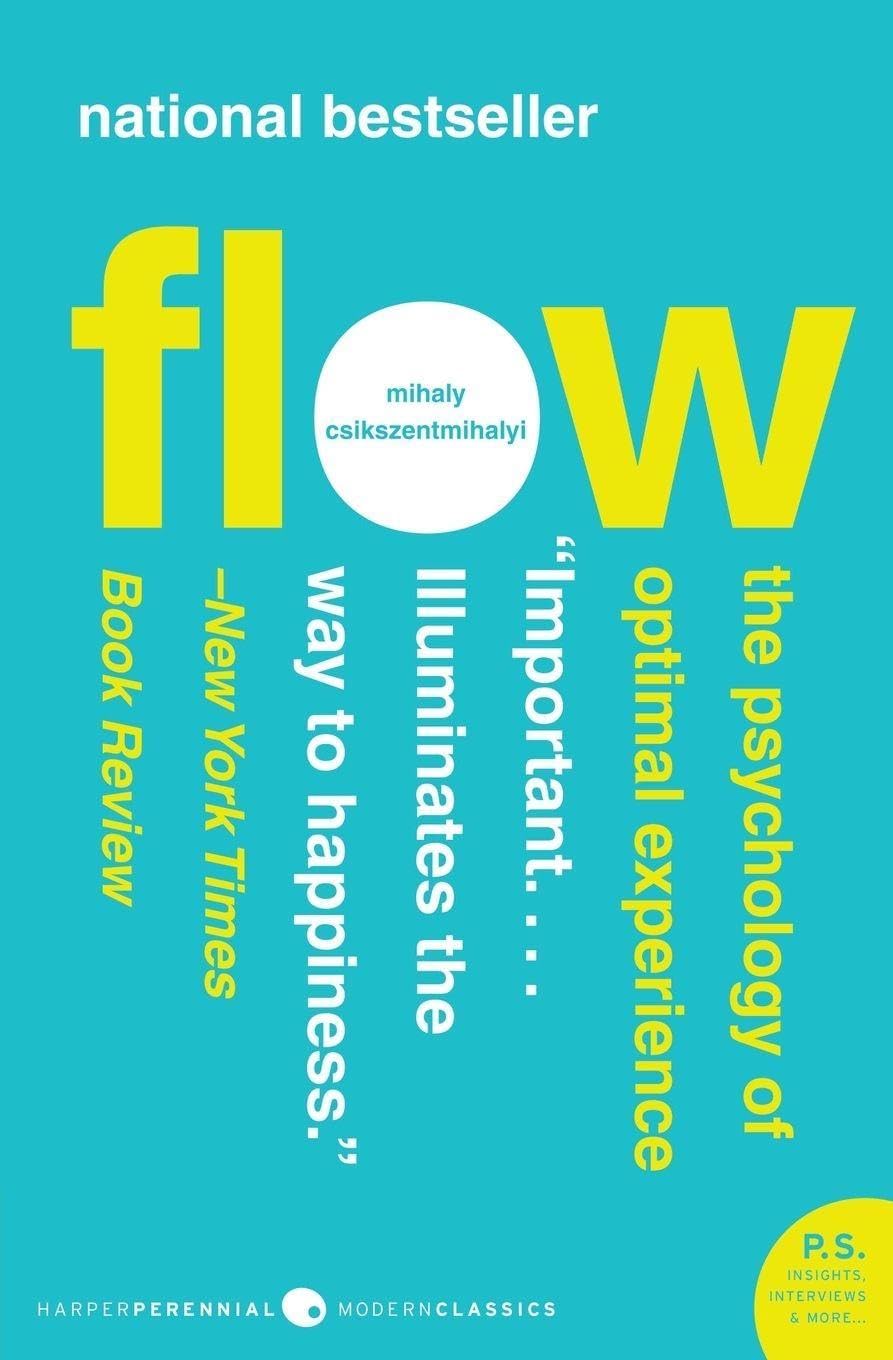
Flow: The Psychology of Optimal Experience
Product ID: 1458759
🎯Clear goals & immediate feedback
📚Compact & travel-friendly
🚀Boosts mental focus & flow
Buy anything from 5,000+ international stores. One checkout price. No surprise fees. Join 2M+ shoppers on Desertcart.
Desertcart purchases this item on your behalf and handles shipping, customs, and support to Italy.
🎉 Flow into your best life — where focus meets fulfillment!
Flow: The Psychology of Optimal Experience by Mihaly Csikszentmihalyi is a bestselling, research-driven book that explores how mastering focus, aligning challenges with skills, and cultivating resilience can transform mundane tasks into deeply rewarding experiences. Compact and ideal for busy professionals, it offers practical insights to boost happiness, creativity, and mental control, making it a must-read for anyone seeking to optimize their personal and professional life.
| Best Sellers Rank | #5,155 in Books ( See Top 100 in Books ) #8 in Happiness Self-Help #9 in Popular Psychology Creativity & Genius #17 in Creativity (Books) |
| Customer Reviews | 4.5 out of 5 stars 7,418 Reviews |
O**H
Taking Back Control of the Quality of Life.
Below are key excerpts from the book that I found particularly insightful: 1- "This book summarizes, for a general audience, decades of research on the positive aspects of human experience—joy, creativity, the process of total involvement with life I call flow...This book tries instead to present general principles. along with concrete examples of how some people have used these principles, to transform boring and meaningless lives into ones fill of enjoyment." 2- "What I "discovered" was that happiness is not something that happens. It is not the result of good fortune or random chance. It is not something that money can buy or power command. It does not depend on outside events, but, rather, on how we interpret them. Happiness, in fact, is a condition that must be prepared for, cultivated, and defended privately by each person. People who learn to control inner experience will be able to determine the quality of their lives, which is as close as any of us can come to being happy." 3- "From their accounts of what it felt like to do what they were doing, I developed a theory of optimal experience based on the concept of flow—the state in which people are so involved in an activity that nothing else seems to matter; the experience itself is so enjoyable that people will do it even at great cost, for the sheer sake of doing it." 4- "The most important step in emancipating oneself from social controls is the ability to find rewards in the events of each moment. If a person learns to enjoy and find meaning in the ongoing stream of experience, in the process of living itself, the burden of social controls automatically falls from one's shoulders. Power returns to the person when rewards are no longer relegated to outside forces. It is no longer necessary to struggle for goals that always seem to recede into the future, to end each boring day with the hope that tomorrow, perhaps, something good will happen. Instead of forever straining for the tantalizing prize dangled just out of reach, one begins to harvest the genuine rewards of living. But it is not by abandoning ourselves to instinctual desires that we become free of social controls. We must also become independent from the dictates of the body, and learn to take charge of what happens in the mind. Pain and pleasure occur in consciousness and exist only there. As long as we obey the socially conditioned stimulus-response patterns that exploit our biological inclinations, we are controlled from the outside. To the extent that a glamorous ad makes us salivate for the product sold or that a frown from the boss spoils the day, we are not free to determine the content of experience. Since what we experience is reality, as far as we are concerned, we can transform reality to the extent that we influence what happens in consciousness and thus free ourselves from the threats and blandishments of the outside world." 5- "Control over consciousness cannot be institutionalized. As soon as it becomes part of a set of social rules and norms, it ceases to be effective in the way it was originally intended to be. Routinization, unfortunately, tends to take place very rapidly. Freud was still alive when his quest for liberating the ego from its oppressors was turned into a Staid ideology and a rigidly regulated profession. Marx was even less fortunate: his attempts to free consciousness from the tyranny of economic exploitation were soon turned into a system of repression that would have boggled the poor founder's mind." 6- "Over the endless dark centuries of its evolution, the human nervous stem has become so complex that it is now able to affect its own states, making it to a certain extent functionally independent of its genetic blueprint and of the objective environment. A person can make himself happy, or miserable, regardless of what is actually happy "outside," just by changing the contents of consciousness. We all kn»now individuals who can transform hopeless situations into challenges to be overcome, just through the force of their personalities. This ability to persevere despite obstacles and setbacks is the quality people most admire in others, and justly so; it is probably the most important trait not only for succeeding in life, but for enjoying it as well." 7- "Whenever information disrupts consciousness by threatening its goals we have a condition of inner disorder, or psychic entropy, a disorganization of the self that impairs its effectiveness. Prolonged experiences of this kind can weaken the self to the point that it is no longer able to invest attention and pursue its goals." 8- "Following a flow experience, the organization of the self is more complex than it had been before. It is by becoming increasing complex that the self might be said to grow. Complexity is the result of two broad psychological processes: differentiation and integration. Differentiation implies a movement toward uniqueness, toward separating oneself from others. Integration refers to its opposite: a union with other people. with ideas and entities beyond the self. A complex self is one that succeeds in combining these opposite tendencies. The self becomes more differentiated as a result of flow because overcoming a challenge inevitably leaves a person feeling more capable, more skilled. As the rock climber said, "You look back in awe at the self, at what you've done, it just blows your mind." After each episode of flow a person becomes more of a unique individual, less predictable, possessed of rarer skills. Complexity is often thought to have a negative meaning, synonymous with difficulty and confusion. That may be true, but only if we equate it with differentiation alone. Yet complexity also involves a second dimension—the integration of autonomous parts. A complex engine, for instance, not only has many separate components, each performing a different function, but also demonstrates a high sensitivity because each of the components is in touch with all the others. Without integration, a differentiated system would be a confusing mess. "low helps to integrate the self because in that state of deep concentration consciousness is unusually well ordered. Thoughts, intentions, feelings, and all the senses are focused on the same goal. Experience is in harmony." 9- "There are two main strategies we can adopt to improve the quality of life. The first is to try making external conditions match our goals. The second is to change how we experience external conditions to make them fit our goals better. For instance, feeling secure is an important component of happiness. The sense of security can be improved by buying a gun, installing strong locks on the front door, moving to a safer neighborhood, exerting political pressure on city hall for more police protection, or helping the community to become more conscious of the importance of civil order. All these different responses are aimed at bringing conditions in the environment more in line with our goals. The other method by which we can feel more secure involves modifying what we mean by security. If one does not expect perfect safety, recognizes hat risks are inevitable, and succeeds in enjoying a less than ideally predictable world, the threat of insecurity will not have as great a chance of marring happiness. Neither of these strategies is effective when used alone. Changing external conditions might seem to work at first, but if a person is not in control of his consciousness, the old fears or desires will soon return, reviving previous anxieties. One cannot create a complete sense of inner security even by buying one's own Caribbean island and surrounding it with armed bodyguards and attack dogs." 10- "As our studies have suggested, the phenomenology of enjoyment has eight major components. When people reflect on how it feels when their experience is most positive, they mention at least one, and often all, of the following. First, the experience usually occurs when we confront tasks we have a chance of completing. Second, we must be able to concentrate on what we are doing. Third and fourth, the concentration is usually possible because the task undertaken has clear goals and provides immediate feedback. Fifth, one acts with a deep but effortless involvement that removes from awareness the worries and frustrations of everyday life. Sixth, enjoyable experiences allow people to exercise a sense of control over their actions. Seventh, concern for the self disappears, yet paradoxically the sense of self emerges stronger after the flow experience is over. Finally, the sense of the duration of time is altered; hours pass by in minutes, and minutes can stretch out to seem like hours. The combination of all these elements causes a sense of deep enjoyment that is so rewarding people feel that expending a great deal of energy is worthwhile simply to be able to feel it." 11- "The same situation holds true for the artist painting a picture, and for all activities that are creative or open-ended in nature. But these are all activities that are creative or open-ended in nature. But these are all recognize and gauge feedback in such activities, she will not enjoy them. In some creative activities, where goals are not clearly set in advance, a person must develop a strong personal sense of what she intends to do. The artist might not have a visual image of what the finished painting should look like, but when the picture has progressed to a certain point, she should know whether this is what she wanted to achieve or not." 12- "As this example illustrates, what people enjoy is not the sense of being in control, but the sense of exercising? control in difficult situations. It is not possible to experience a feeling of control unless one is willing to give up the safety of protective routines. Only when a doubtful outcome is at stake, and one is able to influence that outcome, can a person really know whether she is in control." 13- "In our studies, we found that every flow activity, whether it involved competition, chance, or dimension of experience, had this in common: It provided a sense of discovery, a creative feeling of transporting the person into a new reality. It pushed the person to higher levels of performance, and led to previously undreamed-of states of consciousness. In short, it transformed the self by making it more complex. In this growth of the self lies the key to flow activities." 14- "There is ample evidence to suggest that how parents interact with a child will have a lasting effect on the kind of person that child grow up to be. In one of our studies conducted at the University of Chicago, for example, Kevin Rathunde observed that teenagers who had certain types of relationship with their parents were significantly more happy, satisfied, and strong in most life situations than their peers who did not have such a relationship. The family context promoting optimal d experience could be described as having five characteristics. The first one is clarity: the teenagers feel that they know what their parents expect from them—goals and feedback in the family interaction are unambiguous. he second is centering, or the children's perception that their of parents are interested in what they are doing in the present, concrete feelings and experiences, rather than being preoccupied with whether they will be getting into a good college or obtaining a well-paying job. Next is the issue of choice: children feel that the variety of possibilities from which to choose, including that of breaking parental rules—as long as they are prepared to face the consequences. The fourth differentiating characteristic is commitment, or the trust that allows the child to feel comfortable enough to set aside the shield of his defenses. and become unselfconsciously involved in whatever he is interested in. And finally there is challenge, or the parents' dedication to provide increasingly complex opportunities for action to their children." 15- "Without interest in the world, a desire to be actively related to it. a person becomes isolated into himself. Bertrand Russell, one of the greatest philosophers of our century, described how he achieved personal happiness: "Gradually 1 learned to be indifferent to myself and my deficiencies; I came to center my attention increasingly upon external objects: the state of the world, various branches of knowledge, individuals for whom I felt affection." There could be no better short description of how to build for oneself an autotelic personality. In part such a personality is a gift of biological inheritance and early upbringing. Some people are born with a more focused and flexible neurological endowment, or are fortunate to have had parents who promoted unselfconscious individuality. But it is an ability open to cultivation, a skill one can perfect through training and discipline. It is now time to explore further the ways this can be done." 16- "Even the simplest physical act becomes enjoyable when it is transformed so as to produce flow. The essential steps in this process are: (a) to set an overall goal, and as many subgoals as are realistically feasible; (b) to find ways of measuring progress in terms of the goals chosen; (c) to keep concentrating on what one is doing, and to keep making finer and finer distinctions in the challenges involved in the activity; (d) to develop the skills necessary to interact with the opportunities available; and (e) to keep raising the stakes if the activity becomes boring." 17- "To realize the body's potential for flow is relatively easy. It does not require special talents or great expenditures of money. Everyone can greatly improve the quality of life by exploring one or more previously ignored dimensions of physical abilities. Of course, it is difficult for any one person to reach high levels of complexity in more than one physical domain. The skills necessary to become good athletes, dancers, or connoisseurs of sights, sounds, or tastes are so demanding that one individual not have enough psychic energy in his waking lifetime to master more than a few. But it is certainly possible to become a dilettante—in finest sense of that word—in all these areas, in other words, to develop sufficient skills so as to find delight in what the body can do." 18- "But for a person who has nothing to remember, life can become severely impoverished. This possibility was completely overlooked by educational reformers early in this century, who, armed with research results, proved that "rote learning" was not an efficient way to store and acquire information. As a result of their efforts, rote learning was phased out of the schools. The reformers would have had justification, if the point of remembering was simply to solve practical problems. But if control of consciousness is judged to be at least as important as the ability to get things done, then learning complex patterns of information by heart is by no means a waste of effort. A mind with some stable content to it is much richer than one without. It is a mistake to assume that creativity and rote learning are incompatible. Some of the most original scientists, for instance, have been known to have memorized music, poetry, or historical information extensively." 19- "External forces are very important in determining which new ideas will be selected from among the many available; but they cannot explain their production. It is perfectly true, for instance, that the development and application of the knowledge of atomic energy were expedited enormously by the life-and-death struggle over the bomb between dited enormously by the life-and-death struggle over the bomb between Germany on the one hand, and England and the United States on the little to the war; it was made possible through knowledge laid down in more peaceful circumstances—for example, in the friendly exchange of more peaceful circumstances—tor example, in the friendly exchange of over to Niels Bohr and his scientific colleagues by a brewery in Copenhagen." 20- "The bad connotations that the terms amateur and dilettante have earned for themselves over the years are due largely to the blurring of the distinction between intrinsic and extrinsic goals. An amateur who pretends to know as much as a professional is probably wrong, and up to some mischief. The point of becoming an amateur scientist is not to compete with professionals on their own turf, but to use a symbolic discipline to extend mental skills, and to create order in consciousness." 21- "At the same time, it would be erroneous to expect that if all ill jobs were constructed like games, everyone would enjoy them. Even the mos favorable external conditions do not guarantee that a person will 1 be in flow. Because optimal experience depends on a subjective evaluation of what the possibilities for action are, and of one's own capacities, it happens quite often that an individual will be discontented even with a potentially great job." 22- "A community should be judged good not because it is technologically advanced, or swimming in material riches; it is good if it offers people a chance to enjoy as many aspects of their lives as possible, while allowing them to develop their potential in the pursuit of ever greater challenges. Similarly the value of a school does not depend on its prestige, or its ability to train students to face up to the necessities of life, but rather on the degree of the enjoyment of lifelong learning it can transmit. A good factory is not necessarily the one that makes the most money, but the one that is most responsible for improving the quality of life for its workers and its customers. And the true function of politics is not to make people more affluent, safe, or powerful, but to let as many as possible enjoy an increasingly complex existence." 23- "Why are some people weakened by stress, while others gain strength from it? Basically the answer is simple: those who know how to transform a hopeless situation into a new flow activity that can be controlled will be able to enjoy themselves, and emerge stronger from the ordeal. There are three main steps that seem to be involved in such transformations: 1. Unselfconscious self-assurance...2. Focusing attention on the world...3. The discovery of new solutions." 24- "THE AUTOTELIC SELF: A SUMMARY - 1. Setting goals...2. Becoming immersed in the activity...3.Paying attention to what is happening...4. Learning to enjoy immediate experience." 25- "But complexity consists of integration as well as differentiation. The task of the next decades and centuries is to realize this underdeveloped component of the mind. Just as we have learned to separate ourselves from each other and from the environment, we now need to learn how to reunite ourselves with other entities around us without losing our hard-won individuality. The most promising faith for the future might be based on the realization that the entire universe is a system related by common laws and that it makes no sense to impose our dreams and desires on nature without taking them into account. Recognizing the limitations of human will, accepting a cooperative rather than a ruling role in the universe, we should feel the relief of the exile who is finally returning home. The problem of meaning will then be resolved as the individual's purpose merges with the universal flow."
S**Y
Pleasantly surprise, I like it.
My takeaway from reading the book, Flow by Michaly Csikzentmihalyi is that happiness can be achieved by changing consciousness in which you bring order to tasks that you do (sometimes daily) and can bring enjoyment to your life, hence happiness and it called flow. It sounds simple but it is rather complex. The book is written by an intellectual and at times its seem for intellectuals. You have to pay attention otherwise you'd be like me when I had to re-read the paragraph for it to make it sense. The premise is that for you to be happy-you have to overcome challenges and use your skills to do it. Flow and happiness are by-product of the task. But there is a delicate balance between the complexity of the challenge and the complexity of your skill. It have to be aligned. If one is greater then the other, then you will need to increase and improve your skills or lower the challenge. Only then, will flow exist. The author gives a few examples of this: a tribe in New Zealand moves every seven years as to give the tribe new trails, new enemies, new challenge for the happiness of the group. And he give examples of a culture that every year destroys a monument and re-builds it trying to make it better and more beautiful. To achieve flow , there are clear rules that must be followed: The task must have clear goals and actions needed to overcome the obstacles. Immediate feedback is needed to see what you doing is working or not working. The challenge and the skills must be aligned but it has to stretch the person, it has be hard enough to do but not too hard where he will give up. Once the goal is met, a new goal needs to be set. Once, flow is established a few things happens, one time is distorted, you derived enjoyment in you life, the reward of life is established, and regardless if you have stress in your life or not, you bounce back and establish flow. One question I had once, How can I apply this in my life? I have goals I have not reached. It begs the question, are the goals too unrealistic and complex or do I lack the skills to achieve and overcome the challenge. I think my conclusion is the latter so I have to find a way to increase and improve my skills. My other takeaway is that the author states many times, that life is inherently hard , filled with stress and for him the admirable trait is one of perseverance, resiliency and of confidence. That becomes the challenge and few individuals are able to do this, he gives examples of veterans wounded in combat who attitude and resiliency are amazing and are able to achieve flow with positive and outstanding results. He says the trick is that one has to believe in themselves. The attitude is of a pilot who knows if he runs into problems , he can safely land the plane. My last takeaway from the book, is that he repeats himself and in one of the reviews, it said it was a bad thing. When, actually for me is a good thing, he talks a lot of psychic energy and how is used. Psychic energy is what you pay attention to every day. It is limited and it has to be used wisely. He talks a lot of external and internal forces and how you cannot control external but you can control internal, the consciousness, the psychic energy, the attention and the positive attitude knowing you can do it regardless what hte external pressures are. He has a few favorite workers describing flow, the surgeon who challenge is obvious and so is his feedback, the operation was either a success or failure, the dancer who is totally absorbed in her performance, where time doesn't exit, the mountain climber who sees every little details in his quest to climb the mountain. The concentration is like breathing, they are not aware of it, an explosion could occur near by and they wouldn't be aware of it. He talks a lot about paradoxes, how you must change consciousness to achieve flow but by doing you lose your self, you become part of what you are doing- by being in control, you lose control and perfection and clarity occurs. I really enjoyed the book, overall my recommendation is positive, However, there a one thing I wish I would have seen. I am a big fan of summaries and the last chapter didn't make sense to me, he talked about the meaning of life and different models of it. For me , it would have make more sense, to tie it up and give practical example how an average person could use flow, I understand he wrote, a seguel to Flow, maybe he explains in practical manner how to use flow in your life not how dancers, chess players, musicians and surgeons uses flow. I do recommend Flow and you will see how you can use it in your own life.
I**.
The mental state we should all long for
At the beginning this book seemed to me to have a very interesting theme because since a long time ago I became acquainted with Timothy Gallwey’s books (The Inner Game of Tennis, Golf, Work, etc.) and I became very interested on the theme of sports psychology. And not only that, I became fascinated with the idea of how this psychology relates with the rest of human psychology. As years went by, I learned to try to use these concepts for everyday life. I learned that the principles discussed in those books were not exclusive to sports; they are relevant to the spiritual life of every human being. The book Flow describes that there is a mental state in which human performance reaches excellence. This state features some interesting aspects, of which the most important is concentration. When a human being reaches this state, time seems to stop, enjoyment is superlative and self-consciousness disappears, as if one reached the state of communion with some deity. This state is what the author denominates “flow”. By reading this book, I learned to call this state this way, which I think is very appropriate. Everyone of us have experienced flow at some point in our lives. When this happens, whatever we are doing can be qualified as excellent. In my own experience, I have been surprised by my own performance in some tasks throughout my life once I concluded them. I have had some brilliant moments on rare occasions and I can say that the main attribute in all of them has been good concentration. Timothy Gallwey’s books deal precisely about that concentration and the interaction among our different selves that affect such focus. When concentration is maximized, incredible things usually happen. Human greatness rests precisely in its capacity to stay in the “flow” state which let humans conquer goals that would seem incredible by any observer. The “flow” state is the state to which everyone should aspire in every moment of his or her existence. If that cannot be done, it is due to the attachments that block them. Such attachments need to be minimized in order to reach this state. It would seem strange that such issue deserves so much attention: increase in human performance. But whenever we try it, we realize that excellence in performance provides great happiness. But such happiness is not the result of the pride of having reached a goal, but of having been concentrated for a moment. When we are focused in something and reach the “flow” state, we realize that that is the goal of our existence, at least during that moment. After all, ancient Greeks institutionalized Olympic Games for a reason: they were searching not excellence in entertainment, but rather excellence in concentration. On the same token, eastern experts who practice martial arts reach excellence only after the subject is able to enjoy a profound spirituality at the moment of combat. This means that pinpointed focus is what lets humans relate with their creator. This may not relate very well with traditional Christian doctrine, but oriental religions seem to follow this statement. At any rate, even Christian religions go a long way dealing about taming the self (temptations, mental vices, pride, etc.); what they deal with is liberating people of whatever distracts them from living their lives with excellence, even in the most trivial daily activities. In other words, religion tries to each happiness and in order to do that, humans need to do whatever is necessary to reach the flow state. This is not easy since in order to conquer trust and tranquility it is necessary to live a good life. Whatever that means depends on every soul. And the field in which the flow state should be reached also depends on every person. In think the "flow" state is related to an important concept that was discussed at length in the book Zen and the Art of Motorcycle Maintenance by Robert Pirsig, and which is named "quality". This concept is much more than what we usually mean by it, since although it has something to do with excellence, its effect on human lives has much to do with his or her happiness and transcendence. In that book, "quality" is not only explained, but also demonstrated through philosophies established throughout several centuries. Therefore its reading, although dense, is extremely interesting. But this book (Flow) goes a long way to explain this term in a sensible manner and using examples from daily life that everyone of us can relate to. In fact, while reading this book, there were some instances in which the author used examples from his personal life, explained through several pages just to prove a small point. I wished he did not use so many examples just to keep me from losing the main point. However, the flow concept is very important and I am grateful that someone went a long way to put it accesible and in simple terms. We cannot say that the way to happiness is the same for everybody, but definitely all those ways have a common ingredient: the "flow" state.
S**S
A Thought-Provoking, Academic Look at What Makes Life Enjoyable
We can bring more enjoyment into our lives by structuring conditions that promote flow. Csikszentmihalyi lays out what makes this possible—clear goals, immediate feedback, focused attention, and a challenge that matches our skills. When we're in flow, time disappears, effort feels effortless, and we’re fully absorbed in what we’re doing. One of the most interesting ideas in Flow is the autotelic personality. That is, people who can create flow anywhere, regardless of circumstances. Csikszentmihalyi suggests we can cultivate this by setting goals, immersing ourselves in what we’re doing, and choosing to engage with the present moment. He also explores meaning by examining how purpose, intention, and action shape a cohesive, fulfilling life. As he describes how the self becomes more complex over time, I found myself thinking about Maslow’s hierarchy of needs and the idea of transcendence from an Eastern perspective. He outlines a shift from self-interest to community, then self-actualization, and, for some, transcendence. But what he means by transcendence is never fully defined. He also doesn’t clearly address how our needs evolve as we move through this proposed model of complexity. Or, for that matter, if he’s suggesting an additional tier to Maslow’s hierarchy of needs. I recently made changes to my own work approach based on Deep Work by Cal Newport, which helps create conditions for flow. Csikszentmihalyi says enjoyment happens at the edge of boredom and anxiety. That gives me a useful way to check in with myself within these deep work blocks. If I’m bored, I can raise the challenge. If I’m anxious, I can bring it back into the realm of what feels possible. Beyond work, I started looking at where I struggle with flow. Networking is a big one. I often go in without clear goals and tend to get stuck in my own head instead of immersing myself in the environment. Next time, I’ll set an intention and focus outward rather than inward. As an executive coach, I also see how this applies to leadership transitions. Many of my clients come from flow-heavy roles—design, development, research—only to find management scattered and disengaging. If they’re struggling, a lack of flow might be part of the problem. That’s something I plan to explore more in my coaching. Flow is worth reading if you're interested in creativity, focus, or purpose. It made me rethink how I approach work and life, and it gave me a practical way to gauge whether I’m stretching myself in the right ways. If you want more enjoyment in what you do, this book is a solid place to start.
I**N
Incredibly insightful
Amazon already did a good job summarizing Mihaly Csikszentmihalyi's Flow, so I will instead focus on evaluating its content. The book is set up in a way where the first few chapters concentrate on defining and analyzing the intricate relationship between human consciousness and happiness. Once this is firmly established, Csikszentmihalyi goes on to introduce the concept of flow, its physiology and its conditions. All subsequent chapters then examine flow in various aspects of our lives and the last chapter focuses on the philosophical implications of the concept and whether it relates to finding "meaning in life". It has been said in science that any researcher should have the ability to explain their theory clearly and concisely to a layman. I felt that Csikszentmihalyi's style of writing is very true to this statement, as he puts in a particular effort to make his book accessible and very easy to read for just about anyone. I would even say that he is overly simple to a fault - using a philosophically-conversational tone at the expense of a slightly more rigid "literature review" style that predominates more modern pop sci books. Despite this, the author is still capable of conveying a decent amount of science and methodology behind his discovery and analysis of the optimal experience model. To me, the most powerful chapters were really the first five where, as I discussed earlier, Csikszentmihalyi really puts the meat on the bones of his theory of flow and masterfully connects everything together. Some passages just made so much sense that I had to put the book down and seriously contemplate about what is being said and how it relates to my entire understanding of life. To use the author's own language it put me in a very deep and enjoyable "flow of thought". The book does have a small blemish in the fact that it gets a bit repetitive when it goes into listing the occurrence of flow in everyday settings. I don't have anything against the discussion of applicability of the theory, it just seems that sections containing very similar messages could have been condensed. Perhaps 240 pages (not including notes and references) is a bit much for this type of format and ideally it should have been closer to 200 pages. However, I want to emphasize that this small fault does not in any way make the book a "drag" and some people may find this "extra" information rather useful. To conclude, I found Csikszentmihalyi's lifelong research, his findings and the overall message of his work extremely compelling and powerful. The theory of flow does an excellent job describing many aspects of our lives and most importantly sheds light on the conditions of happy and meaningful existence. I would honestly recommend this book to anyone. It is rather short and very readable and guaranteed to make you analyze your life and the life of your friends and family through the lens of the theory of flow.
V**S
Controversial approach to happiness
The concept of flow is widely known these days, but on a superficial level. So what can the original book teach us? Flow is defined here as a state when you're "so involved in activity that nothing else matters", no surprises, but it is presented in a greater context, as a way to achieve happiness. We're told that "psychic entropy" (or lack of control over conciseness, or simply random thoughts), is the thing that prevents happiness. Flow, on the other hand, is "optimal experience", the reverse of psychic entropy. Actually, this scale from psychic entropy to flow *is* the measure of happiness. Then, the book gives some conditions for achieving flow -- basically finding tasks that are challenging enough, but not too much, together with unambiguous and fast feedback (I found that part somewhat vague). And there's a lot of examples of flow experiences. Everything can become flow, if challenges are sought and overcome. Every chapter fits into a solid book structure. But it's not clear the structure makes sense. Yes, being engaged in activity at proper challenge level can be very rewarding. Is it an answer for everything? Is unhappiness indeed the same as psychic entropy? Maybe if one cannot concentrate on anything at all, yes, but hardly in all cases. Is suppressing distressing thoughts by finding a random engaging experience the best approach? No matter what that experience is? True, the book does mention that some flow experiences are not necessary good, but then goes on giving a lot of examples of flow, regardless of their value. If I'm constantly bothered by a bunch of unresolved problems, would it be wise to go and find some flow experience, to suppress the thoughts about these problems? Maybe find flow in washing dishes? Even if I manage to get very very engaged in that, will I feel a slightest bit better afterwards? The book was originally published in 1990, and it shows. I found no mention of Daniel Kahneman' concept of experiencing self and remembering self, which means that no matter how pleasurable flow might be in the moment, it is only one part of the story (see "Thinking, Fast and Slow"). There's no mention of Daniel Gilbert, who claims that people mostly stay at their baseline happiness level, and so expending great effort to become happier is probably a mistake (see "Stumbling on Happiness"). Instead, we find some favorable mentions of Mr. Freud, for the first time in all the books I read. Flow is probably an important part of good life experience, and this book is important in giving examples of flow. But equating flow with happiness is very controversial, and too much of the book is based on that equality.
H**N
A fine dessert wine; not a pint of beer! Heartily recommended for those looking for mental stimulation
Some books are like a pint of beer. You guzzle it down in something of a hurry before it warms up, and before it's all done you're looking forward to the next, cold one. Others are like a really good dessert wine. You spend time sniffing it, taking in the floral notes, before you take the first hesitant sip. This book is the latter. It took me a good long while to read it. This is the 35th book I've read in 2014, and it took me all of June and most of July to get through it. This is not because it is a bad book or badly written. It is because each page is filled with possibility; each concept, each story/ parable told makes you go off into a reverie of thought and memory. At its core, the book is about "Flow" or that state of consciousness that one achieves when engaged in an "enjoyable" activity. Something difficult, but doable, with a clear goal, and that requires a specific set of skills to perform a specific set of actions to get there. This might be running a 5k, or bringing up a child, or deciding to rid the world of cancer - you decide! According to the author, Mihaly Csikszentmihalyi, as human beings we have an infinite variety of flow experiences available to us - various avenues that he delves into in some detail, that open up based on the possibilities of our body, our minds, our work/ workplaces, our families, communities, and so on. This is something I think we can all empathize with and was certainly a feeling that is familiar to me. Then the author goes on to make a strong assertion - that to feel flow is to be happy. Nay, to be happy is to be in flow. The assertion is an ambitious one, but quite convincing. Most of what I consider to be happiness can indeed be defined as flow activities or their outcomes. Then he makes an even stronger assertion, one that took my breath away: flow, and the pursuit of flow, can give your otherwise chaotic life meaning. I was blown away to read descriptions of what the author calls an "auto-telic" personality - people to whom their purpose in life is intrinsic to their identity/ self. These are people who have either settled on a life that affords them many flow experiences, or who actively seek out flow experiences and lead a negentropic life as a result. This is breath-taking to me because this is the answer to the existential crisis. Not my existential crisis, however maudlin, but The Existential Crisis. The author is offering a competing worldview here in the same space as where the Buddha, most of organised religion, Neitszche, Kant, Plato and others operate. He is tackling ontological questions, universal questions, based on anecdotes and (while well researched and documented) basically life stories of fairly normal, "ordinary" people! It was also breath-taking because I bought it. I knew I was falling for it hook, line, and sinker! I was reliving my life, reassessing my happy and sad moments in the context of flow, and of flow as a way to seek order amid chaos. I think it will be some time before I internalize and synthesize everything I've thought up as I read this book. I like to think I'm auto-telic to a certain extent, and feel like I understand better how or why I've been as happy as I've been at certain points in my life. I'll almost certainly read this book again, but that is some time away. For now, it has proven a very thought-provoking read indeed. Heartily recommended to anyone that likes a good bit of mental stimulation - whether you buy into it or not.
R**N
Stands the test of time
This book is a classic, breaking down the subject of Flow and explaining how we experience our lives. Full of research, real-life examples and suggestions on how to increase the frequency of optimal experiences.
Trustpilot
1 month ago
3 days ago