💧 Elevate your tap game—because your water deserves a glow-up!
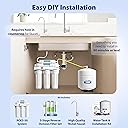
The APEC WATER ROES-50 is a WQA-certified under-sink reverse osmosis system delivering up to 50 gallons per day of ultra-pure water by removing 99.99% of impurities through a robust 5-stage filtration process. Designed for easy DIY installation with color-coded tubing and quick-connect fittings, it includes a premium brushed nickel faucet and water tank. Trusted for over 20 years, this system ensures crisp, clean water that supports a healthy, modern lifestyle.


| ASIN | B00I0ZGOZM |
| Best Sellers Rank | #9,661 in Tools & Home Improvement ( See Top 100 in Tools & Home Improvement ) #21 in Under-Sink & Countertop Filtration |
| Brand | APEC WATER |
| Date First Available | February 13, 2014 |
| Global Trade Identification Number | 00854961005051 |
| Installation Type | Under Sink |
| Is Discontinued By Manufacturer | No |
| Item Weight | 24.9 pounds |
| Item model number | ROES-50 |
| Lower Temperature Rating | 40 Degrees Fahrenheit |
| Manufacturer | APEC Water Systems |
| Maximum Flow Rate | 0.03 Gallons Per Minute |
| Model Name | ROES-50 |
| Operating Pressure Range | 40-85 PSI |
| Package Information | Dispenser |
| Power Source | Ac |
| Product Dimensions | 16"L x 5.25"W x 17.5"H |
| Special Feature | Reduce TDS |
| Supported Water TDS Level Maximum (PPM) | 2000 |
| UPC | 735090919450 854961005051 |
| Upper Temperature Rating | 100 Degrees Fahrenheit |
P**H
There is nothing like clean water, and plenty of it!
This is an absolute must-have during our unfortunate period of being forced to stay home (forced in a sense, but you know what I mean). Given, our install was within the breakroom at the office here, but some of us will be buying into these for our homes as well as it keeps us from having to worry about finding water in stores with so many hoarders selfishly taking all of the bottles for themselves. Why bother when you can have unlimited clean water at home without ever having to leave the house to buy more? For one, the price of this is pretty good for what you get. It is going to cost you less than subscribing to a Sparklets delivery service, while not much more than filling your jugs up manually at a local water store (I won't compare against the vending machine fillers as those are just plain nasty). Now, add the fact that you don't have to drive anywhere for it, or have to wait for a truck to bring it to you. The water is simply always there. Also, the price of the filters is quite reasonable. Don't get me wrong. They aren't incredibly cheap, but their quality thus far seems to be quite good and we appreciate that they aren't gauging customers like refrigerator manufacturers do with their (useless) filters (these are far better since they actually work). We had to take a (very detailed) vote with an email passed around, on which model should be installed in the breakroom. It was a toss-up between this one and the 6-stage option, which simply added alkalization. However, the final vote leaned heavily toward the 5-stage as the body needs some of its acidity to function properly. Thus too much (drinking nothing but) alkaline water could actually be a bad thing. So 5-stage option it was. Installation isn't too difficult, although it was a little more for our situation since 80% of the space under the sink (the only place we were allowed to put it) is located behind the guts to the sink without any way of actually getting back there (an odd design but looks nice on the outside). So we had to remove more than half the plumbing down there in order to get to the valves/supply in the back. Regardless, with 2-3 of us helping at any given time, he had the entire project (and the extension kit to the fridge, seen running through the cabinets in a frew of the attached images) done in around an hour and a half or so. This included a number of social distractions. As long as you are confident in yourself, you will be fine. Just remember, don't be shy with the teflon tape. If you see threads where something screws together, go ahead and apply some (even if the instructions don't say to). You can never be too safe when it comes to preventing leaks! They also give you enough, which is nice. It asks you to flush the system for the first time by letting the tank fill for 2-3 hours and then flush it out the faucet for 5-6 minutes. This is because the carbon filter initially causes the water to gain some blackness to it. This is true, although you will want to do this twice in our opinion (maybe even three times to be sure). After that, things seem nice and pure. Regardless, after the first flush, it is safe even if you see a little of the black dust left over. It's just the carbon dust from the filter and harmless. If you see what looks like tiny white residue floating on the top, that is also harmless--those are just micro-bubbles caused by the air/pressure in the line (they eventually go away). The PPM (parts per million) of the normal city water coming to the tap was close to 500 PPM (Las Vegas tap water is a bit nasty). The (useless and expensive) fridge filter lead to around 460-470 PPM and similar taste. The RO processed water is around 9-12 PPM. So this seems to be working quite well so far. As mentioned, we also got the additional kit to break off to the fridge as well. It took a little while for the fridge to flush things out so it was only using the new water, but now it has the same PPM. We will make sure to update if anything changes, but so far, we are loving this and there is many of us who plan to buy into one at home. -- Update 05/07/2020 -- So far, everything has been working fantastically. No complaints from anyone, including on the taste. We have also uploaded a few images now that Amazon has returned the option for customer reviews. **If you have found our review helpful, please vote it as helpful below so I know. This helps me provide quality feedback in the future.
A**E
No regrets!
Great tasting water once you get the filters purged ! Our water is so crisp and clean tasting this system works great ! Best water ever I highly recommend! For the price you can't beat it plus it comes with extra filters ! Me and my oldest son are the water drinkers in this house and now my whole household loves drinking water and that says a lot for toddlers ! If your thinking about getting a water filtration system this one has a great price point and instillation isn't bad at all had it up and running in about 1 hr ! But my uncle did install it and he works for a watersoftner company so for the complete novice it might take 2 hrs ? He recommended this one to me and has it in his own home . No regrets!
S**Y
>>> DOES THE JOB
> I purchased the APEC ROES-50 to replace a similar 25 year-old system, largely because I was due for a completely filter change (including the membrane), and a tank change --- which would have costed as much as a new system. > The APEC ROES-50 system includes everything you need for a complete installation, including adapters, a splitter, and a valve to attach to your cold water line, and an RO (reverse osmosis) faucet. Caveat, I recommend a dual dishwasher/RO air gap, or at least an RO air gap faucet, which are NOT included. I very strongly recommend a small tube of food-grade silicon grease. > Since my old system was a 1/4" tubing system (like the APEC ROES-50), I used the old 1/4" water supply line (meaning that I did not have to install any adapters, splitters, valves, nor a new line). I could have used my old (air-gap) RO faucet --- but I chose to use the (included) new (non-airgap) faucet. EASE OF INSTALLATION > The two hardest parts of a new installation are installing the adapter (if necessary), a splitter, valve, and a new cold water supply line, AND drilling a hole in your countertop for the reverse osmosis faucet. If you install a dual dishwasher/RO air gap, that will require a second hole. Since I did NOT have to do any of that, my installation was very easy. Essentially, all I had to do was install a valve on the top of the new tank (very easy), install the 3 primary filters (very easy), and connect lines to the water supply, to the tank, and to the RO faucet (easy). > Connecting the lines to the water supply, to the incoming water line, water tank, and to the RO faucet was very easy: You pull out plugs from the connectors, insert the new lines (IMPORTANT -- as deep as they will go), and then pull out on the new lines to tighten the connection. Remarkable! Installing the connections on my old system was much more difficult, and almost invariably leaked. The new quick connections were ridiculously easy, and after about 2 years, have NEVER leaked. OTHER OPTIONS > Tempted by a smaller, more compact system? That's fine for a drinking water system, say in an office. But check out the tank capacity, the amount of water that such a system can deliver at one-time is about half-the nominal tank capacity. A 1 gal system would only deliver a little over half-a gallon at a time. Smaller (than 5-gal tank) systems are likely to be too small for a home kitchen, if you want to do more than boil a pot of spaghetti. A small system will probably generate much less RO wastewater (and therefore be kinder to your water bill), but maintenance will probably be comparatively high --- because they use non-standard components. Most of the components of the ROES-50 system are industry-standard --- you can purchase most of the components (under various brands) from Home Depot --- and therefore, the prices are competitive. > You need a 5 gallon tank (which can actually deliver only 2--3 gallons at-a-time) for a home kitchen system. You may never use more than a gallon at a time, but that first gallon will be delivered quickly -- the second or third gallon will be tad slower. If you want a fourth or fifth gallon, you'll have to wait a half-hour or so. If you need a higher capacity system, I strongly suggest that you add additional storage tanks first, rather than a higher capacity filtering system. (If you opt for a nominally higher capacity filtering system, you'll need the additional tanks anyway to take advantage of the higher capacity filtering system). > I considered a ca $30 more expensive 3/8" line system (largely because I suspected that a 3/8" system would be less leak-prone). I'm glad I did not buy it. For one thing, I would have had to install new fittings for the water supply to the RO system. It is claimed that the 3/8" system fills big cooking pots quickly, but frankly, the 1/4" system does as well. Bullshxt !!! --- the difference would be measured in seconds, and your max capacity would still only be 2-3 gallons at a time. If you increase your storage to, say, 20 gallons (to be capable of delivering 10-15 gallons at a time) (very easy, just purchase the tanks and fittings to connect them), then maybe the system would "fill big pots" noticeably faster (but still measured in seconds). > By the way a 2--3 gallon capacity (for the ROES-50 system, with just a single 5 gal tank) might sound inadequate, but in 25 years, I've never felt the need for greater capacity -- I virtually never used more than a gallon at a time. (Well, collecting 10 gal in plastic milk bottles ahead of a hurricane can take an afternoon, but I've only done that once). And the solution (for me, if I felt that I needed it) would be to add a second 5-gallon tank, not to "upgrade" to a "higher capacity" system. Moreover, presumably a "100 gallon/day system" probably generates 2x more RO wastewater than a 50 gallon/day system -- and the difference may add up to considerably higher water bills. > It was my impression that the ROES-50 system came with standard fittings, and that I'd have to pay more for a quick-connect system. But my ROES-50 system came with quick-connect fittings. No error by APEC nor Amzn -- the box and instructions were clearly labeled "ROES-50". TIPS > When installing the cold water supply, tank, faucet, and drain lines, it is best NOT to shorten them for a neater installation (as I did for my first RO system). In the future, you may need to change the water tank and the reverse osmosis faucet, and maybe even your main sink faucet. In the past 30 years I've changed my main faucet 3 times, my RO faucet 3 times, my RO tank 3 times, and my RO membrane 4 times, plus changing the other RO filters many times. If you shorten the lines, you might have to disconnect various lines for access, which can be surprisingly confusing, and might be difficult to re-install without leakage. If you leave the lines long, you can probably simply move the RO system aside for access without having to disconnect anything. > To install the cold water supply, tank, and reverse osmosis faucet lines, keep the connection CLEAN until installation (i.e., don't remove the plugs early, and wipe off the ends of the lines with a clean cloth) just before you insert them into the connectors). Insert the end of the line as deep into the connector as it will go, then pull back HARD to set the connection. Leave 3--5" space with your cabinet walls (or door) so that there is no sideways strain on the lines at the connectors. > Use (food grade) silicon grease (NOT included) when installing the three big filter housings. The 3" diameter o-rings in the three big filter housings come greased already with silicon grease (be VERY careful not to contaminate the surfaces of the greased o-rings with dust or grit). When you change the filters in the future, you should clean the o-rings (until no more black carbon comes off on a paper towel), and re-grease them with food grade silicon grease, and wipe off the excess, thoroughly. > The 2 large carbon filters also have rubber disks, which are best LIGHTLY greased with silicon grease (wipe off ALL excess). Don't forget to remove the shrink plastic around the three big filters before installing them (as one reviewer claimed that her plumber had failed to do). > APEC recommends installing the RO drainline into your sink drain pipe as low as practical to avoid the sounds of RO waste water dripping into your sink drain. Instead, I suggest installing the RO drainline below the level that the drain line exits the RO manifold (which depends on where and how you mount the RO manifold), but otherwise AS HIGH AS POSSIBLE, to minimize backflow from your sink U trap, which really has disgusting stuff (mats of bacteria) in it. I actually have a 6" high "stand", consisting of 4 short lengths of 4x6 boards to raise the system as high as possible in my sink cabinet. Beware that the water level in your sink waste line can be higher than the top of the sink drainline U-trap if your sink is draining slowly. The HIGHER the drainline enters your sink drainline, the safer, albeit the sound of dripping water may be a little louder. Be vigilant to maintain your sink waste line clear at all times and that water never backs up in your sink. [See "No Air Gap" below for a better idea] > Applying silicon grease to the threads of the big filter housings makes them easier to tighten tight enough to prevent leakage, and to later loosen to change the filters. (Read some of the negative reviews which complain that it is impossible to tighten the housings tight enough to stop leaks, or that it is impossible to remove the housings to replace filters. Many users apparently overtighten them, to the point that the housings eventually crack. Trust me --- USE SILICON GREASE on the filter housing threads. Screw the filter housings on and off several times to be sure that the silicon grease is thoroughly spread on the threads), then tighten firmly hand-tight --- you should not have to use tools. CAUTION -- Some day, your system or your sink will leak. So, I very strongly suggest that you invest in a leak detection alarm. You don't need to get fancy. You don't need WiFi and other silly features. I bought a package of 2 alarms for $8 twenty years ago, and they have saved my hotwater heater cabinet from being destroyed, and my sink cabinet from being destroyed a half-dozen times. These days $10 (each) alarms are good enough for this purpose. Weathertek (and probably some other manufacturers) also makes a sink cabinet mat which I highly recommend. The mat catches leaks before they puddle up enough to trigger your leak alarm. Slow leaks can damage press-board cabinets without setting off a leak alarm. If you change your water heater, install a deep plastic dish (designed for the purpose), beneath it, with a leak detector inside the dish. NO AIR GAP > RO systems require a wastewater drain line --- almost always draining into your sink drain pipe. That's because additional water is used to flush the reverse osmosis filter --- you've got to get rid of those sodium ions, calcium ions , chloride ions, etc. trapped by the osmosis filter, or the filter would be quickly hopelessly clogged up. That RO wastewater has to drain somewhere. > I was surprised by the lack of an airgap in the wastewater line in the APEC ROES-50 system (which is usually built into included RO faucets). The cheapest option is to connect your RO wastewater line to your dishwasher air gap (if your dishwasher is adjacent to your RO system, and has an airgap). > The best option is to use a "dual inlet air gap" specifically designed for a dishwasher and an RO system --about $40 from Amzn. There is even a model with a 1/4" push-in fitting on the RO side (the same type fitting as this APEC ROES-50 system for all the other connections). The only downside to a dishwasher/RO airgap is that you need another ~1" diameter hole in your countertop. Also, the APEC ROES-50 wasteline is 3/8", so you'll need a 3/8" to 1/4" tubing adapter -- but that's cheap and easy. > If your dishwasher is NOT adjacent to your RO system, you can replace the included non-airgap RO faucet with an airgap RO faucet. Easy-pesy, but an extra expense, and not as good a solution as a dishwasher/RO airgap. > If your RO system drains into the highest sink in your house or building, which is also and the highest sink in your neighborhood, you do NOT live in a flood zone, and your water pressure is stable (even after severe storms, etc.), and is at a higher elevation than any toilet in your neighborhood -- then you are PROBABLY okay without an airgap, albeit I'd still recommend a combined dishwasher/RO air gap. > If you are at a comparatively low elevation of a municipal sewage system (i.e., if sewage may flow into your home plumbing during a flood, etc.), then an air gap RO system is recommended (and probably mandated by law if you are connected to a municipal water system). In many municipalities, an airgap is even mandated for even stand-alone dishwashers. You MAY be able to recover from a potential contamination event by replacing ALL of the filters in the system (at about the cost of an entirely new system, which would be a better idea), but the true danger is in not knowing that your system has been contaminated. > Without an air gap, your system can become contaminated simply from the sewage-like gunk in your sink drain line if your RO system ever looses water pressure (say during a widespread power outage that shuts down the municipal water pumps, or even during maintenance of the municipal water lines). If your system is for vacation home etc., where you may turn off the water for long periods (or otherwise your water pressure is not continuous), then an airgap is probably essential. WHY IS A DISHWASHER AIR GAP BETTER THAN AN AIR GAP RO FAUCET? > That sewage like bacteria in your sink U-trap can grow up into your RO drain line and clog it, causing your air gap faucet to leak onto your counter (it is designed to do this). If you have an air gap RO faucet your wastewater drainline needs to be cleaned every 4-6 months. Read the reviews -- several reviewers claim that they replace their entire RO systems every 2 years or so because of the leakage from the RO airgap faucet (even though, obviously, it would be much more practical to simply clean the RO wastewater line). > Cleaning the wastewater line of an RO airgap faucet usually means disconnecting the RO drainline at your sink U-bend and running a special brush up the drain line to the RO air gap faucet. Alternatively, RO air gap faucets usually have a ~1/8" diameter drain hole on the side (non-air gap faucets do not have a drainhold). With a large syringe (at least 1/8" diameter at the pointy end) is possible to force a blast of air, or to inject an ounce or so of Clorox (or hydrogen peroxide, or even diluted dishsoap) through the drain hole (and down the RO waste-water line). The problem is that it is easy to forget to clean the RO wastewater drainline on schedule, and wake up to a flood on your countertop some morning. It's happened to me MANY times. > WHY WON'T AN RO WASTE WATER LINE ALSO CLOG IF IT IS ROUTED THROUGH A DISHWASHER AIR GAP? A bacterial mat won't grow up your dishwasher wasteline because the drain line is much larger, much longer, and is the dishwasher side is vigorously flushed every time you run your dishwasher -- and even if the bacterial mat got to the dishwasher air gap, the airgap would stop it from getting any farther. > Why does the APEC ROES-50 have a 3/8" wastewater line even though my old RO system had a 1/4" RO waste water line? This is apparently APECs attempt to reduce the probability of clogging of the RO wasteline with a sewage-like bacterial mat growing from the U-trap of your sink drain pipe. But, in my opinion the larger wastewater line only slows down the wastewater flow velocity, making it easier for the bacterial mat to grow up the line and into your RO system (since there is no air gap to stop it).
A**7
Clean drinking water.
With 5 stages of filtration, this system provided clean, fresh tasing drinking water. The system has a 3 gallon holding tank and can make about 50 gallons of filtered water and hour. Install was straight forward. Double check the connections. I found 2 hoses not seated all the way. Clean look, comes with everything needed to install it.
T**M
Early failure ruins otherwise good product
Easy to install, good performance but key component suffer early failure. After just a little over 2 years after installation, the main housing of one of the filter body cracked at the inlet and leaked about 1/2 cup each day. The only fix is to take it apart and replace.
E**J
I live in an area where the city water is questionable. It could very much be a placebo, but the water tastes good without any smell. No leakage yet.
B**H
The tap water we use at home had a strange smell.our home is 10 years old. My wife wasnt comformtable using it for drinking or cooking even after it goes through a regular filter. I bought the APEC ROES-50 system after much research. Both me and my wife are completely completely satisfied with this purchase. Water tatses awsome now after installing Apec RO and and there is no stink in the water either. Qyality at the Price: I had veen putting off buying an RO previously due to the cost involved with other systems. But Im gappy to report that Apec RO system delivers quality at a reasonable price. Installation: I also worried about the installation. But it was an easy DIY. Took me about 2 hours to complete. There are plenty of vidoes online and the instruction manual is detailed enough. The storage tank holds enough water for 3 adults through out the day. I could not hear any operating noise tha few people noted. The drain noise that some people noted can also be avoided if you follow the intructions properly . It fits under our kitchen sink faucet cabinet and neatly tucked away. I did not have to drill any holes in the counter top. I just replaced the spray hose with the RO faucet. Delivery and packaging: The product arrived in 3 days and packaging was good. No damage on delivery. The included faucet looks good and feels solid enough. Although it works on water pressure (not electricity), I found the stream of water to be ok and not weak. Water PPM: I tested the water from the RO and the equipment showed 6 ppm which is great and clean. Exactly what I expected out of the system. I would definitely recommend this system
A**R
جودة عالية تم قياس الاملاح الموجودة بالماء بجهاز القياس ونقاوة الماء تماثل الماء المقطر قبل التنقية ماء الصنبور يحتوي املاح بنسبة 089 وبعد مرورها على الجهاز صارت النسبة 003
C**A
I have bought this product and wasn't aware or warned the water system of UK differs from US and Romania. I received the "Self piercing feed water adapter" instead of the default "Feed water adaptor 3/8" - 1/2" with needle valve kit" This made the installation a very dificult procedure as all our water cables cannot be pierced and I had to look a day or 2 for a working custom model. Could not find. This is why I am writing this review, to ask you kindly if you know how I can get "Feed water adaptor 3/8" - 1/2" with needle valve kit"
J**.
Este sistema necesita conectarse a una toma de tenga por lo menos 40 psi de presión, para trabajar de forma eficiente (más de 50 psi es lo ideal). Yo instalé un hidroneumático de 1/2 HP y tanque de 24 litros, que genera hasta 40 psi y agregué una bomba de saturación (permeate pump), para elevar la presión de salida al tanque y reducir la cantidad de agua de desecho. Logré la eficiencia indicada por el fabricante de 3 litros de agua de desecho por cada litro purificado. En estas condiciones estoy purificando 5 litros por hora con 15 litros de desecho. La manguera negra no la conecté al drenaje porque me puede tirar tanta agua, que además no tan sucia y se puede usar para el aseo o el jardín, en vez de eso pongo la manguera en una cubeta de 20 litros, que se llena cada dos días aproximadamente. En mi colonia el agua municipal trae mucho sedimento, así que recomiendo poner un filtro de los normales de cartucho de fieltro antes del tinaco o cisterna, de preferencia. Logré purificar de 380 TSD que entrega el agua de la llave, a 18 TDS, que es el mismo valor de las aguas de garrafón (e-pura, bonafont). Si en su casa no pueden o no quieren elevar a la presión necesaria, tambien pueden comprar una bomba elevadora de presión especial para estos sistemas, pero son caras (RO booster pump). El agua tiene muy buen sabor!
Trustpilot
5 days ago
4 days ago