Buy anything from 5,000+ international stores. One checkout price. No surprise fees. Join 2M+ shoppers on Desertcart.
Desertcart purchases this item on your behalf and handles shipping, customs, and support to Italy.
🌌 Own the night sky—see what others miss!
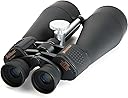
The Celestron SkyMaster 20x80 binoculars combine powerful 20x magnification with large 80mm objective lenses and premium BaK-4 prisms to deliver bright, sharp images ideal for astronomy and long-range terrestrial viewing. Designed for extended use, they include a built-in tripod adapter for stable mounting, a durable water-resistant rubber armor, and come with a deluxe carrying case and lifetime warranty—perfect for serious stargazers and outdoor enthusiasts seeking professional-grade optics.


| ASIN | B0007UQNTU |
| Age Range (Description) | Adult |
| Age Range Description | Adult |
| Apparent Angle of View | 3.7 Degrees |
| Best Sellers Rank | #172 in Camera & Photo Products ( See Top 100 in Camera & Photo Products ) #95 in Binoculars |
| Brand | Celestron |
| Built-In Media | Carrying case, Instruction manual, Lens cloth, Neck strap, Objective lens caps, Rainguard |
| Coating | Multi-Coated |
| Color | Black |
| Compatible Devices | Tripod, Camera, Smartphone Adapter |
| Customer Reviews | 4.4 out of 5 stars 3,523 Reviews |
| EU Spare Part Availability Duration | 10 Years |
| Enclosure Material | Rubber |
| Exit-Pupil Diameter | 4 Millimeters |
| Eye Relief | 18 Millimeters |
| Features | Water Resistant |
| Focus Description | Manual Focus |
| Focus Type | Center Focus |
| Global Trade Identification Number | 00050234710183 |
| Item Dimensions L x W | 9"L x 4.7"W |
| Item Dimensions L x W x H | 9"L x 4.7"W x 12.8"H |
| Item Weight | 4.8 Pounds |
| Low Light Technology | Yes |
| Magnification Maximum | 20 x |
| Manufacturer | Celestron |
| Manufacturer Part Number | 71018-CGL |
| Model Name | SkyMaster 20x80mm Porro Binoculars |
| Model Number | 71018 |
| Mount Type | Tripod Mount |
| Objective Lens Diameter | 80 Millimeters |
| Prism Type | Porro Prism |
| Size Map | Giant |
| Special Feature | Water Resistant |
| Specific Uses | Astronomical viewing or terrestrial (land) use - especially over long distances. |
| Specific Uses For Product | Astronomical viewing or terrestrial (land) use - especially over long distances. |
| UPC | 050234710183 |
| Warranty Description | Limited Lifetime Warranty |
| Water Resistance Level | Water Resistant |
| Zoom Ratio | 20 multiplier_x |
S**R
For the price, an Excellent Binocular with expansive field of view & generous eye relief, especially for night sky viewing
Upgraded my SkyMaster 15x70 binos to the 20x80 model. This review concerns astronomical use, especially as it relates to casual observation. I just returned from two evenings with it under the dark skies of WV's Monongahela National Forest 1) Field of view offers wide angle eye candy. 3.7 degrees with the feeling of expansiveness--even at 20x. I could place Orion's belt in one view; Orion's sword in another; The entire Pleiades (M45) in one glimpse; much of Kemble's Cascade; nearly all sections of the Veil Nebula complex; The Lagoon (M8) and Trifid Nebulae in one field; Can almost place M7 with M6 in Scorpius in the same field, also the Coathanger asterism fits nicely into the field of view. 2) Spectacular views offered of M7 near the Scorpion's tail, The Swan nebula (M17), Dumbbell Nebula (M27), a billowing Orion Nebula (M42), Pleiades (M45), Andromeda Galaxy (M31) with companion galaxies...can seem to infer some stars on the outskirts of globular clusters M13 (Hercules) and M22 (Sagittarius). Veil Nebula is breathtaking under dark sky (t5he western side resembles a fuzzy fish hook). Can see North American Nebula near Deneb at top of Cygnus. I returned to several of these again and again--so rewarding were the views. I set it up a week ago for a backyard star party and the Pleiades was really impressive for viewers as was the Perseus Double Cluster and Albireo double star. The Orion nebula is also magnificent. 3) Generous Eye Relief is best utilized by folding the eyecups back 4) Used a 30 year old aluminum camera tripod that is sturdy enough to hold the 20x80 with ease. How I found it effective was to sit in a wooden kitchen table chair with the tripod legs fully extended and tripod close in with bino eye cups folded back. My tripod has a shaft that can rise about 10 inches more so I used that incrementally as viewing angle was increased--not unlike a barber's chair raising or lowering. Ample eye relief coupled with the folded back eye cups and raised tripod slant the bino was attached to meant I could view objects 45 degrees up from the horizontal. Objects near vertical I could manage limited viewing by actually leaning back with binos and tripod legs laying across me. That's how I viewed the Veil Nebula. Be mindful of the weight before trying this!! It was OK for me but may not be for you. Test that carefully. The 20x80 mount is more robust than the attachment I used with the same tripod with the 15x70's. 5) Clarity of image was NOT sharp all the way to the edge. However, for the comparatively low price of the 20x80 I really can't complain about this as I'd pay much more for that level of optics. 6) I have an 11" SCT telescope. The 20x80 is a nice, satisfying casual alternative to setting up my larger scope and I had so much fun with it one evening I never bothered to set up my SCT. 7) These binos are HEAVY so a sturdy tripod is recommended. The 20x80 is significantly heavier than my 15x70 set. I can use each hand held on their own for limited viewing by gripping the large ends with each hand. 8) The moon is not excessively bright as it tends to be telescopically so you need not be overly concerned about temporary "blindness" from viewing the moon then switching to other stellar objects. Eye recovery is but momentary. 9) Did finally view Jupiter. The line up of the moons is more as one sees telescopically rather than with traditional binocular views. Be advised that surface brightness is so great one will likely NOT be able to the bands on Jupiter. Mars and Jupiter are definitely bright discs. haven't yet had a good look at Saturn as its currently near the sun in the sky.
W**M
Exactly what I expected
I had done my research and been able to play with a friend's SkyMaster 20x80 Celestron binoculars for a few nights to see how well they met my needs. I wanted these as an alternative to hauling my heavy classic Celestron C-8 up into the hills over dirt roads (with washboards, ruts, all that fun stuff). These give me a lightweight alternative and work great with my heavier camera tripod. The package arrived from the UK a couple days early, which was awesome. The box looked like a cross between being re-used and having had some heavy-handed handling during transit. That was concerning, but the box inside that was in pristine condition and the actual Celestron box inside that was pristine as well. The binoculars came encased in a soft foam housing and my greatest fear, them getting knocked out of collimation during shipping, didn't happen. There were no collimation errors at all. I tested them in my in-city driveway over a few nights when we finally had clear skies. As others say, you can hand hold these, but you're going to quickly be reaching for your tripod to hold them. The strain on your arms builds up fast. Looking through them, the moon is fantastic and M31 is an impressive size. Saturn was basically a slightly larger dot than a star, and I could not make out any rings. That was expected, and I might be able to see a distortion caused to the dot by the rings at a dark sky site. Tsuchinshan-ATLAS was a joy to view. All these views were nice and clear, once the binoculars were properly adjusted to my eyes and mounted on my tripod. The only downside I've encountered so far is that when they're on the tripod, anything near zenith is hard on the neck. My tripod gets the binoculars up to a comfortable height for an evening of viewing, but the steep angle for high overhead views gives one a crick in the neck. A set of 45 degree adapters for the eyepieces should take care of that, though. I'm really looking forward to seeing the Orion nebula, the Pleiades, and other DSOs as the year goes on. I realize these won't give me "as good a view" as my C8, obviously, but what I've seen so far tells me I made the right choice for what I wanted them for: a "lightweight" alternative to lugging my heavy C8 up in the hills. This way I can always have them there whenever I go out for astrophotography. Oh, and they're pretty decent for terrestrial observations, too.
J**R
A Closer Look
These are powerful but heavy. You need to use a tripod or be able to brace your arms on something to hold them still. Remarkable star viewing, so much easier than a telescope.
B**Y
Great Binoculars
I was deciding between the Celestron SkyMaster 20x80 Binoculars and the Celestron SkyMaster Giant 15x70 Binoculars with Tripod Adapter . I am glad I got the 20X80s. I was afraid they would be too heavy and have too narrow a field of view. No problem on either count. The 15X70s would have been a good choice too, but I got a used (Like New) pair from Amazon Warehouse. They were described as like new and they were not exaggerating. They were new! The box was still sealed by Celestron. Some of the reviews commented that the collimation was off. If you are going to own a really nice set of binoculars, you need to learn to collimate them. Mine came very well collimated but in the first week my tripod leg collapsed and they hit the ground. It was in the grass, so no major damage, but they did need to be recollimated. I was getting double views of everything. I only had to tweak two of the collimation screws and they were back to perfect collimation. The views were merged and the exit pupils were perfectly round. There is a lot of information out there concerning collimation, some good and some not so good. I recommend going to a forum called cloudy nights. They have a knowledgeable bunch of people there. As far as the binoculars themselves, I don't find them too heavy to hold by hand, but a tripod is a major help for steady views. The views are clear and crisp. They can pick up Jupiter's moons, but I haven't noticed any banding. Saturn's rings were a little harder to see, I couldn't quite make them out. I need to wait for a better night; we've had a little fog lately. I did notice some chromatic aberration while viewing the moon as it was quite bright. With stars and planets, I was very pleased with the contrast. The build and fit is impressive although the tripod mount, on first impression, seemed a little cheap looking. It is a brushed or painted aluminum. Mechanically it seems sound enough, but a chrome finish steel would have been a better choice, but that would have added to the weight. The caps fit somewhat snug inside the barrels but they don't seem to me that they will be very secure for long, only time will tell. Of course you are buying binoculars primarily for the optics, but those optics must be protected, so good caps are important. Speaking of protection, that brings us to the carrying case. Seriously, why did Celestron even waste their time on this? The one I got is a flimsy, unpadded cloth sack. Use it to carry your lunch in or better yet, just pitch it. Get a good padded metal or plastic case. I reused the foam from the Celestron box that the binoculars were in to line a plastic case and it works great, the foam is already cut to the proper shape to securely hold the binoculars. To sum up, I would recommend buying these for terrestrial or celestial viewing, but do get a better case and a tripod.
S**M
RECAPP about Collimation
When I received it the collimation was off. Rather than send it back and risk getting another pair that was off, I called Celestron. The "Life Time No Fault Warranty" only applies if you get it from an "authorized" dealer even though my pair was new. Which means you need to pay like $200+ for these to actually have a warranty. However I asked if I could collimate it myself even though the manual says it should only be done by a professional with specialized tools. They could not or would not tell me anything about how to collimate it. Luckily I did find some general instructions on the web and found the prism tilt screws to turn and got it perfect. You need to gently pry back the edge of the rubber hand grips to access the screws. The whole process wasn't even that difficult! I don't know why it has to be such a state secret with Celestron. Since then the binos have been wonderful and well worth the discount of buying from an "unauthorized dealer". Thank you, Gary, for your tip about collimating. These binoculars were terrible when I first looked through them, and nothing I could do would solve the problem. (My eyes could not focus together and I saw double images.) The barrels appeared to be misaligned, and I was going to send them back. Then I read Gary's review (Collimation Easily Done) and thought, "What the heck? I can at least try." I followed Gary's instructions and easily fixed the problem within minutes. They work really well now, but I'm giving them a four-star rating since Celestron really should tell the consumers how to fix this problem by themselves without having to pay someone else to do it. To add to Gary's tip: You'll need a tiny flat-head screwdriver (like what you use to repair eyeglasses) in order to adjust them. The hand grip (that portion on the top of each barrel of the binoculars) only needs to be pulled back a little ways until the screw is exposed, and you only need to adjust the side that's off. (It should be obvious which side is off or if both sides are off. Close your left eye and then your right while looking through the binoculars.) Check the binoculars (by looking through them) each time you make an adjustment until you have it perfect. It can be done, and it's well worth it! Thanks to all who responded for your kind advice. I experimented after all and found it incredibly easy to collimate the Celestron Skymaster 20X80. By carefully peeling away the rubber lining on the handgrips from the top, nearest the focussing wheel, the collimation screws are revealed at about 11 o' clock and 1 o' clock. I then mounted the binos on a tripod and focused on a bright star (it happened to be Achernar) and while looking through the binoculars, made minute adjustments on the screws until the images through the two lenses merged and voila! For the first time I could clearly see the four moons of Jupiter in perfect focus through these binos!
R**A
Large aperture, semi-large quality
I ordered the 20x80 Celestron and tried them in fairly rural desert skies along with other binoculars I own. Here's the deal, the price is low because the quality is average. These are nice binoculars for the price, but not super high quality. I'm speaking more about astronomical night use. These would be fine during the day or for terrestrial use. Despite other reviews claiming these are great for astronomy, there simply is better out there for just a little more money. If you are looking at the moon or bright planets, these are going to work fine as it's hard to tell astronomical quality on these bright objects. However the true quality comes out when looking for dimmer objects like star clusters which is what most amateur stargazers eventually do. This is when you'll see the Celestron won't measure up to higher quality binoculars. Binoculars with FULLY multi-coated optics and the highest quality glass prisms produce sharper and brighter images. This is also evident during daytime viewing but it's startlingly apparent when looking at the night sky. You will see similar images with these binoculars, but they will be darker and less vibrant than a higher quality pair if you're using them for backyard astronomy. Honestly my smaller 15x70 Oberwerk LW for less money give a better experience for night viewing.
E**Y
Having a great time with these
I love these binoculars so much. I had a couple of telescopes. One was too heavy, and the other one was smaller but had a computerized system that I am shamed to say was too complicated for me to use. That is, I felt so intimidated by it, I never used it, and then I sold it. These binoculars are awesome because you can just pic them up and take them outside and do some star gazing. The only set up is putting them on a tripod, which is what O do, or you could just sit at a table or something and lean your elbows on the surface to prevent shaking. It’s easy peasy, and you can do it spontaneously. Also, I could bring them on a plane if I wanted, which is what I would like to do when I go visit my sister in New Mexico. I couldn’t do that with something bigger. These certainly can’t do what a big, fancy telescope could do. But I can see a whole lot more than I can see with my naked eye, and I am looking forward to using them more frequently to push their limits. I like Celestron products. I bought a smaller pair of binoculars from them years ago, and then have my wife some as a gift because O liked them so much. I didn’t really consider other brands when I bought this pair. It’s just a really good value for the money. Highly recommend for other Star gazers and people who hope to see a beautiful landscape in more detail. It’s not like having your own observatory, but it’s pretty awesome.
D**D
Clear, Sharp, Jaw Dropping Images
I have a few binoculars my favorite for astronomy is the Celstron12x60; bright, sharp views. Next is the 20x80 for sharp, bright, jaw dropping views. My 25X70 is nice but it is pushing the magnifying limits with a 70mm aperture; so things are not as sharp as I like and it really needs attention and work focusing it. I will probably get passed it on to a deserving child. My 10x50 are my light gazing around the Universe with little work. Brings out enough stars, and has a great field of view for viewing satellites and such... My 7x50 puts me to sleep. If I only had two it would be the 20x80 and 12x60 both are bright and sharp. If you want to keep in the Awe the tiny binoculars won't do it... My 102mm refractor Telescope is much better with excellent upgraded eyepieces. It is sharp and bright but not portable and viewing is with one eye. Where I live I need to climb up small hills to get a better 360 degree view. I have a monopod for the 12x60 and 25x70 and a tripod for the 20x80. It really is necessary for viewing the stars. I like to study at what I am looking at. Everything I use is Celestron, great prices, been around forever. The stuff is great for Home Astronomers. I hope this helps and can save you a bit of money. If you have lots of money 6 to 8 inch scopes are great. Customers do have negative reviews about Celestron binocular alignment. Don't drop them. Watch how you ship them. I have had no problem with the ones I own. I know I can reach Customer Service.
D**N
Great Beginnners Sky Searchers. Amazing Powerful general Purpose (Bulky) Binoculars
Beautifully clear image offered by the large 80mm lens. They have a robust feel and seem to be well made and should last for many years with care. These are a great starter pair for sky watching, but if that is your main use for them you W|ILL need a Tripod. They are heavy but thats not the real problem, if you focus on anything that is on considerable magnification it is impossible to hold them still enough to get any sort or real idea of the target image, in addition as soon as you try and adjust the focus, you loose the target you are focussing on. I bought these as a powerful set for sky watching, birding, and general scenery when walking and holidaying. Though bulky they are worth carrying for the quality and depth of the image that is available. Easily backpackable. I live in a city and it is amazing the way on a CLEAR night they cut through the haze that is there (but not visible) and allows you so see a complete vista of stars that are not available to the naked eye. I wish I could have afforded the 25x100, but for that cost I will supplement it and buy myself a good telescope. These are fantastic powerful general purpose binoculars and can be used for sky watching WITH a tripod, dont believe reviews that say you dont need it. Great Value. Recommended. I wish they had provided a better padded carry bag.
V**L
Pretty solid piece
I thought that the magnification is really good
A**A
GREAT FOR ASTRONOMY!
First thing first, delivery service, packaging was great. This is my first binoculars ever. So I can't say if this piece is completely out of collimation (will give updates once I check). Pros: 1. Well built. 2. Fully multicoated optics. 3. Value for money. 4. Best for beginners in Astronomy. Cons: 1. Quality of the bag provided is not good. (substitute would be a DSLR camera backpack and it will do the job). 2. Collimation could be a problem. (Almost all heavy binos have this error). You can fix it yourself or could ask for a replacement. In detail:- 1). You cannot get this quality at this price. Compare with ORION 20X80 --- which is around ₹ 25k. 2). If you cannot decide about getting 20X80 or other smaller binos then I would say 20X80 would be better. It has a larger objective of 80mm which increases your limiting magnitude to approx +7(with naked eyes your limiting magnitude is around +1). That's a huge difference. You will be able to see most of the messier objects and other DSOs apart from Moon, planets, and Orion nebula. 3). It is literally a pair of two small telescopes😉. A telescope equivalent to these binoculars will be above ₹ 30k (trust me), So this is a great deal. Some important points: 1). You can adjust the interpupillary distance. (As any other binoculars have) 2). You can adjust the dioptre setting (for individual focus adjustment for eyes) by rotating the right eye piece. (please Google for more information) 3). Centre focus wheel is given. ( For focusing at different distances) (All above three adjustments could be stiff in the starting) Suggestion for Tripod: 1). A fluid head tripod is a must (for smooth and precise maneuvering of binoculars). 2). Tripod must be heavy (to keep binoculars steady/ 20X magnification is too much). 3). A branded tripod is not required. 4). I will suggest getting a tripod from a photo store. (If it's in your budget then Manfrotto fluid head tripod will be the best) An Update: 1). Saturn's ring is visible. It will need a nice focus and patience. 2). The object should be at the center of the field of view to avoid chromatic abrasion. 3). Four of Jupiter's moon are visible. You can not make out the Great Red spot. 4). After watching planets for an hour, I found my binoculars are perfectly collimated. 5). Bright objects (-2 magnitude or higher) will give chromatic abrasion. 6). You will be able to see stars as dim as +8 magnitude in a light-polluted sky. 7). Andromeda galaxy will cover your entire field of view on a very dark night. 8). Many DSOs around the Sagittarius constellation are visible from these binoculars. 9). The field of view is around 2.6° and not 3.7° as mentioned. 10). The moon looks breathtakingly beautiful. It will appear three dimensional with these giant binoculars. You can make out Apollo missions' landing sites to a precision of few kilometers. 11). Orion Nebula will be visible bright and crisp. Your field of view will be contain just the Orion sword. 12). If you are willing to do astrophotography using these binoculars then you will need a smartphone adapter for binoculars (just search for it and you will find it on amazon) and a photo staking software - DeepSkyStacker which will stack together hundreds of shots of a DSO and after few hours of processing, you will get a bright and detailed astrophotograph. 13). Neptune and Uranus are visible just like a dot but you can make out their color. Best at this price!! Clear skies!!
B**O
Excelente custo benefício
O que dizer de um binóculos que traz as maravilhas do céu até seus olhos? Alguns meses atrás comprei um 7x50 da mesma marca e após varrer boa parte do céu, senti a necessidade de um upgrade. Apesar de o 15x70 ser mais barato, resolvi ir de vez atrás de um maior e deparei com esse 20x80. Arrependimento? Apenas com o tempo de espera até chegar, passou pouco mais de 1 mês até ter em mãos. Já o binóculos em si é sensacional, não tem comparação com meu 7x50 quanto à observação do céu. Obviamente não é possível ver detalhes dos planetas, mas Titã é visível, Saturno aparece como uma luz alongada e Júpiter é majestoso com seus maiores satélites, imponente no campo de visão! Notam-se muitas crateras e montanhas na Lua com uma qualidade incrível! Além disso é possível ver também aglomerados estelares, nebulosas e algumas galáxias, porém dependem pelo menos de um céu rural. Falando em nebulosas, a Carina e a de Órion são as mais lindas para se ver, na minha opinião. Para se ter uma ideia do que é possível enxergar, no centro de onde moro cheguei a identificar, com muito custo, estrelas até da magnitude +10.2, sendo mais fácil identificar até mais ou menos +9.5. Já objetos menos densos, como nebulosas e cometas, dependem muito da poluição luminosa e não chegam a tal magnitude. Como nem tudo é perfeito, há alguns pontos negativos: 1° - a aberração cromática é bem forte nos objetos mais brilhantes, mas não chega a comprometer a experiência. 2° - por mais que na embalagem diga que serve para visualização terrestre de longa distância, não gostei da falta de nitidez nos morros ao longe. Nesse quesito ainda prefiro meu 7x50. No geral, é um equipamento indispensável e ótima alternativa aos telescópios baratos. Mas tenha em mente que é praticamente exclusivo para astronomia.
ク**り
我が家にやってきた「100円望遠鏡」
手持ち出来る低倍率双眼鏡ばかり使っていたので多少倍率が大きなものが欲しくなり、最初は廉価なトラベルスコープを検討しました。 しかし、同価格帯にこれがあることを思い出してからは無性に欲しくなり注文後5日で届きました。 並行輸入品ですが、製品自体スチロールの型に収まって箱に入っており、それが更に二重に梱包されていたため全くダメージはありませんでした。 早速手持ちで覗いてみましたがさすがにブレてよくわからず、三脚に乗せてやっとピントと光軸確認できました。幸いな事に星がきれいな点になってくれます。 また丁度晴れたのと気温が低めだったこともあり、80ミリの集光能力だと殆どどこに向けても星が見えます。 街灯などの影響は多少ありますが思った程ではなかったです。(Vixen旧アスコット(7×50)の様なフレアは出ません。比較対象がなんですが) ただ20倍となると安物カメラ三脚では三脚や双眼鏡にちょっと触れただけでもブレてしまいますので中央からおもりを釣り下げて安定させようと思いますが、昼間の地上であればそれほどシビアにはならないので車に積んで見晴らしのいいところで周囲を眺める使い方の方が増えるかもしれません。 こうなるとまさに我が家の100円望遠鏡(観光地にあるアレ)ですね。 このモデルはこのサイズの光学機器としてはかなり安物ジャンルに入ると思いますが、こういった使い方には十分な性能ですし、お値段以上に楽しめそうです。末永く使っていきたいです。 2019/02 この双眼鏡用に廉価で安定した三脚を入手しました。 →アマゾンBASIC ガングリップ雲台つき三脚 約3千円 最大地上高180cm程あり、この双眼鏡をかがまないで覗けます。 (高さと強度が両立して廉価なものは少ないです。) ただし、元々ついているガングリップ雲台は仰角が大きくなる星見では接眼高さが大きく変わり使いにくいので、3/8ネジの低めの自由雲台に取り換えて使っています。 ご参考になれば幸いです。
Trustpilot
5 days ago
3 weeks ago