Pro Git
Product ID: 10541088
Buy anything from 5,000+ international stores. One checkout price. No surprise fees. Join 2M+ shoppers on Desertcart.
Desertcart purchases this item on your behalf and handles shipping, customs, and support to Italy.
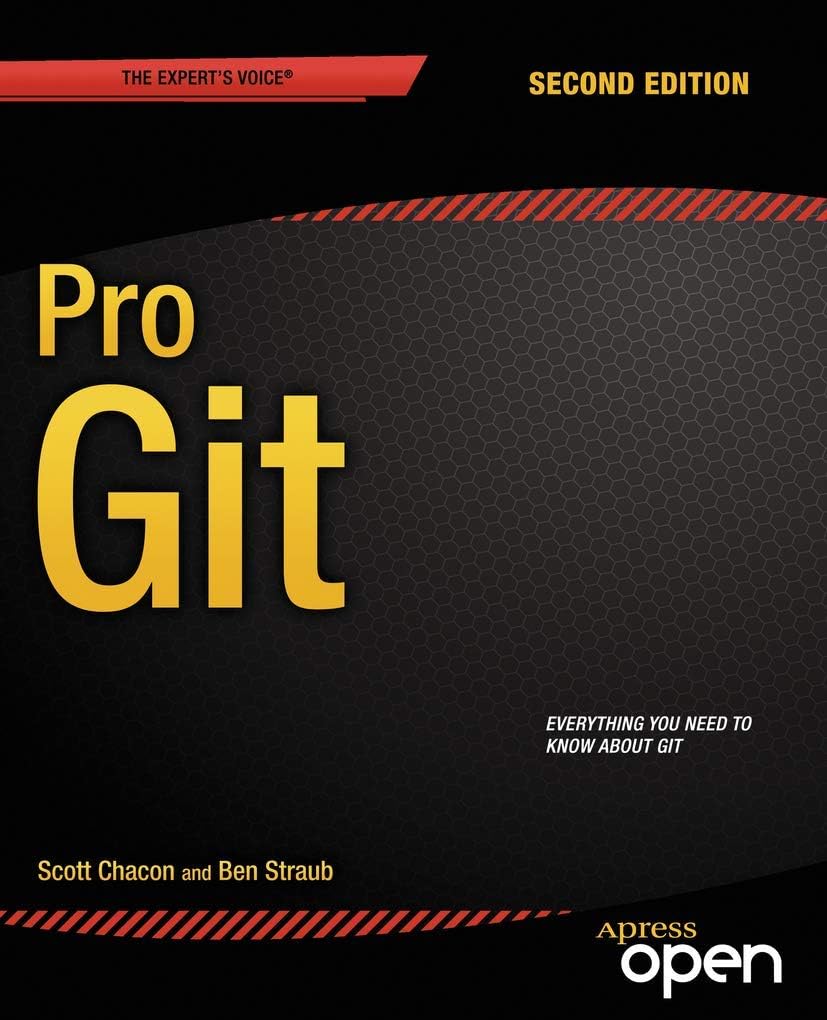
Pro Git (Second Edition) is your fully-updated guide to Git and its usage in the modern world. Git has come a long way since it was first developed by Linus Torvalds for Linux kernel development. It has taken the open source world by storm since its inception in 2005, and this book teaches you how to use it like a pro. Effective and well-implemented version control is a necessity for successful web projects, whether large or small. With this book you’ll learn how to master the world of distributed version workflow, use the distributed features of Git to the full, and extend Git to meet your every need. Written by Git pros Scott Chacon and Ben Straub , Pro Git (Second Edition) builds on the hugely successful first edition, and is now fully updated for Git version 2.0, as well as including an indispensable chapter on GitHub. It’s the best book for all your Git needs. Review: Easy Read, Very Lucid, Thorough, To-the-Point -- BUT ... Get the first edition, instead ! - I stand by my original comments, but having purchased BOTH the first and second editions, I would recommend getting the first edition, instead. The first edition has the best index. Unfortunately the second addition has a very weak index, which makes it difficult to use as a reference. You won't miss the second edition (which I have also purchased). It has 175 more pages, but I haven't found anything in it that I've needed and haven't found in this first edition (the diagrams are larger, but that doesn't contribute to that many more pages). The first edition includes things like "Cherry Picking", "Sub-networking", "External Tools", and "Hooks". -- My Original Review -- Easy read, very lucid, thorough, and to-the-point. What more could I ask? The first edition is the best book on Git that I have found, and I've purchased a LOT of them. I've read several tutorials on git and have found none as clear and to-the-point as Scott Chacon's "Pro Git". I'm a very experienced Subversion user and administrator; and feel that, in two partial days I understand and can do everything in git that I've done in svn. In addition, Scott Chacon avoids all of the inaccurate put-downs of Subversion that are so prevalent in the other Git books -- a shame, since Subversion has similar lightweight branching, copying, tagging as git, and a fully editable off-line local workspace (admittedly, unlike many of the earlier server-based tools, such as CVS, SCCS, RCS, ClearCase, VSS, TFS, etc.). Git has the advantage over Subversion of being a distributed system for local/personal projects and for the ability to integrate local repository operations into a remote repository almost seamlessly. I'm not sold on the value of git's history-cleanup operations that everyone seems to love -- they just seem to be an opportunity for users to create problems unnecessarily that are irrecoverable, or difficult to recover from. However, I'm not yet a git guru, so I'll withhold judgement on that. Again, Scott Chacon avoid's the proselytizing and sticks to teaching the functionality and benefits of git; which I appreciate -- especially compared with the other git references I've read. Review: An excellent read for the inspired - An excellent read for the inspired! It's very easy to find help online for simple 'git' tasks. It's even easy to help help online to build a nice 'git' workflow. This book is not for that purpose... This book is an excellent dive into how git works under the hood. It's so much more than a how-to internet guide. It seeks to impart real knowledge. It gave me the knowledge I needed to solve some issues that the internet guides only made worse. It gave me the knowledge I needed to understand the core of the issues, work back through them carefully and prevent them from ever happening again. If you've worked with a forking model where rebasing happens often you can understand how git can be a pain. This book has given me so many reasons to hold git high above all other version control systems.
| Best Sellers Rank | #203,349 in Books ( See Top 100 in Books ) #25 in Linux & UNIX Administration (Books) #38 in Linux Networking & System Administration #151 in Software Development (Books) |
| Customer Reviews | 4.5 out of 5 stars 3,054 Reviews |
W**N
Easy Read, Very Lucid, Thorough, To-the-Point -- BUT ... Get the first edition, instead !
I stand by my original comments, but having purchased BOTH the first and second editions, I would recommend getting the first edition, instead. The first edition has the best index. Unfortunately the second addition has a very weak index, which makes it difficult to use as a reference. You won't miss the second edition (which I have also purchased). It has 175 more pages, but I haven't found anything in it that I've needed and haven't found in this first edition (the diagrams are larger, but that doesn't contribute to that many more pages). The first edition includes things like "Cherry Picking", "Sub-networking", "External Tools", and "Hooks". -- My Original Review -- Easy read, very lucid, thorough, and to-the-point. What more could I ask? The first edition is the best book on Git that I have found, and I've purchased a LOT of them. I've read several tutorials on git and have found none as clear and to-the-point as Scott Chacon's "Pro Git". I'm a very experienced Subversion user and administrator; and feel that, in two partial days I understand and can do everything in git that I've done in svn. In addition, Scott Chacon avoids all of the inaccurate put-downs of Subversion that are so prevalent in the other Git books -- a shame, since Subversion has similar lightweight branching, copying, tagging as git, and a fully editable off-line local workspace (admittedly, unlike many of the earlier server-based tools, such as CVS, SCCS, RCS, ClearCase, VSS, TFS, etc.). Git has the advantage over Subversion of being a distributed system for local/personal projects and for the ability to integrate local repository operations into a remote repository almost seamlessly. I'm not sold on the value of git's history-cleanup operations that everyone seems to love -- they just seem to be an opportunity for users to create problems unnecessarily that are irrecoverable, or difficult to recover from. However, I'm not yet a git guru, so I'll withhold judgement on that. Again, Scott Chacon avoid's the proselytizing and sticks to teaching the functionality and benefits of git; which I appreciate -- especially compared with the other git references I've read.
D**D
An excellent read for the inspired
An excellent read for the inspired! It's very easy to find help online for simple 'git' tasks. It's even easy to help help online to build a nice 'git' workflow. This book is not for that purpose... This book is an excellent dive into how git works under the hood. It's so much more than a how-to internet guide. It seeks to impart real knowledge. It gave me the knowledge I needed to solve some issues that the internet guides only made worse. It gave me the knowledge I needed to understand the core of the issues, work back through them carefully and prevent them from ever happening again. If you've worked with a forking model where rebasing happens often you can understand how git can be a pain. This book has given me so many reasons to hold git high above all other version control systems.
G**S
An Amazingly Informative Read
Before I begin, an introduction is in order, to provide a little context. I'm a Windows .NET developer, and have been using Git for the past eight years or so. I use it in both my day job (the projects we work on are all source controlled in Git these days), but also in my writing business, to source control the Scrivener projects for my books. It's a fantastic tool for version controlling any kind of file you can think of. Although I am comfortable with various graphical wrappers, I've also always prefered the Git Bash interface, perhaps because I've always liked Bash's simplicity and elegance, having played around with various flavours of Linux over the years. With that out of the way, what did I think of this book? I thought I was pretty knowledgable about Git before. I was wrong. This book is a fantastic reference, and it showed me that the things I was using Git for barely constitute 10% of everything it's capable of. It's not like I've been doing this <i>wrong</i> necessarily; it's just that there are so many better ways to achieve many of the things I've been trying to do. For example, I knew about rebasing, but I've always been a bit afraid of it. I'm going to be using it more from now on (although as the book points out, I'm going to avoid rebasing anything I've already pushed up). I also can't tell you how many times I've made a commit, forgot to add a file, and then had to make a second commit immediately afterwards. I'll be using <b>git commit --amend</b> more often now. Finally, I can't wait for an excuse to use <b>git bisect</b> to find the exact commit where something stopped working! Another thing I never really understood is why you would use <b>fetch</b> and not <b>pull</b>. Although I now understand the difference much more clearly, I'm still going to keep using <b>pull</b> (perhaps with <b>--rebase</b>, though), since I don't remember ever being in a situation where I had more than one remote for my repository. This book is staying on my e-reader, and I'll be referring back to it constantly. On the downside, the formatting of the Kindle Edition isn't great. I like to read white text on a black background because of my visual disability--I need the contrast--but for some reason, clickable URLs in this book (and there are many) are coloured in dark orange. Also, the code samples are a bit difficult to follow at times, because they're indented and don't flow very well on the large font size I tend to use. Speaking of code samples, all git commands embedded in the narrative are formatted in fixed-pitch font (which is a good thing), but that formatting is inconsistent, so you sometimes see things which you think are supposed to be part of the command, but they're actually part of the narrative, or vice versa. And the index at the end isn't linked, which makes it completely useless since there's no way to click on a term to go directly to that chapter. Other than that, it's an entertaining and informative read. I nodded and smiled a few times, as the authors describe some pain I've already been through, but I stared at the screen and went "Wow! I never knew that." many more times that that.
C**E
Git will save you time!
I have started reading the online version of this book and found that it allowed me, a complete noob, to install, set up my global username and email, set my preferred editor, and connect to my GitHub repositories so that I can push and pull to upload/download for my programming book project. For readers who don’t know much about Git or why it is useful, allow me to explain why it is so important for my project and saves me time. I am in the process of writing a book about computer programming. I am the only author, so none of the collaboration features are needed in my case. I have two computers, one with Windows 11 and the other with Debian Linux. It is required that I be able to access the latest version of my book so that I can write separate instructions for installing SDL on Windows and Linux. Using Git, I am able to upload my latest manuscript and all images and other files with it to GitHub, then download them to the other computer without even having to open up a web browser. This process saves time because it means I don’t have to open up the browser, navigate to the repository folder, select individual files that I remember updating, and commit changes. Instead, do it from the command line, and it takes literally less than five seconds to type the command “make push” to run my makefile rule to upload it. I turned a one-minute process into a 3 second process, which will save me time for the rest of my life as I write books or new software projects! I feel dumb for not learning to use git years ago! Definitely recommend the Pro Git book because the Kindle edition is free. Learning to use Git will save you time, just like it has me!
A**E
It helped me to finally understand Git well, and to be able to avoid confusions with Svn
Wonderful book and well written. It helped me to finally understand Git well. As I was a cvn and svn user before, Git was counter-intuitive for me so I had to study Git in detail to compensate for that. This book helped me to get the needed details to grasp git well and to avoid the confusion with Svn, it warns the readers that even if the terms are similar or even identical , those means different things in Git than in Svn and to not try to translate each command of Svn in its Git equivalent as they are build on totally different concepts, Svn is centralized versioning system Git is distributed. Also there is a first chapter that helped me a lot in which the author describes the categories of versioning systems which are 3: local versioning, centralized and distributes.
J**R
Well written and very useful Needs better example code formatting
This books has a lot of useful information explained in a very clear and easy to understand manner. Very useful for anyone who needs to get up and running with git.The only issue I have is the formatting of the code blocks on kindle version(I don' t know if the print version has the same). The formatting is terrible, lots of spaces between the lines of code huge fonts making it very difficult to follow or read.
R**O
Nice book
Very useful, even with IA still use it when I need it
C**D
Great for Beginners and Pros Alike
Great instruction manual for anyone who wants to learn and use git without going through GitHub. It teaches you everything you need to know and way more in depth then the course found on sites like Code Academy. After reading this book you find out how little they actually teach and how GitHub focused they truly are. This book is easy to follow along with and learn so anyone beginner like me or pro can use it and learn. I would recommend this to anyone who wants to learn git especially since the pdf from Amazon or the actual Git site is free.
J**S
There's a lot to this book! Well written and nicely structured. Both good overview and detailed
Manages to give both great overview of git and also very detailed. Nice balance of theory and practice. I have only understood about half of it (having owned it for about a year). This is not because it is poorly written, but because there is a lot to it. Fortunately it is nicely structured so you can learn what it is that you need to know at the time, and gradually expand your knowledge. I expect to keep referring to it in the future.
P**N
easy of knowledge
easy to understand
P**S
Muito bom para conhecimento
Ótimo livro para conhecer os comandos do git
C**N
Excellent book
Excellent book
M**S
Super gut für Einsteiger
Da ich während meiner Ausbildung was das Thema git angeht eigentlich gar nicht ausgebildet wurde habe ich auf Raten eines Freundes dieses Buch gefunden. Es gibt sehr gute und vor allem schnell zu verstehende Grundlagen zu git und dem Arbeiten damit. Kann das Buch wirklich allen empfehlen. Noch ein kleiner Tipp: am besten nebenbei in einem Test Repo mitmachen :)
Trustpilot
2 weeks ago
1 month ago