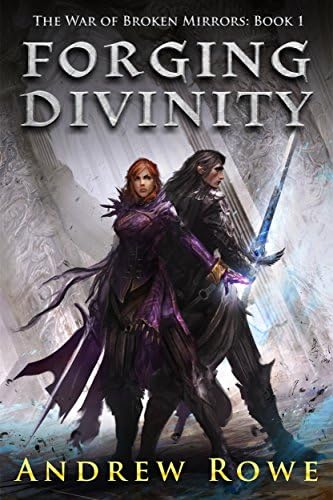
Forging Divinity (The War of Broken Mirrors Book 1) Kindle Edition
Product ID: 102870208
Buy anything from 5,000+ international stores. One checkout price. No surprise fees. Join 2M+ shoppers on Desertcart.
Desertcart purchases this item on your behalf and handles shipping, customs, and support to Italy.
Full description not available
C**S
Got tired of the mother/son dynamic between Lydia/Taelien.
Edit: I'm changing my rating to 3 stars, as I feel a 2 star rating for writing of this caliber is uncharitable. My personal enjoyment of the material is more on a 2 star level, however.Where to start? Positives, I suppose.- The writing is tight. No overlong exposition or unnecessary detail, prose is average or slightly better. Editing is quite a large step up from most self-pubs.- Characters are well drawn and very distinct, though virtually zero development occurs (more on that later). Many self-pub writers have difficulty writing easily distinguishable characters. Not so, in this case.- There was an air of mystery about the primary characters. The book is written from three distinct POVs, and each time we get a little bit of info on their reactions and motivations, but it’s only enough to give a glimpse of who they really are (I thought – more on this later). There are hints of rich backstory to flesh out each character.- The opening really grabbed me – legendary sword of unknown power and its mysterious wielder pairing up with a powerful undercover sorceress,Unfortunately, after the first 30-40% of the book, none of the promise that seemed so rich early in was delivered upon. The cons started to pile up, and never really stopped mounting for me:- The magic system is neat, but execution is flawed; there’s very little consistency. Some characters need auditory cues to “cast”, some don’t, some need gestures, some don’t. Each person is supposed to be bounded by affinity for a limited number of “dominions” (e.g. dreams, knowledge, metal, fire, etc), but the author plays extremely fast and loose with what can be done with each of these. It really seems that he made the system up, then just allowed the various characters to do whatever they tried to do with the only limit being how powerful they were within their domain.- The characters are extremely flat and uninteresting. There was only the barest hint of character development. It took a while to find out that they really don’t have much depth. In the end, they’re pretty much caricatures more than they are characters.Taelien is kind, gregarious, chivalrous and dumb. He acts like a complete child and this never changes. Other characters view him this way, and it fits because that’s pretty much exactly what he is. A very powerful child, but a child nonetheless. He takes his cues from Lydia throughout the book, and is pretty much powerless to act with any autonomy whatsoever.Lydia is an overbearing, condescending, arrogant bully who feels it’s her right to impose her will on others wherever she goes. The character of Moiraine in WoT fits her pretty much like a glove…except when you realize that that’s completely ridiculous because she’s about 20, and Moiraine is supposed to be over 70 or something. She thinks of (and actually refers to) Taelien as a child and mothers him the entire way through the book. She acts in a similar manner to pretty much anyone else. Some of this can be explained away when she needs to be in her frosty court sorceress persona, but early in the book she reflects on the great disparity between her undercover “ice queen” persona, and her natural, more friendly and compassionate self. Unfortunately this is just fluff, because we see only the tiniest bit of evidence that she might not actually be the former through and through. She’s calculating and thoughtful, but mostly to no real effect. She’s often afflicted with analysis paralysis, and progress pretty much just falls into her lap.Jonan was full of potential. Many reviewers called him the rogue. The funny, fun-loving sidekick. Somewhat appropriate, but his character is very similar to Lydia (intelligent and calculating, distrustful) excepting the fact that he pretty much acts like a doormat.- Characters go through the story helping others and doing things for completely inexplicable reasons. Taelien gets thrown in prison in the beginning for some reason completely unknown to him. Lydia helps break him out, and for some reason he continues to follow her like a puppy at her vague agreement to help him with his quest to find out more about himself. Now, if I had a clear goal, like find some guy (who I’ve been told can help me figure out my lineage and birthright), unless somebody or something is going to imminently help me get at this goal, I’m going to part ways from it. Instead, he gets distracted *constantly* with what I refer to as “side quests”. He’s helping a cause that he doesn’t even appear to have a strong moral reason to support. Jonan does much the same. For some reason Jonan bands together with these two people (Lydia and Taelien) that assaulted him, took him prisoner, and interrogated him, despite the fact that their ideologies are ostensibly at ends with one another. What? Later, another character attacks him by breaking into his home and smashing valuable belongings critical to his magic, and he just shrugs it off and offers to assist her for some reason. Again, what? This kind of behavior is everywhere too.- The pace of the book is worse than glacial. I read hundreds of pages of idle talk or inner monologue with no meaningful activity whatsoever. The vast bulk of the book covers discussions that occur in a matter of moments, much of it being an inner monologue from the current POV character. Eventually it just feels like a lot of churn for no reason.- The world building seemed flat. It surprised me that so many reviewers felt that this was a strong point of the novel. Then again, I categorize magic system as just that, and not related necessarily to world building. World building - to me - tells the story of the people, their cultures, their philosophy, their politics, their technological maturity, their regions and regional disputes, their resources, and so forth. I feel this novel did almost none of that. The only sense I got that the nations were different at all was the fact that they worshiped different gods. I couldn’t get a sense that there was any differentiation of ethnicities within the races (if there even were), and even the races were only described in the broadest terms.Overall, the book just felt dull and uninteresting, and I didn't identify with the characters one bit. I was very disappointed since it got rather good reviews and the beginning really grabbed me. I won’t be reading the second.
L**S
Short and fun...
"Certainty in the face of variables is a sign of insanity."I loved this as much as I didn’t, which is why it fell into my LIKED vs. my LOVED rating. I felt like a pendulum trying to decide, but in the end there were a few more negatives than positives. But it didn’t get close to my INDIFFERENT rating, so that should say how much I liked it.I couldn’t really summarize this as the story revolves around three characters all on their own mission that ended up overlapping one other. I’m afraid if I tried I’d accidentally give something away. So the book blurb is going to have to do.The world was nicely developed, in my opinion. I never felt cheated. Matter of fact, in the beginning there’s a lot thrown at you. And I never felt like it let up. Not in a cool way, but in a let’s-get-all-this-out-now way. Normally I can go along with info dumps when it’s worked into a dialog. That happened in a lot of places, but it was sooooo long that I ended up skipping, hoping I’d understand later. I did, so yay me and yay to Rowe for keeping it clear. The world, however, never came close to the amount we learned about the magic system. Some people are going to love it. For me—and keep in mind that I love love love magic—it was too much. Much like the world building, it felt long-winded and overcomplicated. I skimmed, and I fear I payed a price for that. I think if i would have been patient, some of it could have been more entertaining.I liked the writing for the most part. Action scenes were incredible. I had a clear picture of what was happening. Those scenes were the reason this didn’t get a lower rating. They were really nifty, particularly those with Taelien. There were some typos, enough that I noticed by not enough to ruin the book for me.Now, the reason I was enjoying this so much was the characters. Taelien was a badass, and his magic was by far my favorite. Manipulating metal might sound boring, but Rowe made it fun. Super fun! Taelien's got a lot to find out about himself, and he truly wants to be a good person. He’s an easy character to root for, especially with his adventurous personality and slightly blind bravery. Our heroine, Lydia, was nicely gifted, but her magical ability of gaining knowledge about stuff just wasn’t as enthralling as magic used in a fight. Even so, she was a tough gal, collected, curious, and strong in her own right. Never a damsel in distress. Our other protagonist, Jonan, used sight magic—making himself invisible, looking through mirrors, and so forth. I never got as good of a feel for him as I did the other two. I could never quite peg his intentions.Overall, I’d recommend this to those that like a traditional upbeat fantasy. It’s short and fun. Because of Taelien I’ll be picking up the second book. I’m curious about his story and where he’ll end up.
T**S
Hard magic, epic story
I'll admit this one took a while to get into, since the opening chapters were very dialogue-heavy. The book also gives a lot of insight into what is happening in the characters heads, which took a bit of getting used to. However, once the book got going, I found myself really appreciating the detailed thoughts, since the characters are very logical and I love the "rationalist" genre.After the first few chapters, I was hooked (~30% on my kindle). The magic system is pretty great. I'm a fan of hard magic systems, and there are detailed rules, limitations, and costs to the magic in this book. I really appreciated the diversity of the magic, as well. As much as I love Sanderson's magic systems, sometimes they are fairly limited. Forging Divinity has magic of all types: physical, elemental, healing, knowledge, illusion, etc.The worldbuilding is also great. Godhood can be sold to the highest bidder? Awesome. Multiple conspiracies, a looming war, original races that are tied into the magic system? Even better.The characters are good as well, though not as strong as the worldbuilding. Each of the three main characters has access to different magic types, has their own hidden agendas that you slowly learn about, and distinct personalities. One is overly analytical about everything, one is a hotheaded warrior, and one is a secretive spy who relies on illusions instead of direct magics.Overall, the book was a slow start but a great read. I've bought the second and am looking forward to reading it in the near future. I might have to put the sequel off for a bit, because once I hit the 30% mark of this one I pretty much couldn't put it down (so much for being productive this week).
K**R
Reads like someone is playing an rpg
Sleep all the characters think in perfectly formed sentences and with exacting logic. Always. Even under stress and when having to take split second decisions.Shame, it could be much better if the characters were a little bit less like data from star trek.The author writes the same way in ought books, she probably needs to have a think about a more human style and do some objective comparison with other authors.
M**E
Strong characterisation
This is the first novel from Andrew Rowe which, despite some minor quibbles, roped me in from the very start. One thing that often turns me off about epic fantasy is the dominance of overly dramatic dialogue that turns the characters into caricatures; more story puppets than real, fleshed out people.And it is this that is the strongest aspect of Forging Divinity. The characters seem real, with complex motives that are intrinsic to the story rather than a byproduct of it. By the time I was halfway through it really felt as if I knew the characters and I actually cared what happened to them.The minor quibbles I mentioned - there are some times when the dialogue felt a little stretched out, and drifted into monologue... Also, there are quite a few words left out from sentences throughout the book, which was rather jarring at times, so it could do with tighter proof reading I think.Despite this, Forging Divinity is a book which really stands out amidst the wall of self published fantasy I seem to accumulate on my Kindle. I look forward to the next book.
P**N
Captivating characters and story!
A great story and twist on magic. Some amazing ideas and plot twists; loved the variety in the characters who I felt had some real originality in them. Enjoyed the story and looking forward to reading more from this author!
M**L
Slow start, exhilarating read.
A very good book. Started out slow but after about 100 pages or so, it quickly turned into a novel I could not put down.There's a couple of flaws, but only minor. One being the extreme lengths of paragraphs at the start. It did take a while to get into as stated but as I progressed, the writing began to flow more efficiently. The other flaw being that there's a few words double typed but again, that was at the very beginning.A fantastic book and I can't wait for the next one!
G**
good read
was a good read
Trustpilot
2 months ago
1 week ago